The move from eighth to ninth grade is one of those milestones that can feel exciting and intimidating at the same time. Students may be looking forward to more independence, new subjects, electives, clubs and new people, while quietly wondering whether they will be able to keep up with everything that comes with it.
For many students, the questions go far beyond Where will my classes be? They may be wondering what happens if their friendship group changes, whether the workload will suddenly become overwhelming, how they will manage tests and projects from several subjects at once, whether teachers will expect them to be more independent, or what they should do if they start to struggle.
This is why preparing students for high school needs to be about more than explaining schedules and school rules. Well-planned high school transition activities give eighth graders the chance to explore what may change, identify the skills they already have, anticipate challenges, and practice strategies they can use once they get there.
High School Readiness Is More Than Academic Readiness
When we talk about whether a student is “ready” for high school, it is easy to focus mainly on academics. Can they complete the work? Are their grades where they need to be? Do they have the foundational skills for the next level?
Those things matter, and ninth grade deserves the attention. Research from the University of Chicago has found that how students do in their first year of high school is a strong signal of later outcomes: students who are on track at the end of ninth grade (enough credits and no more than one failing grade in a core course) are about three times more likely to graduate. But academics are only one part of the transition.
High school students are often expected to manage multiple deadlines, navigate different teachers and expectations, advocate for themselves, keep track of materials, balance school with other responsibilities, manage changing friendships, make decisions about courses and future pathways, and recognize when they need support. A student can be academically capable and still find these demands difficult.
This is why we like to approach high school transition activities from several angles: academics, but also organization, relationships, independence, self-advocacy, resilience, well-being, and the support systems around each student.
Begin With What Students Think High School Will Be Like
Before we start teaching students about high school, it is worth finding out what they already believe about it.
Eighth graders arrive at transition lessons with all sorts of ideas gathered from siblings, friends, older students, movies, social media and their own imaginations. Those ideas can range from fairly realistic to wildly inaccurate.
A High School Myth vs. Reality activity is a great way to bring those assumptions into the open. Read out statements such as “Seniors pick on freshmen,” “You can’t ask teachers for help in high school” or “Everyone already has their friends sorted,” and let students vote myth or reality before you discuss each one. Rather than simply correcting students, use their responses to start conversations:
- What do you think will be different?
- What are you looking forward to?
- What are you worried about?
- What have you heard from other people?
- What do you think high school teachers will expect from you?
These conversations give us a much clearer picture of what students need from transition preparation. They also let students discover that many of their peers have exactly the same questions.
Prepare Students for a Bigger Workload Without Making It Sound Scary
One of the most practical areas to address before ninth grade is workload and time management.
Students may be juggling assignments, tests, homework, study, sports, appointments, family responsibilities and social commitments at the same time. Telling them they will need to “manage their time better” doesn’t give them a strategy for doing it.
Instead, we can teach students how to look at a large task and make it smaller. If a project is due in three weeks, what needs to happen this week? If three tests are coming up, which one needs attention first? Where will deadlines be recorded? What routine will help them check what is coming up?
This is also a good moment to normalize organizational supports. Planners, calendars, phone reminders, checklists, folders and routines aren’t evidence that a student is “bad at organization.” They are tools that take some of the load off working memory. We want students entering high school with the understanding that successful students don’t remember everything. They build systems so that they don’t have to remember everything.
Try this in your next session: give students a mock ninth grade week with a project due Friday, a math test Wednesday, two soccer practices and a family event. Ask them to plan it on a blank weekly calendar, then compare plans in pairs: “What did you schedule first, and why?” If you want to build these skills over several sessions, our guide to executive functioning activities for teens has more ideas.
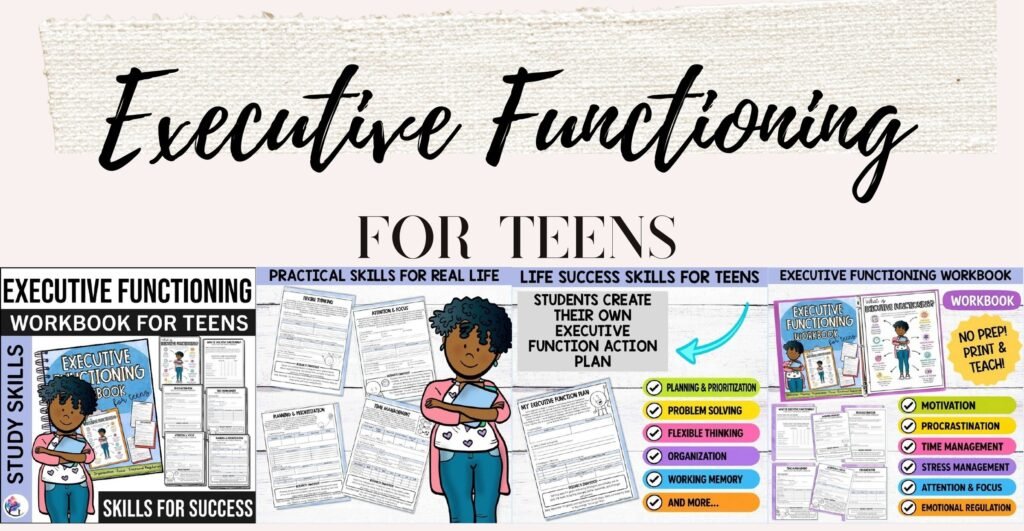
From our counseling room to yours: for students who need more structured practice with planning and follow-through, our Executive Functioning Skills Activities and Worksheets for Teens includes a self-assessment, procrastination and time audit activities, and weekly planning pages. It suits small groups or individual sessions with late middle school and high school students; you might start with the self-assessment so each student chooses one skill to work on before ninth grade. One reviewer noted, “The activities feel age appropriate for teens and have led to some really good conversations with my students.”
Talk About Friendship Changes Before They Happen
The social transition into high school can be just as significant as the academic one.
Some students will arrive with an established friendship group. Others may know only one or two people. Some will be starting completely fresh. Even students who move up alongside close friends may find that different classes, interests and activities begin to change their social circles.
We can prepare students for this without suggesting that their friendships are destined to fall apart. Transition lessons can explore what healthy friendships look like, how to keep existing relationships while being open to new ones, how to recognize peer pressure, what respectful boundaries look like, and what to do if they start feeling excluded or disconnected.
It also helps to broaden the idea of belonging. A student doesn’t need to find one perfect friendship group in the first week. Belonging can grow through classes, clubs, sports, music, shared interests, teachers, support staff, or finding one person they feel comfortable talking to. You might ask the group: “Where are three places at high school you could meet someone who likes what you like?”
Give Students Opportunities to Problem-Solve Real Situations
One of our favorite ways to teach transition skills is through scenarios.
Instead of saying, “You need to be organized,” picture a student who has three tests coming up, hasn’t started a project, has soccer practice twice this week, and is beginning to feel overwhelmed. Now there is something to work with.
What could this student do first? What has made the situation harder? What could they do differently next time? Who could they ask for help? Which part of the problem is within their control?
Fictional student stories let students think through difficult situations when they aren’t personally in the middle of them, and they don’t require anyone to disclose their own experiences in front of the group. Students can often talk insightfully about what a character should do before they are ready to say that something similar is happening to them.
Teach Self-Advocacy as a Skill
As students become more independent, we expect them to speak up for themselves more often. But self-advocacy isn’t something students automatically know how to do because they have reached a particular age.
A student may know they are confused but have no idea how to approach a teacher. Another may recognize that they are becoming overwhelmed but worry that asking for support will make them look incapable. Some students wait until a manageable problem has become a much bigger one because they didn’t know how to start the conversation.
High school transition preparation should therefore include the language of help-seeking. A student might practice saying, “I’m having trouble working out where to start with this assignment. Could you help me break it down?” Another might need, “I’ve fallen behind and I’m trying to catch up. Can we talk about what I should prioritize first?”
We can also help students identify who they could approach. Depending on the school, this might include a classroom teacher, school counselor, grade-level dean or administrator, learning support staff, a coach, or another trusted adult. Independence doesn’t mean never needing help. Part of becoming more independent is recognizing when a situation needs support and knowing how to access it. Our article on teaching self-advocacy to teens goes deeper into this.
Try this in your next session: our Speak Up! Self-Advocacy Skills Presentation breaks self-advocacy into small, practical steps: working out what you need, deciding who to approach, using specific “I” statements, and what to do if the answer is no. It is written for high school students and works well with eighth graders in the spring before the move, or with ninth graders in the first weeks of the year. Pause on each scenario and have pairs script the first sentence they would say. One reviewer appreciated that it “helps students understand what they can actually say in different situations.”

Use Interactive High School Transition Activities to Get Students Talking
A high school transition lesson doesn’t need to be a presentation where students sit quietly while an adult tells them everything they need to know. Some of the most useful information comes from the discussions that happen between the slides.
Movement and choice make it easier for everyone to take part. In a “Stand Up If…” warm-up, students stand if a statement fits them (“Stand up if you have an older sibling in high school,” “Stand up if you’re nervous about finding your classes”). In “Move to a Corner,” each corner of the room represents a response, such as how hard a situation would feel, and students explain their choice to the people who joined them. Both let students see that their worries are shared without having to say them out loud first.
Rather than finishing with “Any questions?”, close with an action step: each student writes one practical thing they will do before or during the first month of ninth grade.
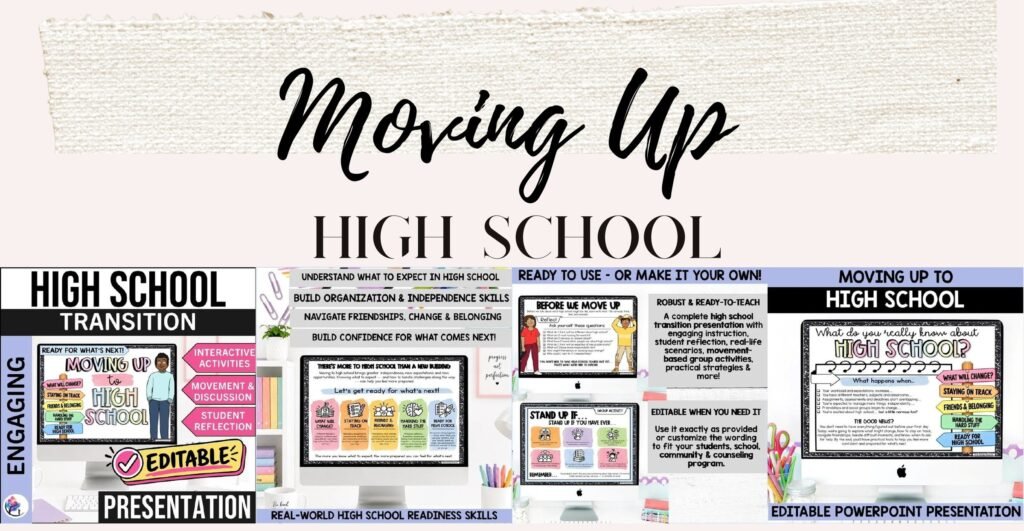
From our counseling room to yours: our Moving Up to High School: Ready for What’s Next? Editable Presentation brings these pieces together for eighth grade classroom lessons or ninth grade orientation. Students meet Ethan, Sofia and Noah in realistic student stories, take part in Stand Up If…, Myth vs. Reality, Move to a Corner and How Hard Would This Be? activities, and finish with a Ready-for-High-School Plan and a One Step Forward action. Because it is editable, you can add your own school’s schedule, support services and procedures. One reviewer said, “The activities kept them involved and gave us some really useful talking points about what to expect.”
Reinforce High School Readiness With a Game
Once students have learned and discussed these skills, they need chances to apply what they know. A game format works well here because it creates a little distance between the student and the problem.
Instead of asking, “Do you procrastinate?”, we can give a team a scenario about someone who has procrastinated and ask them to solve it. Instead of asking a student directly whether they are worried about making friends, we can explore a friendship challenge together. That difference can make conversations feel safer and often leads to richer discussion.
Timing is flexible, too. A counselor might teach the main transition lesson in the spring of eighth grade and bring back a review game during a later classroom visit, a transition day, a small group, or an end-of-year session, so students retrieve and use the ideas rather than hearing the same information twice.
Our High School Survival Files Digital Game was designed for exactly this follow-up. Teams work through five detective-themed categories covering time management, friendships and belonging, study habits and help-seeking, future pathways, and stress and resilience. One reviewer shared that “The interactive activities encouraged thoughtful conversations, built confidence, and helped reduce anxiety about the transition.”
Don’t Forget to Talk About the Future
The high school transition is also an opportunity to begin talking about the future without expecting students to have their lives mapped out. Questions about courses, electives, careers and further education can feel exciting for some students and pressuring for others.
We can shift the conversation away from “What are you going to be?” and toward questions such as: What interests you? What are you curious about? What are you good at? What would you like to learn more about? Which electives or clubs might let you try something new?
At this stage, exploration is the goal. Students can begin connecting strengths, interests and possible pathways without feeling as though they are making a permanent decision. When you are ready to build on this in ninth grade and beyond, our guide to career readiness for teens offers practical next steps.
End With a Plan, Not Just Information
At the end of a high school transition lesson, students may have heard a lot of useful information. The important question is what they will remember when they need it.
One simple activity is to have students complete a short personal plan:
- One thing I can do to stay organized is…
- If I start feeling overwhelmed, I can…
- One way I can make or keep healthy friendships is…
- If I need help at high school, I can go to…
- One thing I’m looking forward to is…
- One skill I want to keep developing is…
These answers turn a general lesson about high school into a personal transition plan. If you can, keep a copy and revisit it with students during the first months of ninth grade, when the plan meets real life.
We aren’t trying to convince students that high school will always be easy or that nothing will go wrong. We are helping them recognize that when challenges do happen, they have strategies, people and skills they can draw on. For students whose worries about the move are more intense or persistent, our post on teen anxiety coping skills may help, alongside individual support and a conversation with families.
Supporting Students Through What Comes Next
A successful transition to high school isn’t about having every answer before the first day. It is about helping students become more comfortable with the idea that they can navigate change.
They can learn a new routine. They can build a better organizational system. They can meet new people. They can recover from a disappointing grade. They can handle a friendship changing. They can ask a teacher for clarification. They can seek support when something becomes too much. And they can gradually become more independent without having to figure everything out alone.
When our high school transition activities focus on those practical skills, we move beyond preparing students for where they are going and start preparing them for what they can do when they get there.
Frequently Asked Questions
When should high school transition activities start?
Many schools begin in the spring of eighth grade, once course selection and orientation dates are known, and continue support into the first weeks and months of ninth grade. Transition is a process rather than a single event, so a lesson before the move and a check-in after it is more useful than one session alone.
What are signs a ninth grader may be struggling with the transition?
Watch for slipping grades or missing work, increased absences, withdrawing from friends or activities, frequent visits to the nurse, or a student who seems more anxious or irritable than usual. Course failures and attendance in ninth grade are closely linked to later outcomes, so early check-ins matter.
How can counselors involve families in the move to high school?
Share key dates, the names of support staff, and how students can ask for help. Encourage families to talk with their teen about what they are looking forward to and worried about, and to help set up a simple homework and planner routine before the year begins.
Are these activities suitable for small groups as well as classrooms?
Yes. Classroom lessons work well for the whole grade, while small groups suit students who are anxious about the move, are new to the district, or need extra practice with organization or self-advocacy.
Looking for practical, ready-to-use resources to support your high school transition lessons? The All Therapy Resources Membership provides access to a growing collection of thoughtfully developed counseling activities, interactive games, and therapeutic tools designed to save preparation time while supporting meaningful, skill-focused learning.