


School counselors operate in a constant tension between clinical presence and administrative compliance. You walk into the building intending to support students through crisis, social-emotional learning, and college readiness. Then the day dissolves into a search for lost notes, or a frantic attempt to reconstruct service minutes before an audit. This friction isn’t merely annoying. It degrades the quality of care you can provide and feeds the burnout that plagues the profession. When documentation feels like a separate burden rather than part of practice, student contact time shrinks to make room for the paperwork.
Efficient tracking is a form of professional self-care and ethical practice. A counseling data tracker for caseload management should work as a silent partner, organizing your responsibilities without demanding extra cognitive energy. Shift from fragmented paper systems to streamlined digital tools, and you reclaim hours previously lost to manual compilation. That shift lets you focus on what matters: being fully present with the children and adolescents who need your support.
Why Traditional Caseload Management Fails School Counselors
Paper logs and disjointed note-taking create a false sense of organization while increasing your long-term administrative burden. You might jot session notes on sticky pads, printables, or in separate notebooks, but these analog methods lack the connectivity modern accountability reporting demands. When an administrator asks for a summary of Tier 2 interventions, or a breakdown of direct versus indirect services, you’re stuck manually aggregating weeks or months of scattered information. This retrospective reconstruction is prone to error, and it eats into planning periods that should go to consultation and program development.
The psychological toll of this fragmentation is real, and often overlooked. Worrying constantly about whether you’ve adequately documented a student interaction creates a background hum of anxiety that interferes with therapeutic attunement. Professional standards hold that systematic data collection is essential for demonstrating the efficacy of comprehensive school counseling programs and ensuring equitable access to services, yet traditional methods make that kind of systematic approach nearly impossible to sustain. When your tracking system doesn’t match your actual workflow, documentation becomes a reactive chore instead of a proactive part of ethical care.
Burnout often stems from this mismatch between clinical intent and administrative reality. Counselors using automated Excel trackers report spending significantly less time compiling end-of-year reports than those relying on manual paper logs or scattered notes. The difference isn’t just speed. It’s mental bandwidth: knowing your data is captured accurately in real time frees you to engage more deeply during sessions. Effective caseload management means distinguishing direct student services, indirect services, and program planning so your reports actually reflect how your time gets used, a distinction paper systems rarely capture with enough detail.
Understanding Where Your School Counseling Time Goes
Effective caseload management involves more than documenting student sessions and monitoring progress. School counselors also need to understand how their time is distributed across direct student services, indirect support, program activities, and administrative responsibilities.
In my experience, tracking service delivery can provide valuable insight into workload demands, competing priorities, and opportunities to strengthen school counseling programs. Rather than relying on estimates, consistent use-of-time data allows counselors to identify patterns, communicate their contributions, and engage in more informed discussions about service allocation.
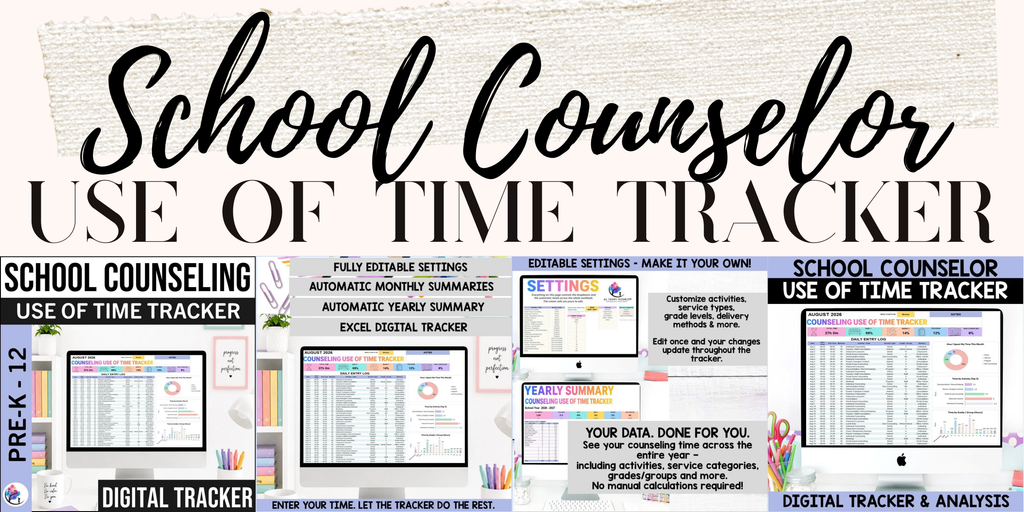
Our School Counseling Use of Time Tracker – Excel Worksheet was developed to simplify this process. This automated Microsoft Excel workbook allows school counselors to record daily activities, categorize direct and indirect services, and generate monthly totals, percentages, visual charts, and a yearly summary.
With customizable activity categories and an August-to-July tracking format, the resource provides a practical way to review how counseling time is allocated throughout the school year.
When combined with individual and group counseling outcome data, use-of-time tracking can provide a more complete picture of both the services delivered and the support provided to students.
Essential Features of an Effective Counseling Data Tracker
A generic spreadsheet can’t meet the specific demands of school counseling accountability because it has no built-in clinical logic. You need a tool that knows the difference between a check-in and a structured intervention, and that sorts entries by MTSS tier or ASCA domain automatically. Without that structural alignment, you’re performing mental gymnastics every time you log an entry, translating raw notes into reportable categories. That translation layer adds fatigue and raises the odds of miscategorizing something during a high-stress week.
Automated Calculations for Service Minutes
Adding up session minutes by hand is a primary source of documentation error and wasted time. An effective counseling data tracker for caseload organization needs pre-built formulas that sum duration fields instantly as you enter sessions. This keeps your total service minutes current and accurate, and it eliminates the end-of-month reconciliation scramble that plagues many counseling offices. When the calculations happen in the background, you can trust your totals at a surprise audit or an IEP meeting without checking them against paper receipts first.
This also supports ethical practice by giving you an objective record of service delivery. Discrepancies between intended and actual service minutes often go unnoticed in manual systems until it’s too late to correct course. Automated tracking gives you immediate feedback on your service distribution, so you can adjust your schedule before a gap turns into an equity problem. You get clarity on whether high-needs students are receiving the support intensity their plans require, which turns the data from a backward-looking record into a forward-planning tool.
Tiered Intervention Documentation
Accountability models require clear differentiation between universal, targeted, and intensive supports. Your tracker should let you tag or filter entries by MTSS tier so you can generate reports that show the full scope of your program. ATR designs its trackers to align with tiered intervention frameworks, so the data you collect serves clinical monitoring and administrative accountability at the same time. That alignment means you’re not keeping separate logs for different tiers, or manually sorting data when annual results reports come due.
Separating tiers within a single system also clarifies your role boundaries. When you can visually distinguish Tier 3 individual counseling from Tier 1 classroom lessons, you protect your time from mission creep and inappropriate referrals. That visual separation helps administrators see the scope of your work beyond crisis response, and gives you the evidence to advocate for protected counseling time by showing exactly how much of your week goes to each level of intervention.
Digital Tools for Individual Student Progress Monitoring
Tier 3 students need the most rigorous documentation, given the intensity of support involved and the potential legal stakes. You need a dedicated system for these high-needs cases, one that goes beyond attendance logging to capture intervention type, progress toward goals, and clinical observations. Standalone digital workbooks built for this purpose offer structure without the overhead of full database software. They bridge flexible note-taking and rigid accountability reporting, which suits the dynamic nature of school counseling.
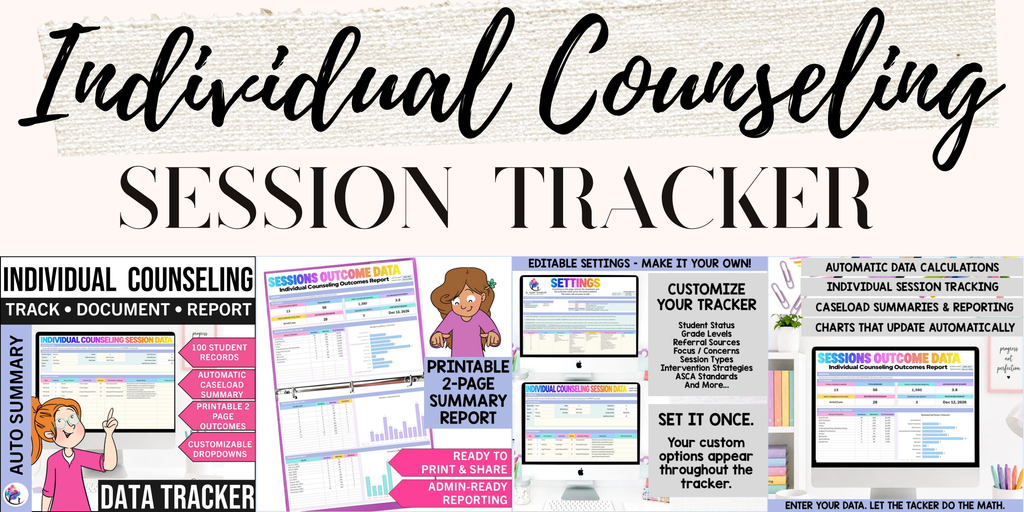
Individual School Counseling Session Tracker & Log & Digital Tracker & Report (Tier 3)
Our Individual School Counseling Data Tracker is an editable Excel workbook designed to simplify individual student counseling documentation and caseload management. With linked student records, session logs, automatic counseling minute calculations, and a caseload summary dashboard, it helps school counselors organize interventions, monitor service delivery, and maintain consistent records without repetitive manual calculations.
Integrating Data Collection Into Daily Planning Routines
Retrospective documentation is inherently flawed, because memory fades fast after intense clinical interactions. Embed data fields directly into your weekly planner and you capture information at the point of service, which preserves accuracy and cuts end-of-day fatigue. When logging becomes part of your planning rhythm instead of a separate task, it stops feeling like an intrusion on your clinical work. This acknowledges something real: counselors think in schedules and appointments, not in abstract data categories.
Using Planners for Real-Time Logging
Physical or printable planners with dedicated data sections build on a habit you already have: checking your schedule. Instead of switching between a calendar and a separate log, you record session details in the same space where you planned them. That proximity cuts friction and makes documentation feel like a natural extension of preparation. You catch nuances that would otherwise get lost if you waited until Friday afternoon to reconstruct the week from memory.
Real-time logging also supports reflective practice by keeping student needs visible throughout the day. Seeing a gap in follow-ups, or a cluster of crises, in your planner prompts an immediate adjustment instead of a delayed realization. That responsiveness matters for trauma-informed practice, where consistency and reliability build safety. Your planner becomes a living document that guides clinical decisions in real time, not just a record of what already happened.
Visual Tracking for Accountability
Seeing your caseload distribution visually prevents service gaps and role imbalance. Color-coded systems or chart views within your planner reveal patterns that rows of text obscure, like over-representation of certain grade levels, or neglect of indirect services. This visual feedback lets you self-correct before administrators notice the disparity, turning an abstract accountability requirement into something concrete that fits your daily workflow.
Visual tracking also communicates your workload to others better than words do. Show a principal a color-blocked week and the conversation shifts from perception to evidence. That transparency builds trust and opens the door to collaborative problem-solving around scheduling and staffing. You move from defending your use of time to analyzing it together, for the good of the program.
Tracking Use of Time for Advocacy and Role Clarity
Direct student services tell only part of the story of comprehensive school counseling. Indirect services, consultation, collaboration, and program planning matter just as much but often stay invisible in traditional tracking systems. Capturing these activities accurately matters for showing administrators and stakeholders the full scope of your role. Without that data, your workload looks lighter than it is, which makes it harder to justify appropriate counselor-to-student ratios or protected non-direct service time.
Accurate use-of-time data provides valuable advocacy evidence during budget cycles and staffing discussions. When you can demonstrate how much time is spent on mandated testing, special education meetings, consultation, and direct student services, conversations about staffing and workload become data-driven. The School Psychologist Use of Time Tracker simplifies this process with automated categories that distinguish assessment, consultation, and direct intervention. The same principles apply to school counseling, where understanding how time is allocated supports role clarity and comprehensive programming.
This kind of tracking also clarifies your own professional identity and boundaries. Seeing exactly where your time goes helps you spot mission creep and realign your practice with ethical standards. You can decide which committees to join, or which duties to delegate, based on actual time costs rather than a vague impression. Role clarity comes from honest data, and it lets you advocate for yourself and your program with evidence behind you.
Demonstrating Small Group Counseling Outcomes with Data
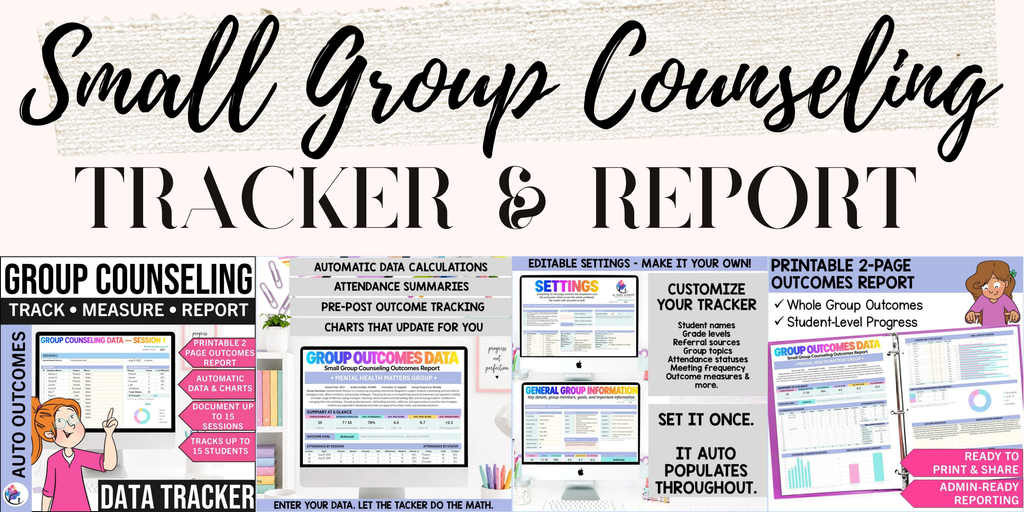
Beyond tracking how time is spent, demonstrating the impact of school counseling interventions is essential for program advocacy. The Small Group Counseling Data Tracker & Automated Outcomes Report helps school counselors document attendance, monitor individual and group progress, measure pre- and post-intervention outcomes, and automatically generate charts and a professional two-page outcomes report. This provides meaningful, measurable evidence to share with administrators, MTSS teams, and school stakeholders, strengthening data-driven decision-making and demonstrating the value of small group counseling programs.
Maintaining Ethical Standards Through Consistent Documentation
Organized record-keeping is an ethical obligation, not just an administrative requirement. Consistent documentation protects continuity of care when students change schools, graduate, or move between providers within the same district. Gaps in records can lead to duplicated assessments, missed interventions, or inappropriate placements that harm vulnerable students. Your tracker is the institutional memory for each child’s support journey, protecting their right to consistent, informed care no matter who’s on staff next year.
Legal defensibility depends almost entirely on the quality and consistency of your documentation. In disputes over service delivery or student outcomes, contemporaneous records carry far more weight than reconstructed memories. A systematic tracking system shows professional diligence and adherence to standards, which protects your license and reputation. That protective function makes documentation an act of self-preservation as well as student advocacy.
Ethical practice also means using data to examine equity in service delivery. A regular review of your tracking data shows whether certain student populations get disproportionate attention, or get neglected. This reflective use of data lines up with the social justice commitments at the center of the counseling profession. You move past compliance into real program evaluation, using your tracker as a mirror for continuous improvement.
Streamlining your documentation doesn’t mean cutting corners. It means working smarter so you can save your energy for direct student support. Explore the All Therapy Resources Shop for data trackers and planners built for school-based professionals, or look into the ATR Membership Library for ongoing access to the full collection. Invest in systems that honor the complexity of your role, so you can keep showing up fully for the students who need you most.
Frequently Asked Questions
What specific features make a counseling data tracker effective for accountability reporting?
Effective trackers include automated minute calculations, MTSS tier categorization, and alignment with ASCA or state accountability models. These features eliminate manual aggregation errors and generate audit-ready reports without additional formatting. Generic spreadsheets typically lack this clinical logic, requiring extra work to translate raw data into compliant documentation.
How can school counselors track individual session data without adding significant administrative time?
Use purpose-built digital workbooks like the Individual School Counseling Session Tracker that automate calculations and organize notes chronologically. Embedding data fields directly into weekly planners also captures information at the point of service rather than retrospectively. Both approaches reduce documentation to seconds per entry instead of minutes.
Why is tracking ‘use of time’ critical for advocating for appropriate counselor-to-student ratios?
Use-of-time data reveals the true scope of indirect services, consultation, and program planning that direct-service metrics miss. This evidence demonstrates actual workload to administrators during staffing discussions, moving conversations from perception to documented reality. Without it, non-direct services remain invisible and vulnerable to elimination.
How do integrated planners differ from standalone spreadsheets for daily caseload management?
Integrated planners combine scheduling, lesson planning, and data tracking in one cohesive resource, reducing context-switching between tools. Standalone spreadsheets excel at calculation but lack daily navigation features and clinical scripts. Planners embed data collection within the workflow of school counseling, making documentation feel like planning rather than separate paperwork.
What is the connection between consistent data tracking and ethical school counseling practice?
Consistent documentation ensures continuity of care during provider transitions and provides legal defensibility in disputes. It also enables equity audits to identify service disparities across student populations. Systematic tracking demonstrates professional diligence and protects both student rights and counselor licensure through verifiable records.
Explore School Counseling Tools & Resources
Looking for practical tools to simplify your school counseling workload? Explore our collection of school counseling data trackers, planners, and ready-to-use resources designed to support caseload management, student progress monitoring, and everyday counseling practice.