
A child may understand a question, follow a routine, and appear fully engaged, yet go quiet when it is time to explain what happened, ask for help, or share an idea. Those moments are where expressive language activities for children become especially useful. The goal is not to pressure a child to perform or to turn every interaction into a test. It is to create predictable, meaningful opportunities for children to practice putting thoughts, needs, experiences, and feelings into words.
Expressive language includes far more than naming objects correctly. It involves vocabulary, sentence structure, grammar, narrative skills, word retrieval, social communication, and the ability to communicate a message for a real purpose. A child may need support in one area while showing clear strengths in another. For busy professionals, the most useful activities are flexible enough to fit into counseling, speech-language sessions, classrooms, small groups, and home-based practice.
Why expressive language practice needs a purpose
Children often use new language more readily when the activity gives them a reason to communicate. A 2024 meta-analysis of naturalistic approaches such as Enhanced Milieu Teaching, which teach language during meaningful everyday communication, found strong effects for young children. Asking a child to produce longer sentences repeatedly can feel abstract or demanding. Asking them to tell a puppet what happened at recess, describe a picture so a partner can draw it, or explain which coping tool might help a character creates a genuine communication task.
This matters across disciplines. A school counselor may be supporting a student who needs words for worry, disappointment, or conflict. An occupational therapy-informed provider may be helping a child describe body signals and sensory needs. A special educator may be building language for classroom participation. Speech-language professionals may target specific linguistic forms, vocabulary, or narrative structures. The shared principle is simple: children benefit when language practice is relevant, supported, and repeated across settings.
The level of support should depend on the child. Some children benefit from visual choices, sentence starters, or modeling. Others need wait time, a clear topic, and an interested listener. For children who use AAC, gestures, sign, or another communication modality, expressive language practice should honor and incorporate that system rather than treating spoken language as the only valid response.
Expressive language activities for children in everyday sessions
Use visual scenes to move beyond labeling
A detailed picture scene can support rich language without requiring special materials. Rather than asking only, “What do you see?” invite the child to notice actions, intentions, problems, and possible solutions. A playground, classroom, kitchen, or community scene works well because it contains familiar routines and social situations.
Begin with concrete prompts, such as “Tell me what the child is doing.” Then expand naturally: “What happened right before this?” “What might they be thinking?” “What could they say next?” If a child answers with one or two words, reflect their message back in a slightly fuller form. When a child says, “Boy sad,” an adult might respond, “Yes, the boy feels sad because his block tower fell down.” This gives the child a model without implying that their first attempt was wrong. This kind of expansion, or recast, has research behind it: a review of recast studies found it effective for building grammar.
Picture scenes are also useful for emotional literacy and problem-solving. A child can practice language for perspective-taking while discussing someone else, which often feels safer than beginning with a personal experience.
Build stories with a beginning, middle, and end
Narrative language supports academic participation, peer conversations, and self-advocacy. In a longitudinal study, narrative skills at age five predicted reading comprehension at age ten, although the effects were small. It also gives children a structure for sharing experiences that may otherwise come out in scattered pieces. Use three to five picture cards, simple drawings, or everyday objects to create a story together.
Offer a framework such as character, setting, problem, feeling, plan, action, and ending. Younger children may use a short sequence: first, next, last. Older children can work on adding relevant details, explaining character motivation, or identifying what changed by the end of the story.
A helpful variation is collaborative storytelling. The adult starts with one sentence, the child adds the next, and each person takes a turn moving the story forward. This reduces the demand of generating an entire narrative alone. It also offers natural practice with listening, staying on topic, and responding to another person’s ideas.
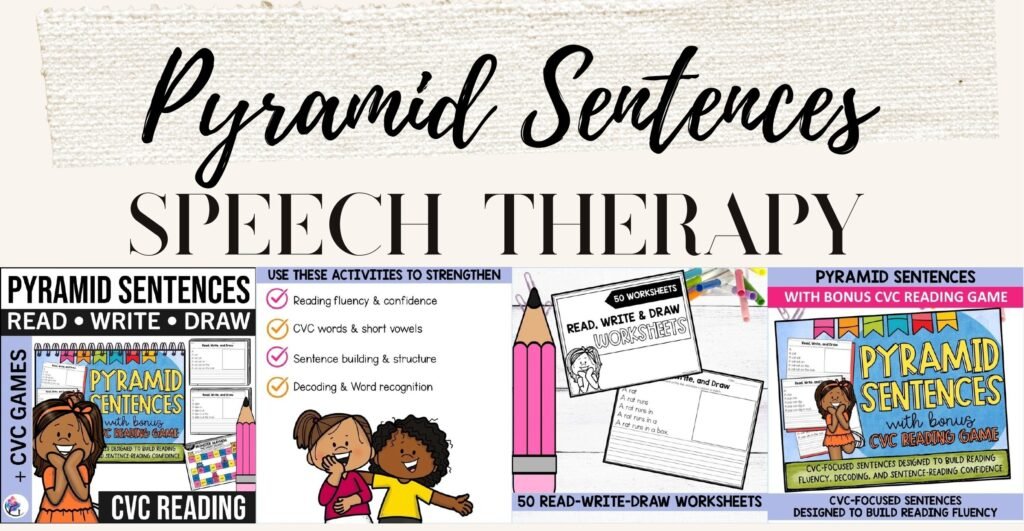
Try this in your next session: for children who are ready to move from single words to longer sentences, our Pyramid Sentences with Bonus CVC Reading Games build a sentence one word at a time, so each line is just a little longer than the last. Although it is designed as a reading resource, the same gradual structure works well as a speaking model: the child says each line aloud, then tries adding their own detail at the top of the pyramid.
Turn play into a communication role
Play-based activities can offer a natural, lower-pressure context for spontaneous language. Set up a simple scenario with figures, blocks, art supplies, pretend food, or a game board, then give the child a role that requires communication. They might be the builder who explains a design, the coach who teaches the rules, the detective who describes clues, or the helper who solves a character’s problem.
The adult’s role is to follow the child’s lead while adding language opportunities. Pause before handing over a desired item, a strategy used in naturalistic approaches such as Enhanced Milieu Teaching. Make a gentle mistake that invites correction. Ask for clarification when a message is unclear, but do so respectfully: “I want to make sure I understand. Can you show me or tell me more?”
This approach is particularly helpful for children who become less communicative during worksheet-heavy tasks. It is not a replacement for structured intervention goals when those are needed, but it can provide a lower-pressure context for practice and observation.
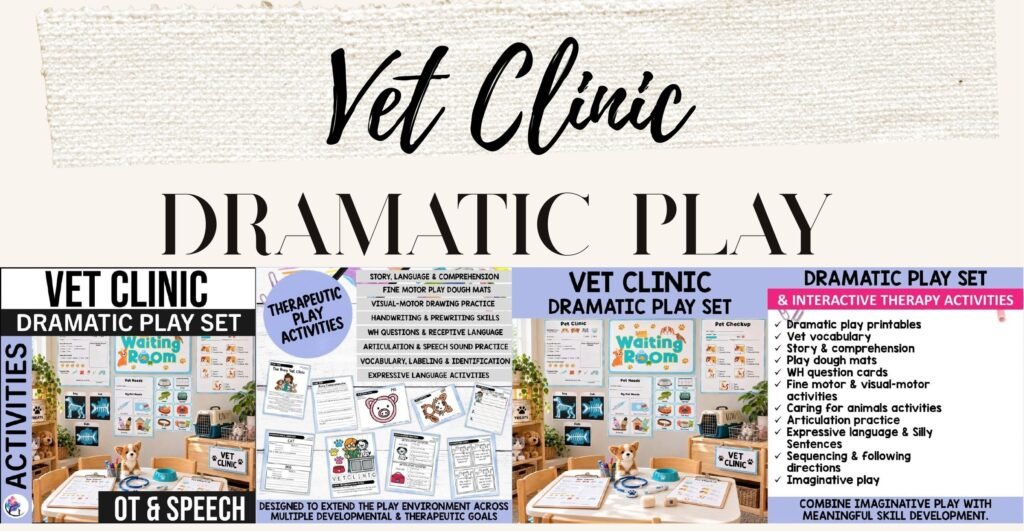
From our therapy room to yours: if you want a ready-made play scenario, our Vet Clinic Dramatic Play & Interactive Therapy Activities give children a role with a real reason to talk: checking in a pet, describing what is wrong, explaining the treatment and asking questions. It is easy to add the communication temptations above, such as a pause before handing over the bandage or a “mistake” the child can correct.
Practice describing and giving directions
Barrier-style activities make communication visible. Place a simple picture, design, or arrangement of objects between two partners so they cannot see each other’s work. One person describes what to draw or build, while the other follows the directions. At the end, compare the results and identify which details helped.
This activity supports vocabulary, spatial concepts, complete sentences, sequencing, and repair strategies. It also normalizes communication breakdowns. If the listener places an item in the wrong spot, the child can practice saying, “I meant next to it,” “Move it higher,” or “Let me explain that another way.” These are valuable self-advocacy skills, especially for children who tend to give up when they are misunderstood.
Adjust complexity carefully. A younger child might direct placement of three colored blocks. An older student might describe a visual design, explain the steps in a science task, or give directions for a preferred game.
Use feelings language in real-life scenarios
Many children can label basic emotions on a card but need more support using emotion words in context. Short scenarios can help bridge that gap. Present a common situation, such as being left out of a game, getting an unexpected change in routine, making a mistake, or receiving feedback from a teacher. Ask what the person may feel, what clues show that feeling, and what they could say or do next.
Keep the focus on nuance rather than finding one correct answer. A child may feel disappointed, embarrassed, frustrated, worried, or several emotions at once. Offer language frames when useful: “I feel ___ because ___.” “I need ___.” “Could you help me with ___?” “I need a break, then I can try again.”
Sentence frames by level. Offer these as optional supports, and fade them as the child gains confidence.
| Level | Frame | Example | Practice it with |
|---|---|---|---|
| 1 | I feel ___. | I feel sad. | Feelings & Behavior SEL Workbook |
| 2 | I feel ___ because ___. | I feel sad because my tower fell. | “I Statements” Activities & Craft |
| 3 | I feel ___ because ___. I need ___. | I feel frustrated because it keeps falling. I need help holding it. | Conversation Starters Card Game |
| 4 | When ___ happened, I felt ___. Next time I could ___. | When my tower fell, I felt frustrated. Next time I could build a wider base. | Pyramid Sentences |
For counseling and behavior support, this practice can strengthen the link between internal experiences and communication. It should remain trauma-informed: children never need to disclose personal events to participate. Fictional characters, neutral examples, and the option to pass all help preserve emotional safety.
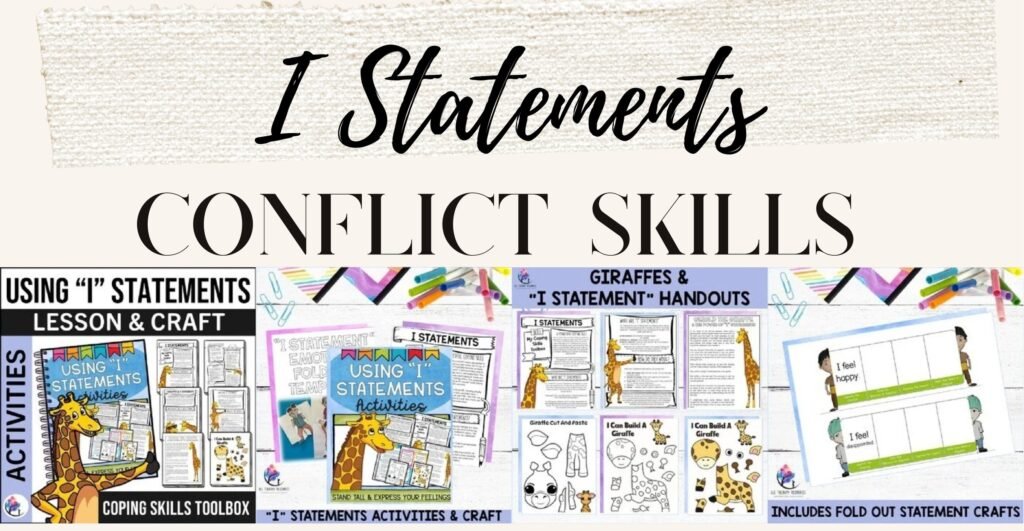
For counselors: our “I Statements” Conflict Resolution Activities & Craft give children a simple, repeatable frame for expressing feelings respectfully, using a story character, discussion questions and a craft. One reviewer wrote, “The story of Gerald the Giraffe made “I Statements” fun and relatable, and the crafts and discussion questions kept my students engaged and thinking deeply.”
Create a weekly talk routine
Brief, repeated routines can provide steady practice that is easy to sustain. A classroom check-in, therapy closing prompt, or family conversation ritual can offer steady practice with expressive language. Prompts might include, “One thing I noticed,” “A challenge I handled,” “Something I want help with,” or “A question I still have.”
A consistent format can reduce planning demands because children learn what to expect. At the same time, the content can remain personal and flexible. Visual supports, word banks, and sentence stems should be available as tools, not requirements. Some children will outgrow them quickly; others may benefit from them for longer.
Scaffold without taking over
Adults can unintentionally do too much of the talking when they are trying to help. A child pauses, and the adult supplies the word. A child gives a partial answer, and the adult turns it into a full response before the child has another chance. Modeling is valuable, but children also need enough wait time to organize their message.
Try using a responsive sequence: pause, acknowledge the child’s attempt, add one level of language, and invite another turn. If a child says, “He mad,” an adult might say, “He is mad because the game ended. What could he say when he feels mad?” This honors the original communication while gently extending it.
For children with significant language needs, collaborate with the speech-language pathologist and follow the child’s established communication supports. General classroom, counseling, and home activities can reinforce skills, but individualized assessment and intervention decisions belong within the appropriate professional scope.
Notice progress that matters outside the activity
Progress is not limited to longer sentences or more correct grammar. A child may show meaningful growth by initiating a request, clarifying a misunderstood message, using a new feeling word, telling an event in order, or asking a peer a follow-up question. Brief notes about the prompt used, level of support, and child response can help teams identify patterns over time.
Often, the most useful expressive language practice feels like a well-supported conversation rather than an exercise. When children have time, choices, useful words, and adults who listen closely, communication becomes less about getting the answer right and more about being understood.
Frequently Asked Questions
What is expressive language?
Expressive language is how a child communicates thoughts, needs and ideas, through speech, sign, writing or AAC. It includes vocabulary, sentence structure, grammar, storytelling and using language for real purposes.
What are good expressive language activities for children?
Picture scene descriptions, collaborative storytelling, pretend play with a communication role, barrier games and short feelings scenarios all give children a genuine reason to talk while practicing specific skills.
How can I help a child who answers in one or two words?
Give wait time, then expand what the child said into a slightly fuller model (“Boy sad” becomes “The boy feels sad because his tower fell”) and invite another turn. Avoid asking the child to repeat a correct version.
When should I refer a child for a speech-language evaluation?
If you have ongoing concerns about how a child expresses themselves compared with peers, talk with the speech-language pathologist and follow your setting’s referral process. Classroom and counseling activities can reinforce skills, but assessment belongs within the SLP’s scope.
References
- University of Washington: Receptive and expressive language disorders
- ASHA Evidence Maps: 2024 meta-analysis of Enhanced Milieu Teaching
- Cleave et al. (2015): The efficacy of recasts in language intervention
- British Journal of Educational Psychology: narrative skills and later reading comprehension
- Cochrane review: speech and language therapy interventions for children with primary speech and language delay or disorder
Looking for practical, ready-to-use resources to support your expressive language goals? The All Therapy Resources Membership provides access to a growing collection of thoughtfully developed speech and language activities, interactive games, and therapeutic tools designed to save preparation time while supporting meaningful, skill-focused learning.