

Children often begin feeling frustrated with reading and speech long before adults fully understand how much hidden neurological work is actually happening underneath the surface.
A child looks at a simple word like “smile,” and to an adult it may seem straightforward.
But underneath that moment, the child’s brain is trying to hear multiple sounds, hold those sounds in sequence, connect speech sounds to print, coordinate visual scanning, retrieve vocabulary, plan speech movements, maintain attention, and remember what they are supposed to write — all at the same time.
For some learners, that is incredibly demanding work.
Many children never say:
“This feels neurologically overwhelming.”
Instead, we often see…
guessing,
avoidance,
silliness,
rushing,
shutting down,
or children quietly deciding they are “bad readers” or “bad at speech.”
That is why I think movement-based speech therapy and phonics activities can be so incredibly powerful.
Because sometimes children do not need more pressure.
Sometimes they need the learning presented in a way that keeps the nervous system emotionally engaged long enough for the learning to actually stick.
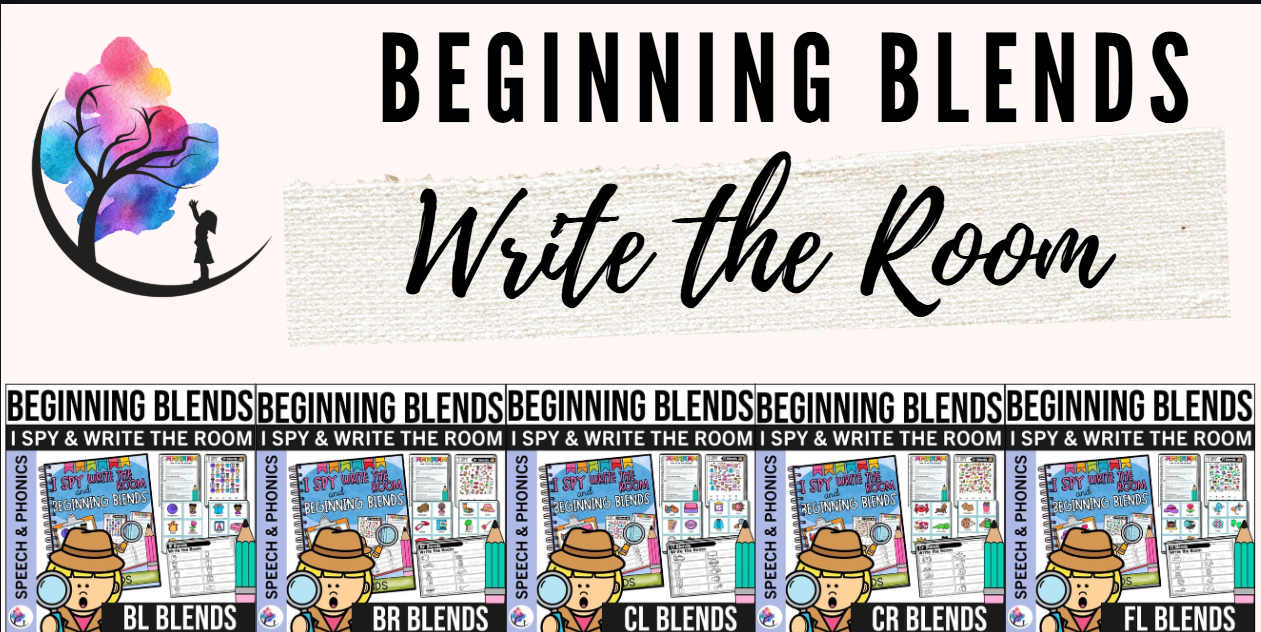
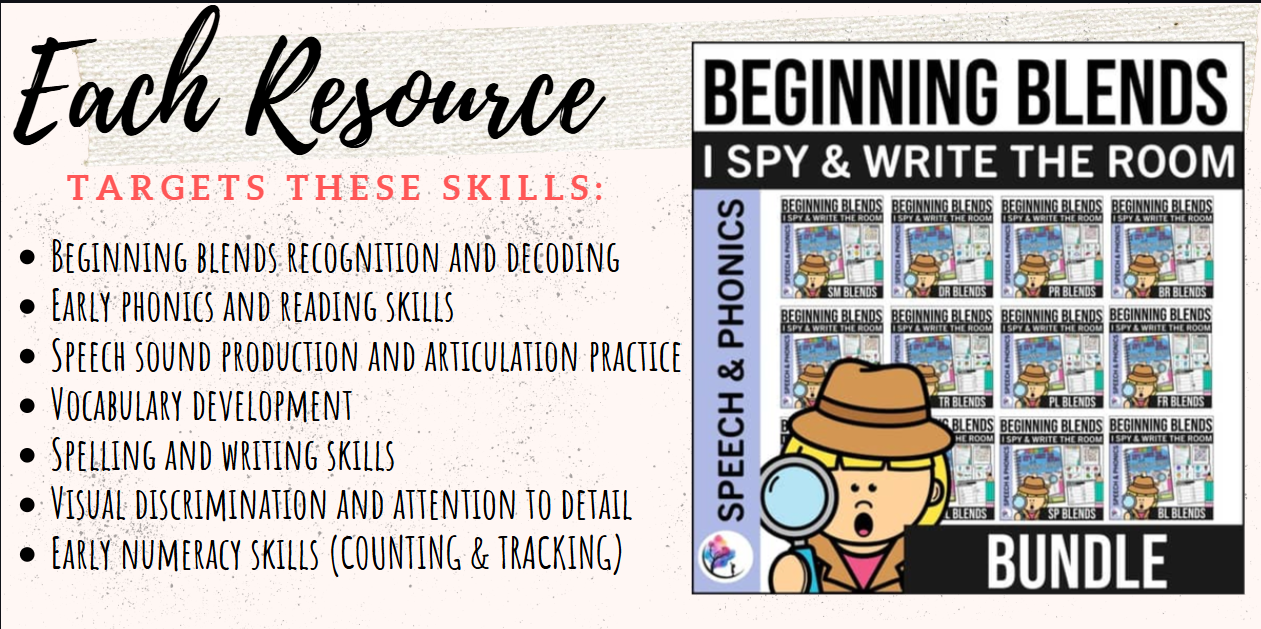
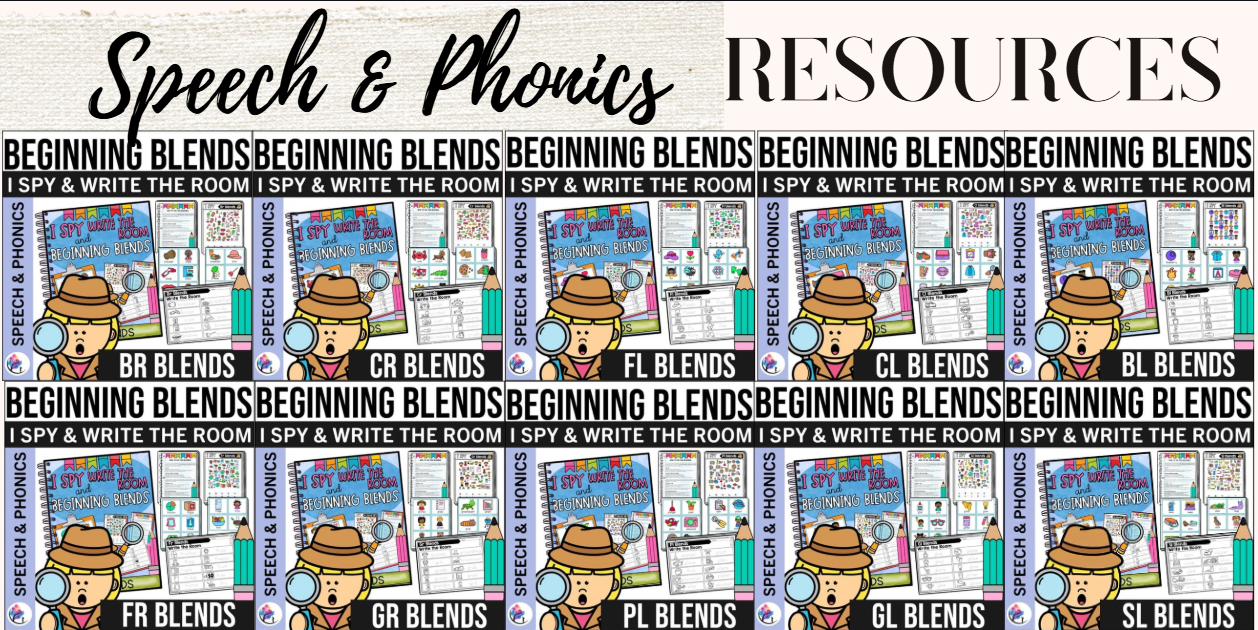
That is exactly why we love using our collection of “Beginning Blends Write the Room and I Spy activities” for Speech Therapy and early phonics intervention. There are a 20 of 20 resources in our collection. One resource, our SM blends resource, for example, supports children in practicing target words such as smile, smell, smash, smoke, smart, and smock through movement-based visual scanning, writing, sound awareness, and speech production activities.
Why Beginning Blends Can Feel So Difficult for Some Children
One thing I think adults sometimes underestimate is how much cognitive load sits inside early literacy tasks.
Beginning blends require children to process more than one sound together at the beginning of a word while maintaining the correct sequence smoothly and accurately.
A child working on the word “smile” is not simply memorizing letters. They are learning how sounds work together inside spoken and written language. They are trying to hear the blend, hold it in working memory, produce it clearly, connect it to print, and understand what the word means — all within seconds.
That is a huge amount of neurological coordination.
Research around phonological awareness shows that children need explicit opportunities to hear, manipulate, and connect sounds within spoken language because these skills form an important foundation for reading development. The National Reading Panel identified phonemic awareness and systematic phonics instruction as key components of effective literacy instruction because children benefit from structured opportunities to connect speech sounds with print.
And honestly, many children who appear inattentive or resistant are often simply overwhelmed by the hidden processing demands underneath the task.
Speech Therapy and Literacy Development Are Deeply Connected
One thing Speech Therapists understand so well is that speech and literacy do not develop in completely separate boxes.
Children who struggle with articulation or phonological processing are often simultaneously working hard to develop decoding, spelling, sound awareness, and reading fluency skills too.
The American Speech-Language-Hearing Association explains that integrated phonological awareness intervention combines speech production practice with phonological awareness and letter-sound knowledge. (asha.org)
That overlap matters deeply.
Because children often make stronger progress when speech sounds, phonics, vocabulary, and print awareness are practiced together in meaningful ways rather than through isolated drill alone.
This is one reason beginning blends activities can be so clinically useful. Children are repeatedly:
seeing the blend,
saying the blend,
hearing the blend,
writing the blend,
and connecting it to meaning.
That kind of integrated practice strengthens multiple literacy pathways at once.
Why Movement-Based Learning Helps So Many Children
Honestly, many children are not designed to learn language sitting still for long periods of time.
Some children regulate through movement.
Some sustain attention more effectively while active.
Some process information more clearly when the body is involved alongside the brain.
That is one reason Write the Room activities can work so beautifully for speech and phonics intervention.
Instead of remaining seated at a desk completing repetitive drills, children move purposefully around the room locating target cards, visually scanning for information, saying words aloud, identifying blends, and recording responses.
The movement itself often helps keep the nervous system more alert and engaged.
And from a neuroscience perspective, movement matters. Research in educational neuroscience suggests that physical movement can support attention, memory, engagement, and cognitive activation because multiple neural systems become involved during active learning experiences.
Children are not just passively receiving information.
They are actively experiencing it.
That difference matters enormously for many learners.
Visual Scanning and Attention Skills Are Quietly Developing Too
One thing I love about I Spy activities is that they support far more than phonics alone.
Children are also strengthening visual discrimination, visual scanning, attention to detail, working memory, and sustained focus.
In our SM blends I Spy activity, children visually search for target images such as smile, smoke, smash, and smell while locating and counting repeated pictures throughout the page.
That visual search process is incredibly important for many early learners.
Some children struggle to efficiently organize visual information on a page. Others lose track visually, skip items, or become overwhelmed by busy visual environments. Some children appear distracted when in reality their brain is working very hard to process and organize visual detail accurately.
I Spy activities allow children to strengthen those skills in ways that feel playful rather than stressful.
Children often tolerate much higher levels of repetition when the task feels like discovery rather than performance.
Repetition Matters — But Emotional Safety Matters Too
Children often need far more repetition than adults realize before speech sounds and phonics patterns become automatic.
But repetition only works when the nervous system stays emotionally connected to the task.
That emotional piece matters deeply.
Some children already carry embarrassment around speech difficulties.
Some become anxious during reading tasks.
Some have quietly started believing they are “behind” compared to peers.
Children rarely verbalize those fears directly.
Instead we often see…
avoidance,
behavior,
rushing,
perfectionism,
guessing,
or complete disengagement.
That is why playful, movement-based intervention can be so powerful.
The learning still remains structured and purposeful, but the emotional pressure decreases. Children feel like they are searching, moving, discovering, and participating rather than constantly being evaluated.
And regulated children almost always learn more effectively than dysregulated ones.
Why Multi-Sensory Learning Is So Effective
Research in literacy and child development consistently supports multi-sensory learning approaches because children learn best when multiple systems are activated together.
Write the Room and I Spy activities naturally combine:
visual learning,
auditory processing,
movement,
speech production,
writing,
attention,
and language processing simultaneously.
That integrated approach helps strengthen learning pathways because the child is not only hearing information — they are actively doing something with it.
Our SM blends activity specifically highlights that the activities support phonics, speech sound production, vocabulary development, spelling and writing skills, visual scanning, and movement-based engagement for active learners.
That layered learning is where some of the most meaningful growth often happens.
Real-World Reflections
Children who resist speech or literacy tasks the most are often the children trying hardest internally.
The child laughing everything off may already feel embarrassed.
The child wandering around the room may actually be trying to regulate an overwhelmed nervous system.
The child guessing words quickly may be terrified of getting it wrong.
When we begin seeing children through that lens, intervention changes.
We stop asking:
“How do I make this child do more work?”
And instead begin asking:
“How do I help this child stay emotionally connected to learning long enough to experience success?”
That shift matters.
Because speech therapy and literacy intervention are not only academic experiences.
They are emotional experiences too.
Children need opportunities to feel:
capable,
successful,
engaged,
and safe enough to keep trying.
Sometimes one movement-based activity can completely change how a child feels about practicing sounds, reading words, or participating in literacy tasks.
Those emotional shifts matter just as much as the academic ones.
Final Thoughts
Beginning blends activities are about far more than simply identifying words around the room.
When designed thoughtfully, speech therapy Write the Room and I Spy phonics activities can support articulation, phonological awareness, decoding, vocabulary development, spelling, visual scanning, attention, working memory, and confidence-building all within one engaging learning experience.
Research continues showing us that phonological awareness and systematic phonics instruction are foundational for literacy development, particularly when speech sounds, sound awareness, and print are connected meaningfully through active and multi-sensory learning experiences. (nichd.nih.gov) (asha.org)
Want More Ready-to-Use Speech Therapy Resources?
If you are looking for engaging, evidence-informed speech therapy resources that support communication, confidence, regulation, and meaningful learning outcomes, many of the activities discussed in this article are already included inside the All Therapy Resources Membership.
Our membership gives professionals access to a growing library of therapy, SEL, speech, OT, behavior, and educational resources designed to save time while supporting real-world therapeutic practice.
Inside the membership, you’ll find:
• Speech therapy games and activities
• Phonics and literacy supports
• Social-emotional learning resources
• Interactive digital games
• OT, behavior, and counseling materials
• Print-and-go therapy supports for a wide range of ages and needs