
The school counselor role is often misunderstood by parents, teachers and even students. Most people know there is a counselor at school, but they may not know exactly what the counselor does, when students can access support or how families and staff can work with them. When that picture is unclear, people tend to reach out late, or not at all.
That is why introducing the school counselor and the counseling program early in the year matters so much. Families should not have to wait until their child is struggling to discover who their school counselor is, and teachers should not have to guess how to ask for help. When everyone understands the role, trust and collaboration with families and staff become much easier to build.
What the School Counselor Role Includes
The American School Counselor Association (ASCA) describes school counseling programs as comprehensive in scope, preventive in design and developmental in nature, organized around the ASCA National Model. That work supports students’ academic, career and social/emotional development. It includes direct services with students (instruction, appraisal and advisement, and counseling) and indirect services on their behalf, such as consultation, collaboration and referrals.
ASCA recommends a student-to-school-counselor ratio of 250:1, with the goal that counselors spend 80% of their time in direct and indirect student services. Many counselors work with much larger caseloads, which is one more reason clear expectations help: families and staff can reach the right person, for the right kind of support, sooner.
ASCA also publishes a list of appropriate and inappropriate activities for school counselors. A few examples are useful to share with staff, because they shape what people can expect from you:
| Within the school counselor role (ASCA) | Outside the role, per ASCA |
|---|---|
| Short-term individual and small-group counseling | Long-term counseling to address psychological disorders |
| Counseling students who have disciplinary problems | Performing disciplinary actions or assigning consequences |
| Consulting with teachers about classroom connections and classroom management | Covering classes or supervising common areas |
| Interpreting test results and student records | Coordinating testing programs or keeping clerical records |
Want a parent-friendly summary to hand out? Our Role of the School Counselor handout and the wider Coffee with the Counselor collection explain the role in plain language for families.
Do Families Know What the School Counselor Does?
Because we work inside school counseling every day, it is easy to assume families understand it. In reality, many parents have had little contact with a school counselor, and their picture may be based on what counseling looked like when they were students.
Parents often have practical questions they have never had the chance to ask. What happens when my child visits the counselor? Will I be contacted? Is counseling confidential? Can I reach out myself, or does my child need a referral?
Answering these questions early removes some of that uncertainty. It also sends families a simple message: you are welcome to reach out. A short script for a parent night might sound like this: “You do not need to wait for a problem to contact me. If something is on your mind about your child, a quick email or call is always a good place to start.”
The School Counselor Role Is About More Than Crisis Support
A common misconception is that students only see the counselor when something has gone wrong. Crisis response can be part of the school counselor role, but ASCA describes school counseling as preventive and developmental, so much of the work happens before a concern becomes overwhelming.
Picture a student who is navigating a changing friendship, another who is struggling with organization or school stress, and a third who is anxious about moving to middle school. None of them is in crisis, yet each could benefit from a short check-in, a small group or a classroom lesson.
Normalizing these different forms of support reduces the stigma around asking for help. Students can then see their counselor as someone who is already part of their school community, not only the person they are sent to when there is a problem.
Why Families Should Meet the School Counselor Early
There is a big difference between meeting the school counselor at the start of the year and meeting them for the first time during a difficult situation.
Picture a parent receiving a call about their child from someone they have never met. Even when the counselor is warm and supportive, the relationship begins at an already stressful moment. Now picture the same parent having already seen the counselor at Open House. They know the counselor’s name, understand the role and know how the program works. There is already a little familiarity there.
From a trauma-informed perspective, that matters. SAMHSA lists trustworthiness and transparency among the key principles of a trauma-informed approach. Clear information, predictability and knowing where support is available can help people feel safer accessing it when they need it. Our article on why meeting the school counselor matters looks at the same idea from the student’s side.
Helping Teachers and Staff Understand the School Counselor Role
Teachers are often the first to notice when something changes for a student: withdrawal, friendship difficulties, frustration, worry or a student who does not seem like themselves. When staff understand the school counselor role, they know when consultation or a referral is appropriate and what may happen after they raise a concern.
It also helps to be clear about what the role is not. Because ASCA lists assigning discipline as outside the counselor’s role, staff may need to hear that the counselor supports students with behavior concerns but does not hand out consequences. Protecting that boundary helps students keep seeing the counselor as a safe person.
A simple faculty-meeting script: “If you are worried about a student, you can always consult with me first. We can talk it through together and decide whether a referral, a check-in or a classroom strategy makes the most sense.” Teachers see students in situations counselors may never observe, and counselors bring another perspective on social-emotional development, coping and wellbeing. Neither holds the whole picture, but together we see much more of it.
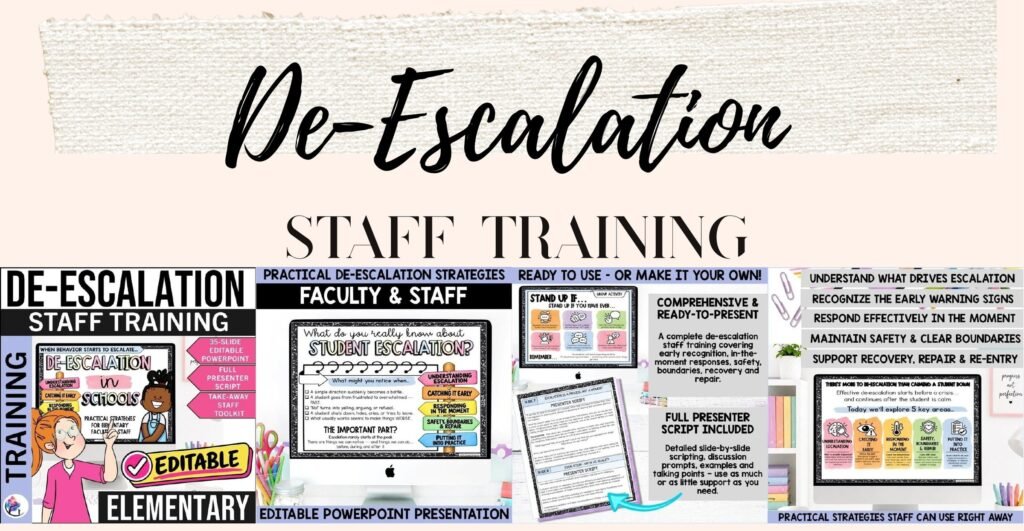
Try this at your next staff meeting: many counselors also support staff professional development, and responding to escalating behavior is a common training need. Our Elementary De-Escalation Staff Training Presentation includes a 35-slide PowerPoint with editable presenter scripts, a staff toolkit, quick-access scripting tools and case studies for group discussion. You could run one section per faculty meeting across a term, using the scenarios to talk through what to try before a referral and when to bring the counselor in. Middle school and high school versions are also available.
The School Counselor Role Is Collaborative
School counselors do not support students in isolation. ASCA’s position on school-family-community partnerships states that school counselors have an essential and unique role in promoting, facilitating and advocating for collaboration with families and community partners.
Parents know their children in ways schools cannot. Teachers see students learning, interacting with peers and responding to everyday expectations. Counselors bring their own professional perspective. When those pieces come together appropriately, we develop a much clearer understanding of what a student may need.
Explaining this collaborative side of the role makes reaching out feel less intimidating. Contacting the counselor does not have to mean someone is escalating a problem. Sometimes it simply means adding another supportive person to the conversation. For practical ways to keep those conversations warm and productive, see our parent communication tips for counselors.
What Parents Should Know About School Counseling
Parents do not need a lengthy presentation full of professional terminology. They need clear information about what the program offers and how it relates to their child, such as friendships, emotions, coping, school adjustment, academic concerns, transitions and future planning.
Families should also understand the difference between school counseling and ongoing therapy. ASCA’s guidance on school counselors and student mental health describes short-term counseling, crisis intervention and referrals to school and community resources, and notes that long-term therapeutic counseling is not the school counselor’s role. When a student needs more, the counselor can help families find and connect with outside services.
Most importantly, tell parents how to contact you. It sounds simple, but it matters.
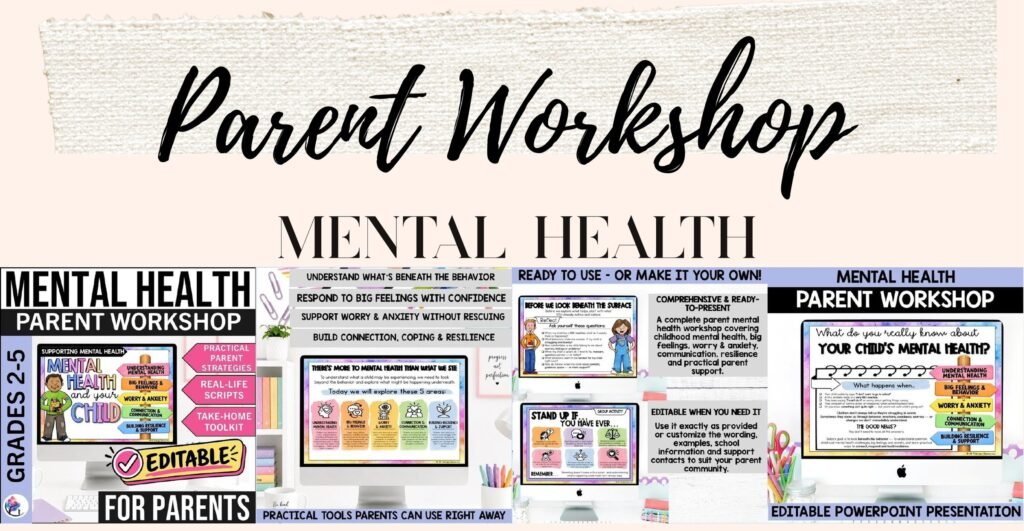
Try this for your next parent evening: a parent workshop is a natural next step once families know who you are. Our Mental Health Parent Workshop Presentation for Grades 2 to 5 pairs a 34-slide PowerPoint with a Parent Support Toolkit of strategies, parent scripts, coping tools and take-home resources. It covers big feelings and behavior, worry and anxiety, connection and resilience, and when a child may need additional support. It works well for a Coffee with the Counselor morning or an evening session, and it reinforces the message that families are partners. There are also middle school and high school editions.
Explaining Confidentiality in School Counseling
Confidentiality is one of the areas parents, teachers and students ask about most, and it is worth addressing before a difficult situation occurs.
ASCA’s position on the school counselor and confidentiality asks counselors to explain the meaning and limits of confidentiality to students in developmentally appropriate terms, to make sure faculty and administration understand those limits, and to balance their obligation to the student with parents’ and guardians’ legal rights to be the guiding voice in their children’s lives. Confidentiality may need to be breached to prevent serious and foreseeable harm.
That does not need to sound frightening or legalistic. With younger students, you might say: “What we talk about stays between us, unless I am worried about your safety or someone else’s. If that happens, I will tell you before I talk to another adult who can help.” With parents and staff, explain in calm, straightforward language what they can expect to hear from you and why some details stay private.
Key Messages to Share About the School Counselor Role
When introducing your counseling program to parents or faculty, these messages are especially helpful to communicate:
- Students do not need to be in crisis to see the counselor. School counseling offers early support for everyday challenges as well as bigger concerns.
- The role covers several areas of development. Academic, career and social/emotional development are all part of the work.
- Support can look different for different students. Individual support, small groups, classroom lessons, consultation and school-wide activities can all be part of the program.
- Parents and caregivers are important partners. Families know their children well, and that insight matters.
- Teachers can consult with the counselor. A conversation between colleagues is often a better first step than an immediate formal referral.
- Confidentiality has limits. Everyone should understand how privacy works and when information may need to be shared to keep a student safe.
- Asking for support should feel normal. Visiting the counselor does not mean something is wrong; asking for help is a healthy skill students can carry well beyond school.
Sharing these messages early prevents many misunderstandings later and builds a shared understanding of what your program is trying to achieve.
How to Introduce the School Counselor Role at Back to School Events
Back to School Night, Open House, Meet the Teacher events and parent information sessions are ideal opportunities to introduce yourself. You do not need to explain every detail of your program in one presentation.
Begin with who you are and what you do. Then outline the main areas students can receive support with, how they access your services, your referral process and your contact details. Briefly address confidentiality and the difference between school counseling and outside therapy. For ideas to use with students in those first weeks, our guide to back to school counseling activities has plenty to choose from.
Faculty meetings offer another opportunity to explain the role. Teachers can learn how to consult with you, when to refer a student and what support is available across the year. A little communication at the start of the year can save a great deal of confusion later.
Let Families and Staff Meet the Person Behind the Role
Professional information matters, but so does letting people see a little of you. Families are not only meeting “the school counselor.” They are meeting the person their child might one day sit with on a difficult day.
Being professional and being warm are not opposites. If you are comfortable, add a photo, share why you enjoy working with students or mention something that helps families see you as approachable. You do not need to share your life story; you are simply helping people put a person behind the title.
A Ready-Made Meet the School Counselor Presentation
A well-structured presentation saves preparation time and makes sure the essentials are covered: what school counselors do, how students access support, confidentiality, referrals, the difference between school counseling and outside therapy, and how families can make contact. Because no two counseling programs look exactly the same, an editable format matters, so you can reflect your own procedures, services and referral process.
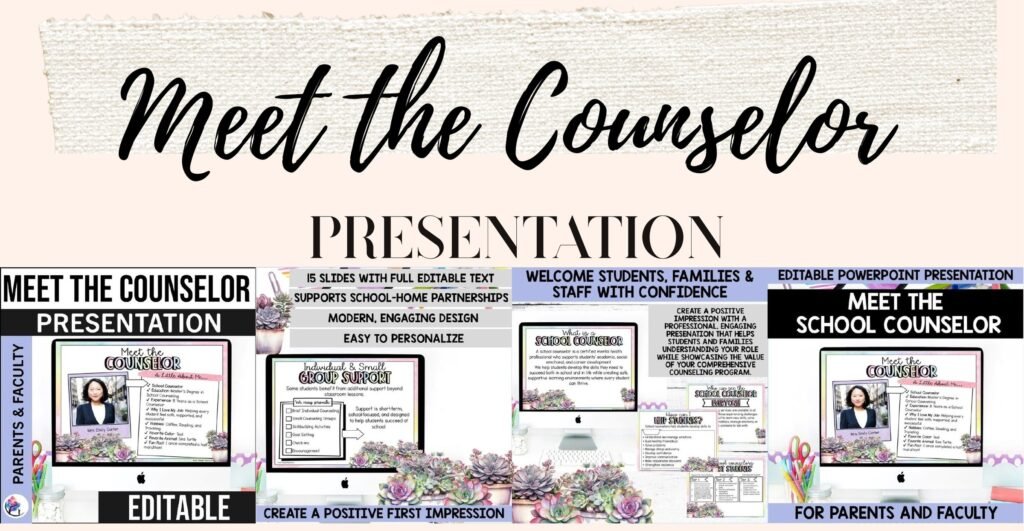
From our counseling room to yours: our Meet the School Counselor Presentation (Pastel) is an editable PowerPoint for Back to School Night, Open House, faculty meetings or parent information sessions. Add your name, photo and contact details, adapt the wording to your program, and share it digitally with families who cannot attend. Prefer bolder colors? It also comes in a Bright design. One counselor used it with parents and faculty at the start of the school year and found that “it answered so many common questions about what school counselors do, how students can access support, and when families can reach out.”
A Clear School Counselor Role Helps Build Trust
When parents and staff understand the school counselor role, they know when and how to reach out. Teachers know they can consult. Parents know there is someone at school they can contact when they are worried about their child. Students begin to see counseling as one of the ordinary supports available within their school.
We cannot predict which student or family will need us later in the year, but we can make sure they already know who we are before that day arrives. Sometimes it begins with something simple: “Hi, I’m your school counselor. Here’s how I can help.”
Frequently Asked Questions
What is the role of a school counselor?
According to ASCA, school counselors deliver a comprehensive, preventive and developmental program that supports students’ academic, career and social/emotional development. This includes direct services such as counseling and classroom instruction, and indirect services such as consultation, collaboration and referrals.
Do school counselors provide therapy?
School counselors provide short-term counseling and crisis intervention within the school setting. ASCA notes that long-term therapeutic counseling is not their role; when a student needs ongoing support, counselors help families connect with school and community providers.
What is the recommended school counselor to student ratio?
ASCA recommends a ratio of 250 students to one school counselor. Actual ratios vary widely by state, district and grade level.
Will the school counselor tell parents what my child shares?
Counselors aim to protect students’ privacy while respecting parents’ rights. Confidentiality has limits, particularly when there is a risk of serious and foreseeable harm. Policies vary, so ask your school counselor how this works in your school.
References
- ASCA: The School Counselor and School Counseling Programs
- ASCA: School Counselor Roles and Ratios
- ASCA: Appropriate and Inappropriate Activities for School Counselors
- ASCA: The School Counselor and School-Family-Community Partnerships
- ASCA: The School Counselor and Student Mental Health
- ASCA: The School Counselor and Confidentiality
- SAMHSA (2014): Concept of Trauma and Guidance for a Trauma-Informed Approach
Looking for practical, ready-to-use resources to support your work with families and staff? The All Therapy Resources Membership provides access to a growing collection of thoughtfully developed counseling activities, interactive games, and therapeutic tools designed to save preparation time while supporting meaningful, skill-focused learning.