At the beginning of the school year, school counselors are often looking for Meet the School Counselor activities that introduce their role, explain how students can access support, and help children feel comfortable approaching them.
Those lessons are genuinely valuable, particularly for students who are new to the school or have never worked with a school counselor before. But we found ourselves thinking about another group of students: the ones who already knew us.
They already knew where the counselor’s office was. They knew that counselors could help with worries, friendships, big feelings, problems at school, challenges at home, and all sorts of other things that might be happening in their lives.
They didn’t really need another presentation explaining what a school counselor does. What we wanted was a fun way to reconnect, build rapport, and start the new school year with conversation and connection.
That question led us to a different kind of beginning-of-year activity: a This or That assumptions game.
Sometimes the Goal Isn’t Introduction, It’s Reconnection
There is an important difference between students knowing what a school counselor does and actually feeling comfortable talking to their school counselor.
A student may be able to explain the counselor’s role perfectly and still hesitate to approach them when something is wrong. Knowing that support exists doesn’t automatically mean a child feels comfortable accessing it.
That’s why we wanted our beginning-of-year activity to feel different. Rather than standing at the front of the room and telling students about ourselves, we turned it around and asked them to make some assumptions about us.
Do you think your counselor is a morning person or a night owl? Do they prefer sweet or salty snacks? Were they quiet or talkative as a child? Do they have a hidden talent? Have they ever been sent to the principal’s office?
Suddenly, students weren’t listening to another introduction. They were curious. They were guessing. They were laughing. And, most importantly, they were talking to us.
The Game Is Really a Conversation Starter
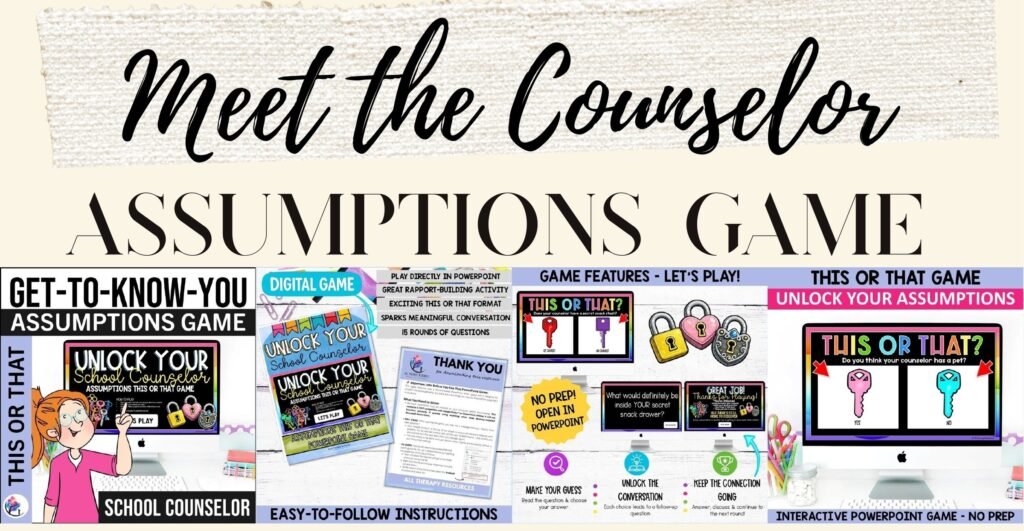
The premise of an assumptions game is simple. Students see a fun This or That question about their school counselor and choose which answer they think is correct.
They then “unlock” the answer and discover whether their assumption was right.
But getting the answer right isn’t really the point.
Each choice leads into a follow-up conversation prompt that brings the discussion back to the students. While they’re learning something appropriate and lighthearted about their counselor, we’re also learning about them.
A question about whether the counselor prefers one thing or another might turn into students sharing their own preferences, experiences, interests, similarities, and differences.
That is where a simple guessing game becomes something much more useful. It provides a structure for natural counselor-student conversations without making students feel as though they’re being interviewed.
Try this at the start of the year: our Unlock Your School Counselor: This or That Assumptions Game is ready to use as an editable PowerPoint. Students guess, “unlock” the answer, and then a follow-up prompt turns the conversation back to them. Add your own answers, and it is ready for your first classroom visit.
Why We Loved Using It at the Beginning of the Year
The beginning of the school year can involve a lot of information for students. They are learning new routines, classroom expectations, schedules, procedures, rules, names, and responsibilities.
Sometimes they simply don’t need another adult giving them another list of things to remember.
We wanted students to have an experience with their counselor that was positive, playful, and low pressure.
The game gave us opportunities to laugh with students, be surprised by their guesses, tell an appropriate little story about ourselves, and then ask them about their own experiences.
Choose any self-disclosure deliberately: keep it brief, light and appropriate for school, and always bring the focus back to the students.
Those moments might seem small, but rapport is often built through exactly these kinds of interactions. A child experiences an adult as interested, approachable, predictable, and enjoyable to talk to.
For students who already understood the counselor’s role, this gave us a reason to reconnect without unnecessarily reteaching information they already knew.
Building Rapport Before Students Actually Need Support
One of the biggest reasons we value beginning-of-year rapport-building activities is that we don’t necessarily want a student’s first meaningful interaction with a counselor to happen when they are already distressed.
If students only associate the counselor with moments when something has gone wrong, walking through the counselor’s door can feel like a very big step.
But imagine that same student has already played a game with the counselor. They’ve laughed together, shared an opinion, discovered something they have in common, and experienced that adult as someone who listens to them.
The student may not have learned anything new about the technical role of a counselor, but they have learned something potentially just as valuable: “I feel comfortable talking to this person.”
When a friendship problem, family concern, worry, mistake, or difficult day eventually happens, that existing connection can matter.
The Follow-Up Conversations Are the Best Part
Although students love trying to work out the correct answers, the follow-up questions are where we really get to know them.
We might discover which students love animals, who prefers drawing to sport, who has an unusual hobby, who loves telling stories, or which students have unexpectedly similar interests.
We also begin noticing how students interact.
Some students will confidently answer every question. Others may watch for a while before joining in. Some will discover something in common with another student and suddenly become much more engaged.
We’re not formally assessing students through the game. We’re simply creating opportunities to notice, listen, and connect.
At the beginning of a school year, those little pieces of information can be incredibly useful.
A Fun Option for Students Who Already Know the Counselor’s Role
We certainly wouldn’t replace a Meet the School Counselor lesson when students genuinely need to understand the counselor’s role, confidentiality, available supports, or how to access counseling services.
There is absolutely a place for those lessons.
But if you’ve been working at the same school for several years, you may find yourself walking into a classroom where students could practically deliver your Meet the Counselor presentation for you.
That’s where this type of activity can be particularly useful.
Instead of repeating, “A school counselor can help you with…”, we can spend that valuable time strengthening the relationship that may make students more comfortable using those supports in the first place. Research on student help-seeking suggests students are more willing to ask adults for help when they have a good relationship with them.
It also works well if you’re a new counselor at an established school. Students may already understand what school counselors do, but they don’t know you yet. The game gives them an interactive way to do that.
We Don’t Rush Through the Questions
When we use a rapport-building game like this, the goal isn’t to get through every question as quickly as possible.
If a particular question gets students talking, we let them talk.
You can ask students to vote before revealing your answer, invite them to explain why they chose something, have them move to different sides of the room for their choice (or offer a private vote, such as mini whiteboards, so hesitant students are not put on the spot), or even keep score if your group enjoys a little friendly competition.
When the follow-up question appears, give the conversation some space.
The PowerPoint game provides the structure, but the conversations happening around the game are where the relationship-building occurs.
This also makes it flexible enough to use with different groups. A whole classroom might have a lively discussion, while an individual student or small group may spend much longer talking about one particular question.
Question ideas to get you started: keep your answers light and school-appropriate, and let the follow-up prompt do the real work.
| # | This or That question about you | Follow-up prompt for students |
|---|---|---|
| 1 | Morning person or night owl? | When do you feel most awake and ready to learn? |
| 2 | Sweet or salty snacks? | What is your go-to snack after a long day? |
| 3 | Quiet or talkative as a kid? | Which word describes you at school, and is it different at home? |
| 4 | Dogs or cats? | Tell us about a pet you have or would love to have. |
| 5 | Beach or mountains? | Where is your favorite place to relax? |
| 6 | Planner or go-with-the-flow? | What helps you when your plans change? |
Want more ready-made prompts? Try our Conversation Starters Card Game or our Back to School Getting to Know You Activities.
It’s Not Just for School Counselors
Once we started thinking about why the activity worked, we realized there was nothing uniquely “school counselor” about the underlying concept.
At the heart of the activity is reciprocal, low-pressure relationship building.
A teacher may have a classroom full of students who know exactly what a teacher does but don’t know anything about their new teacher yet.
A speech therapist may be meeting students who already understand speech therapy but need time to become comfortable with the person they’ll be working with.
An occupational therapist may want to begin a new therapeutic relationship without the first session feeling like an endless stream of adult-led questions.
The same format works for any helping professional who wants the first meeting to feel like a conversation rather than an interview.
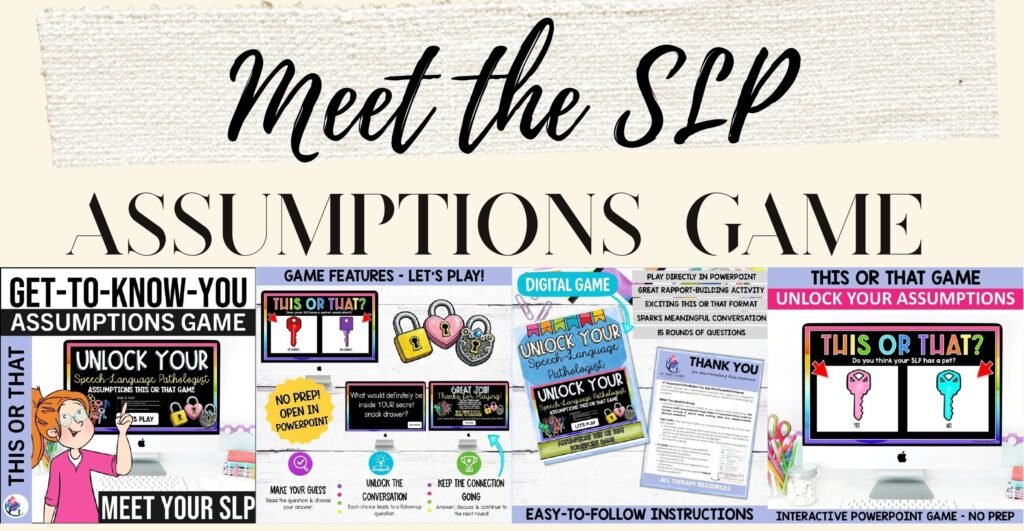
For speech-language pathologists: our Meet the SLP: Get to Know You Assumptions Game uses the same guess, reveal and discuss format for speech and language therapy, and there are versions for teachers, occupational therapists and school counselors too. One school shared, “Our staff loved the concept and it’s such a clever way to introduce the SLP role while challenging some of the assumptions students may have.”
Why This Format Can Work Particularly Well in Therapy
When we first meet a child in a therapeutic setting, we naturally have questions.
We want to learn about their interests, strengths, preferences, experiences, challenges, goals, and what they might need from us.
But from the child’s perspective, answering question after question from an unfamiliar adult can sometimes feel more like an interview than the beginning of a relationship.
A reciprocal get-to-know-you activity changes the dynamic.
Instead of the adult doing all the asking, the child gets to be curious too. They get to guess. They get to discover something about the adult. Then the conversation naturally turns back to them.
“You thought I’d choose that one! Why?”
“Okay, you got me completely wrong! What would you choose?”
The interaction becomes more conversational and less clinical, while still maintaining appropriate professional boundaries.
For some students, that can be a much easier way to begin building trust.
There Is No Pressure to Get It Right
There is another reason we like the assumptions format: students are expected to get some answers wrong.
They’re guessing!
That creates a naturally low-stakes activity where making a mistake can actually be funny.
For students who are reluctant to participate because they worry about being wrong, this can be refreshing. There isn’t a correct academic answer they should already know. Nobody is being tested.
Students simply make a prediction, discover the answer, and keep going.
The goal isn’t accuracy. The goal is participation and connection.
From “Meet the Counselor” to “Get to Know Your Counselor”
There will always be students who need explicit teaching about what a school counselor does, and we should absolutely provide that.
But sometimes our beginning-of-year goal can be different.
Students already know our job, the support school counselors provide and where to find us.
Now we want them to know that we’re approachable.
We want them to have a positive interaction with us before something difficult happens. We want to learn a little more about them. We want students to laugh, participate, share, and begin the year remembering that the counselor’s office isn’t only somewhere you go when things are going badly.
An assumptions game is a fun way to do exactly that.
Because ultimately, the questions about favorite snacks, hidden talents, morning routines, and childhood personalities aren’t really the important part.
They’re simply the doorway into something much more valuable:
connection.
Frequently Asked Questions
What is a good meet the school counselor activity?
For students who are new to you, explain your role, confidentiality and how to access support. For students who already know your role, a rapport-building game such as a This or That assumptions game can be more engaging.
How do you build rapport with students at the start of the year?
Create low-pressure, playful interactions where students can laugh, share opinions and discover things in common with you, before they ever need support.
Is it okay for school counselors to share personal information with students?
Light, appropriate details such as favorite snacks or hobbies can help build connection. Keep disclosures brief and deliberate, and always bring the focus back to the students.
Can this activity work for teachers, SLPs and OTs?
Yes. The guess, reveal and discuss format works for any professional who wants the first meeting to feel like a conversation rather than an interview.
Looking for practical, ready-to-use resources to support your back-to-school counseling and rapport-building? The All Therapy Resources Membership provides access to a growing collection of thoughtfully developed counseling activities, interactive games, and therapeutic tools designed to save preparation time while supporting meaningful, skill-focused learning.