Advanced phonics activities help students through the point where reading and spelling suddenly become more complicated. A student may know single letter sounds well, and then come digraphs, vowel teams, silent letters, R-controlled vowels and all the other patterns that make English spelling such an interesting system to learn.
This is often when students need more than another spelling list to memorize. They need chances to see patterns, hear them, say them, compare them and use them again in real words. For speech-language pathologists, special education teachers and literacy interventionists, the gap between “I know this when you show me” and “I can use this when I read and spell” is where thoughtful practice makes the biggest difference.
Why Advanced Phonics Activities Matter for Spelling
Early phonics gives students a vital foundation. They begin connecting letters with sounds and learn that written words are not strings of symbols to memorize. As reading develops, those relationships become more complex. Students meet letter combinations that represent single sounds, different spellings for the same sound, and familiar letters behaving differently depending on the word.
Think about how much a student eventually needs to understand beyond single letters: digraphs such as sh, ch and th, trigraphs, vowel teams, R-controlled vowels, diphthongs, silent-letter patterns and suffixes. If you are teaching the first of these, our guide to teaching digraphs in engaging ways covers games and activities for that stage.
Reading research helps explain why this matters for spelling. Linnea Ehri describes orthographic mapping as the process of connecting a word’s letters to its sounds so that its spelling, pronunciation and meaning are stored together in memory. That process depends on phonemic awareness and grapheme-phoneme knowledge. In practical terms, students remember the spelling of a word more easily when they can link each letter or letter group to a sound they hear in it, rather than trying to memorize the word as a visual shape.
This is also the thinking behind Structured Literacy, which the International Dyslexia Association describes as a comprehensive, integrated approach to reading and writing instruction: explicit, systematic, responsive to student data, and with enough practice for skills to become fluent. The activities below are practice ideas that fit inside that kind of instruction. They are not a replacement for a planned scope and sequence.
When Knowing the Sound Is Not Quite Enough
Have you ever practiced a pattern with a student, felt confident they had it, and then found it had disappeared by the next session? Learning is rarely a neat journey from “doesn’t know” to “knows forever.” A student might recognize sh immediately on a card but hesitate when they meet it in an unfamiliar word. Another might read a vowel team correctly but struggle to recall the same pattern when spelling.
That does not necessarily mean they have forgotten. It often means the skill is not automatic yet. Recall for spelling is harder than recognition for reading, because the student has to produce the pattern without a visual prompt.
Research on retrieval practice is helpful here. A systematic review of 50 classroom experiments (Agarwal, Nunes and Blunt, 2021) found that bringing information to mind through low-stakes quizzing consistently benefited learning in real classrooms. For phonics, that means asking students to produce sounds and spellings themselves, briefly and often, not only re-reading or re-showing the pattern.
Picture a student who reads “boat” correctly but writes “bote.” A helpful response is not “You know this.” Try: “Say boat slowly. How many sounds do you hear? Which sound is tricky? Which spelling of the long o sound do we use in this word?” The student retrieves the pattern rather than being handed it.
Advanced Phonics Activities Should Connect Sounds and Patterns
One of the most helpful shifts is moving away from treating every spelling word as a separate piece of information. Instead, help students notice what words have in common. If you are exploring a vowel team, collect words containing that pattern, read them together and ask, “What do you notice?”
You can also compare patterns. Which words sound alike but are spelled differently, and which letter combinations keep appearing? This turns spelling into something students investigate rather than memorize. English has plenty of exceptions, but it also has many patterns students can learn to recognize and use, and even irregular words usually have only one or two “tricky” parts.
7 Advanced Phonics Activities to Try
You do not need an elaborate literacy lesson every time you practice phonics. Most of these advanced phonics activities take five to ten minutes and work in speech therapy sessions, small-group intervention, resource rooms and tutoring.
| # | Activity | What it practices | Quick prompt |
|---|---|---|---|
| 1 | Sound Hunt | Spotting a pattern in real text | “Find three words with igh.” |
| 2 | Pattern Sort | Comparing spelling patterns | “What do these words have in common?” |
| 3 | Movement Cue | Engagement and a consistent recall cue | “Show me the move, then say the sound.” |
| 4 | Find the Tricky Part | Attention to the hard-to-spell part | “Which part would be easiest to forget?” |
| 5 | Word Building | Applying a pattern across words | “Change one sound. What’s the new word?” |
| 6 | Same Sound, Different Spelling | Choosing between spelling options | “Which spelling of /f/ fits phone?” |
| 7 | Quick Retrieval Challenge | Recalling sounds and spellings | “I say the sound, you write a spelling.” |
Want more ready-made practice? Browse our Phonics & Early Reading Skills collection, including the SH Digraphs Game for targeted digraph practice.
1. Go on a Sound Hunt
Choose a sound or spelling pattern and ask the student to find examples in a decodable passage, a book, a worksheet or a classroom display. When they find a word, read it together and identify where the target pattern appears. Keep a running list and see how many examples you collect.
This helps students recognize the pattern outside a flashcard or spelling list. For SLPs, it also gives a natural way to combine sound production with reading: the student says the word aloud as they add it to the list.
2. Sort Words by Their Patterns
Give students a set of words and ask how they could be grouped. Depending on your target, they might sort by vowel team, ending pattern or another spelling feature. Asking “What do you notice?” before stating the rule gives students the chance to spot the connection themselves.
Follow the discovery with a clear, explicit statement of the pattern. Discovery keeps students engaged, and explicit teaching makes sure everyone leaves with the same accurate rule.
3. Add a Movement Cue
A simple movement can make repetitive practice feel more active and give you a consistent cue to use when you return to a pattern. Show the pattern, say the sound and pair it with the same movement each time.
It is worth being precise about what movement does and does not do. A meta-analysis of Orton-Gillingham interventions (Stevens et al., 2021) noted that current research does not show the simultaneous use of several senses improves reading outcomes on its own. So treat movement cues as a way to support attention and engagement, while the core learning remains the connection between sounds, letters and spelling patterns. For more on this, see our post on movement-based speech and phonics activities.
4. Find the Tricky Part
Write a word and ask the student which part would be easiest to forget when spelling it. Circle, underline or highlight that section. This helps students stop seeing the whole word as equally difficult and focus attention on the part that needs more thought.
Then compare the word with others containing the same feature. In “night,” for example, the student can hear /n/ and /t/ clearly, so the tricky part is the igh spelling of the long i sound. Linking it to “light,” “fight” and “high” builds pattern knowledge instead of word-by-word memorization.
5. Build Words With the Pattern
Start with one spelling pattern and build as many words around it as you can, using letter tiles, cards or a whiteboard. Ask students to change one sound at a time: “Make coat. Now change /k/ to /b/. Now change /t/ to /st/.” Each change asks the student to listen for sounds and map them to letters, which is the skill spelling depends on.
With older students, extend this to suffixes, for example “hop, hopped, hoping, hopping,” and discuss how adding a suffix can change the spelling of the base word.
6. Play “Same Sound, Different Spelling”
Choose a sound that can be spelled more than one way, such as /f/ (f, ff, ph) or long a (a-e, ai, ay), and collect examples together. Ask students to sort the words by spelling pattern, then look for clues about when each spelling tends to appear (for example, ay often comes at the end of a word, ai in the middle).
This teaches an important part of advanced phonics: one sound does not always have only one spelling. Rather than pretending English is perfectly predictable, we help students become curious about the patterns they meet.
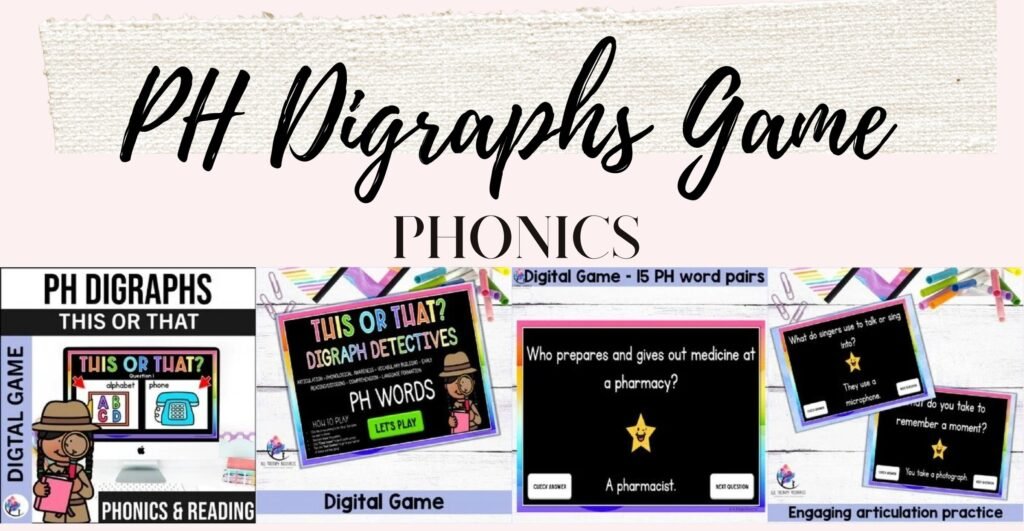
Try this in your next session: for a focused “same sound, different spelling” round, our PH Digraphs Game is a digital “This or That?” game with 15 pairs of PH words and simple questions, so students hear, say and read the PH spelling of /f/ in real vocabulary. It suits speech therapy, SPED classrooms and reading intervention groups, and works well before a sort of f, ff and ph words. One educator who used it during literacy groups wrote that “students absolutely loved it. The interactive format kept even reluctant learners engaged.”
7. Try Quick Retrieval Challenges
Once a student has practiced several patterns, mix them up. Show one at a time and ask for the sound, or say the sound and ask the student to write a spelling that can represent it. Keep it brisk, two or three minutes, and give immediate feedback so errors are corrected rather than practiced.
Keep these challenges encouraging rather than high-pressure. The goal is to move students from “I know it when you show me” toward “I can bring it to mind when I need it.”
Advanced Phonics Activities for Struggling Readers
Students who find reading or spelling difficult are often acutely aware of it. By the time they reach more advanced patterns, some have spent years watching peers seem to read and spell with less effort. That emotional experience matters. A student who hesitates may need processing time, a prompt or a different way to approach the pattern, not “Come on, you know this.”
Keep activities short and achievable. Instead of presenting many patterns at once, focus on a small number, build accuracy, then add more. A useful script is: “Let’s check the sounds together. Tap them out with me. Which part are you unsure about?” This keeps the student problem-solving instead of guessing.
Students who continue to have significant reading or spelling difficulties may need assessment and targeted intervention. ASHA notes that speech-language pathologists play a direct role in literacy, including the assessment and treatment of written language disorders such as dyslexia, so collaboration between SLPs, special educators and classroom teachers is often the most effective route.
Phonics Practice Should Not Feel Like a Test Every Time
If every interaction with phonics feels like an assessment, some students focus more on avoiding the wrong answer than on experimenting with language. Practice can stay structured without feeling like a test. Say the sounds together, take turns finding words, or deliberately make a silly mistake and see whether the student catches you: “I’m going to spell rain as r-a-y-n. Did I get it right?”
Students are learning something complex, and errors give us useful information about what needs more practice. A quick note of which patterns a student misses also helps you plan the next session.
Moving From Basic Sounds to Advanced Phonics Patterns
Once students have a secure foundation with basic letter-sound relationships, introduce more complex patterns gradually: digraphs and trigraphs, long and short vowels, vowel teams, R-controlled vowels, diphthongs, hard and soft sounds, silent-letter patterns, suffixes and advanced spelling patterns. There is no prize for racing through them. A student who confidently uses a smaller number of patterns is in a stronger position than one who has briefly met dozens without enough practice to remember them.
Repetition does not have to mean the same worksheet again. Use the same pattern in different ways: read it, say it, find it, sort it, write it and look for it in connected text. For SLPs, R-controlled vowels are a good example of where speech and spelling goals overlap, since many students working on vocalic /r/ also find ar, or, er, ir and ur hard to spell.
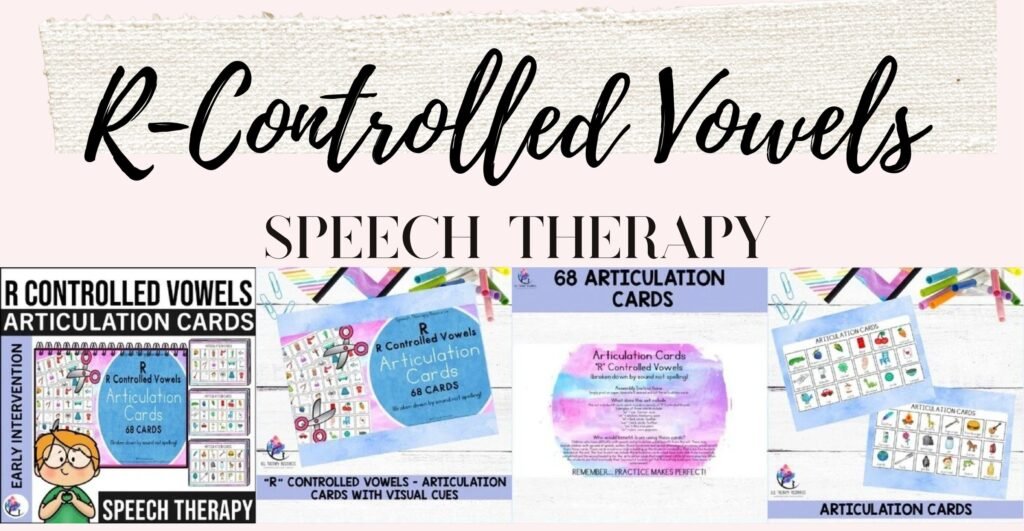
Try this in your speech room: if you are combining articulation and spelling goals, our R-Controlled Vowels Articulation Cards with Visual Cues give students a clear picture and word for each target, so you can practice saying the word, then ask which spelling of the vowel it uses and sort the cards by pattern. They suit elementary students in speech therapy or small-group intervention. One reviewer described them as “Quick and easy to prep.”
Using Phonics and Spelling Cards in Sessions
Cards are one of the most flexible tools for advanced phonics practice, because you can pull out only the patterns a particular student is working on rather than using a whole set at once. That makes it easier to meet each student where they are and build from there.
A simple five-minute routine might look like this: review three known cards quickly, introduce one new pattern explicitly, read and spell three words containing it, then finish with a mixed retrieval round. Most importantly, cards are meant to be used with a student. Show the pattern, talk about it, find it in words and practice using it, so that something that once took enormous concentration starts to come automatically.
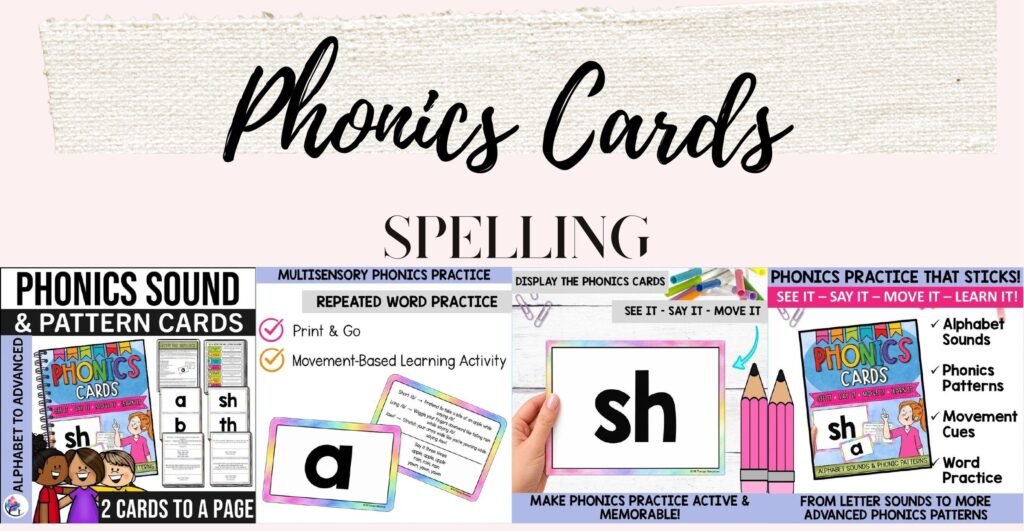
Try this in your next session: our Advanced Phonics & Spelling Cards cover A–Z sounds, short and long vowels, hard and soft sounds, digraphs, trigraphs, vowel teams, R-controlled vowels, diphthongs, silent-letter patterns, suffixes and advanced spelling patterns. Each double-sided card shows the pattern on the front, with the sound, a movement cue and practice words on the back, so they fit the five-minute routine above for intervention groups, speech sessions or tutoring. One reviewer shared that they “cover more advanced sound patterns that my students really needed extra practice with,” and that they have used them “for quick review, small groups and individual support.”
Frequently Asked Questions
What are advanced phonics skills?
Advanced phonics skills go beyond single letter-sound correspondences. They include digraphs, trigraphs, vowel teams, R-controlled vowels, diphthongs, silent-letter patterns, alternative spellings for the same sound and common suffixes.
What is orthographic mapping, and why does it matter for spelling?
Orthographic mapping is the process of linking a word’s letters to its sounds so the spelling is stored in memory along with its pronunciation and meaning. It depends on phonemic awareness and letter-sound knowledge, which is why activities that ask students to listen for sounds and connect them to spellings support spelling memory.
Are multisensory phonics activities evidence-based?
Explicit, systematic phonics instruction has strong research support. The specific benefit of adding several senses at once is less clear: a 2021 meta-analysis found current research does not show it improves reading outcomes on its own. Movement and visual cues can still be useful for engagement, alongside clear instruction.
How can SLPs support phonics and spelling?
SLPs bring expertise in phonological awareness and speech sound production, which underpin reading and spelling. ASHA describes SLPs as having a direct role in literacy, and many combine articulation targets with matching spelling patterns or collaborate with special educators on intervention.
References
- Ehri, L. C. (2014). Orthographic mapping in the acquisition of sight word reading, spelling memory, and vocabulary learning. Scientific Studies of Reading, 18(1), 5–21.
- International Dyslexia Association: Structured Literacy fact sheet
- Agarwal, P. K., Nunes, L. D., & Blunt, J. R. (2021). Retrieval practice consistently benefits student learning: A systematic review of applied research in schools and classrooms. Educational Psychology Review.
- Stevens, E. A., et al. (2021). Current state of the evidence: Examining the effects of Orton-Gillingham reading interventions for students with or at risk for word-level reading disabilities. Exceptional Children, 87(4), 397–417.
- ASHA Practice Portal: Written Language Disorders
Looking for practical, ready-to-use resources to support your phonics and spelling instruction? The All Therapy Resources Membership provides access to a growing collection of thoughtfully developed phonics, speech and literacy activities, interactive games, and therapeutic tools designed to save preparation time while supporting meaningful, skill-focused learning.