How do we make sound and word practice feel like play rather than work? Anyone who has supported a child who struggles to decode simple words, or to say them clearly, knows the tension between repetition and engagement. Children need consistent, targeted practice in phonological awareness, articulation and decoding, but that practice also has to hold their attention. CVC words in speech therapy offer a practical meeting point: short enough to practice many times in a session, and structured enough to link speech sounds to letters.
Below, we look at why short vowel CVC words and digraphs are such useful targets for SLPs and early literacy teams, what the research does and does not tell us, and how interactive “This or That” games can turn word-level practice into real communication.
Why CVC Words Matter in Speech Therapy and Early Reading
CVC words (consonant, vowel, consonant) such as cat, bed, pig, top and cup are the backbone of early decoding and blending instruction. Their predictable structure helps children connect each sound to a letter. For students working on articulation, a CVC word is also a manageable unit: one target sound, one short vowel, one final consonant, all at the word level.
This overlap between speech and literacy is not a coincidence. The National Reading Panel identified explicit instruction in phonemic awareness and systematic phonics as key elements of effective early reading instruction. At the same time, a study of children with speech sound disorder found elevated rates of reading disability compared with peers, with the risk strongest when a language impairment was also present (Peterson et al., 2009). The same study found that many children with speech sound disorder developed literacy in the average range, so this is a reason to watch closely, not a prediction for any one child.
For SLPs, the practical takeaway is that word-level speech work and early phonics can support each other. When a child hears, says, reads and explains a CVC word in the same activity, we are giving several systems a chance to practice together.
Where Digraphs Fit
Digraphs are two letters that represent one sound, such as sh, ch, th, wh and ph. They are more abstract than CVC words because the letter-to-sound match is no longer one to one. Some, like kn and wr, include a silent letter. Qu is often taught alongside digraphs, although it usually represents two sounds (/kw/), which is worth pointing out to students who notice the difference.
Digraphs often overlap with articulation goals too. In a large review of US consonant acquisition, Crowe and McLeod (2020) reported that most children had acquired /sh/ and /ch/ by about age 5, while the voiceless /th/ (as in thin) was among the last consonants acquired, by about age 7. That means a kindergartner who is still learning to read ship and chip may also still be learning to say them clearly. For more ideas on this skill, see our guide to teaching digraphs in engaging ways.
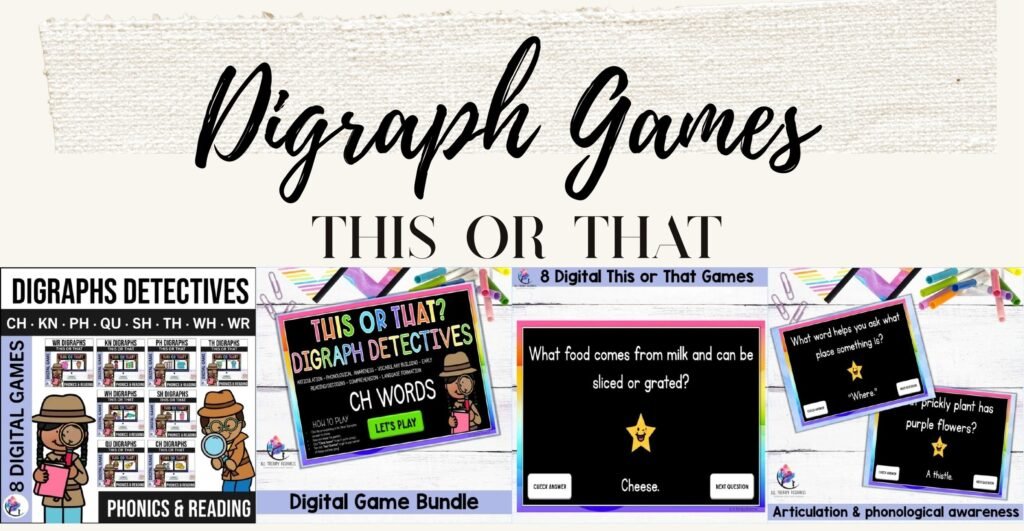
Try this in your next session: The Digraphs Digital Games Bundle includes eight “This or That” PowerPoint games, one each for CH, KN, PH, QU, SH, TH, WH and WR. Each slide shows two words that look or sound similar, and the student decodes both, listens for the target sound and explains which one fits. It suits K–2 speech therapy, intervention groups and literacy centers. Start with the digraph that matches the student’s articulation target (for example SH or CH), so the same session covers sound production, sound discrimination and decoding.
What Makes a “This or That” Game Useful in Sessions
Repetition matters, but repetition alone rarely holds attention. Practice tends to go further when it includes a little novelty, a real choice and a reason to talk. A “This or That” format does this simply: the student sees two options, makes a choice and explains it. SLPs will recognize the link to contrast work, because the student has to notice the difference between two similar words before choosing.
In a session, a well-designed game of this kind can be:
- Student-centered: the student chooses, explains their thinking and answers in full sentences, which adds expressive language practice to every turn.
- Low prep and flexible: usable one-on-one, in small groups or with a whole class on an interactive whiteboard.
- Multi-skill: articulation, phonological awareness, vocabulary, comprehension and sentence formulation can all be targeted in one activity.
Picture a second grader who mixes up /sh/ and /ch/ and has stopped responding to flashcards. In a two-choice game, the adult models “I chose ship because I hear /sh/ at the start,” and the student uses the same frame on the next turn. The choice gives the student a reason to listen carefully, and the sentence frame turns a single-word answer into language practice.
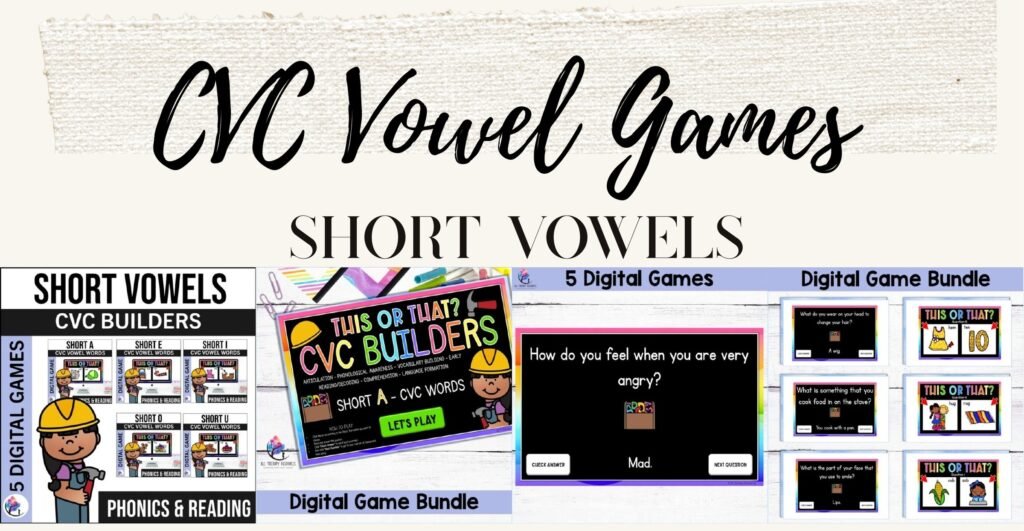
Try this in your next session: The Short Vowels CVC Digital Games Bundle includes five “This or That” PowerPoint games, one for each short vowel (a, e, i, o, u). Students compare two CVC words, identify the vowel sound and explain their choice in a complete sentence. It is designed for PreK–Grade 1, intervention groups and speech therapy. Use a single vowel game for focused practice, then mix two vowels (for example short a and short e) once the student is accurate, so they have to listen for the contrast. The games need the desktop version of PowerPoint (Windows or Mac).
Practical Tips for Using CVC and Digraph Games in Therapy or Class
- Use sentence frames. Invite full-sentence answers such as “I chose ___ because I hear the ___ sound.” This builds expressive language alongside phonics.
- Group by sound, then mix. Use a single vowel or digraph for concentrated practice, then mix sounds for review and generalization.
- Track growth simply. A short rubric with three areas (sound accuracy, decoding accuracy, quality of explanation) shows progress over several sessions.
- Add movement. Students walk to one side of the room for each answer option, which suits groups who need to move.
- Support multilingual learners. Pictures, spoken models and written words together give several cues at once. Keep in mind that some English vowel and digraph contrasts do not exist in every home language, so a “mistake” may reflect a language difference rather than a disorder.
The table below matches common session goals with a CVC or digraph activity.
| Session goal | What it looks like | Suggested ATR resource |
|---|---|---|
| Word-level articulation | Student names CVC pictures with a visual cue for the target sound | Articulation Cards: CV, VC, CVC, CVCV |
| Short vowel clarity | Student practices each short vowel in words, then in a short phrase | Short Vowel Sounds Articulation Cards |
| Sound discrimination | Student hears two similar words and picks the one with /sh/ | SH Digraphs Game |
| Sentence formulation | Student builds a sentence one word at a time from a CVC word | Pyramid Sentences Activities |
Games work best alongside structured drill, not instead of it. Many SLPs start a session with a quick round of picture cards to warm up the target sound, then move into a game where the same words appear in a more natural, choice-based exchange. Our posts on articulation cards with visual cues and why some students don’t generalize speech skills look at that balance in more detail.
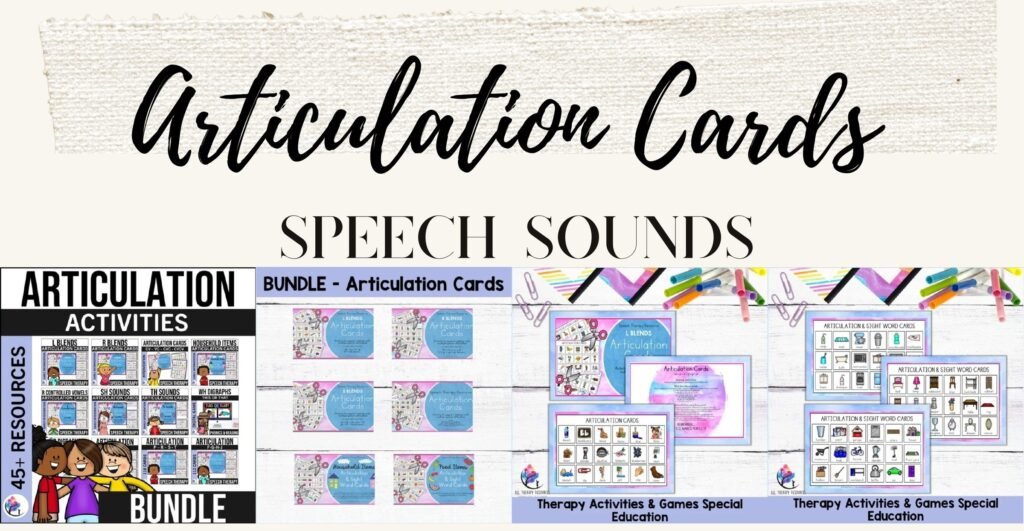
Try this in your next session: The Articulation Cards Bundle brings together visual articulation cards for CV, VC, CVC and CVCV words, short vowels, blends, final consonants and individual sounds such as SH, CH and TH, with games and handouts. It suits school-based SLPs working with younger students or anyone who benefits from picture-based cues. Use the CVC cards as a two-minute warm-up for the target sound, then move straight into a “This or That” game with the same sound so the student carries the clear production into a choice-and-explain task.
Frequently Asked Questions
Why use CVC words in speech therapy?
CVC words are short and predictable, so a student can produce a target sound many times in a session with little extra load. They also connect speech sounds to letters, which helps when a student’s speech goals overlap with early phonics and decoding.
Is a digraph the same as a blend?
No. In a digraph, two letters make one sound (sh in ship). In a consonant blend, each letter keeps its own sound and the sounds are said together (s and t in stop). Students often need to practice both, and the difference matters for both reading and articulation.
What age are CVC and digraph games best for?
CVC work usually fits preschool to first grade, and digraph work usually fits kindergarten to second grade. Older students in intervention or speech therapy can still benefit when these are their current targets, especially if the activity is presented in an age-respectful way.
Can I use PowerPoint phonics games in Google Slides?
Interactive PowerPoint games usually rely on features that do not carry over to Google Slides or PowerPoint Online. The ATR “This or That” games need the desktop version of Microsoft PowerPoint on Windows or Mac.
Looking for practical, ready-to-use resources to support your CVC and digraph speech therapy sessions? The All Therapy Resources Membership provides access to a growing collection of thoughtfully developed speech and language activities, interactive games, and therapeutic tools designed to save preparation time while supporting meaningful, skill-focused learning.