
Are your students feeling overwhelmed, anxious, or mentally blocked during tests, even when they have studied and know the content? Are you looking for a way to teach coping strategies that students will engage with, remember, and use when it counts?
Test anxiety shows up in struggling students and in high-achieving students who put enormous pressure on themselves. Teaching strategies is only half the challenge. The other half is getting students to buy in. Test anxiety games and other interactive activities can help with that, because they give students a low-pressure way to talk about worry and rehearse what to do. If you are looking for the bigger picture of how test anxiety develops and how to assess it, start with our guide to understanding test anxiety in students. This article focuses on the games themselves: why they help, how to run them, and how to adapt them for different ages.
Why Test Anxiety Needs More Than “Stay Calm”
Test anxiety is more than “nerves.” It usually involves a combination of:
- Cognitive overload (worried thoughts competing for attention)
- Emotional overwhelm (feeling panicked or frozen)
- Physical responses (racing heart, sweating, a stomach ache, shutting down)
Research on attentional control theory (Eysenck et al., 2007) suggests that anxiety makes it harder to keep attention on the task at hand, so thinking becomes less efficient. That is one reason a student who knew the material the night before can feel blank in the exam room.
So telling students to “stay calm” or “do your best” is rarely enough. They need:
- Language to understand what is happening in their brain and body
- Strategies they can practice ahead of time
- Opportunities to apply those strategies in realistic situations
Picture a fourth grader who says, “My brain just stops working on tests.” A simple explanation of the stress response, followed by one calming strategy practiced in a game round, gives that student something concrete to try the next time it happens.
Try this in your next session: before you teach any test strategies, help younger students understand what their brain does under stress. Our Flipping Your Lid Digital Game for Kids is a team-based PowerPoint game for elementary students that introduces the upstairs and downstairs brain, fight, flight and freeze, and calming tools in child-friendly language. Play a round, then ask, “What might your Guard Dog do during a test, and what helps it settle?” One reviewer shared, “My students loved the game format. It kept them engaged while reinforcing ideas about stress responses and calming strategies. Perfect for counseling groups.” A teen version is available for older students.

Why Test Anxiety Games Help Students Engage
Instead of passive listening, minimal participation, or students tuning out, a well-run game tends to bring hands up, students debating answers, and conversations about coping strategies. Games create a low-pressure, high-engagement environment where students can explore anxiety without feeling exposed or judged.
They allow students to:
- Learn through scenarios rather than lectures
- Practice thinking through challenges with support
- Hear different perspectives from peers
- Talk about a “character” or a scenario before talking about themselves
It helps to be clear about what the game is and is not. The game is a delivery format. The active ingredients are the strategies inside it. Brief cognitive-behavioral programs for test anxiety have reduced test anxiety in adolescent students (Putwain & von der Embse, 2020), and a recent meta-analysis of mindfulness interventions found a moderate reduction in test anxiety, although results varied widely between studies (Yılmazer et al., 2024). Research on games themselves is still emerging: a systematic review of serious games for anxiety and depression in young people found the studies too varied to compare effectiveness (Martinez et al., 2021). So we present test anxiety games as an engaging, evidence-informed way to teach and rehearse coping skills, not as a stand-alone treatment.
Scenario-Based Practice: Where the Learning Happens
One of the biggest strengths of interactive games is the scenario-based approach. Instead of abstract ideas, students work with:
- Realistic test situations
- Common anxious thoughts
- Practical decision-making moments
For example:
- “You forget an answer during a test. What could you do next?”
- “Your heart is racing and you feel stuck. Which strategy could help?”
- “You hear yourself think, ‘I’m going to fail.’ What is a more helpful thought?”
This helps students normalize their experiences, explore options safely, and build a mental toolbox of responses. It also aligns with CBT principles, where students learn to notice a thought, consider whether it is helpful, and practice a more balanced response.
A short script can keep the discussion focused: “Let’s hear two different ideas. Which one would you be most likely to use in a real test? What would it sound like in your head?” Inviting students to answer for a scenario character, rather than for themselves, keeps the activity emotionally safe and avoids pressuring anyone to disclose.
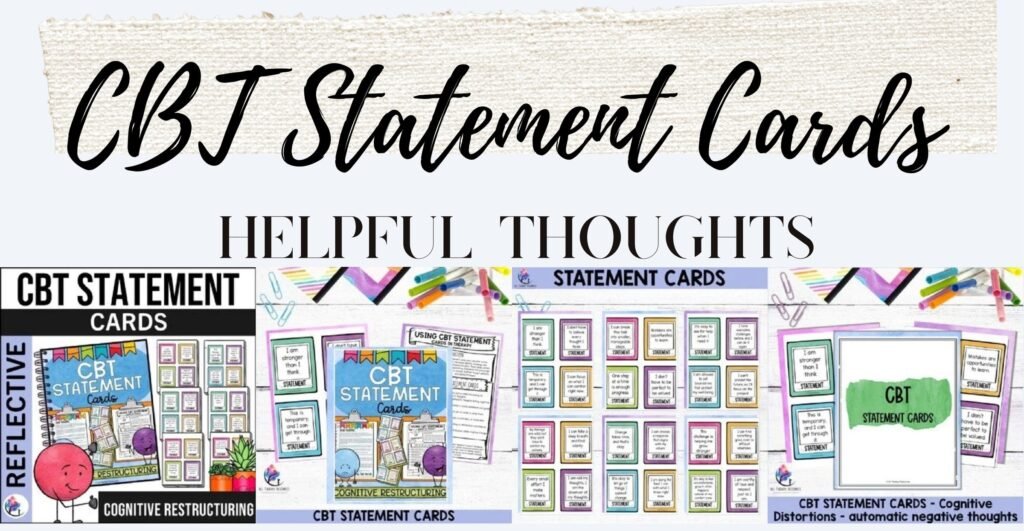
From our counseling room to yours: after a game round, older students often benefit from slowing down and working with individual thoughts. Our CBT Statement Cards give you ready-made thought statements to sort, discuss, and reframe as helpful or unhelpful, in individual or small group sessions. Pull out three test-related statements and ask, “What would a supportive friend say back to this thought?” One therapist described them as a “Great activity for tele-health counseling. Really helpful in exploring negative thoughts and practicing the skill of reframing the thoughts.”
Keep It Simple to Run
No matter how good a resource is, if it is complicated to use, it won’t get used. PowerPoint-based games are a practical option for busy school counselors and educators because there are no new platforms to learn. Most are click-and-go and work well in whole-class lessons, small groups, and individual counseling sessions.
A simple structure keeps a 20 to 30 minute session on track:
- Warm-up (3 minutes): a quick check-in, such as “Show me on your fingers how you feel about tests, from 1 to 5.”
- Game rounds (15 minutes): teams answer questions and scenarios, with a short discussion after each reveal.
- Practice (5 minutes): everyone rehearses one strategy together, such as slow breathing or a helpful self-talk phrase.
- Close (2 minutes): each student names one strategy they will try on their next test.
Adapting Test Anxiety Games for Different Ages
Test anxiety doesn’t look the same at every age.
Younger students might not yet have words for “anxiety” and can feel confused or frightened by physical sensations. Keep language concrete (“butterflies in your tummy,” “your brain’s alarm”), use visuals, and practice one strategy at a time.
Older students are more likely to experience performance pressure, negative self-talk, and worry about expectations, grades, or the future. They respond best to realistic scenarios, choices, and discussions that respect their growing independence.
Developmentally appropriate games let you meet students where they are, adjust language and complexity, and build skills progressively over time.
Try this with middle schoolers: test anxiety rarely sits on its own, so it helps when students can match coping skills to all kinds of stress. Our Choose the Coping Skill: Middle School Digital Game uses team play and scenario questions about academic stress, peer dynamics and strong emotions, so students compare helpful and unhelpful choices. Run it the week before a testing window and finish by asking each team which strategy they would use in the exam room. One reviewer wrote, “Middle school students can be tough to engage, but this worked beautifully. The game format kept them interested…” There are also elementary and high school versions.

Practical Ways to Use Test Anxiety Games
Here are some ways to build test anxiety games into your school year:
| Setting | When to use it | Focus | Suggested ATR resource |
|---|---|---|---|
| Whole-class SEL lesson | A few weeks before an assessment period | Normalize test anxiety and build shared language | Beat the Test Stress Digital Game |
| Small group counseling | Ongoing, for students who need extra support | Practice strategies in a safe, smaller setting | Beat the Test Stress Game (Grades 1–3) |
| High school advisory or group | Before finals or high-stakes exams | Self-talk, performance pressure and test-taking strategies | Beat the Test Stress Digital Game (Grades 9–12) |
| Booster session | During the testing window | A quick reminder of each student’s go-to strategy | Test Anxiety Counseling Brochure for Kids |
| Family partnership | Alongside classroom or group work | Help caregivers use the same language at home | Test Anxiety Coffee with the Counselor Parent Handout |
Want more? Browse our full test anxiety resources or the wider collection of digital counseling games.
What Realistic Progress Looks Like
The goal is not to remove anxiety completely. Some nervousness before a test is normal. The goal is to help students manage it. When students understand their anxiety, have strategies they have practiced, and know what to do when they feel stuck, many feel more confident walking into a test.
Keep a trauma-informed lens throughout: offer choices about participation, avoid putting individual students on the spot, and remember that worry about tests may be linked to pressures outside school. If a student’s anxiety is intense, persistent, or affecting daily life beyond testing, games are a starting point, not the whole plan. Consider individual counseling, consultation with families, a referral for further support, or a conversation about appropriate testing accommodations. For more ideas on supporting anxious students more broadly, see our guides on how school counselors help with student anxiety and teen anxiety coping skills.
Frequently Asked Questions
What age group are test anxiety games suitable for?
Test anxiety games can be used from early elementary through high school, as long as the language, scenarios and strategies match the students’ developmental stage. Younger students need simple, concrete language and visuals, while teens benefit from realistic scenarios and more discussion.
Do I need special technology to use digital test anxiety games?
Most PowerPoint-based counseling games run on standard school computers and can be projected for a whole class or shared on screen in a small group or telehealth session, with no extra platforms or logins.
How long does a typical session take?
A game works well in a 20 to 30 minute small group session, or it can be extended into a full lesson with more discussion and strategy practice.
Can games reduce test anxiety on their own?
Games are best seen as an engaging way to teach and practice coping skills, not a stand-alone treatment. Cognitive-behavioral and mindfulness-based approaches have research support for reducing test anxiety, and research on games for anxiety is still emerging. Students with severe or persistent anxiety may need individual support or a referral.
References
- Eysenck, M. W., Derakshan, N., Santos, R., & Calvo, M. G. (2007). Anxiety and cognitive performance: Attentional control theory. Emotion, 7(2), 336–353.
- Putwain, D. W., & von der Embse, N. P. (2020). Cognitive-behavioral intervention for test anxiety in adolescent students: Do benefits extend to school-related wellbeing and clinical anxiety?
- Yılmazer, E., Hamamci, Z., & Türk, F. (2024). Effects of mindfulness on test anxiety: A meta-analysis. Frontiers in Psychology, 15, 1401467.
- Martinez, K., Menéndez-Menéndez, M. I., & Bustillo, A. (2021). Awareness, prevention, detection, and therapy applications for depression and anxiety in serious games for children and adolescents: Systematic review. JMIR Serious Games, 9(4), e30482.
Looking for practical, ready-to-use resources to support your test anxiety lessons and groups? The All Therapy Resources Membership provides access to a growing collection of thoughtfully developed counseling activities, interactive games, and therapeutic tools designed to save preparation time while supporting meaningful, skill-focused learning.