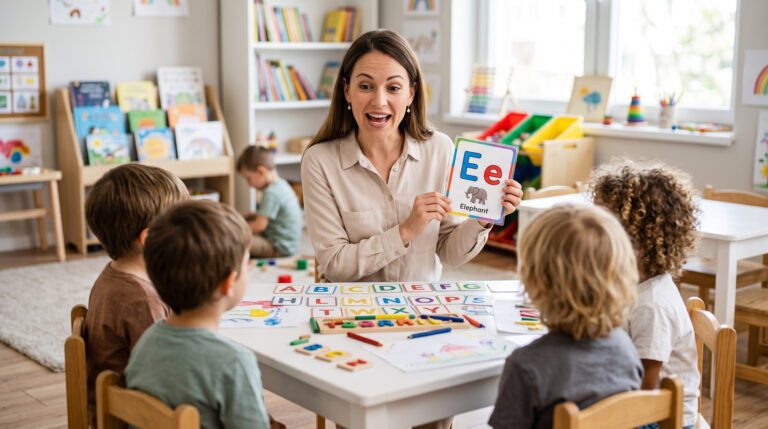
Children often communicate the most when they stop feeling tested. Picture a child who barely responds to direct questions but starts talking while building a block tower, or a student who avoids drill cards yet uses a target word several times during a game. Many SLPs see this every week, and it is one of the main reasons play-based speech therapy has such a strong place in pediatric practice.
Play is not a break from intervention. Well-planned play-based speech therapy activities give children a reason to communicate, many natural practice opportunities, and a setting that feels safe enough to try. Below, we look at what developmental science and intervention research support, where the popular “brain-based” claims go further than the evidence, and how to plan play so it stays purposeful.
Language Grows Through Connection and Regulation
Children do not learn language in isolation. They learn it in interaction. The Harvard Center on the Developing Child describes how responsive “serve and return” exchanges help build neural connections that support communication and social skills. When an adult notices a child’s sound, gesture or word and responds in a way that keeps the exchange going, that back-and-forth is part of how language develops.
Two well-known studies point in the same direction. In a study of 9-month-old infants, babies who heard Mandarin from a live speaker learned to tell apart Mandarin speech sounds, while babies who heard the same speakers on video or audio did not. In a 2018 MIT study of 4- to 6-year-olds, the number of conversational turns children experienced at home was more closely linked to their language scores and to activity in a language-related brain region than the number of words they heard. That study was correlational, so it does not prove that conversation causes these differences, but it fits what responsive-interaction research has found for decades: the exchange matters, not only the input.
Play is one of the easiest ways to create those exchanges in a session. A shared game, a pretend scene or a toy that needs help to work sets up turn after turn of real communication.
Why Play Gives Children a Reason to Communicate
In play, children communicate because they want something: a turn, a toy, help, information or shared fun. That motivation is what makes language purposeful rather than performed on request.
The American Academy of Pediatrics’ clinical report on play describes it as supporting language, social, emotional and cognitive skills, and as a key to executive function. For SLPs, the practical value is that play lets us build communication temptations into the activity itself.
Picture a child working on requesting. You set up a wind-up toy, let it run down, and wait with an expectant look. The child reaches. You model, “Go!” and pause. When the child says or signs “go,” the toy runs again. Ten minutes later, the child has requested many times, and every request was meaningful because it made something happen.
Try this in your next session: place a motivating item in a clear container the child cannot open, offer only a few pieces of a puzzle at a time, or “forget” a needed item such as the paintbrush. Wait at least five seconds before modeling. These small sabotage moments create natural reasons to request, comment or ask for help.
Stress, Regulation and Access to Language
Communication is not only a skill issue. A child’s state also affects what they can show us. Research on stress and the brain, much of it from animal and adult studies, shows that uncontrollable stress can rapidly weaken prefrontal cortex function, the system involved in working memory and flexible thinking. It is reasonable to expect that a child who feels anxious, rushed or overwhelmed will find it harder to retrieve words, plan a sentence or monitor a speech sound, though research directly linking stress to speech performance in therapy is limited.
This matters for many children on an SLP caseload, including children with developmental language disorder, speech sound disorders, autism, ADHD or trauma histories. When communication feels risky, we may see silence, avoidance, scripting, silliness or shutdown rather than a direct statement that the task feels too hard.
Play does not remove challenge, but it can lower the pressure around it. Picture a student who freezes when asked to say “/s/ in the initial position” but will happily say “sun,” “sock” and “soup” while feeding a puppet. The target is the same. The demand feels different. Our article on co-regulation and matching a child’s energy explores this side of the relationship in more depth.
Repetition Matters, and So Does Engagement
Speech and language skills need practice. Children often need many exposures to a word, sound or sentence structure before they use it independently, and principles of motor learning suggest that the amount and type of practice matter for speech production. A tutorial by Maas and colleagues reviews these principles, while noting that few studies have tested them directly in speech treatment.
Here is where play needs planning. Play can increase the number of practice opportunities, or it can quietly reduce them if most of the session is spent setting up, waiting for turns or chatting. A good rule of thumb is to decide before the session how many productions you are aiming for and choose a play format that keeps the child producing the target often.
Within a well-designed game, a child may say “my turn,” “go,” “help” or a target word dozens of times without the repetition feeling like a chore. That is the sweet spot: high practice density with enough fun that the child wants to keep going. Our guide to articulation activities for speech therapy shows how to match the game to the child’s current practice level, from single words to conversation.
From our speech room to yours: repetition feels less like drill when each turn adds something new. Our Pyramid Sentences Activities build a sentence one word at a time (“A cat,” “A cat sat,” “A cat sat on the mat”), so early elementary students repeat familiar words many times while working toward a complete sentence. In a session, turn each pyramid into a climb: the child reads or says each level to move a game piece up, then draws the finished sentence. It suits students working on sentence length, CVC words or speech sound practice in connected speech, and it includes bonus CVC reading games for a quick warm-up.

Multisensory Play: Helpful, With Realistic Expectations
Play-based activities naturally combine movement, visuals, sound, touch and social interaction. Many SLPs find that multisensory activities such as sound hunts, movement games, sensory bins and hands-on crafts help children stay engaged for longer and give them more than one way to remember a target.
It is worth being precise about the evidence here. Claims that multisensory activities “strengthen pathways” or “activate more of the brain” go further than current speech and language research supports. What we can say with more confidence is that attention and engagement make learning more likely, and that visual and movement cues can be useful supports for some children. Treat multisensory play as a way to support attention and memory for the target, not as a treatment in itself.
Picture a child practicing /f/. Instead of a stack of picture cards, you hide pictures around the room. Each time the child finds one, they “blow” it like a gentle wind as a reminder of the airflow, say the word, and add it to a basket. The movement and the visual cue support the target, and the hunt keeps them motivated.
Try this in your next session: our Phonics Sound and Pattern Cards pair each letter or spelling pattern with a simple movement cue and practice words, which makes them a good fit for early readers and students whose speech and literacy goals overlap. Use them for a quick warm-up, or turn them into a game where the child performs the movement, says the sound, and then names a word from the back of the card. One reviewer shared, “I’ve been able to use them for quick review, small groups and individual support.”

Speech Therapy Can Feel Emotional for Children
Many children carry quiet feelings about their communication. Some become the class clown to avoid being vulnerable. Some stop participating because getting it wrong feels painful. Some say as little as possible because talking is tiring. Some look oppositional when they are overwhelmed.
These responses can be misread as low motivation. A trauma-informed lens asks a different question: what might make communication feel unsafe for this child right now? Children need regular experiences of communication as successful, playful and connected, not only as something to be corrected.
In practice, that can mean following a correction with an easy win, praising effort as well as accuracy, letting the child choose the game, or building in a role where they are the expert who teaches the puppet. Pressure in therapy can also show up later as skills that do not carry over to the classroom, which we explore in why some students don’t generalize speech skills.
Child-Led and Guided Play: What the Research Supports
Children often communicate more when they have some ownership of the interaction. Responsive strategies such as following the child’s lead, imitating and expanding their words, and modeling language within play are central to many established early language approaches.
The evidence base is growing, though it varies by population and approach. A meta-analysis of parent-implemented language interventions found positive effects on receptive and expressive language for young children with language impairments. A large meta-analysis of interventions for young autistic children found the strongest support for naturalistic developmental behavioral interventions, which are delivered in everyday routines such as play, especially for social communication and language outcomes. A 2022 review of guided play found benefits over direct instruction or free play for some outcomes, though the studies were varied and many were small.
The takeaway for SLPs is that child-led does not mean unplanned. The most useful play-based sessions combine the child’s interests with a clear target and deliberate adult moves: modeling, expanding, waiting and creating opportunities.
Picture a child who chooses the pretend shop. You are working on two-word combinations. You become the customer and model “want donut,” “pink donut” and “more sprinkles,” then pause. When the child says “pink,” you expand: “Pink donut! Here’s your pink donut.” The child led the play, and you led the language.
From our speech room to yours: pretend play scenes make it easy to follow a child’s lead while still targeting specific goals. Our Donut Shop Dramatic Play Set includes shop printables, a short story with comprehension questions, WH question cards, vocabulary and sentence-building activities, and functional props such as pretend money and order forms. It suits preschool and early elementary students in individual or small group sessions. Set up the shop, let the child choose a role, and use the order forms to practice requesting, describing and answering questions in a context that feels like play.

Play-Based Speech Therapy Activities to Try
Use this table to match a play format to the skills you are targeting. Each activity works best when you plan the target and the number of opportunities in advance.
| Play activity | Targets | How to keep it purposeful | Suggested ATR resource |
|---|---|---|---|
| Pretend play scene | Requesting, vocabulary, WH questions, turn-taking | Take a role yourself and model the target language before handing over the next turn | Vet Clinic Dramatic Play Set |
| Choice game | Speech sounds, sound discrimination, sentence formulation | Ask the child to say the chosen word, then use it in a sentence | PH Digraph “This or That?” Game |
| Hands-on theme tray | Describing, prepositions, following directions | Give directions one step at a time, then switch so the child gives the directions | Cookie Tray Therapy Kit (Farm Theme) |
| Question turn-taking game | WH questions, conversational turns | Answer each card yourself too, so the child hears models and asks you a follow-up question | All About You WH Question Cards |
| Feelings matching game | Emotion vocabulary, describing, social communication | Ask “How do you know?” to prompt describing clues in the face | Facial Expressions Emotion Matching |
| Role-play sequence | Sequencing, narrative, expressive language | Act out the steps, then ask the child to retell what happened first, next and last | Fire Station Dramatic Play Set |
Play works alongside structured practice, not instead of it. For children working on comprehension, our guide to receptive language worksheets for kids shows how to keep paper-based tasks active and interactive.
Frequently Asked Questions
What is play-based speech therapy?
Play-based speech therapy uses play, such as games, pretend scenes, toys and hands-on activities, as the context for targeting speech and language goals. The SLP still plans specific targets and uses strategies such as modeling, expanding and creating communication opportunities within the play.
Is play-based speech therapy evidence-based?
Several approaches delivered through play and everyday routines have research support, including parent-implemented language interventions and naturalistic developmental behavioral interventions for young autistic children. The strength of the evidence varies by approach, age and goal, so it is best to match the method to the child’s needs and monitor progress.
Does play-based therapy work for articulation goals?
It can, as long as the activity keeps the number of practice trials high. Speech sound goals usually need many accurate productions, so choose games with quick turns and plan how many productions you want in the session.
Is play-based speech therapy only for young children?
No. The format changes with age. Preschoolers may use pretend play and toys, while older students often respond well to board games, card games, barrier games, role-play and collaborative challenges.
References
- Center on the Developing Child, Harvard University: Serve and return
- American Academy of Pediatrics (2018): The power of play clinical report
- Kuhl, Tsao and Liu (2003): Social interaction and infant phonetic learning
- Romeo et al. (2018): Conversational turns and children’s brain response to language
- Arnsten Lab, Yale School of Medicine: Uncontrollable stress and prefrontal cortex function
- Maas et al. (2008): Principles of motor learning in treatment of motor speech disorders
- Roberts and Kaiser (2011): Parent-implemented language interventions meta-analysis
- Sandbank et al. (2020): Project AIM meta-analysis of autism interventions
- Skene et al. (2022): Guided play in early education, systematic review and meta-analysis
Looking for practical, ready-to-use resources to support your play-based speech therapy sessions? The All Therapy Resources Membership provides access to a growing collection of thoughtfully developed speech and language activities, interactive games, and therapeutic tools designed to save preparation time while supporting meaningful, skill-focused learning.