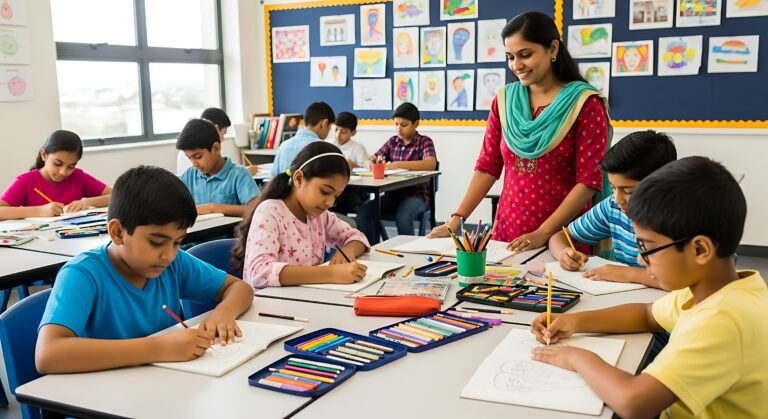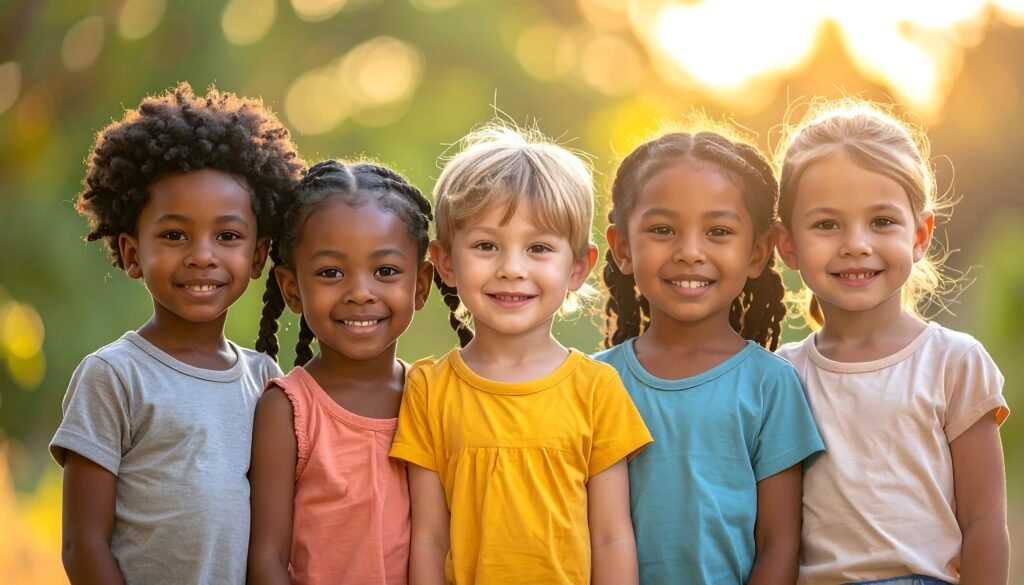
Children notice differences early. They notice accents and languages, hairstyles and skin tones, wheelchairs and hearing aids, the foods in a classmate’s lunchbox, and the way other families do things at home. Noticing is not the problem. Curiosity about other people is a healthy part of development. What matters is the meaning children gradually attach to those differences, and that meaning is shaped by the adults, peers, stories and messages around them.
That is where well-planned inclusion activities for kids make a real difference. When school counselors, therapists and educators respond to children’s questions with calm curiosity, teach perspective taking explicitly, and build classrooms where every child belongs, children learn that differences are safe to talk about and that every person is more than a first impression. This guide covers what research tells us about how children’s ideas about difference develop, practical activities for elementary and middle school students, and what to say when a child repeats a stereotype. If you are working with older students or want a closer look at stereotypes themselves, our companion article on helping kids and teens recognize stereotypes and build inclusion goes further.
How Children’s Ideas About Differences Develop
Sorting the world into categories is one of the most useful things a developing brain does. It helps children recognize letters, learn routines, and predict what comes next. Children also sort people into groups, and research suggests that which groups they notice, and what they come to believe about those groups, depends heavily on their environment. Developmental intergroup theory (Bigler & Liben, 2007) describes children’s stereotyping and prejudice as largely shaped by environmental factors, which is encouraging news for anyone working with children: what is learned can be influenced.
A few findings help put the timeline in perspective:
- Early perceptual preferences. In a well-known study, three-month-olds, but not newborns, looked longer at faces from their own racial group (Kelly et al., 2005). Researchers generally link this to the faces babies see most often. A looking preference in infancy is not prejudice, but it shows how quickly experience starts to shape attention.
- Early associations. A 2020 study summarized by the American Psychological Association noted that by around age 3, some U.S. children already associate certain groups with negative traits, while the adults surveyed believed conversations about race should begin when children are almost 5 (Sullivan, Wilton & Apfelbaum, 2020).
- A peak in the early school years. A multinational meta-analysis found that ethnic, racial and national prejudice tends to rise during the preschool years, peak at around ages 5 to 7, and then decline on average as children grow older (Raabe & Beelmann, 2011).
These are group averages, not predictions about any individual child. They do suggest that early elementary school is a valuable window for conversations about fairness, kindness and difference, and that waiting until children are “old enough” may mean they have already filled the gaps on their own.
A note on “implicit bias”
Implicit bias refers to automatic associations that people may hold without consciously endorsing them, usually measured with reaction-time tasks such as the Implicit Association Test. In one study of White American children, implicit scores were similar at age 6, age 10 and in adulthood, while openly stated preferences decreased with age (Baron & Banaji, 2006). It is worth holding this research lightly in practice. A large meta-analysis of 492 studies found that changes in implicit measures did not reliably lead to changes in behavior (Forscher et al., 2019). For counselors and educators, the practical focus is less on “removing bias from the brain” and more on what children do and say: how they treat peers, whether they include others, and how they respond when they notice something unfamiliar.
Try this in your classroom: share the idea of “brain shortcuts” in child-friendly language. “Our brains are great at sorting things into groups, like fruit and vegetables. Sometimes our brains try to sort people too, and that’s when we can get things wrong. People are much more interesting than one group. When we notice a quick guess about someone, we can slow down and ask, ‘What else could be true?'”
Curiosity First: Responding When Children Ask About Differences
Young children ask direct questions. “Why does that boy use a wheelchair?” “Why does her family speak a different language?” “Why is his skin darker than mine?” Adults often feel uncomfortable in these moments, so the instinct is to hush the child or change the subject. Children tend to learn something from that response too: that the difference is embarrassing or not okay to mention.
Most young children asking these questions are not judging. They are observing, comparing and trying to make sense of what they see. A calm, factual, warm answer teaches that differences are safe to talk about, that asking respectfully is different from making assumptions, and that the other person is a whole person, not a label.
A simple three-part response works across most situations:
- Acknowledge the noticing. “You noticed that Sam uses a wheelchair.”
- Give a short, accurate answer. “His wheelchair helps him get around, the same way your legs help you.”
- Connect to common ground. “I know Sam loves soccer too. What else do you think you two have in common?”
Be careful not to make the child who is “different” responsible for explaining themselves. If the question is asked within earshot, keep the answer brief and respectful, and let that child choose whether to share more. Older students can be coached to ask respectful questions (“Would you be comfortable telling me about…?”) and to accept “I’d rather not” as an answer.
Try this in your next session: run a quick “Notice, Wonder, Connect” round with a picture book or photo of a busy community scene. Students share one thing they notice, one respectful question they wonder about, and one way they connect with someone in the picture. Model the language first: “I notice… I wonder… I’m like them because…”
Perspective Taking: Teaching “What Else Could Be True?”
Perspective taking asks children to pause and consider that someone else’s experience, thoughts or feelings may differ from their own. It develops gradually through childhood and adolescence, and it is a skill that benefits from direct teaching and practice rather than reminders to “be kind.”
Many peer conflicts start with two children interpreting the same moment differently. Picture a student who says a classmate is “rude” because she never joins in at lunch. The classmate may be shy, new to the school, still learning English, or feeling anxious about where to sit. Helping children ask, “What else could be true?” creates space for empathy before judgment.
This kind of work is also supported by research. A meta-analysis of 122 comparisons from prejudice-prevention programs for children and adolescents found low to moderate overall effects, with direct contact experiences and programs that build empathy and perspective taking among the more effective approaches (Beelmann & Heinemann, 2014). The authors also note that effects were stronger on what children think than on how they feel or behave, and that long-term follow-up is limited, so these skills need regular practice.
Practical ways to build perspective taking:
- Retell a story from another character’s view. After a read-aloud, ask: “How would this story sound if the character who was left out told it?”
- Use “thought bubble” scenarios. Show a simple scenario and have students draw or write what each person might be thinking and feeling.
- Practice the three-question pause. “What do I see? What am I guessing? What else could be true?”
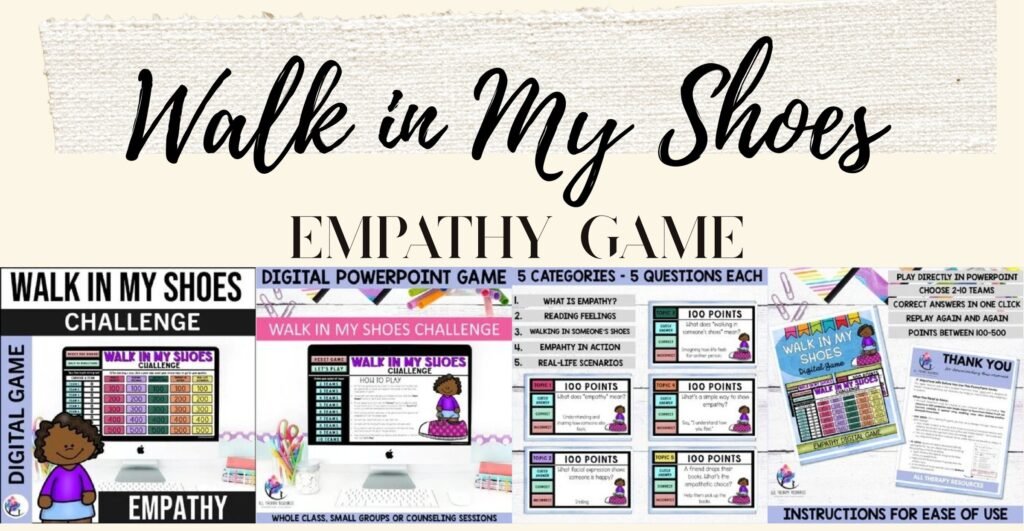
Resource spotlight: if you would like a ready-made way to practice these skills with a group, our Walk in My Shoes Digital Game is an interactive PowerPoint game with five sections, from “What is Empathy?” and “Reading Feelings” to perspective-taking scenarios and real-life situations. It suits individual sessions, small groups or whole-class lessons. Try playing in teams, then pausing after each scenario to ask, “What else could be true for this person?” before revealing the answer, so the discussion does the teaching rather than the points.
Inclusion Activities for Kids: A Quick Reference
The activities below can be adapted for counseling groups, classroom lessons and advisory. Each one keeps the focus on curiosity, fairness and connection, and none requires students to share personal information they would rather keep private.
| Activity | How it works | Core skill | Works well for | Suggested ATR resource |
|---|---|---|---|---|
| Same and Different | Partners find three things they share and one thing that makes each of them unique, then share with the group. | Common ground, valuing differences | Grades K–5 | My Unique Rainbow Craft |
| Fair or Not Fair? | Students sort short scenarios (being left out of a game, a rule that only applies to some) and explain their thinking. | Fairness, kind communication | Grades 1–3 | Breaking the Bias: Kindness, Fairness & Inclusion Challenge |
| Assumption Detective | Students spot the assumption in a statement (“She’s quiet, so she doesn’t want friends”) and generate other possible explanations. | Recognizing stereotypes, flexible thinking | Grades 4–8 | Breaking the Bias: Understanding Fairness, Stereotypes & Inclusion Challenge |
| Walk in Their Shoes | Students read a scenario, then describe what each person might be thinking and feeling. | Empathy, perspective taking | Grades 2–8 | Walk in My Shoes Digital Game |
| Inclusion Circle | A community circle with a talking piece and prompts such as “A time I felt included was…” (passing is always allowed). | Belonging, respectful listening | Grades 3–8 | Respect & Inclusivity Restorative Circle Questions |
A note on facilitation: keep scenarios fictional at first. A made-up situation feels safer than discussing something that happened in the class last week, and it lets children explore ideas without anyone feeling singled out. As trust builds, students can connect the ideas to their own experiences if they choose.
Building Cultural Understanding Without Stereotyping Cultures
Cultural understanding activities can accidentally reinforce the very stereotypes they aim to reduce. When a lesson presents “what people from a country do,” children may walk away with a new generalization rather than a deeper understanding. A more helpful focus is on individuals and everyday life: the languages people speak at home, how families spend weekends, favorite foods, the stories behind names, and the many ways people within any group differ from one another.
Some principles that keep this work respectful and trauma-informed:
- Invite, don’t require. Family stories can include loss, separation, migration, foster or kinship care. Offer choices (“Share something about your name, a favorite family food, or a place that matters to you”) and always allow a pass.
- Never ask one child to speak for a group. “What do people in your culture think?” places an unfair burden on a child. Ask about their own experience instead, if they want to share.
- Emphasize “within-group” variety. Help students notice that two people from the same background can like different things, and that two people from quite different backgrounds can have a lot in common.
- Pair learning with real connection. A systematic review of early childhood interventions found mixed results overall, with positive effects more common for children’s attitudes than for their actual peer relationships (Aboud et al., 2012). Cooperative tasks in mixed groups, buddy systems and shared projects give children the chance to turn understanding into friendships.
For more whole-school ideas, see our guide to strategies for promoting diversity and inclusion in schools.
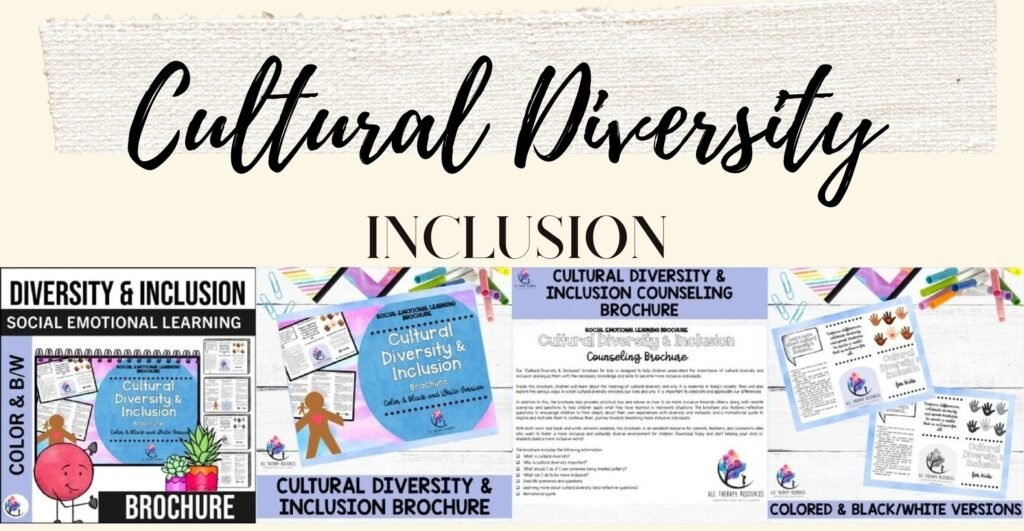
Resource spotlight: our Cultural Diversity & Inclusion Brochure walks children through what cultural diversity means, why it matters, what to do if they see someone treated unfairly, and practical ways to be more inclusive, with real-life scenarios and reflective questions. It comes in color and black and white, so it works as a small group handout, a lesson closer, or a take-home piece for families. One educator kept it simple: “I used this with my small group lesson and students enjoyed using it.” Another reviewer described adding the brochure to a Counselor Corner display in the school’s front hallway for students, parents and the wider community.
When a Child Repeats a Stereotype or Excludes Someone
Sooner or later, a child will say something like “Girls can’t be goalie” or “We don’t want him, he talks funny.” Children often repeat things they have heard without understanding them. A response rooted in shame tends to shut the conversation down, and the assumption simply goes underground. A response that is calm, curious and clear gives the child a chance to think again.
A five-step approach:
- Check on the child who was affected first. “Are you okay? You’re welcome to play.” Their safety and belonging come before the teaching moment.
- Stay calm and get curious. “I heard you say girls can’t be goalie. What makes you think that?”
- Offer a counterexample. “Lots of girls are great goalies. Priya was the goalie in our last game, remember?”
- State the expectation clearly. “At our school, everyone can try any position.”
- Support repair. “What could you say to Priya now?” Coach a genuine repair rather than a forced apology.
Follow-up matters. If the same comment comes up repeatedly, or if a child is being targeted, treat it as a pattern that may need your school’s bullying or behavior support procedures, along with communication with families. Our article on restorative practices for teaching fairness and perspective offers a framework for repair conversations.
Resource spotlight: for a structured lesson on why judging others by appearance, abilities or background is unfair, our Empathy Activities & Judging Lesson includes handouts, a reflection questionnaire, feelings and body sensation posters, example scenarios and 66 scenario cards. It works for individual or group sessions. One reviewer wrote, “I have used this in many ways including as a lunch bunch round table going through the scenario cards and reflecting/brainstorming them together.” Another used it with adapted students in junior high to introduce the idea of discrimination, noting the examples were easy to follow and explain.

Belonging Is the Foundation for Inclusion
Underneath every conversation about difference sits one shared need: every child wants to belong. The CDC describes school connectedness as students feeling that adults and peers at school care about them as individuals and about their learning, and links it with better attendance, higher grades, and lower risk of poor mental health, substance use and violence.
Belonging is built far more often in ordinary moments than in special events. It is the child who invites someone standing alone into a game, the student who listens before deciding what a classmate is like, and the adult who pauses to explore different perspectives rather than rushing to the “right” answer. When children experience belonging themselves, they are more able to offer it to others.
The next time a child asks a question about someone who seems different, or repeats something they have heard, try asking yourself first: “What is this child trying to understand?” That small shift turns a correction into a conversation, and conversations are where empathy grows.
Frequently Asked Questions
At what age do children start noticing differences between people?
Earlier than many adults expect. Research shows that infants begin to show preferences for familiar faces in the first months of life, and some preschoolers already link certain groups with positive or negative traits. That is why age-appropriate conversations about kindness, fairness and differences can start in preschool and early elementary school.
Is it better not to point out differences with young children?
Children notice differences whether or not adults mention them. When adults avoid the topic, children may fill the gaps with their own assumptions or messages from elsewhere. Calm, factual answers and a focus on common ground help children see that differences are normal and safe to talk about.
Do inclusion activities for kids actually reduce bias?
The evidence is encouraging but modest. Reviews of programs for children and adolescents show low to moderate effects on average, with empathy, perspective taking and positive contact among the more promising approaches. Effects are often stronger on attitudes than on behavior, so ongoing practice and real cooperative experiences matter more than a single lesson.
How should these conversations change for teens?
Older students are ready to examine stereotypes, media messages, peer influence and identity in more depth. Our article on helping kids and teens recognize stereotypes includes ideas for middle and high school, and the Breaking the Bias: Recognizing Bias & Stereotypes Challenge is designed for Grades 9–12.
References
- Aboud, F. E., et al. (2012). Interventions to reduce prejudice and enhance inclusion and respect for ethnic differences in early childhood: A systematic review. Developmental Review, 32(4), 307–336.
- Baron, A. S., & Banaji, M. R. (2006). The development of implicit attitudes: Evidence of race evaluations from ages 6 and 10 and adulthood. Psychological Science, 17(1), 53–58.
- Beelmann, A., & Heinemann, K. S. (2014). Preventing prejudice and improving intergroup attitudes: A meta-analysis of child and adolescent training programs. Journal of Applied Developmental Psychology, 35(1), 10–24.
- Bigler, R. S., & Liben, L. S. (2007). Developmental intergroup theory: Explaining and reducing children’s social stereotyping and prejudice. Current Directions in Psychological Science, 16(3).
- Centers for Disease Control and Prevention: School connectedness helps students thrive.
- Forscher, P. S., et al. (2019). A meta-analysis of procedures to change implicit measures. Journal of Personality and Social Psychology, 117(3), 522–559.
- Kelly, D. J., et al. (2005). Three-month-olds, but not newborns, prefer own-race faces. Developmental Science, 8, 31–36.
- Raabe, T., & Beelmann, A. (2011). Development of ethnic, racial, and national prejudice in childhood and adolescence: A multinational meta-analysis of age differences. Child Development, 82(6) (summary via ScienceDaily).
- Sullivan, J., Wilton, L., & Apfelbaum, E. P. (2020). Adults delay conversations about race because they underestimate children’s processing of race. Journal of Experimental Psychology: General (summary via APA).
Looking for practical, ready-to-use resources to support your inclusion and empathy lessons? The All Therapy Resources Membership provides access to a growing collection of thoughtfully developed counseling activities, interactive games, and therapeutic tools designed to save preparation time while supporting meaningful, skill-focused learning.