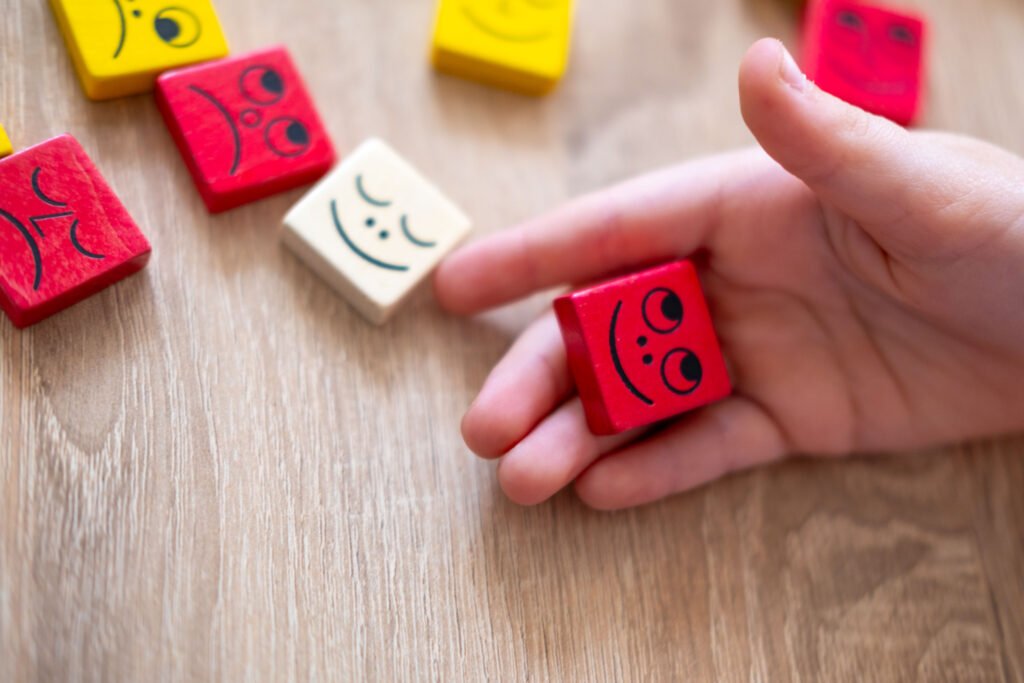
Teaching students to identify feelings sounds simple on the surface, yet in practice it is one of the most complex and foundational skills we teach in schools. How often do we hear students say “I don’t know” when asked how they’re feeling, or watch behavior escalate because a student couldn’t name what was happening inside their body?
For school counselors, teachers, and school psychologists, identifying feelings is more than an SEL goal. It is a gateway skill that supports emotional regulation, behavior, relationships, and learning. When students can recognize and label their emotions, they have a much better starting point for using coping strategies, communicating needs, and staying engaged in the classroom.
Below are practical, trauma-informed tips for teaching feelings identification in real school settings (counseling rooms, classrooms, and small groups), with sample language you can use tomorrow and tools that support emotional awareness across grade levels.
Why Identifying Feelings Is a Foundational SEL Skill
Emotional identification sits at the start of most social-emotional learning frameworks. CASEL’s framework lists “identifying one’s emotions” as part of self-awareness, alongside separate skills for managing emotions. It is hard to regulate a feeling you cannot recognize, and hard to problem-solve a feeling you don’t have words for.
There is also an interesting research thread behind “name it.” In a UCLA brain imaging study, adults who labeled the emotion on a face with a word such as “angry” showed reduced amygdala activity compared with when they matched the face to a name. The study involved adults, not children, so we treat it as a helpful rationale rather than proof that labeling calms every student. In schools, the practical takeaway is that naming a feeling gives students a pause point between the feeling and the next action.
Picture a student who is described as “defiant” because he refuses to start a writing task. When an adult asks, “Is this feeling more like stuck, worried, or frustrated?” he points to “worried” and says he doesn’t know how to start. The behavior hasn’t gone away, but now the adult has something to work with.
When students build feelings identification skills, educators often see:
- A clearer starting point for emotional regulation and self-control
- Richer emotional vocabulary and communication
- More effective use of coping skills
- Greater empathy and peer understanding
- Fewer misunderstandings between students and adults
Broader research on school-based SEL programs links well-implemented SEL instruction with gains in social-emotional skills and classroom behavior, and with fewer conduct problems. For educators and mental health professionals, feelings identification supports both preventative SEL and targeted intervention.
Start With Emotional Vocabulary (And Normalize All Feelings)
One of the most important steps when teaching feelings identification is expanding emotional vocabulary beyond “happy,” “sad,” and “mad.” Many students experience emotions in their bodies long before they can name them, and a limited word bank makes every uncomfortable feeling sound like “mad.”
It also helps to say clearly that all feelings are allowed, even when behavior needs support. This reduces shame and defensiveness and makes honest answers more likely.
Effective ways to build emotional vocabulary:
- Introduce one or two new emotion words at a time, then revisit them across the week
- Use visuals, faces, and relatable scenarios
- Model emotion language aloud: “I’m feeling frustrated because the projector isn’t working. I’m going to take a breath and try again.”
- Normalize mixed emotions: excited and nervous can exist together
- Offer “feeling families” (annoyed, frustrated, furious) so students can describe how big a feeling is
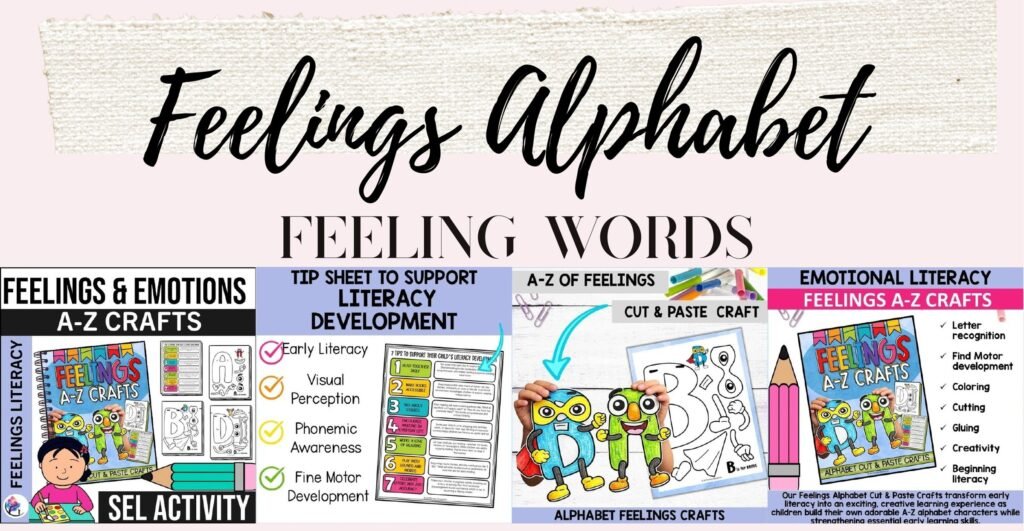
Try this in your classroom: for younger learners, pair new feeling words with something they can make and keep. Our Feelings Alphabet A–Z Crafts give each letter a feelings character to color, cut, and assemble, so a “word of the week” becomes a hands-on activity and a classroom display you can point back to. One reviewer used them with a K–2 autism class, and another shared that the crafts “gave my students a fun, hands-on way to talk about different feelings without it feeling too structured or clinical.”
Use Body Awareness to Teach Students to Identify Feelings
Feelings are not only thoughts; they are physical experiences. Many students struggle to identify emotions because they don’t yet recognize body cues such as tight shoulders, a fast heartbeat, a heavy stomach, or a warm face.
Teaching interoception (awareness of internal body signals) gives these students another way in. In research with more than 700 adults in Finland, Sweden, and Taiwan, participants colored body outlines to show where they felt different emotions, and each emotion produced its own distinct body map. Body-based approaches can be especially useful for students who shut down during verbal discussions: pointing to where a feeling shows up is often easier than finding the word.
Practical body-based strategies include:
- Short body scans or guided visualization
- Mapping feelings onto a body outline
- Discussing physical sensations linked to emotions (“Where do you notice worry? Some people feel it in their tummy.”)
- Using color or symbols to represent sensations
For a deeper look at this approach, see our guide to teaching body sensations and interoception.
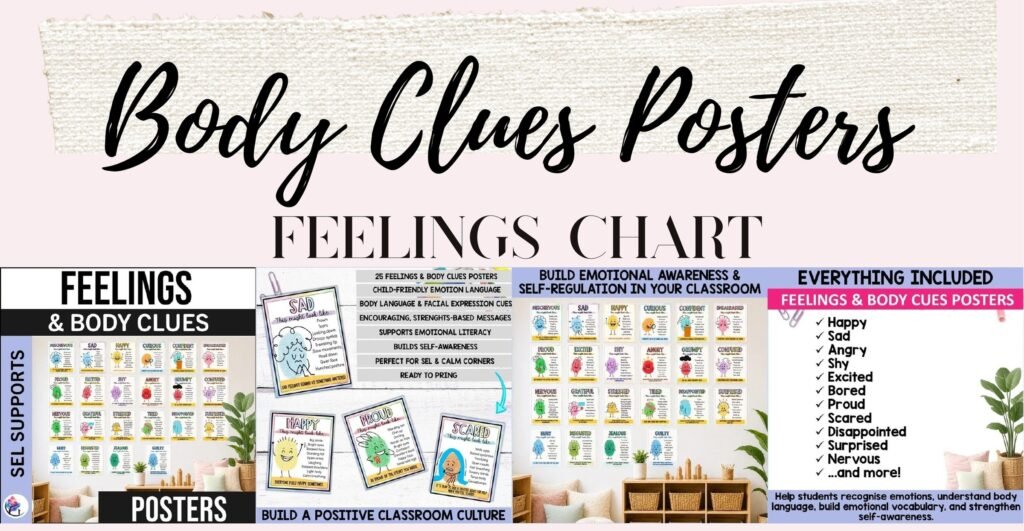
Try this in your next session: our Feelings & Body Clues Posters (Pastel) show each emotion through facial expressions, body language, and internal body sensations, with gentle messages that every feeling has a purpose. Display them in your calm corner or counseling space, then during a check-in ask, “Which poster matches what your body is telling you right now?” One reviewer noted, “They give students a concrete way to recognize how emotions show up in their bodies…” and found them helpful during check-ins and emotional regulation lessons.
Teach Feelings Through Scenarios and Choice-Based Learning
Students learn best when emotions are placed in context. Abstract discussions about feelings often fall flat, especially for younger learners or students with emotional regulation challenges.
Scenario-based learning allows students to:
- Practice identifying emotions in real-world situations
- Explore more than one possible emotional response
- Build empathy and perspective-taking
- Engage without pressure to self-disclose
Choice-based formats such as “This or That” feel playful while still delivering meaningful SEL instruction. They reduce the fear of a “wrong answer” and invite discussion. Many students are also more willing to talk about emotions when they are helping a character rather than talking directly about themselves.
Picture a small group reading a short scenario: “Maya’s friend sat with someone else at lunch.” Ask, “Could Maya feel left out or disappointed? What clues tell you that?” Then follow with, “What could Maya do next?” Students practice naming the feeling and linking it to a choice, without having to share their own lunch-table story. For Grades 1–3, the My Feelings Matter This or That Digital Game offers ready-made scenarios in this format.
Scaffold From Identifying Feelings to Regulating Them
Identifying feelings is not the end goal; it is the bridge to regulation. Once students can name what they feel, they can begin to choose coping strategies that match their emotional needs. The phrase “name it to tame it,” popularized by Dr. Daniel Siegel and Dr. Tina Payne Bryson in The Whole-Brain Child, is an easy reminder for students of all ages.
Scaffolding looks like:
- Identify the feeling
- Notice body sensations
- Connect the feeling to behavior
- Choose a coping strategy
- Reflect on what helped
A sample script for a one-on-one check-in: “You said your body feels hot and your hands are tight. That sounds like frustrated. What’s one thing from your coping list you want to try for two minutes? Afterward, we’ll check in on how your body feels.” For more ideas at the coping step, see our emotional regulation activities for kids.
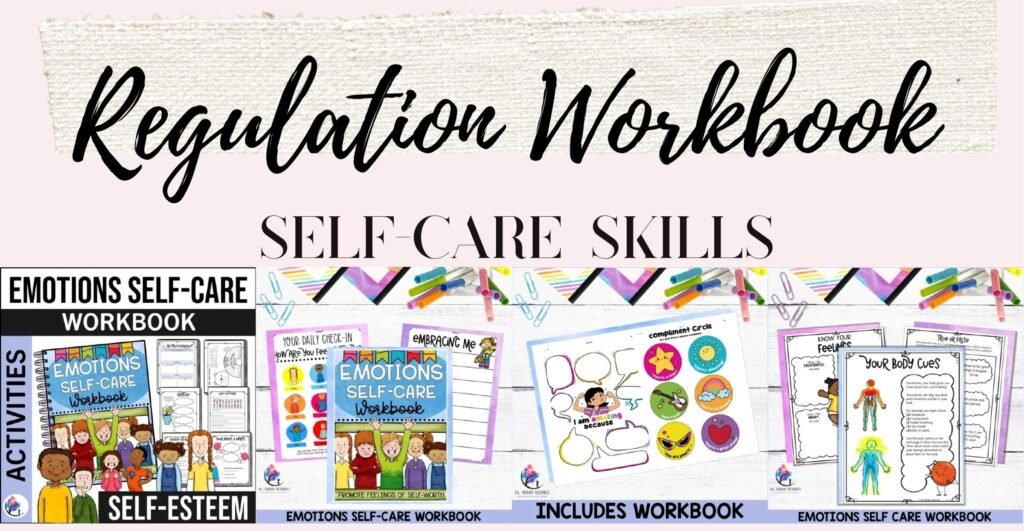
Try this in your next session: when you are ready to move students from naming feelings to managing them, our Emotional Regulation Self-Care Workbook guides elementary students through recognizing and naming emotions, exploring calming and self-care strategies, and reflecting on what works for them. It suits small group counseling, Tier 2 support, and individual sessions: work through one page per session and let students add their favorite strategies to a personal coping plan they can take back to class.
Be Trauma-Informed and Flexible in Your Approach
Not all students are ready to name feelings right away. Trauma-informed practice reminds us to move at the student’s pace, offer choice, and avoid forcing emotional disclosure. SAMHSA’s guidance for a trauma-informed approach names principles such as safety, trustworthiness and transparency, and empowerment, voice and choice. Students tend to open up over time when they feel safe, respected, and not rushed.
Trauma-informed tips include:
- Allowing students to pass or observe
- Using indirect activities before direct reflection
- Offering multiple ways to express emotions (drawing, writing, movement, pointing to a chart)
- Offering feeling words as tentative guesses (“I wonder if that felt a bit embarrassing?”) rather than telling students how they feel
- Reinforcing safety, predictability, and choice
Feelings work can occasionally bring up something serious. If a student shares information that suggests they may be unsafe, stay calm, listen, avoid promising to keep it secret, and follow your school or district protocol and mandated reporting requirements. Our trauma-informed classroom tips offer more ideas for building safety into everyday routines.
Remember: identifying feelings is a skill that develops with practice, not pressure.
Common Challenges Educators Face (And How to Address Them)
Even experienced educators run into challenges when teaching emotional identification. This quick guide pairs common sticking points with language you can try.
| Challenge | What helps | Try saying |
|---|---|---|
| Student says “I don’t know” repeatedly | Offer two or three choices or a visual instead of an open question | “Is it more like tired, worried, or bored?” |
| Student confuses feelings with behaviors | Separate the feeling from the action | “Yelling is what you did. What was the feeling underneath?” |
| Student minimizes or avoids emotions | Shift to a character or a third-person scenario | “What might someone feel here?” |
| Emotional overwhelm during discussion | Pause, regulate first, and keep lessons short and repeated | “Let’s take a breath together. We can come back to this.” |
Want more ready-made visuals for check-ins? The Feelings Iceberg Worksheets help students explore the feelings underneath the surface, and our guide to therapeutic wheels for feelings and coping skills shares more low-pressure ways to start the conversation.
Consistency matters more than perfection.
Final Thoughts: Teaching Feelings Is Teaching Life Skills
Teaching students to identify their feelings is one of the most practical preventive skills we can build in schools. When students understand their emotions, they are better equipped to manage stress, communicate needs, build relationships, and engage in learning.
As educators and mental health professionals, we are not only teaching emotion words. We are building self-awareness, resilience, and coping skills students can carry well beyond the classroom.
Frequently Asked Questions
Why is identifying feelings important in school settings?
Identifying feelings is a core self-awareness skill in SEL frameworks such as CASEL’s. It gives students a starting point for emotional regulation, communicating needs, and solving problems with peers and adults.
At what age should students learn to identify feelings?
Feelings identification can be taught from preschool through high school. Younger children benefit from faces, visuals, and a few words at a time, while older students can work with more nuanced vocabulary, mixed emotions, and the link between feelings, thoughts, and behavior.
What if students don’t want to talk about their feelings?
Use indirect methods like scenarios, visuals, body mapping, or games. Offer choice, allow students to pass, and avoid forcing disclosure.
Can these strategies be used in classrooms and counseling sessions?
Yes. These strategies can be adapted for whole-class SEL lessons, small groups, and individual counseling or therapy sessions.
References
- CASEL: The CASEL framework (self-awareness and self-management competencies)
- CASEL: The benefits of school-based social and emotional learning programs
- ScienceDaily (2007): Putting Feelings Into Words Produces Therapeutic Effects in the Brain (Lieberman et al., UCLA)
- Aalto University: Finnish research team reveals how emotions are mapped in the body (Nummenmaa et al., 2014)
- SAMHSA (2014): Concept of trauma and guidance for a trauma-informed approach
Looking for practical, ready-to-use resources to support your feelings identification and SEL lessons? The All Therapy Resources Membership provides access to a growing collection of thoughtfully developed counseling and SEL activities, interactive games, and therapeutic tools designed to save preparation time while supporting meaningful, skill-focused learning.