Individual counseling sessions often stall when students lack the words to describe what’s happening inside them, or the executive function to pick a regulation strategy in the moment. Therapeutic wheels address both problems by turning abstract concepts into concrete, visual decision-making aids you can use right away. They aren’t posters on a wall. Used well, they’re active session structures that guide the work from identification to intervention.
Most resource lists mention feelings wheels in passing without explaining how to sequence different wheel formats or adapt them for specific clinical goals. This article looks at the distinct functions of feelings, coping, and choices wheels in individual counseling, and how to sequence them to support emotional vocabulary, regulation, and student agency across developmental stages.
Why Therapeutic Wheels Support Session Structure
A therapeutic wheel gives you and the student a shared visual reference point, something to anchor the session to when verbal processing gets hard. That external structure lets you keep the session moving even when the student’s capacity for self-reflection is temporarily knocked out by stress or dysregulation.
Reducing Cognitive Load Through Visual Scaffolding
Asking a dysregulated student to pull words or strategies from memory asks for cognitive resources they may not have available right then. Visual scaffolds like therapeutic wheels are considered best practice in trauma-informed care because they supply external structure when a student’s own regulatory systems are overwhelmed. The wheel does the retrieval work, so the student only has to recognize and select.
That shift changes the pace of your sessions. Instead of spending ten minutes trying to coax out a feeling word through open-ended questions, you can spend that time exploring the emotion once it’s named and tracing what triggered it. The visual format also helps students with language processing differences, who often understand concepts better laid out in space than strung together in a sentence.
Supporting Trauma-Informed Emotional Safety
Predictability is a cornerstone of psychological safety for students with trauma histories. A consistent visual tool signals that the session has a reliable container, and that reduces hypervigilance and lets the nervous system settle. When you bring trauma-informed behavior support strategies into individual work, the wheel becomes part of that predictable rhythm.
Therapeutic wheels can support emotional safety by presenting feelings, coping strategies, and choices in a clear, accessible visual format. Rather than requiring students to generate responses independently, these tools offer structured options that can be explored collaboratively. Their effectiveness depends on thoughtful facilitation, individual needs, and the therapeutic relationship rather than the circular format alone.
Feelings Wheel Counseling Tool for Emotional Vocabulary
A feelings wheel serves a different purpose than a coping skills wheel. It’s built for identification and differentiation, not immediate regulation. A coping wheel helps a student manage an emotion that’s already been named. A feelings wheel builds the granular vocabulary a student needs to name that emotion accurately in the first place.
Moving Beyond Basic Emotion Words
Emotional granularity shapes how effective an intervention can be, because a specific label points to a specific response. A student who can only say “mad” may use a feelings wheel to land on “frustrated” or “overwhelmed” instead, which opens the door to a more targeted coping strategy. Without that distinction, a student might end up applying an anger management technique to what’s actually sensory overload.
You can build this skill by having students point to more than one segment of the wheel in a single session. Letting two emotions sit side by side validates complexity and avoids the flattening that tends to frustrate adolescents. Over time, repeated exposure to more precise vocabulary stretches a student’s default range past the basic happy-sad-mad triad.
Feelings and Emotions Wheel for Counseling Sessions
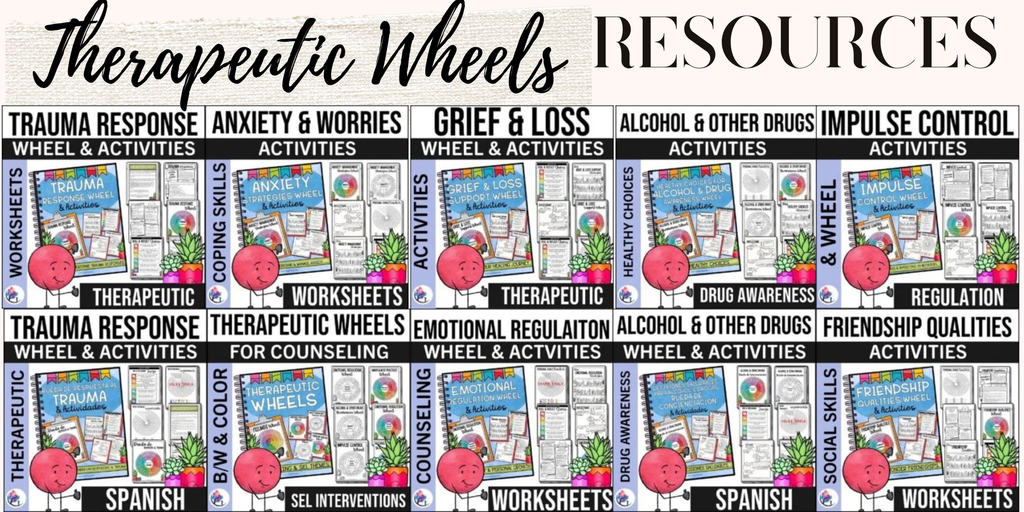
A feelings wheel can be a valuable therapeutic tool for students who struggle to identify, describe, or communicate their emotions. By providing a visual range of emotional vocabulary, feelings wheels support emotional awareness, self-expression, and meaningful counseling conversations.
Our Feelings and Emotions Wheel includes both colorful and black-and-white printable versions, making it easy to incorporate into individual counseling, small-group sessions, classroom SEL lessons, and emotional check-ins.
Invite students to identify an emotion, explore where they notice it in their body, and reflect on what they might need in that moment. For students who find verbal expression challenging, pointing to an emotion on the wheel can provide an accessible starting point for discussion.
Integrating Feelings Alphabet Activities for Younger Students
Younger learners need something tactile and developmentally matched before an abstract wheel will mean much to them. The Feelings Alphabet A-Z Crafts SEL Counseling Social Emotional Learning Activities resource connects early literacy work to social-emotional learning through cut-and-paste crafts. Each letter pairs with a feeling word, building vocabulary through the same multimodal channels used in phonics instruction.
That groundwork makes wheel-based work more effective later, because the student arrives with existing links between letters, words, and emotional states already in place. You’re not introducing new concepts when you move to a feelings wheel. You’re organizing vocabulary the student already has into a new visual structure. The craft component also gives early elementary students something to do with their hands, which helps sustain attention.
Coping Skills Wheel Printable and Regulation Strategies
Regulation needs accessible options in the moment, not theoretical knowledge of techniques a student can’t recall under stress. A coping skills wheel printable works as an external working memory aid, keeping strategies visible and selectable exactly when executive function is weakest.
Matching Coping Strategies to Specific Emotions
Good regulation depends on matching the strategy to the emotional state, not applying generic calming techniques across the board. Deep breathing might help with anxiety, but it could make frustration worse for a student who needs to move their body to discharge energy. A wheel lets you pre-sort strategies by category or intensity, so students can navigate toward a good match without facing an overwhelming set of choices.
All Therapy Resources designs its therapeutic tools for professional use in educational and community settings, combining clinical insight with practical application, which helps keep that matching process sound. You can customize blank wheel templates to reflect the specific strategies you’ve taught and practiced with a given student. That personalization is what turns a generic tool into a tailored intervention plan.
Using Interactive Games to Reinforce Skill Selection
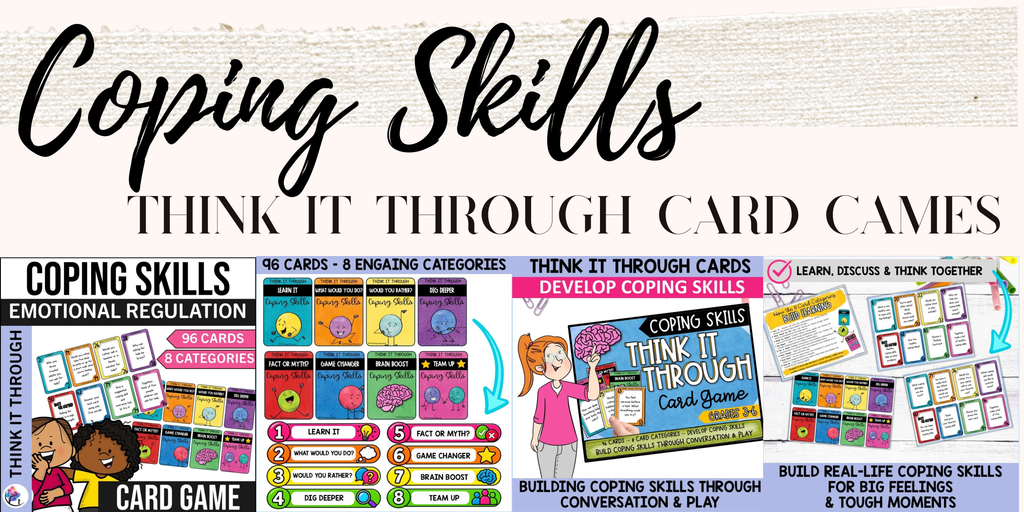
Knowing a coping strategy exists and knowing when to use it are two different skills. The Think It Through Coping Skills Card Game provides students with interactive, conversation-based opportunities to explore different coping strategies, consider when they may be helpful, and strengthen emotional awareness and decision-making skills.
These games do double duty in a session: they build the relationship while also rehearsing the skill. You get to watch how a student thinks through choices in real time, which gives you assessment data a worksheet can’t. The playful format also lowers resistance for students who associate counseling with deficit-focused conversations.
Choices Wheel Counseling Activity for Agency Building
Anxiety and perfectionism often show up as decision paralysis, because the student sees every choice as carrying the potential for catastrophic error. A choices wheel addresses that by making decision-making visible, bounded, and reversible, instead of abstract and infinite.
Restoring Autonomy in Anxious Students
Choice-based interventions restore a sense of autonomy for anxious students by making decision-making visible and bounded rather than abstract and infinite. When options exist only inside a student’s head, they multiply endlessly and start to feel equally weighted. Putting them on a wheel imposes structure the anxious brain can’t generate on its own, and that external containment lowers the stakes each choice seems to carry.
For students wrestling with perfectionism specifically, the perfectionism coping skills toolkit pairs well with a choices wheel. It gives students language and frameworks for tolerating imperfection, addressing fear of mistakes and self-pressure directly. Combining the two creates more than one way into the work of rebuilding agency.
Sequencing Choice-Based Interventions Within Sessions
Building agency follows a sequence, moving from highly structured choices toward more open-ended ones. Start with binary choices presented visually, then expand to three or four options as the student’s tolerance for uncertainty grows. Hold off on open-ended generation until the student has shown they’re comfortable choosing from a bounded set across several sessions.
This sequencing keeps you from accidentally recreating the overwhelm you’re trying to reduce. Too much freedom too soon feels unsafe to an anxious student and reinforces avoidance rather than building confidence. You calibrate the structure to what you’re actually seeing, adjusting up or down within and across sessions as needed.
Therapeutic Wheel Activities Across Developmental Stages
Therapeutic wheel activities need adapting to match cognitive maturity, language, and cultural context. What engages a second grader will lose a tenth grader if you don’t modify it, and English-only materials shut multilingual learners out of the support entirely.
Adapting Wheel Complexity for Elementary vs. Secondary
Elementary students do best with wheels that have fewer segments, larger text, and images that reinforce meaning alongside the words. Adolescents need more sophisticated versions, ones that pair identification categories with reflective journaling prompts. At that stage, the wheel becomes a thinking partner rather than just a labeling device, which fits the kind of metacognitive development you’d expect at the secondary level.
You can bring older students into co-creating their own wheels as part of the work itself. That kind of collaborative construction deepens ownership, and it means the vocabulary reflects what the student actually experiences rather than an adult’s assumptions about teen emotions. Designing the tool becomes part of the intervention.
Bilingual and Culturally Responsive Adaptations
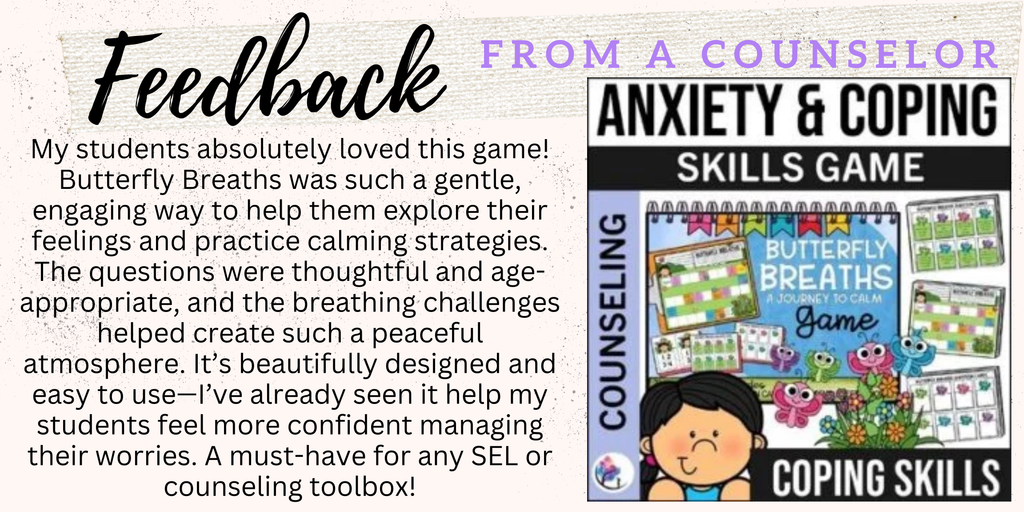
Multilingual learners deserve therapeutic tools in their home languages, not translations tacked on as an afterthought that miss the cultural nuance. Butterfly Breaths: A Journey to Calm, the Spanish-language edition of ATR’s anxiety coping skills game, is built for authentic cultural relevance rather than a mechanical translation. Offering material in a student’s primary language signals respect and clears a linguistic barrier out of the way of emotional processing.
Cultural responsiveness goes beyond language, too. Emotion concepts don’t always map cleanly onto English categories. Some cultures lean on somatic expressions of distress rather than psychological labels, and a wheel should accommodate that instead of forcing assimilation. You honor that by adapting the tool to the student’s framework, rather than asking the student to fit the tool.
Documenting Progress With Wheel-Based Interventions
Progress monitoring has to capture growth without eating into the limited time you have for direct student support. Wheel-based interventions make this easier, because each session produces observable data points that come out of the interaction naturally.
Tracking emotional granularity means noting the shift from broad to specific labels across sessions. You might record that a student moved from only saying “bad” to distinguishing “disappointed,” “lonely,” and “overwhelmed” over six weeks. Coping skill acquisition tends to follow a similar arc, as students move from needing full facilitator guidance to picking a strategy off the wheel on their own.
A documentation system that fits into your existing caseload management, rather than adding a second tracking system on top of it, is worth the setup time. Looking into efficient counseling data tracking methods can help you line up wheel-based observations with the broader accountability your program needs. The goal is capturing real change in a way that satisfies the paperwork without pulling you out of the room.
Expanding Your Toolkit With Professional Resources
Structured visual tools hold up well in practice because they give both student and practitioner something reliable to lean on. Working therapeutic wheels into your regular individual counseling practice builds the kind of consistency that helps a skill generalize across settings and over time.
All Therapy Resources designs its materials specifically for helping professionals who need practical, ready-to-use tools. Take a look at the All Therapy Resources shop or the Membership Library for therapeutic wheels, complementary counseling tools, and resources that cut down on session prep while supporting the work you’re already doing with students.
Frequently Asked Questions
How do I introduce a feelings wheel to a student who resists talking about emotions?
Begin by using the wheel yourself to label neutral or positive states during non-threatening moments, modeling its use without demanding participation. Offer the wheel as an optional pointing tool rather than requiring verbal responses, allowing the student to engage at their own pace. Resistance often decreases once the student observes that the tool reduces rather than increases emotional demand.
Can therapeutic wheels be used effectively in group counseling settings?
Yes, wheels function well in groups when each member has individual access to a copy or when the wheel serves as a shared reference for structured turn-taking. Group use adds peer modeling benefits as students hear others articulate selections from the same visual menu. Ensure adequate copies or projection so no student is excluded from simultaneous participation.
How often should I update or customize a student’s coping skills wheel?
Review and revise the wheel whenever previously effective strategies stop working or when new skills have been practiced sufficiently to warrant inclusion. Seasonal transitions, schedule changes, and developmental milestones often trigger the need for updates. Treat the wheel as a living document that evolves with the student rather than a static artifact created once and filed away.
What signs indicate a student is ready to move from a feelings wheel to a choices wheel?
Readiness emerges when the student consistently identifies emotions with minimal prompting and begins asking what to do about those feelings. This shift from identification to action-seeking signals sufficient emotional vocabulary to support decision-making work. Introduce the choices wheel gradually while maintaining access to the feelings wheel for moments when identification still requires support.