
Restorative practices discipline alternatives for schools mark a real shift in how educators and mental health professionals address behavior: away from compliance, toward connection and accountability. For school counselors, social workers, and teachers managing complex classroom dynamics, the gap between theory and Monday-morning application often feels wide. Academic literature covers the philosophy of restorative justice at length. Finding ready-to-use materials that turn that philosophy into something you can hand a student is a different problem entirely.
You need tools that bridge this gap without hours of adaptation or extra clinical training. All Therapy Resources designs restorative conversation worksheets and SEL activities specifically for school counselors who want low-prep, trauma-informed alternatives to exclusionary discipline. Discipline reform takes more than philosophical buy-in. It takes resources that fit inside a caseload that is already full.
Why Schools Are Shifting Toward Restorative Practices
The move away from zero-tolerance policies comes from decades of data showing punitive measures don’t improve safety or behavior, and they land hardest on vulnerable students. By the 2011-2012 school year, nearly 3.5 million students were suspended annually, a figure that cost the country 18 million days of instruction, according to analysis from the University of Chicago Education Lab. That removal rate didn’t improve school climate. It entrenched cycles of disengagement and academic failure that outlasted the original incident.
The High Cost of Exclusionary Discipline
Exclusionary discipline costs more than instructional time. It affects long-term educational attainment and community trust. According to the Learning Policy Institute, American schools spend over $4 billion annually on physical security technologies despite thin evidence that this spending works, which points to the need for relationship-based alternatives instead. When a student is removed from class, they miss academic content and social learning at the same time. That makes reintegration harder and raises the odds of another infraction down the line.
This financial and human cost has pushed districts to look for models that address root causes instead of symptoms.
Evidence for Restorative Approaches
Research suggests that well-implemented restorative practices in schools can contribute to stronger student relationships, improved school climate, and reductions in exclusionary disciplinary responses, such as suspensions. Rather than relying solely on punitive consequences, restorative approaches emphasize accountability, repairing harm, and rebuilding trust within the school community.
However, restorative practices are not a quick fix. Their effectiveness depends on consistent implementation, appropriate staff training, clear behavioral expectations, and meaningful student participation. Schools are more likely to experience positive outcomes when restorative approaches are embedded within a broader framework of positive behavior support, social-emotional learning (SEL), and trauma-informed practices.
Importantly, restorative discipline does not mean eliminating consequences or overlooking harmful behavior. Instead, it encourages students to understand the impact of their actions, take responsibility, and participate in appropriate steps toward repairing harm while maintaining clear boundaries and ensuring student safety.
Core Principles of Restorative Justice in Education
Understanding the psychological foundations of restorative justice helps you tell genuine practice apart from a softened consequence with new vocabulary. The framework runs on different assumptions about motivation, harm, and repair than traditional discipline does, and that distinction matters. Misapply it, and the expected outcomes won’t show up, which breeds frustration fast.
Repairing Harm Over Assigning Blame
Traditional discipline asks what rule was broken and who deserves punishment. Restorative justice asks who was harmed and what it will take to make things right. That reorientation moves the focus from individual culpability to collective responsibility and relational repair, which makes room for accountability that doesn’t rely on shame or isolation. Students learn to see the impact of their actions on other people, instead of just memorizing rules to avoid getting caught.
Repairing harm takes active participation from everyone affected, and that participation builds empathy in a way passive punishment never will.
Building Community Before Conflict Arises
Proactive community-building circles are different from reactive conflict-resolution sessions. They’re preventative infrastructure, not emergency intervention. Regular gatherings establish norms, build trust, and create a shared language that makes the hard conversations possible once a crisis hits. Skip this groundwork, and restorative responses to serious incidents tend to fail, because the people involved lack the relational capital that vulnerability and honest dialogue require.
Time spent on proactive circles cuts down the frequency and intensity of the conflicts that would otherwise need intensive restoration later.
Restorative Practices Activities for Schools: Interactive Learning Through Games
Teaching restorative practices goes beyond discussing expectations and consequences. Students also need opportunities to explore empathy, accountability, conflict resolution, and repairing harm in meaningful ways.
Our Restorative Practices Digital Game Series includes three interactive PowerPoint games designed for classroom lessons, restorative circles, small-group counseling, and social-emotional learning (SEL).
Across the three games, students explore restorative questions, fairness, responsibility, communication, inclusion, and rebuilding trust through engaging scenarios and guided reflection.
These activities provide educators with a practical way to introduce restorative justice principles, strengthen relationships, and help students develop the skills needed to navigate conflict constructively.
Ready-to-Use Restorative Circle Questions and Conversation Worksheets
Facilitating restorative dialogue takes specific skills that a lot of educators were never formally trained in, and that gap breeds anxiety around implementation. Structured prompts and worksheets lower that barrier: they provide scaffolding that keeps the conversation psychologically safe while staying true to restorative principles. With reliable questions already prepared, you can focus on presence and attunement instead of hunting for the right words in an emotionally charged moment.
Printable Prompts for Proactive Circles
Open-ended questions that invite reflection without demanding confession are the backbone of good circle facilitation. Prompts like “What were you thinking at the time?” or “Who has been affected by what happened, and how?” walk students through perspective-taking without steering them toward a predetermined answer. These questions work because they separate the person from the problem, which opens up space for real insight instead of defensive justification.
Printable formats keep facilitation consistent across staff members, which matters anywhere restorative programming is a shared responsibility rather than one person’s job.
Structured Scripts for Restorative Conversations
Restorative conversation worksheets differ from a disciplinary referral in what they document: understanding and repair plans, not just infractions and consequences. A structured script walks the facilitator through the essential phases: acknowledging harm, exploring impact, identifying needs, agreeing on next steps. That documentation does double duty, keeping an accountability record while also capturing growth moments that a standard referral form misses entirely.
Worksheets built for professional use account for developmental differences that generic templates tend to miss, so the same framework can flex from elementary through high school.
Restorative Justice Worksheets, Circle Questions, and Practical Resources
For educators looking to move from restorative theory into everyday practice, having structured resources can make restorative conversations and classroom implementation more manageable.
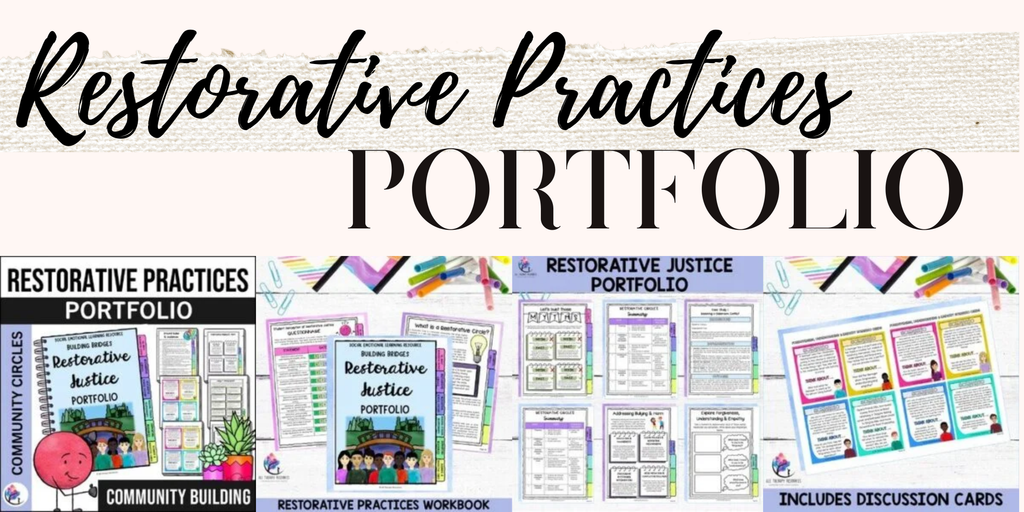
Our Building Bridges: Restorative Justice Portfolio brings together restorative circle questions, reflection worksheets, conversation prompts, scenario cards, and practical guidance for building a restorative school culture.
The portfolio includes tools for facilitating community circles, exploring empathy and accountability, addressing conflict, repairing relationships, and supporting students in reflecting on their choices.
Designed for school counselors, teachers, and student support professionals, these restorative practices resources provide a structured approach to strengthening relationships, encouraging meaningful reflection, and supporting positive school discipline.
Alternative to Suspension Activities That Teach Accountability
Replacing removal with real engagement takes activities that target the underlying skill gaps while keeping students connected to the classroom. Out-of-school suspension teaches avoidance and nothing else. In-school restorative interventions create room for actual skill development and relationship repair. You can run these alternatives without giving up academic rigor or behavioral expectations, as long as the activities are built to teach the missing skill.
In-School Restorative Interventions
Effective alternatives keep students physically present while addressing the specific harm their behavior caused. Digital escape rooms built around flexible thinking, like the Pirate Voyage, Adjust Your Sails Escape Challenge Mission Game, put students into problem-solving scenarios that mirror real social challenges. These activities turn a disciplinary moment into a learning opportunity without stigmatizing the student or pulling them out of their peer group.
In-school interventions work when they feel distinct from regular instruction but still connect back to the broader educational mission.
Skill-Building Replacements for Removal
A lot of behavioral incidents come from underdeveloped social-emotional skills, not willful defiance, which makes skill-building the more logical response. Friendship worksheets and craft activities let students practice prosocial behavior in a structured, low-stakes setting before they need it in an actual conflict. The Friendship Activities Worksheets & Craft, Kindness Coloring Flowers SEL Lesson pairs creative expression with direct instruction on empathy and communication, addressing relational gaps that a punishment can’t touch.
These replacements work best paired with a reflection piece that helps students connect what they just practiced to their own behavioral goals.
Restorative Practices Activity: Exploring Fairness and Perspective-Taking
Before students can repair harm or resolve conflict constructively, they need opportunities to consider different perspectives, distinguish facts from assumptions, and understand how circumstances can influence behavior.
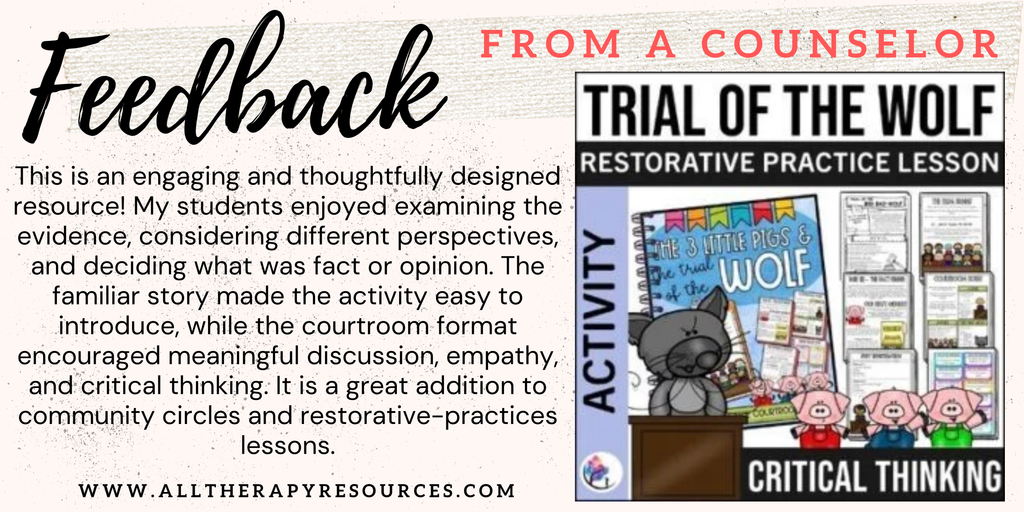
Our Trial of the Wolf Restorative Practices Activity uses the familiar story of The Three Little Pigs to engage students in a fictional courtroom investigation. Students examine evidence, consider different viewpoints, distinguish facts from opinions, and explore how fair decisions require thoughtful reasoning.
Through courtroom roles, evidence cards, guided discussions, and restorative reflection questions, students develop critical thinking, empathy, responsible decision-making, and conflict resolution skills.
This free restorative practices activity provides a practical way to introduce restorative thinking in classroom lessons, community circles, and school counseling groups.
Integrating Restorative Practices With SEL and Regulation Tools
Restorative dialogue asks participants to use higher-order thinking skills that aren’t available while someone is dysregulated. You can’t expect a meaningful accountability conversation until a student has enough self-regulation capacity to engage honestly. Integrating restorative practices with existing SEL curricula means they build on regulation skills already in place instead of operating on their own island.
Calm Down Corners as Restorative Spaces
A designated regulation space bridges crisis de-escalation and restorative processing, giving a student’s nervous system somewhere to reset. Calm Down Corner Printables from All Therapy Resources offer visual supports and sensory tools that help students name emotions and pick a coping strategy on their own. These corners function as restorative infrastructure when they’re framed as preparation for dialogue, not a permanent exile from the group.
A good calm corner has a clear re-entry protocol, one that signals when a student is ready for the restorative conversation.
Anxiety Coping Skills Within Discipline Reform
Anxiety often shows up as behavioral dysregulation, which makes coping-skill development part of any discipline reform that’s built to last. The Anxiety Coping Skills Game, Butterfly Breaths (Spanish edition) gives students interactive practice with relaxation techniques, in a format accessible to Spanish-speaking learners too. Build these tools into a restorative framework, and students develop internal resources alongside the external accountability structure.
Regulation skills taught in isolation rarely transfer to a high-stress moment without an explicit link back to the restorative process.
Implementing Restorative Practices Without Adding to Educator Burnout
Time scarcity is the biggest barrier to sustainable implementation, even for professionals who believe in restorative philosophy down to their bones. Adoption sticks when the systems around it reduce prep time instead of adding another unfunded task to an already full caseload. You deserve resources that respect your expertise and the reality of a packed schedule.
Low-Prep Resources for Busy Counselors
Ready-made digital tools remove the false choice between quality implementation and your own sustainability. An extensive membership library of ready-to-use resources gives you immediate access to materials built around trauma-informed practice. These resources save prep time without sacrificing clinical integrity, so your energy goes toward direct student support instead of toward building materials from scratch.
Low-prep doesn’t mean low-quality, not when the materials are built by people who understand both the therapeutic side and the realities of a school day.
Tracking Progress Without Excessive Paperwork
Documentation often derails restorative initiatives when the system prioritizes compliance over meaningful progress monitoring. Streamlined counseling data tracking methods capture the outcomes that matter without eating up a disproportionate amount of your time. These trackers line up with restorative values: they track growth and repair completion, not just a running count of infractions.
A tracking system built to be sustainable also generates the data that supports the case for keeping the program funded.
Common Misconceptions About Restorative School Discipline
Persistent myths about restorative practices breed resistance among people who misunderstand what implementation actually looks like. Clearing up these misconceptions protects a program from getting scrapped the first time it hits a predictable early hurdle. Structure and consistency are still essential to a successful school-wide rollout, whatever the assumptions about permissiveness might say.
Restorative practices don’t eliminate consequences. They redefine them: obligations to repair, rather than punishments to endure. That distinction matters, because accountability without relationship repair produces compliance without any real internalization, and the underlying issue stays right where it was. Clinical training improves the quality of facilitation, but it isn’t a prerequisite for basic implementation, not when professionals are working from resources built for a school setting.
Successful adoption means knowing the difference between abandoning punishment and abandoning structure. Lose the structure, and you lose the safety that genuine restoration depends on.
Importantly, restorative practices should never require students who have experienced bullying, intimidation, abuse, or serious harm to participate in face-to-face conversations with those responsible. Student safety, informed choice, and emotional readiness must always come first. Restorative approaches work best when participation is voluntary, power imbalances are carefully considered, and appropriate safeguarding procedures remain in place.
Explore the All Therapy Resources Shop or Membership Library for ready-to-use restorative practice worksheets, circle questions, and SEL activities that save you prep time while supporting trauma-informed discipline reform in your setting.
Frequently Asked Questions
What are some alternative discipline approaches besides restorative practices?
Alternative discipline approaches include positive behavioral interventions and supports (PBIS), collaborative problem solving, and trauma-informed behavior management frameworks. Each emphasizes skill-building and relationship over punishment, though they differ in specific implementation strategies and theoretical foundations. Restorative practices complement rather than replace these approaches when integrated thoughtfully.
What is the restorative practices framework in simple terms?
The restorative practices framework centers on repairing harm and rebuilding relationships rather than assigning blame and administering punishment. It operates on the belief that wrongdoing violates people and relationships, creating obligations to make things right. This contrasts with traditional discipline that focuses primarily on rule violations and deserved consequences.
How does restorative discipline differ from traditional school discipline?
Restorative discipline asks who was harmed and what is needed to repair relationships, while traditional discipline asks what rule was broken and what punishment is deserved. Restorative approaches involve affected parties in determining outcomes and emphasize accountability through repair rather than suffering. Traditional models typically exclude victims from the process and define success as compliance rather than healing.
Do restorative practices work for serious behavioral incidents?
Restorative practices can address serious incidents when implemented with appropriate preparation, skilled facilitation, and voluntary participation from all parties. Success depends on adequate pre-work to ensure safety and readiness rather than incident severity alone. Some situations require traditional safety measures first, with restorative processes following once immediate risks are managed.