Walk into almost any school counseling office and you will meet children who seem to need completely different kinds of help. One student explodes after recess. Another dissolves into tears because a classmate chose someone else for a group. A third refuses to try a hard task because they are sure they will fail. Someone else blurts out answers and reacts before thinking, while another quietly worries that they are “not good enough,” whatever the adults around them say.
Each referral arrives with its own story, so it is easy to assume each child needs a separate program: anger strategies for one, anxiety tools for another, friendship lessons for a third. Look underneath, though, and the same small set of core social-emotional skills keeps showing up. Children who struggle to recognize their feelings usually find them hard to manage. Students overwhelmed by disappointment often struggle to solve problems. Unhelpful thinking quietly shapes confidence, friendships and participation. Difficulty pausing affects learning and relationships, and limited safety awareness makes it harder for children to notice risk, set boundaries and reach a trusted adult.
That shift in perspective changes the question we ask. Instead of “Which lesson does this child need?” we start asking, “What underlying skill is this child still developing?” Behavior becomes information rather than the problem itself. An outburst tells us a child is still learning to regulate. A playground argument becomes a chance to practice perspective and problem solving. An impulsive choice points to a developing self-control skill, not a “bad kid.” (Our guide to what behavior is telling us explores this lens in more depth.)
This guide walks through five core social-emotional skills for children that we return to again and again in elementary counseling: emotional awareness, emotional regulation and perspective, impulse control, healthy thinking, and personal safety. For each one you will find what it looks like, what to say, and a simple way to practice it.
How These Five Skills Fit the CASEL Framework
If you work in a school that uses CASEL’s framework, it helps to be clear about where these skills sit. These five are not CASEL’s five core competencies. The CASEL framework names self-awareness, self-management, social awareness, relationship skills, and responsible decision-making, and describes them as interrelated competencies that can be taught across classrooms, schools, families and communities. The five skills in this guide are a practical, counseling-focused way of breaking several of those competencies into teachable pieces for younger students.
That distinction matters for planning. Our five skills lean heavily on self-awareness and self-management, with personal safety drawing on responsible decision-making and relationship skills. Social awareness and the wider relationship skills (empathy, cooperation, resolving conflict) deserve their own focus, which is why we pair this work with dedicated social skills instruction.
| Core skill | Closest CASEL competency | What it looks like in a session | Suggested ATR resource |
|---|---|---|---|
| Emotional awareness | Self-awareness (“identifying one’s emotions”) | Naming a feeling and the body clue that came with it | Painting My Emotions |
| Emotional regulation and perspective | Self-management (“managing one’s emotions”); responsible decision-making | Sizing a problem and choosing a response that fits | Be the Captain of Your Ship |
| Impulse control | Self-management (“exhibiting self-discipline”) | Practicing a pause before acting on an urge | Don’t Pop My Bubble |
| Healthy thinking | Self-awareness (“linking feelings, values, and thoughts”) | Checking the evidence for an automatic thought | Detective Mind |
| Personal safety | Responsible decision-making (safety concerns); relationship skills (“seeking or offering support and help when needed”) | Spotting clues that something is unsafe and naming a trusted adult | Safety Detectives |
There is good reason to teach these skills explicitly. A large meta-analysis of school-based SEL programs (Durlak and colleagues, covering 213 studies and more than 270,000 students) found improvements in social and emotional skills, classroom behavior and emotional distress, and an average gain of 11 percentile points on achievement tests compared with students who did not take part. Those findings describe well-implemented programs, not any single activity, so the strategies below are best understood as practical, evidence-informed ways to build the same skills.
1. Emotional Awareness: Naming What Is Happening Inside
Adults often assume children already know what they are feeling. We ask “What’s wrong?” or “Why are you upset?” and get silence, a shrug, tears or the familiar “I don’t know.” Many children have not yet learned the language of emotions. Frustration, disappointment, embarrassment, loneliness, jealousy, worry and overwhelm can all come out as one word: “mad.”
If every uncomfortable feeling feels the same, it is hard to know what kind of help is needed. Research supports putting time into this skill: a meta-analytic review by Trentacosta and Fine (2010), summarized in a later study, found a small but significant link between children’s emotion knowledge and their social competence, and lower emotion knowledge was associated with more internalizing and externalizing problems. Children generally need to recognize a feeling before they can choose a helpful way to manage it.
So rather than starting with calming strategies, start with curiosity:
- “What does disappointment feel like in your body?”
- “How can you tell when worry is starting to grow?”
- “Where do you notice frustration first: your hands, your face, your stomach?”
- “What clues tell you a feeling is getting bigger before it takes over?”
Picture a second grader who comes back from recess red-faced and refuses to sit down. Instead of “Calm down,” the adult might say, “Your fists look tight and your face is red. I wonder if you’re feeling frustrated or maybe embarrassed. Which one fits better?” Offering two or three words gives the child a choice without putting them on the spot. Body-based approaches such as body mapping can deepen this work for children who notice sensations before they can name feelings.
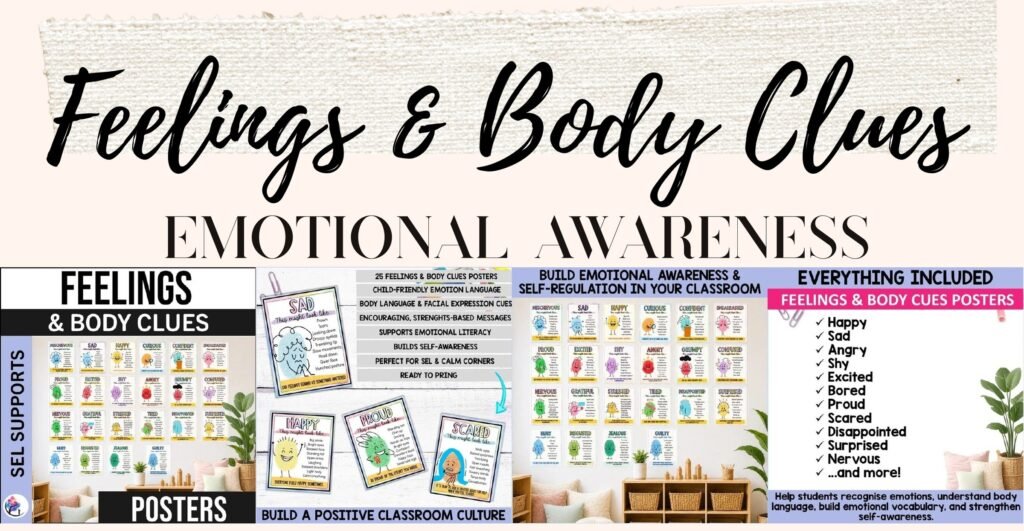
Try this in your next session: our Feelings & Body Clues Posters give each emotion a child-friendly explanation alongside facial expressions, body language and internal body sensations, with gentle, trauma-informed messages that every feeling has a purpose. Use one poster as a daily check-in prompt (“Which clue do you notice in your own body today?”) or display the set in your calm corner so students can point to a feeling when words are hard to find. One reviewer wrote that “They give students a concrete way to recognize how emotions show up in their bodies, which has been so helpful during check-ins and emotional regulation lessons.”
2. Emotional Regulation and Perspective: Big Feelings Do Not Always Mean Big Problems
The size of a child’s emotion does not always match the size of the problem. A broken pencil leads to tears. A bump in line turns into an argument. One lunch break without a best friend feels like the end of the friendship. Saying “It’s not a big deal” comes from a caring place, but it can leave a child feeling dismissed, because to them it is a big deal. They are responding with the tools they currently have.
The goal is not to convince children their feelings are wrong. It is to help them build perspective: every feeling is valid, but not every situation needs the same response. As children learn to tell everyday frustrations from bigger challenges and genuine emergencies, they start to create a little space between the feeling and the reaction. That space is where regulation and problem solving begin.
Helpful reflection questions include:
- “How big is this problem, on a scale from glitch to emergency?”
- “How might this feel tomorrow?”
- “What is a reaction that matches the size of the problem?”
- “Who could help if it is a big problem?”
Picture a student whose drawing gets smudged by a classmate’s elbow. A counselor might say, “That was so disappointing. Let’s size it: is this a small, medium or big problem? What could we do about a small problem like this?” The child’s feeling is acknowledged first, and the problem solving comes second. For more regulation ideas to pair with this, see our emotional regulation activities for kids.
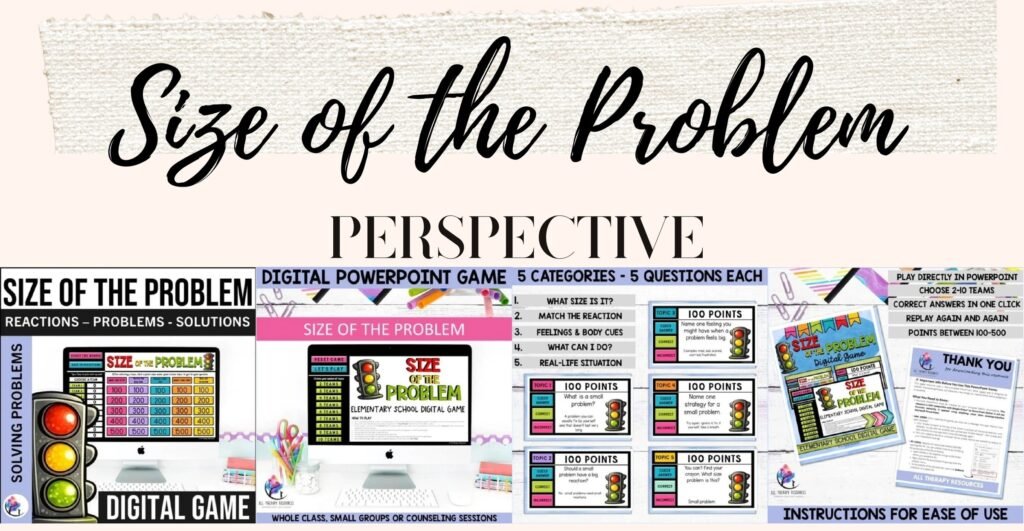
From our counseling room to yours: the Size of the Problem Digital Game is an interactive PowerPoint game that helps elementary students identify whether a problem is small, medium or big and choose a reaction that fits. It works well as a whole-class guidance lesson or with small groups, since you can play with 2 to 10 teams. Pause after each answer and ask, “What would a reaction that’s too big look like? What about one that fits?” so students practice flexible thinking rather than memorizing a chart, and reflect without shame or blame.
3. Impulse Control: The Power of the Pause
If one skill shows up across almost every area of a child’s day, it may be the ability to pause. The pause between feeling angry and shouting. Between frustration and giving up. Between being left out and saying something hurtful back. Between an urge and deciding whether to act on it.
For young children that pause is often tiny; feelings, thoughts and actions happen almost at once. That is not because they are “naughty.” Self-regulation and executive function skills are still developing, and as the Center on the Developing Child at Harvard University notes, children are not born with these skills but have the potential to develop them through interactions and practice. Impulse control is therefore more than teaching children to “stop.” It is building the thinking skills that make stopping possible.
This changes our conversations. Instead of “Why did you do that?”, try “What happened so fast that your thinking didn’t have time to catch up?” That question invites reflection rather than defensiveness, and it opens the door to planning: “Next time you feel that rush, what could your pause look like? A breath? Hands in pockets? Walking to the water fountain?” Our article on impulse control games for children has more practice ideas.
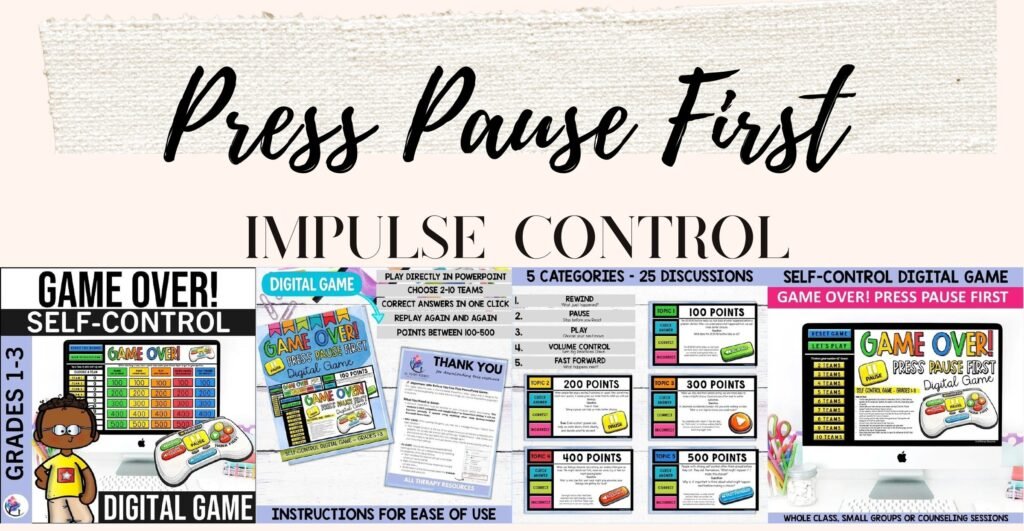
Try this in your next session: Game Over! Press Pause First is a video game-themed PowerPoint game built around one idea: the most powerful button is not PLAY, it’s PAUSE. Students work through real-world scenarios and discussion questions that link triggers, feelings, choices and consequences. Before each round, have the group agree on a “pause signal” they will use during the week, then check in on it next session. One reviewer said it “turned practicing impulse control and stopping to think before acting into something fun and engaging.”
4. Healthy Thinking: The Story a Child’s Mind Tells
Two students can receive the same feedback and walk away feeling completely different. One thinks, “I’m still learning. I’ll keep practicing.” The other decides, “I’m terrible at this. I’ll never be good enough.” Nothing about the situation changed. The difference is the story each child’s mind is telling.
Cognitive behavioral therapy (CBT) offers a useful framework here. As the American Psychological Association explains, CBT rests partly on the idea that psychological problems are linked to unhelpful ways of thinking, and that people can learn to recognize those distortions and reevaluate them. In child-friendly terms, one mistake becomes “I always get things wrong,” one disagreement becomes “Nobody likes me,” and one tricky math lesson becomes “I’m just not smart.” Left unchallenged, those thoughts shape confidence, motivation and behavior.
The encouraging part is that healthy thinking can be taught. Rather than telling children to “think positive,” help them become investigators of their own thoughts:
- Notice the thought: “What did your brain say to you right then?”
- Check the evidence: “What tells us that’s true? What tells us it might not be the whole story?”
- Try a fairer thought: “What would you say to a friend who thought that?”
Picture a fourth grader who crumples a worksheet and says, “I’m the dumbest kid in the class.” A counselor might respond, “That sounds like a heavy thought. Let’s be detectives for a minute. Is there any evidence that you’ve learned hard things before?” The aim is a realistic, compassionate thought, not a forced positive one. Many children find it freeing to learn that not every thought deserves to be believed simply because it showed up.
5. Personal Safety: More Than “Stranger Danger”
Safety education once focused almost entirely on strangers: don’t talk to people you don’t know, don’t accept rides, stay close to trusted adults. Those messages still have a place, but personal safety is much broader. It means helping children notice when something doesn’t feel right, understand that their body gives them important information, know that boundaries matter, identify safe adults, and feel confident asking for help. Being polite should never come at the expense of feeling safe.
These skills connect directly to the other four. A child who can name “uncomfortable” or “confused” (emotional awareness), stay steady enough to think (regulation), pause before going along with something (impulse control), and question a thought like “I’ll get in trouble if I tell” (healthy thinking) is better placed to seek help. Research on school-based body safety education is encouraging but should be described carefully: a Cochrane review found that programs improved children’s knowledge and protective behaviors and did not increase anxiety or fear, while noting that studies have not yet adequately measured long-term effects on abuse itself.
Practice can be gentle and scenario based. Picture a small group sorting cards into “safe,” “unsafe” and “check with a trusted adult,” then naming one trusted adult at school and one at home. A useful script is: “If something feels wrong, you can say no, get away, and tell a trusted adult. If the first adult doesn’t listen, keep telling until someone does.” For a deeper look at teaching this without fear or shame, see My Safety Matters and our guide to safe and unsafe secrets.
Try this in your next session: keep safety lessons predictable and low pressure. Use fictional characters rather than asking students about their own experiences, offer a “pass” option during discussion, and tell the group in advance how to reach you privately afterward. If a child does disclose, follow your school’s child protection procedures.
Why These Skills Work Best Together
It is tempting to schedule social-emotional learning as separate topics: regulation on Monday, problem solving on Tuesday, impulse control on Wednesday. Children don’t experience life that way. Picture a student who is upset after an argument with a friend. To repair it, they need to recognize what they are feeling, settle enough to talk calmly, notice the thoughts coloring their view of what happened, and pause rather than react. Every skill is working at once.
That is why we treat each lesson as a different entry point into the same larger goal. A child referred for anxiety often benefits from emotional awareness, healthy thinking and problem solving. A child referred for impulsive behavior may need regulation and perspective as much as a self-control strategy. A student with friendship difficulties may be struggling to read their own feelings or interpret social situations. When you plan a group, choose one primary skill and deliberately weave in the others; our guide to planning a small group counseling curriculum shows how to structure that across sessions. If you want to go further into how the brain fits into all of this, our article on brain-based SEL explores teaching emotional regulation through neuroscience.
Most meaningful growth happens quietly. A child notices frustration before it becomes overwhelming. They question a worried thought instead of believing it. They ask for help instead of giving up. They choose kindness after feeling hurt. Those small moments are the skills children will carry into adolescence, relationships, workplaces and families.
Frequently Asked Questions
What are the core social-emotional skills children need?
Frameworks differ. CASEL, whose framework many US schools use, describes five core competencies: self-awareness, self-management, social awareness, relationship skills, and responsible decision-making. In elementary counseling, it can help to break these into concrete, teachable skills such as emotional awareness, emotional regulation, impulse control, healthy thinking, and personal safety, alongside social and friendship skills.
Are these five skills the same as CASEL’s five competencies?
No. The five skills in this guide are a practical breakdown that maps mainly onto CASEL’s self-awareness and self-management competencies, with personal safety drawing on responsible decision-making and relationship skills. Social awareness and broader relationship skills need their own dedicated teaching.
Should social-emotional skills be taught separately or together?
Explicit lessons that focus on one skill at a time are useful, but children use these skills together in real situations. Name one target skill per lesson, then point out how it connects to the others and practice them together through scenarios, role-play and games.
What age are these strategies suited to?
The examples here are written for elementary students. The same skills matter for preteens and teens, but older students usually respond better to more complex scenarios, more choice, and less visual scaffolding.
Looking for practical, ready-to-use resources to support your social-emotional learning lessons? The All Therapy Resources Membership provides access to a growing collection of thoughtfully developed counseling activities, interactive games, and therapeutic tools designed to save preparation time while supporting meaningful, skill-focused learning.