
Ask a group of young children how they are feeling, and you will often hear the same three answers: happy, sad or mad. Perhaps one child says “excited” and another quietly admits to being scared. For many children, those few words are the whole vocabulary they have for an inner world that is far more varied than the words suggest. A child who says “mad” may be embarrassed, disappointed, left out or worried about tomorrow’s spelling test.
That gap matters. Coping strategies such as breathing, movement and calm corners all have an important place in school counseling, but a child has to notice and name what is happening inside before they can choose a strategy that fits. This article focuses on that earlier step: what emotional awareness is, why naming feelings and noticing body clues help, and practical emotional awareness activities for kids that you can use in classrooms, small groups and individual sessions. If you are looking for calming and coping practice once children can recognize their feelings, our companion guide, 10 Emotional Regulation Activities for Kids, picks up where this one leaves off.
What Is Emotional Awareness, and Why Does It Come Before Regulation?
Emotional awareness (often called emotional literacy) is the ability to notice, name and understand feelings in ourselves and in other people. CASEL’s framework places “identifying one’s emotions” at the heart of self-awareness, one of its five core social-emotional competencies, alongside understanding how emotions, thoughts and values influence behavior.
Emotional vocabulary also develops gradually. Research by Nook and colleagues (2017) found that children’s emotion concepts tend to be organized mainly around “good versus bad” feelings, becoming more differentiated with age, and that growing verbal knowledge helps drive that change. In other words, children are not simply hiding feelings they could describe if they tried. Many are still building the language to describe them.
In practice, this means emotional awareness is less a single lesson than a foundation. When a child can say “I’m disappointed” rather than throwing a pencil, the adult has something to respond to, and the child has a starting point for choosing what might help.
Try this in your next session: before teaching any coping strategy, ask, “What do you notice right now? Is it in your body, your thoughts, or both?” Accept “I don’t know” as a valid answer and offer two or three choices: “Some kids feel frustrated, some feel worried, some feel tired. Does any of those fit?” Choices lower the pressure while still building vocabulary.
Why Naming Feelings Matters: Affect Labeling and Emotional Granularity
Putting feelings into words can feel like a simple vocabulary exercise, yet it does more than add words to a list. In a well-known brain imaging study, Lieberman and colleagues (2007) found that when adults labeled the emotion in a picture of a face, activity in the amygdala dropped compared with matching the face to a name, while a prefrontal region linked to regulation became more active. A later review by Torre and Lieberman (2018) describes this “affect labeling” as a form of implicit emotion regulation: naming a feeling can soften its intensity even though it does not feel like a deliberate calming strategy. Most of this research has been carried out with adults, so it is best viewed as a helpful rationale for feelings-naming work with children rather than direct proof of its effect in classrooms.
A related idea is emotional granularity (also called emotion differentiation): the ability to describe feelings with precision rather than in broad strokes. In their review, Kashdan, Barrett and McKnight (2015) report that people with more finely differentiated emotional experience are less likely to turn to unhelpful coping, such as aggression, when they are highly distressed, and they describe emotion differentiation as an important developmental process. For children, that is a strong reason to move gradually from “mad” toward words such as frustrated, jealous, embarrassed or left out.
Picture a student who comes back from lunch saying they are angry. The adult might move straight to calming strategies. But the student may be embarrassed after dropping a tray in front of classmates, or hurt because a friend sat somewhere else. Each feeling points toward a different kind of support: reassurance, repair with a friend, or time to reset. The more precisely children can name what they feel, the more accurately they, and the adults around them, can respond.
A short script can help: “You said you’re mad. I wonder if there’s another feeling under the mad. Sometimes mad has embarrassed or disappointed hiding underneath. What do you think?”
From our counseling room to yours: for Grades 1–3, our Feelings Identification PowerPoint Digital Game gives children repeated, low-pressure practice recognizing and naming emotions through everyday scenarios, then choosing a supportive next step. Project it for whole-class SEL or use it in a small group, pausing on each scenario to ask, “What clues told you how they felt?” One reviewer wrote, “This digital game worked beautifully for helping students identify and talk about emotions.” Another uses it for check-ins and check-outs in individual and group lessons, and another changed the colors to match the Zones of Regulation language their students already knew.

Body Clues: Where Interoception Fits In
Emotions often show up in the body before a child has words for them. Shoulders tense, the stomach tightens, fists clench, breathing speeds up. By the time adults see shouting, tears or refusal, those signals may have been building for several minutes. The behavior is usually the first thing we see, but rarely the first thing the child experiences.
Researchers call our awareness of these internal signals interoception: the perception of bodily states such as heart rate, hunger, temperature and muscle tension. A review by Murphy, Brewer, Catmur and Bird (2017) describes how interoception changes across development and notes a link between lower interoceptive ability and alexithymia, or difficulty identifying one’s own emotions. The authors are also clear that interoception in childhood is understudied, so the research here is promising rather than settled. Teaching body clues is best presented as an evidence-informed practice that supports emotional awareness, not as a stand-alone fix.
It can help to think of body clues as a child’s own early weather report. A darkening sky, a sudden breeze and the first few drops of rain arrive before the storm, and a child who learns to read those signs has time to find shelter. In the same way, a racing heart or a hot face can tell a child, “Something big is building,” while there is still time to ask for help, take a break or use a strategy. Without that report, every emotional storm seems to come out of nowhere.
Keep body-focused activities invitational. Some children, including some with trauma histories or sensory differences, find attention on internal sensations uncomfortable. Offer choices (“You can point to the picture, draw it, or pass”), keep it brief, and pair body awareness with grounding in the room around them. Our article on teaching body sensations and interoception through body mapping goes deeper into this approach.
Try this in your next session: our Body Mapping & Interoception Collaborative Poster pairs a child-friendly body scan script with a large body outline, open-ended symbol and color cards, and 40 question prompts such as “How does excitement feel in your body?” Invite children to place cards where they notice a feeling, then compare: “Worry shows up in your tummy. For your friend, it’s in their shoulders. Both are real clues.” It works well with younger students in small groups and individual sessions. As one reviewer put it, “Wonderful resource to assist with teaching emotional skills. My students don’t even realize they are learning.”

Stories Give Children a Safe Distance From Big Feelings
Ask a child to describe their own worries, and they may freeze. Ask them how a character in a story might be feeling, and the conversation often opens up. Talking about someone else’s emotions first creates a little distance, and that distance can make reflection feel safer, especially for children who are anxious about being “in trouble” or who have learned to keep feelings hidden.
Stories let children practice the core emotional awareness skills without pressure: noticing clues on a face or in a situation, naming the feeling, wondering what caused it and thinking about what might help. Over time, the conversation can gently shift back to the child: “Have you ever felt a little like that?”
Picture a student who shrugs whenever you ask about their day. Reading a short social narrative together, they may confidently explain that the character feels left out because nobody asked them to play. That explanation is a skill in action, and it gives you a bridge to their own experience without demanding personal disclosure.
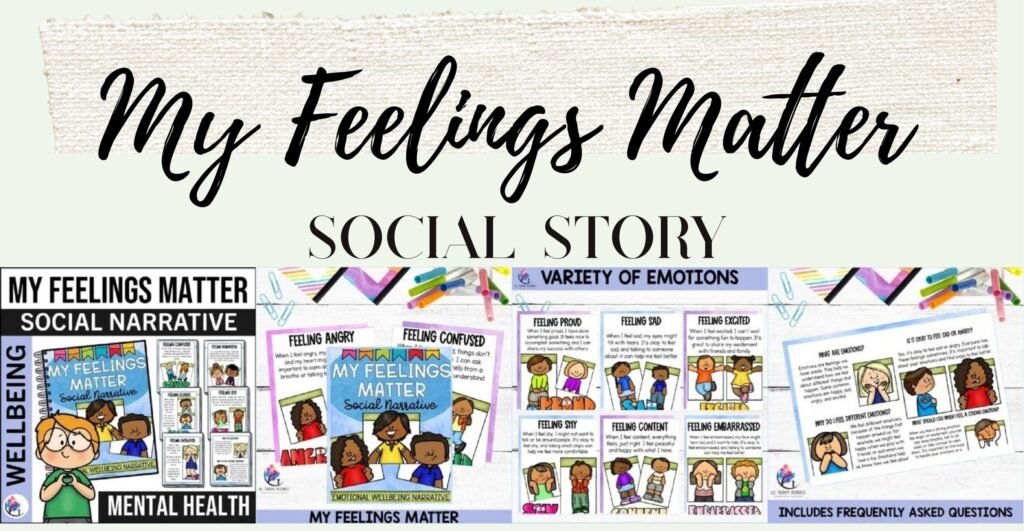
From our counseling room to yours: My Feelings Matter Social Narrative Story introduces young children to a range of emotions with relatable illustrations, simple language, scenarios and strategies, and a short FAQ that answers common questions children ask about feelings. Read one page at a time, then invite children to point to the feeling they have noticed this week or show it with their face. One reviewer shared, “I used the ‘My Feelings Matter’ social narrative in my sessions, and it really empowered my students to express their emotions confidently.”
Emotional Awareness Activities for Kids: A Quick Guide
Children tend to build emotional vocabulary through many short, varied experiences rather than one long lesson. Movement, discussion, sorting and play all give repeated exposure without the lesson feeling repetitive. Use this table to choose an activity that matches the skill your students are working on.
| Activity | What children practice | How it works | Suggested ATR resource |
|---|---|---|---|
| Feelings word ladder | Emotional granularity | Start with a big word (mad) and build a ladder of more precise words (annoyed, frustrated, furious), matching each to a situation. | Feelings and Emotions Cards |
| Feelings write the room | Recognizing emotions in different situations | Children move around the room finding scenario cards, naming the feeling and comparing answers with a partner. | Feelings Write the Room |
| What’s under the mad? | Noticing feelings beneath anger | Read a short scenario where a character “acts mad,” then sort possible hidden feelings such as embarrassed, hurt or worried. | I Feel Embarrassed Social Narrative |
| Spin and share | Linking feelings to experiences | Spin a feelings wheel and share a time a character, or the child, felt that way. Allow a pass option. | Therapeutic Wheels |
| Body clue check-in | Interoception and early warning signs | At the start of a session, children point to where they notice a feeling on a body outline and give it a name, color or weather symbol. | Body Mapping & Interoception collection |
Whichever activity you choose, keep the emphasis on curiosity rather than right answers. Two children can read the same situation differently, and discovering that is part of building empathy.
Curiosity Before Correction: Reading Behavior as Communication
One of the most useful shifts in emotional awareness work is changing the question we ask. Instead of “Why is this child behaving like this?”, try “What feeling might this child not yet recognize?” A child who refuses to start a math task may be overwhelmed by embarrassment or fear of getting it wrong. A child who lashes out on the playground may be hurt at being left out. A child who seems defiant may be anxious in ways they cannot yet describe.
This does not mean behavior is ignored or boundaries disappear. It means the adult gets curious about what the emotion is communicating before moving to consequences or strategies. Treating feelings as information, rather than as problems to make disappear, helps children see that emotions are not working against them. Over time, many children become less frightened of strong feelings once they can recognize and describe them.
Try this in your next session: when a child is calm again after a difficult moment, walk back through it together with three short questions: “What did you notice in your body first?”, “What word fits that feeling best?” and “What might help next time that clue shows up?” Write their words down so they can see their own emotional vocabulary growing.
Emotional Awareness Grows Over Time
Emotional growth is rarely dramatic. It usually shows up in small moments: a child who always said “I don’t know” says, “I think I’m disappointed.” Another notices a racing heart and asks for a break before things escalate. Someone who usually reacts with anger pauses long enough to say they feel hurt.
These moments look small from the outside, but each one represents a child understanding themselves a little better. That is why emotional awareness works best as an ongoing conversation woven through the school year, revisited with each new friendship, disappointment, success and challenge, rather than a single lesson in the SEL calendar. For more on how play supports this ongoing learning, see our article on play-based SEL and emotional regulation.
Frequently Asked Questions
What is the difference between emotional awareness and emotional regulation?
Emotional awareness is noticing, naming and understanding feelings. Emotional regulation is managing how intense a feeling becomes and how we respond to it. Awareness usually comes first, because a child needs to recognize a feeling before they can choose a strategy that fits it.
What are some simple emotional awareness activities for kids?
Feelings word ladders, feelings write the room, story character discussions, feelings wheels and body clue check-ins are all simple to run. Short, frequent practice across different settings tends to be more useful than one long lesson.
What is emotional granularity?
Emotional granularity is the ability to describe feelings precisely, for example telling the difference between frustrated, embarrassed and disappointed rather than calling all three “mad.” Research with adults links greater granularity with less reliance on unhelpful coping under stress, and emotion vocabulary becomes more differentiated as children develop.
What are body clues?
Body clues are the physical sensations that often come with emotions, such as a racing heart, butterflies in the stomach, tense shoulders, clenched fists or changes in breathing. Noticing them can give children an earlier signal that a feeling is building. Keep body-focused activities optional, since some children find attention on internal sensations uncomfortable.
References
- CASEL: The CASEL 5 framework (self-awareness)
- Kashdan, Barrett & McKnight (2015): Unpacking emotion differentiation
- Lieberman et al. (2007): Putting feelings into words (ScienceDaily summary)
- Murphy, Brewer, Catmur & Bird (2017): Interoception and psychopathology, a developmental neuroscience perspective
- Nook et al. (2017): Increasing verbal knowledge mediates development of multidimensional emotion representations
- Torre & Lieberman (2018): Putting feelings into words, affect labeling as implicit emotion regulation
Looking for practical, ready-to-use resources to support your emotional awareness and feelings lessons? The All Therapy Resources Membership provides access to a growing collection of thoughtfully developed counseling activities, interactive games, and therapeutic tools designed to save preparation time while supporting meaningful, skill-focused learning.