Every year, students walk into a new school carrying far more than a backpack. Some arrive excited about electives and new friends. Others arrive with a head full of unanswered questions: Will I find my classes? Will anyone sit with me? Can I keep up? Many feel excitement and anxiety at the same time.
A well-planned school transition program is how school counselors turn those questions into a sense of “I can do this.” It is not a single orientation morning. It is a support plan that runs across grade levels, from planning in the spring before the move, through family communication and orientation, to check-ins in the weeks after students arrive, with extra layers for the students who need them. This guide walks through each phase, whether you are sending students on from elementary or middle school or welcoming them into middle or high school.
Why a school transition program matters
Researchers have described the move from primary to secondary school as one of the most stressful events in a young person’s life. A 2018 review in Frontiers in Psychology found that many studies link the transition to dips in grades and academic self-concept. Findings on anxiety and mood are more mixed, but one pattern was consistent: students who report more worries before the move are more likely to struggle afterward. Positive peer relationships before the transition, teacher support, parental support for autonomy and a growing sense of school belonging were all associated with better outcomes.
The move into high school carries its own stakes. Research from the University of Chicago Consortium on School Research found that ninth graders who are “on track” (earning enough credits to move on to tenth grade with no more than one semester F in a core subject) were four times more likely to graduate than students who were off track. Freshman course performance predicted dropping out better than race, ethnicity, poverty and prior test scores combined. In other words, the first year after a transition is a window where well-timed support can make a measurable difference.
Programs also work best when they are not one-dimensional. A strategy brief from the University of Nebraska–Lincoln summarizes research suggesting that transition programs involving students, families and teachers together have the strongest effects, while efforts that address only one aspect show little independent effect.
Every transition involves both excitement and loss
Before planning logistics, it helps to remember what students are leaving behind: the teacher who believed in them, the classroom where they finally felt confident, the friendship group that made school feel safe, and an environment where they understood exactly how everything worked. Even students who are excited to move on may be grieving some of that.
When we recognize that transitions involve both excitement and loss, nervousness stops looking like something students need to “get over” and starts looking like an understandable response to change. That shift shapes every phase of the program, from the tone of the first lesson to how we respond to a student who is struggling in October.
Phase 1: Plan early and plan together
Strong transition support usually begins in the spring before the move, and it works best as a partnership between the sending and receiving schools. Practical planning steps include:
- Build a small transition team. Include counselors from both schools, a grade-level teacher or team leader, a special education representative and, where possible, an administrator who can protect time for the work.
- Share what matters, with appropriate consent. Agree on what information travels with students (attendance patterns, academic concerns, IEP and 504 plans, known peer or safety issues) and how it will be shared in line with your district’s privacy policies.
- Identify students who may need more. Ask sending teachers and counselors to flag students who have voiced a lot of worry, have attendance or academic concerns, have additional learning needs, are new to the district, or have experienced recent loss or adversity.
- Map the year. Set dates for student lessons, family events, orientation, and check-ins in the first weeks of the new school year, so support does not stop on the last day of the old school.
The timeline below shows how the phases fit together.
| Phase | When | What it looks like | Suggested ATR resource |
|---|---|---|---|
| Planning | Late winter to spring | Transition team, information sharing, list of students needing extra support | Transitions collection |
| Student preparation | Spring, before the move | Classroom lessons on what will change, worries, organization and asking for help | Moving Up to High School Presentation |
| Practice and review | End of year | Game-based review of scenarios and problem-solving | Middle School Survival Files or High School Survival Files |
| Family communication | Spring to early fall | Family evening, take-home information, clear contacts | High School Mental Health Parent Workshop |
| Orientation | Summer to first week | Tours, meeting key adults, practicing schedules and routines | Getting to Know Your School Counselor Game (High School) |
| Check-ins after the move | First 6 to 8 weeks, then each grading period | Brief student check-ins, lunch groups, early review of attendance and grades | Conversation Starters Card Game |
Phase 2: Prepare students emotionally and practically
Practical skills usually get most of the attention: reading a schedule, opening a locker, managing homework, finding classrooms. These matter, but successful transitions involve much more. Students are also learning to manage greater independence, navigate changing friendships, cope with higher academic expectations and advocate for themselves.
The worries students carry are rarely the ones adults predict. Students moving into middle school often wonder whether they will remember their locker combination, get to class on time or know who to sit with at lunch. Students moving into high school share many of those concerns, joined by bigger questions: Will I choose the wrong classes? How will I balance homework, sports, friends and maybe a part-time job? Where do I fit now?
Anxiety often convinces young people that they are the only one feeling uncertain. One of the most useful things a transition lesson can do is let students hear that classmates carry almost identical worries. Helpful lesson elements include:
- Anonymous question boxes, so students can ask what they would never say out loud, answered in the next session.
- Realistic scenarios, such as “Your locker won’t open and the bell is about to ring” or “Your friends are in different classes and you don’t know anyone at lunch,” followed by problem-solving in small groups.
- Explicit help-seeking practice, including who to ask at the new school and the words to use.
- Executive functioning skills taught before they are needed, such as using a planner and breaking a larger assignment into steps. Our guide to executive functioning activities for teens has more ideas.
Students moving into middle school are often managing multiple teachers and classrooms for the first time, alongside puberty and growing awareness of social status. Students moving into high school are more likely to be thinking about credits, course choices and future pathways. Under both sets of concerns sits the same question: “Can I do this?” Our job is to help students answer yes with some evidence behind it.
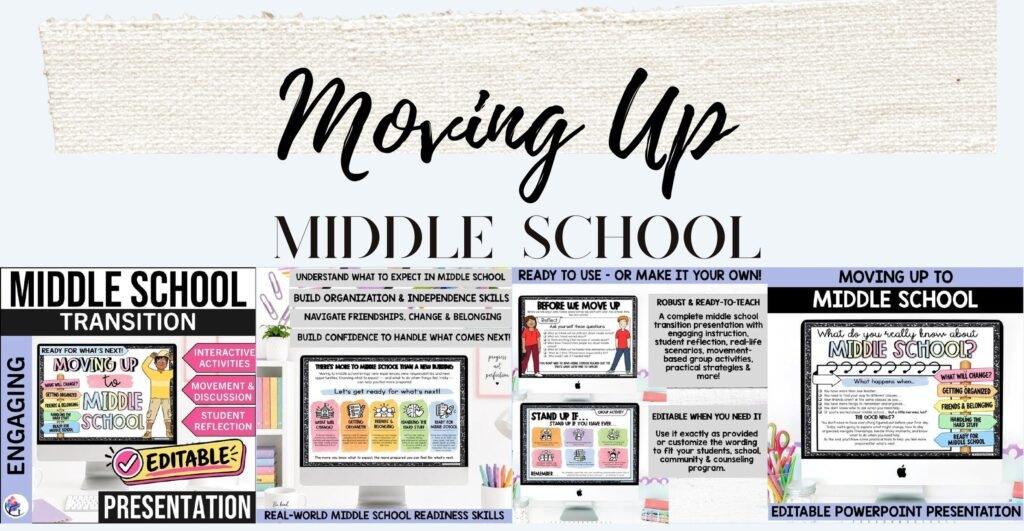
Try this in your next classroom lesson: if you are preparing fifth or sixth graders for the move, our Moving Up to Middle School: Ready for What’s Next! presentation is an editable lesson that uses realistic scenarios, student stories, discussion and reflection to explore schedules and routines, organization, changing friendships, belonging and asking for help. Edit the slides with your receiving school’s details, then pause on the scenario slides so small groups can plan what they would do. One educator wrote, “It covered so many of the questions and worries students have about moving to middle school, and the interactive activities kept them engaged.”
Phase 3: Communicate with families
Families are often as anxious about the move as their children, and they are the adults students talk to at home when worries surface at bedtime. Clear, early communication helps parents and caregivers respond calmly instead of either dismissing worries or amplifying them.
- Hold a family information evening before the move, ideally with staff from the receiving school present, and offer a recording or summary for families who cannot attend.
- Give families one clear contact at the new school and explain how to reach the counselor.
- Explain what is typical in the first weeks (tiredness, irritability, friendship shifts, some dip in grades) and what might signal a need for closer attention (persistent school avoidance, withdrawal, or worries that keep growing rather than settling).
- Share simple conversation starters, such as “What was one thing that felt easier than you expected today?” rather than “How was school?”
- Remove barriers. Offer translated materials and interpreters where needed, and vary meeting times. Our article on parent communication tips for counselors covers how to keep these conversations collaborative.
Research on the transition suggests parental support for growing autonomy matters, so encourage families to stay connected while letting students take on new responsibilities, rather than stepping in to solve every problem.
Try this at your next family evening: our Middle School Mental Health Parent Workshop is an editable presentation and Parent Support Toolkit for families of students in Grades 6–8. It covers stress, anxiety and big emotions, changing friendships and the online world, staying connected as independence grows, and how to judge when something needs closer attention. Run it in the fall of sixth grade as part of your transition program, adding your school’s support contacts to the final slides, so families have shared language for the conversations happening at home.

Phase 4: Make orientation about confidence, not only information
Orientation is valuable, but confidence rarely develops in a single morning. The most useful orientations go beyond a tour and give students a chance to rehearse the moments they are worried about: walking their schedule, opening a practice locker, finding the cafeteria, the nurse and the counseling office.
Consider adding:
- Peer mentors or student ambassadors from the older grades, who can answer the questions students may not ask an adult.
- Meeting key adults by name, including the counselor, so students know who to go to before they need help. Our post on back-to-school counseling activities has ideas for those first connections.
- Extra visits for students identified in Phase 1, in a quieter setting before the whole grade arrives.
Information still matters. The goal is that every question answered before the first day is one less uncertainty a student has to carry into it.
Phase 5: Check in after the move
Many transition programs end on the first day of school, which is when many students need support most. Plan brief, structured check-ins over the first six to eight weeks, then at each grading period.
- Whole-grade pulse checks: a short survey asking students how settled they feel, whether they have someone to sit with at lunch, and whether they know who to ask for help.
- Lunch groups for students who are still finding their people.
- Early review of attendance and grades, especially in ninth grade, where on-track research shows early course performance is a strong predictor of later outcomes. Reviewing data after the first few weeks lets you reach students before small problems become failed courses.
In individual check-ins, listen for the worry underneath the question. Picture a student who says, “What if I get lost?” in the second week. It is easy to reach for the school map. But the question underneath may be, “What if everyone realizes I don’t know what I’m doing?” A response might sound like:
“Lots of students feel that way in the first few weeks, even the ones who look confident. What would help you feel a bit more sure of where you’re going? And who could you ask if you do get turned around?”
When we respond to the emotion beneath the question, not only the practical concern, students leave feeling understood rather than simply informed.
Supporting students who need extra help with the transition
Most students settle within the first term with universal support. Some need more. Students with additional learning needs, students who experienced significant worry before the move, students new to the country or district, and students who have experienced trauma, loss or frequent school changes may benefit from a more individualized plan.
- Personalize the transition for students with IEPs or 504 plans: involve case managers early, share accommodations before the first day, and offer visual schedules or a written “who to go to” plan.
- Offer a small transition group that starts before the move and continues for several weeks afterward, with a consistent adult and a predictable structure.
- Use a trauma-informed lens. For some students, change itself can feel unsafe. Offer choices, predictable routines and a named adult, and avoid pushing for disclosure.
- Coordinate with your MTSS or student support team if a student’s attendance, grades or wellbeing are not improving, and refer for further assessment where needed.
If you are planning a transition group, our guide to planning a small group counseling curriculum walks through structure, session goals and measuring progress.
Try this with your transition group: our Small Group Counseling Data Tracker is an editable Excel workbook for tracking attendance, session goals aligned with ASCA Mindsets & Behaviors, and pre/post scores for up to 15 students. For a transition group, use a short “how settled do I feel?” rating as your pre and post measure, then share the printable outcomes report with your administrator or MTSS team. It turns your transition support into data you can show, which helps when you are asking for time to run the program again next year.

Frequently Asked Questions
What should a school transition program include?
Effective programs usually combine early planning between schools, classroom lessons that address both practical and emotional concerns, family communication, an orientation that lets students rehearse new routines, and structured check-ins after the move. Research summaries suggest programs that involve students, families and teachers together tend to have stronger effects than single activities.
When should transition planning start?
Many schools begin in late winter or spring of the year before the move, so there is time to share information, identify students who need extra support and schedule family events. Support should continue for at least the first six to eight weeks at the new school.
Why is the ninth grade transition so important?
Research from the University of Chicago Consortium on School Research found that ninth graders who are on track to move on to tenth grade are four times more likely to graduate than those who are off track. Monitoring attendance and course performance early in ninth grade gives schools a chance to support students before they fall behind.
How can counselors support anxious students before a school transition?
Normalize the worry, answer questions early, let students rehearse key situations (such as finding classes or asking for help), and connect them with a named adult at the new school. Students whose anxiety is persistent or interferes with daily functioning may need more individualized support or a referral.
References
- Evans, D., Borriello, G. A., & Field, A. P. (2018). A review of the academic and psychological impact of the transition to secondary education. Frontiers in Psychology, 9, 1482.
- UChicago To&Through Project: Freshman OnTrack issue brief
- Erickson, J., Peterson, R. L., & Lembeck, P. (2013). Middle to high school transition. Student Engagement Project, University of Nebraska–Lincoln.
Looking for practical, ready-to-use resources to support your school transition program? The All Therapy Resources Membership provides access to a growing collection of thoughtfully developed counseling activities, interactive games, and therapeutic tools designed to save preparation time while supporting meaningful, skill-focused learning.