Have you ever watched a child push a toy figure off a block tower, or bury a doll under layers of sand, and sensed that something was being said without words?
Children communicate in many ways, and some of their most meaningful messages arrive through symbolism in children’s play rather than direct conversation. For school counselors, psychologists, therapists, and allied health professionals, learning to notice symbolic play, and to respond without rushing to interpret it, makes our support for emotional expression, regulation, and connection more attuned.
This guide looks at how symbolism shows up, the themes that often appear, and how to respond in ways that keep the meaning with the child. It complements our article on symbolic play and trauma processing, with a closer focus on what you might notice and say in the moment.
What Is Symbolism in Children’s Play?
Symbolism in play refers to the way children use objects, stories, characters, and movement to represent something else: an experience, a relationship, a feeling, or a wish. A block becomes a phone, a dinosaur becomes a family member, a sandbox becomes a world with its own rules.
This might look like:
- A child rescuing the same stuffed animal session after session
- A superhero who keeps getting trapped
- Recurring themes of hiding, loss, or danger
- Animals that fight, or protect each other
- A castle that always falls down
These scenes are more than games. They can carry emotional meaning for the child, even when neither the child nor the adult can yet say what that meaning is. That uncertainty matters, and we return to it below.
Why Symbolic Play Matters in Therapy
Symbolic play can be especially helpful for children who:
- Have experienced trauma or loss
- Are minimally verbal or have limited language skills
- Mask their emotions during direct conversation
- Feel unsafe expressing vulnerable feelings
- Live with complex family stress or carry adult worries
For these children, direct questions such as “How are you feeling?” or “Why did you do that?” can feel overwhelming. In the playroom, a child doesn’t have to say “I feel trapped.” They can show it through a character, at a distance that feels safe. This is one reason play-based approaches are so widely used with young children. A meta-analysis of 52 controlled studies found a moderate overall treatment effect for child-centered play therapy, with results varying by factors such as caregiver involvement and treatment integrity (Lin & Bratton, 2015). Play suits many children well, but it is never a substitute for clinical judgment.
Picture a child who sets up a row of dinosaurs every session and always places one alone in the corner, saying quietly, “He doesn’t belong.” Over several weeks, a bridge appears in the middle of the scene, and the lonely dinosaur moves a little closer each time. The adult never tells the child what the dinosaur “means.” They notice, reflect, and let the story unfold at the child’s pace.
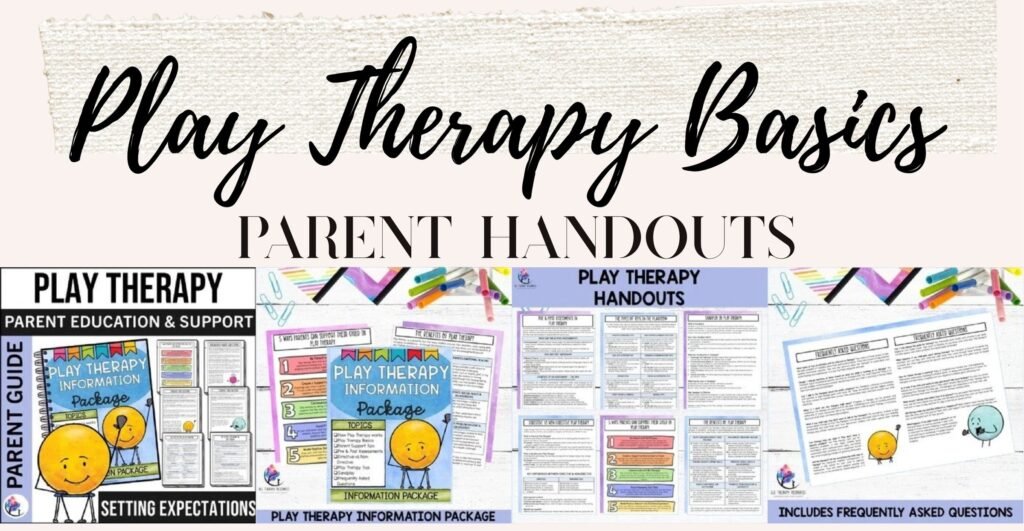
Try this with families and staff: when a parent or teacher asks, “Isn’t that just playing?”, a clear explanation of how play supports children builds trust in the process. Our Play Therapy Information Package includes play therapy basics and parent handouts to share before sessions begin, so caregivers understand why the child leads. One reviewer described it as a “Wonderful resource to assist me with explaining the importance of play with my students.”
How to Recognize Symbolism in Play
Symbolism often shows up through a few recognizable patterns. Treat each one as something to notice and track over time, not as a conclusion.
Repetition
Children often replay the same scene. This is rarely a lack of creativity. Repetition can help a child gain a sense of mastery over something that felt confusing or frightening, and small changes from one version to the next are worth noting. Repetition is not always a sign of progress, though. Psychiatrist Lenore Terr described posttraumatic play that is literal, ritualistic, and repeated without bringing the relief that ordinary play usually brings, a distinction summarized in this 2022 study of post-traumatic play (D’Elia et al.). If a child’s play stays rigid, seems to increase distress, or doesn’t change over many sessions, consult a supervisor or a credentialed play therapist.
Role Choices and Role Reversals
Children might play the aggressor, the rescuer, or the helpless one, and sometimes switch between them. Notice which roles a child chooses, which they avoid, and which roles they give to you. Taking the powerful role in play can be a healthy way to experience control, so it isn’t automatically a concern.
Metaphor and Characters
Animals, superheroes, or fantasy characters may stand in for real people or feelings. A volcano could relate to anger, or it could simply be a volcano. A locked box could hold a secret, a treasure, or nothing in particular. Symbols are personal: the same toy can mean different things to different children, and different things to the same child over time. Hold any idea about meaning as a hypothesis, not a fact.
Spatial Symbolism
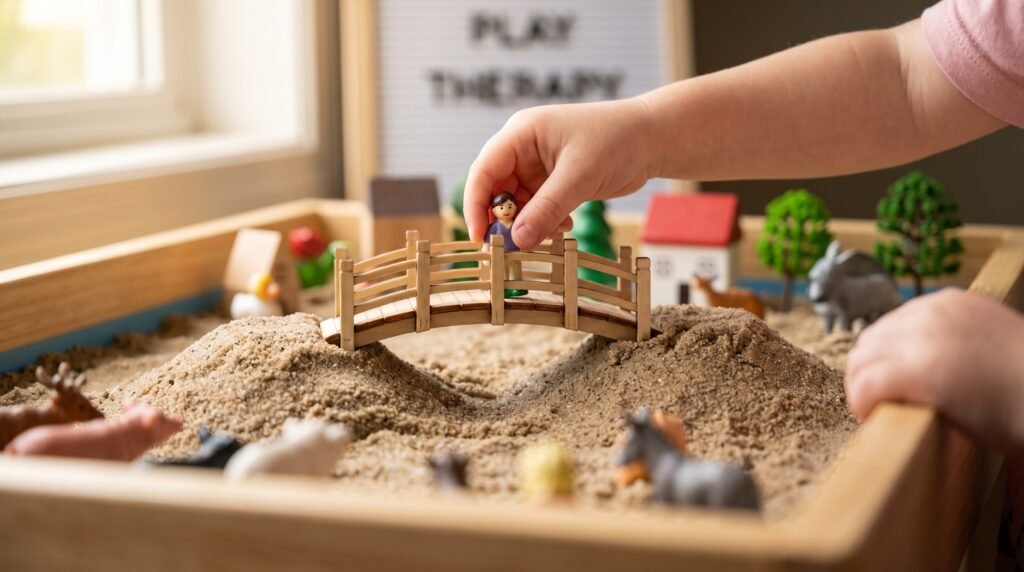
Is something always placed far away? Is something buried, hidden, or fenced in? Is there a barrier between figures? Placement and distance can reflect how a child experiences closeness, safety, or separation. Patterns across several sessions tell you far more than a single arrangement. If you use a sand tray, our guide to sand tray therapy prompts covers how to facilitate without taking over.
Common Themes in Symbolic Play
Play therapists often track recurring themes rather than individual symbols. Themes can point toward what a child is working on, but they are not diagnostic, and no single theme tells you what has happened in a child’s life. Danger themes, for example, may reflect anxiety, something seen in a movie, or lived experience, and the play alone can’t tell you which.
| Theme | What it can look like | A response that stays with the play |
|---|---|---|
| Control and power | The child directs every character, makes the rules, and decides every outcome | “You’re the one who decides what happens here.” |
| Rescue and protection | Characters are repeatedly saved, hidden, or kept safe | “That little one keeps getting rescued. Someone is making sure he’s safe.” |
| Danger and fear | Hiding, chasing, storms, monsters, or disasters | “That looks scary for them. They found a place to hide.” |
| Family roles | Toy families, who sits with whom, who is left out | “Everyone has a place at the table. This one is sitting further away.” |
| Nurturing and caretaking | Feeding, healing, or tucking in toys | “You’re taking such good care of her.” |
Want more ways to work with play themes? Our Metaphoric Stories, Sandplay Therapy Prompts, and Therapy Progress Form can support storytelling, sand tray work, and tracking change with families.
Supporting Symbolic Play Without Over-Interpreting
It’s tempting to say, “That dinosaur must be you.” One of the core principles of child-centered play therapy is following, not leading: the child sets the direction, and the adult stays close.
Be an Attuned Witness
A warm, consistent, nonjudgmental presence is central to the work. Reflect what you see with curiosity rather than interpretation.
Example: “That dinosaur stays on his own. I wonder what that’s like for him.”
Offer Gentle Invitations
If the child welcomes it, you might join the play by mirroring actions, offering a prop, or asking an open question from inside the story.
Example: “Would this one like to try joining the group, or is he not ready yet?”
Avoid Labeling Too Soon
We might sense a link between the play and the child’s life, but naming it before the child is ready can shut the play down, or replace the child’s story with ours. Stay close to the feeling in the play rather than the interpretation. The same care applies when talking with colleagues: sharing what a symbol “means” can lead other adults to treat a guess as a fact. Our article on confidentiality in play therapy looks at what to share and how.
Reflect and Contain
Use language that validates the feeling behind the play, even when the meaning isn’t clear.
Example: “There’s a lot happening in that game. That little figure had a hard time, and you stayed with him the whole way.”
When play raises a safety concern: play themes alone are not evidence that something has happened, and we never question a child through their play to confirm a suspicion. If a child discloses harm, or what you observe gives you reasonable cause for concern, stay calm, listen, don’t promise to keep it a secret, and follow your school or district protocol and mandated reporting requirements. In the USA: 988 Suicide & Crisis Lifeline (call or text 988, or chat at 988lifeline.org), Childhelp National Child Abuse Hotline 1-800-422-4453, or 911 in an emergency. In Australia: Lifeline 13 11 14 (text 0477 13 11 14), Kids Helpline 1800 55 1800, your state or territory child protection service (see the AIFS contacts page), or 000 in an emergency.
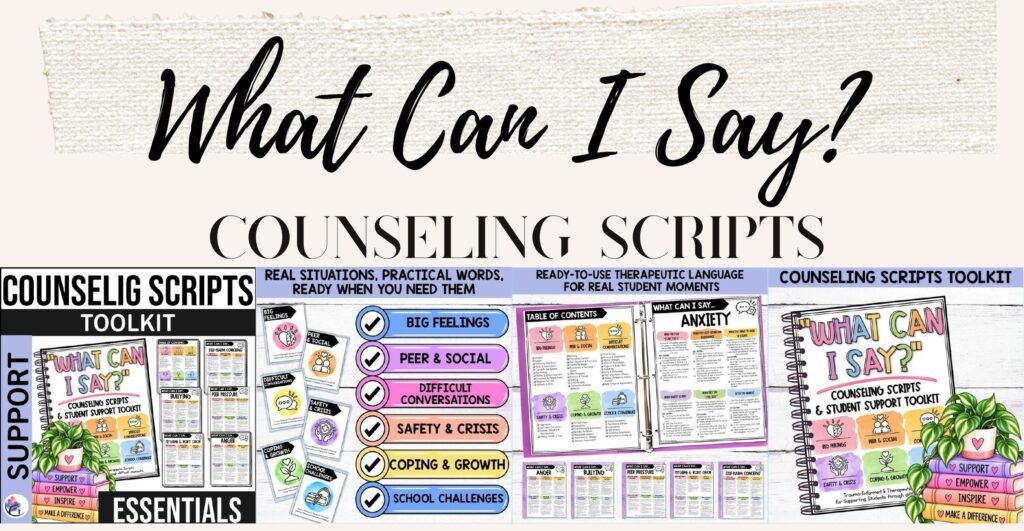
Try this in your next session: if finding the right words in the moment is the hardest part, our What Can I Say? Counseling Scripts Toolkit offers trauma-informed validation statements and reflective questions you can adapt for the children and teens you support. It isn’t play-specific, but it encourages you to consider what may be happening beneath behavior before responding. Keep two or three reflections on a card in your playroom and practice them until they sound like your own voice.
Symbolism and Caretaking Roles
For children who carry a lot of emotional responsibility at home, symbolism can be subtle. They may repeatedly take the helper or fixer role, or have one character carry another character’s burdens.
Picture a child who always plays the nurse caring for a sick toy, and never the patient. One possible meaning is a belief such as “My job is to look after others,” but only the child’s play over time, alongside what you know of their context, can tell you whether that fits. A gentle approach makes room without pushing: “The nurse works so hard. I wonder who looks after the nurse?” If the child one day chooses to be the patient, that shift deserves quiet notice rather than a big reaction.
Small shifts like these matter. They suggest the child is trying out new ways of being in a relationship, in a space that feels safe enough to try.
Practical Tips for Professionals
- Create a safe, predictable environment with consistent toys, routines, and limits, so symbolic play can unfold without pressure.
- Let the child lead where your role allows. Non-directive play therapy is a specialized approach. Professionals without play therapy training can still use core skills such as tracking, reflecting feelings, and following the child’s lead, ideally with supervision or consultation.
- Track themes across sessions. Brief notes on what recurs, what shifts, and how the child’s mood changes are more useful than notes on single symbols.
- Don’t rush to resolve or “fix” the story. Children often need to return to a theme several times. Watch for signs that play is stuck rather than moving (see Repetition above).
- Model emotional language without forcing insight: “That tiger looked brave today.”
- Respect the symbolic process even when it doesn’t make sense to you yet. The meaning belongs to the child.
Older children and teens use symbolism too. Our article on play therapy beyond early childhood explores how to adapt it.
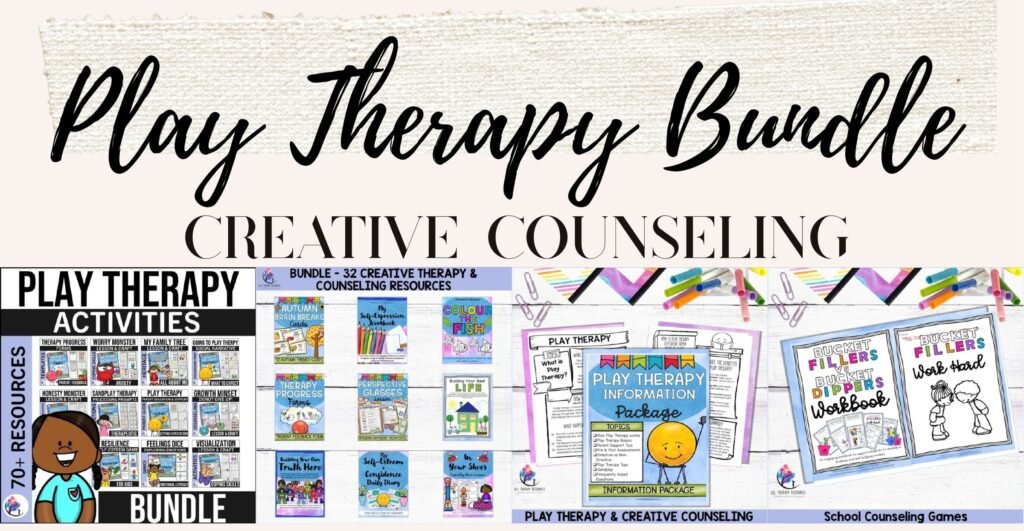
Try this in your next session: for children who need more structure than free play, or for small groups that need a shared starting point, our Play Therapy & Creative Counseling Activities Bundle includes sandplay therapy prompts, metaphoric stories, feelings dice, play dough mats, and creative expression crafts. Keep child-led play as your default, and offer one structured option, such as a sandplay prompt at the start of a group, when a child asks for direction.
Final Thoughts: Symbols Speak When Words Cannot
Children’s play is more than play. It can be their language, their way of saying, This is my world. Please see it.
When we slow down enough to observe, honor, and gently engage with symbolic play, children have a chance to feel heard. Often it isn’t a grand insight that helps most, but repeated small moments of connection and being understood.
It isn’t our job to translate every symbol. It is our job to make space for the child to explore what that symbol means to them.
Sometimes change begins when a dinosaur walks back to the group, when a hidden toy is finally found, or when the volcano cools down. And we’re right there with them.
Frequently Asked Questions
What does symbolism in children’s play mean?
It is the way children use toys, characters, stories, and movement to represent experiences, feelings, and relationships. Pretend play is a typical part of early childhood development, and in therapy it gives children a way to express what is hard to put into words.
Can school counselors use play therapy techniques?
Many school counselors use play-based skills such as tracking, reflecting feelings, and following a child’s lead. Play therapy as a specialized approach calls for specific training and supervision, so work within your training and consult a credentialed play therapist when needed.
When is repetitive play a concern?
Repetition is common and often helpful. It may be a concern when play stays rigid and literal, seems to increase distress rather than relieve it, or doesn’t change over time. In that case, talk with a supervisor or play therapist about next steps.
Looking for practical, ready-to-use resources to support your play-based counseling work? The All Therapy Resources Membership provides access to a growing collection of thoughtfully developed counseling activities, interactive games, and therapeutic tools designed to save preparation time while supporting meaningful, skill-focused learning.