
We tell teenagers to advocate for themselves all the time.
Speak up. Ask for help. Tell your teacher what you need. Set a boundary. Explain what happened. Go and talk to someone.
But there is a problem with that advice. Self-advocacy is not one skill. It is a sequence of skills, and when we tell a young person to simply “speak up,” we may be asking them to complete that entire sequence without ever having taught them how. Researchers describe self-advocacy in a similar way, as a set of components that includes knowing yourself and being able to communicate your needs effectively.
Before a teenager can advocate for themselves, they need to recognize that something isn’t working. They need to work out what they need, decide whether they can manage the situation themselves, identify an appropriate person to approach, find the words to explain what is happening, tolerate the discomfort of speaking up, listen to the response, and decide what to do next.
And sometimes, after doing all of that, the answer is still no.
That’s why meaningful self-advocacy skills for teens need to go much further than confidence or assertiveness. Self-advocacy involves self-awareness, communication, problem-solving, boundaries, help-seeking, decision-making, and the ability to stay engaged when the first attempt doesn’t immediately solve the problem.
That is the kind of self-advocacy we need to teach.
Self-Advocacy Actually Begins Before a Student Says Anything
We tend to think of self-advocacy as speaking, but the first part happens internally.
A student has to recognize: Something here isn’t working for me.
That sounds simple, but it isn’t always. A teenager might know they feel overwhelmed in a class without understanding why. They might repeatedly miss assignment deadlines without recognizing that they need clarification about how to prioritize their workload. They might feel uncomfortable in a friendship but struggle to identify which boundary is being crossed.
Before we ask, “What are you going to say?”, it can be much more useful to ask, “What do you actually need?”
This distinction matters because students can become very good at describing what they don’t want without being able to identify what would help.
“I hate this class.”
“She needs to leave me alone.”
“This assignment is impossible.”
“Nobody listens to me.”
Underneath those statements may be very different needs. One student needs instructions broken into smaller steps. Another needs space from a peer. Another needs clarification. Another wants to feel heard before discussing possible solutions.
Helping students move from “I don’t like what is happening” to “Here is what I need next” is one of the foundations of self-advocacy. Activities that build self-awareness, such as these identity and values activities for teens, make this step much easier.
Self-Advocacy Isn’t the Same as Getting Your Way
This is one of the most important distinctions we can teach teenagers.
Advocating for yourself means having a voice in what happens next. It doesn’t mean having complete control over the outcome.
A student can communicate clearly, explain their needs respectfully, ask an appropriate person for support, and still receive an answer they don’t like. A boundary may be acknowledged without another person agreeing with everything they say. A teacher may listen to a request but be unable to provide the exact solution the student wanted.
If we don’t teach this part, students can easily interpret an unsuccessful outcome as evidence that self-advocacy “didn’t work.”
Instead, we can help students understand that successful self-advocacy might mean being heard, gaining clarification, understanding the available options, negotiating a different solution, or knowing what the next step is.
Sometimes advocacy changes the outcome. Sometimes it changes our understanding of the outcome.
There is one important exception to teach clearly. If a student is being hurt, threatened or bullied, or feels unsafe, a “no” is not the end of the conversation. They should keep telling trusted adults until someone helps, and a friend’s secret that involves someone’s safety should always be shared with an adult.
Both can be valuable.
“Ask for Help” Is Surprisingly Complicated
Adults often say “You should have asked for help” after something has already gone wrong.
But think about what asking for help requires from a teenager.
First, they have to notice that they’re struggling. Then they have to decide that the problem is significant enough to involve someone else. They need to know who can help, find an appropriate opportunity to approach that person, explain what is happening clearly, and risk feeling embarrassed, vulnerable, or misunderstood.
For some students, asking for help also carries beliefs such as “I should be able to do this myself,” “They’ll think I’m stupid,” “I’m bothering them,” or “It isn’t serious enough.”
Research on young people’s help-seeking has found that embarrassment and a preference for handling things alone are among the biggest barriers, so these beliefs are worth naming out loud.
That means help-seeking skills benefit from being explicitly taught and practiced, not simply encouraged.
We can ask students to consider who they would approach for different problems. A classroom teacher might be appropriate for confusion about an assignment, while a counselor may be more appropriate for an ongoing friendship concern. Some situations might require a parent, administrator, coach, learning support teacher, psychologist, or another trusted adult.
Self-advocacy includes knowing not only when to speak, but who needs to hear it.
Students Often Know What They Need but Don’t Have the Words
There is another gap we see frequently.
A teenager may know exactly what they want to communicate internally, but translating that into words while feeling nervous, frustrated, embarrassed, or angry can be difficult.
This is where scripts can be very useful.
Scripts aren’t about giving teenagers robotic sentences they must repeat word for word. They provide a starting point when the student doesn’t know how to begin.
Instead of “I can’t do this,” a student might learn to say, “I’m not sure what I’m supposed to do next. Could you explain that part again?”
Instead of avoiding a difficult conversation with a teacher, they might try, “I’m falling behind and I’m not sure how to catch up. Could we work out what I should prioritize first?”
Instead of tolerating a friendship situation that repeatedly makes them uncomfortable, they might say, “I’m not comfortable with that. Please don’t share things I tell you privately.”
The more we allow students to rehearse these conversations before they urgently need them, the more accessible that language can become in the moment.
Boundaries Are Part of Self-Advocacy Too
Self-advocacy isn’t limited to academics or asking adults for help. It also includes communicating boundaries within relationships.
Teenagers are navigating increasingly complex friendships, group dynamics, romantic relationships, digital communication, family expectations, extracurricular commitments, and social pressures.
They need opportunities to think about what a boundary actually is, what makes them uncomfortable, how they can communicate a limit clearly, and what they can do when another person doesn’t immediately respect it.
A Boundary Line activity works well here. Rather than simply defining boundaries, students show how comfortable they feel communicating them in different situations and discuss why speaking up can feel easier in some situations than others.
A student might confidently tell a stranger no while finding it incredibly difficult to say the same thing to a close friend.
Understanding that difference is part of developing self-awareness.
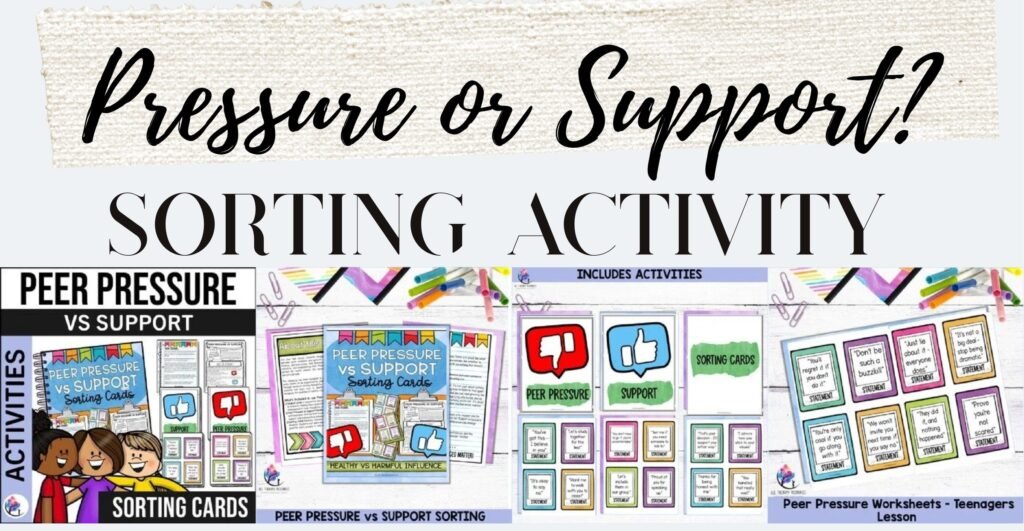
Try this with your students: boundaries are easier to set when students can tell the difference between real support and pressure. Our Peer Pressure vs Support Sorting Activity helps teens sort realistic examples and talk through the gray areas. One reviewer shared, “This was such a powerful activity for my high school students. It really got them thinking about the difference between true support and subtle peer pressure.”
The Hardest Part May Be What Happens After You Speak Up
Many self-advocacy lessons stop at communication.
We teach the student what to say, they say it, and the skill appears complete.
Real life doesn’t work that neatly.
Sometimes the other person misunderstands. Sometimes they say no. Sometimes they promise to help but nothing changes. Sometimes the student approaches the wrong person. Sometimes a solution works temporarily and then the problem returns.
That means an important part of self-advocacy is teaching students what to do after the first conversation.
Can they ask a follow-up question? Can they clarify what they meant? Can they suggest another solution? Can they approach someone else? Can they document what has happened? Can they ask what other options are available?
We want students to understand that needing a second step doesn’t mean their first attempt failed.
Sometimes advocacy is a conversation. Sometimes it’s a process.
Teach Students to Be Specific
One of the simplest ways we can strengthen a teenager’s self-advocacy is by helping them move from broad statements to specific communication.
“School is too stressful” tells us something important about how a student feels, but it doesn’t yet tell us what needs to change.
We can gently unpack it.
Is the workload too high? Is there one particular subject? Are several deadlines happening at once? Is the student confused about expectations? Is something happening socially? Are they struggling to concentrate? Do they need clarification, planning support, additional time, or someone to listen?
Once the problem becomes more specific, the request can become more specific too.
From vague to specific: use examples like these to practice turning a feeling into a clear request.
| What a student might say | What they may need | A clearer request |
|---|---|---|
| “School is too stressful.” | Planning support | “I have three deadlines this week. Could we work out which one to do first?” |
| “I hate this class.” | Clarification | “I’m not sure what I’m supposed to do next. Could you explain that part again?” |
| “She needs to leave me alone.” | Space from a peer, and adult help | “Can I talk to you about a friendship problem? I need help keeping some space from someone.” |
| “Nobody listens to me.” | To feel heard first | “Can I have five minutes to explain what happened before we decide what to do?” |
This is why teaching “I” statements, clear requests, questions, and clarification skills can be so practical. Students aren’t simply learning to talk more. They’re learning to communicate information that gives another person something useful to respond to.
Self-Advocacy Can Look Quiet
There is also a misconception that good self-advocates are naturally confident, outspoken people.
They don’t have to be.
A student doesn’t need to deliver an impressive speech to advocate for themselves. They might send an email to a teacher, write down what they want to say before a meeting, ask a trusted adult to help them start a conversation, request to speak privately, or use a prepared sentence because spontaneous communication is difficult.
For some teenagers, saying “Can I talk to you about something?” is a significant act of self-advocacy.
We need to be careful that when we teach students to “use their voice,” we don’t accidentally define a successful voice as the loudest or most confident one.
Self-advocacy is about effective communication, not performance.
Make Self-Advocacy Something Students Practice
Self-advocacy is difficult to learn passively.
Interactive activities such as Stand Up If…, Move to a Corner, Boundary Line, myth vs. reality discussions, realistic scripts and reflection questions give students a chance to practice rather than just listen.
For example, Move to a Corner asks students to think about who they might approach for support in different situations. That may sound straightforward until students discover that different people in the room have chosen different adults.
Now we have a discussion.
Why did you choose the teacher? Why did someone else choose the counselor? Could both answers make sense? What would make you approach one person rather than another?
The Boundary Line activity opens another conversation about how comfortable students feel communicating boundaries in different situations.
These activities allow students to do much more than memorize a definition of self-advocacy. They begin examining how they personally respond when they need something.
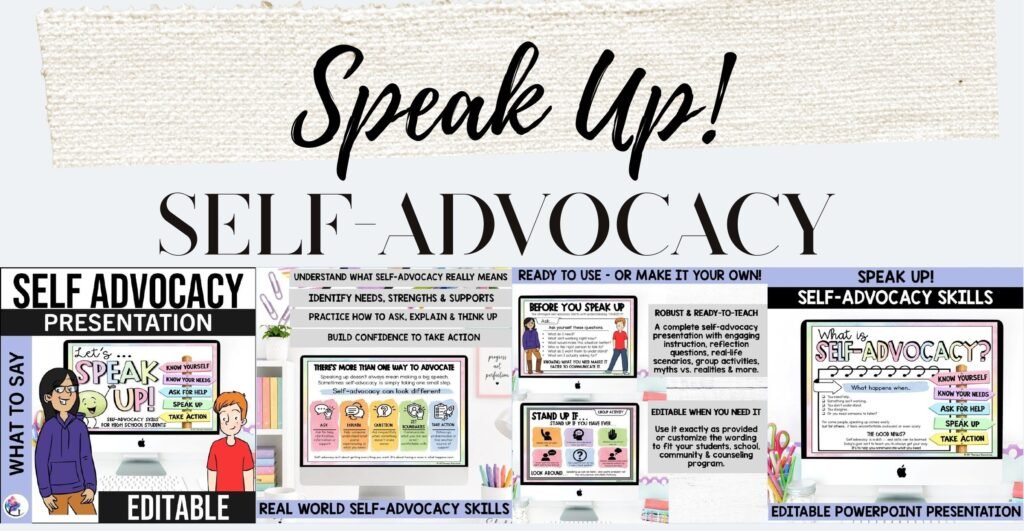
From our counseling room to yours: our editable Speak Up! Self-Advocacy Skills Presentation for high school students was built around these ideas. It breaks self-advocacy into teachable steps, from identifying what you need and choosing who to approach, to using “I” statements, communicating boundaries and deciding what to do when the answer is no. One reviewer wrote, “I really like that it goes beyond simply explaining what self-advocacy is and helps students understand what they can actually say in different situations.”
End With One Brave Step
A strong way to finish any self-advocacy lesson is a One Brave Step activity.
The aim is to move self-advocacy from theory into the student’s own life.
They don’t need to transform overnight into someone who confidently handles every difficult conversation. Instead, they identify one realistic step they could take.
For one student, that might be asking a teacher a question instead of pretending they understand. For another, it could be telling a friend that something is making them uncomfortable. Another student might need to ask for help with an overwhelming workload.
Small acts of advocacy matter because they can help a student build evidence that their voice can be used effectively.
Self-Advocacy Is Ultimately About Agency
When we teach self-advocacy well, we’re teaching much more than communication.
We’re helping young people understand themselves. We’re teaching them to notice their needs, identify their options, communicate clearly, tolerate uncomfortable conversations, solve problems, set boundaries, seek support, and decide what to do when things don’t go exactly as hoped.
It is no accident that advocacy skills for self and others are part of the ASCA Student Standards.
Those skills extend far beyond high school. Research with students with disabilities has linked greater self-determination to better outcomes after high school, such as employment and independent living.
They matter when a young person begins further education or employment. They matter in friendships and relationships. They matter when communicating with healthcare professionals, employers, landlords, colleagues, and other people they will encounter throughout adulthood.
We aren’t teaching students that speaking up guarantees they’ll get what they want.
We’re teaching something much more useful:
You can understand what you need. You can communicate it. You can listen to the response. You can understand your options. And you can decide what your next step will be.
That’s self-advocacy.
Frequently Asked Questions
What are self-advocacy skills for teens?
Self-advocacy skills include recognizing what you need, deciding who can help, explaining the situation clearly, making a specific request, setting boundaries and deciding on a next step if the first attempt does not work.
How do you teach self-advocacy to high school students?
Break it into steps, give students scripts and sentence starters, let them rehearse in role-plays before they need the skill, and finish with one small, real step they can take.
Is self-advocacy the same as being assertive?
Assertiveness is part of it, but self-advocacy also includes self-awareness, problem-solving, help-seeking and coping when the answer is no. Quiet approaches, such as an email or a prepared sentence, count too.
What should a student do if self-advocacy does not work?
Ask a follow-up question, suggest another option or approach a different trusted adult. If the student is unsafe or being hurt, they should keep telling adults until someone helps.
Looking for practical, ready-to-use resources to support your self-advocacy and communication lessons? The All Therapy Resources Membership provides access to a growing collection of thoughtfully developed counseling activities, interactive games, and therapeutic tools designed to save preparation time while supporting meaningful, skill-focused learning.