Gossip and rumors in high school can begin with something that seems small. One comment is shared with a friend, somebody repeats it in a group chat, another person adds their own version, and before long the story has traveled far beyond the people who were originally involved.
For teenagers, the consequences are real. Gossip and rumors can affect friendships, trust, belonging, confidence and reputation, and group messaging means information can travel further and faster than a hallway conversation ever could.
As school counselors, we have an important opportunity here. Rather than simply telling teenagers, “Don’t gossip,” we can help them understand why people gossip, what happens after information begins to spread, and what they can do when they find themselves in the middle of it.
Why Gossip and Rumors in High School Matter
Teenagers are navigating an intensely social stage of development. Friendships matter enormously, belonging matters, and the opinions of peers can carry a great deal of weight. That is one reason gossip becomes so complicated at this age.
When rumors are used to damage someone’s friendships or standing in a group, they fall under what researchers call relational aggression: non-physical behavior that harms a person’s relationships or social standing, such as social exclusion or starting and spreading a rumor (Children’s Hospital of Philadelphia). It is also common. In the 2021–22 school year, 13 percent of U.S. students ages 12 to 18 reported being the subject of rumors at school (National Center for Education Statistics).
Not all gossip is deliberately hurtful, though. A teenager might share something because they want to feel included, have something interesting to contribute to a conversation, or do not stop to think about what will happen next. That distinction matters when we are working therapeutically with students. Understanding why something happened does not remove responsibility, but it gives us a far more useful starting point than labeling a teenager as “a gossip.” Behavior is something we can explore and change.
The Ripple Effect of Gossip and Rumors
The ripple effect is a helpful concept to explore with teenagers. A student might share something with one person and believe it will stay between them. That person tells somebody else, who tells another person, and suddenly the original student has no control over where the information goes.
The impact spreads too. The person being talked about may feel embarrassed, angry or betrayed. Friendships can change, other students may begin treating them differently, and the person who first shared the information may later experience guilt, damaged trust or consequences of their own.
This is why conversations about gossip and rumors in high school need to go beyond whether something is technically true or false. The impact matters too.
Try this in your next session: write one fictional rumor in the center of a page and ask the group to map who might hear it next, how it could change as it travels, and who is affected at each step. Finish with, “Where could someone have stopped this?”
“But It’s True” Does Not Automatically Make It Okay to Share
Sometimes students defend gossip by saying, “But I wasn’t lying. It’s true.” That gives us a valuable opening to talk about privacy.
Information does not become ours to share simply because we know it. Something can be completely true and still be deeply personal. A friend’s breakup, family difficulties, financial situation, mental health, relationship problems or something they disclosed privately may not belong in somebody else’s conversation.
Here we can help teenagers ask a different question. Instead of only asking, “Is it true?”, they can also ask, “Is it mine to share?” That small shift often leads to meaningful discussions about trust, boundaries and respect.
Gossip, Rumors and the Teenage Need to Belong
If we want teenagers to make different choices, we also need to acknowledge why gossip can be socially powerful. Knowing something other people do not know can create attention. Sharing information can make someone feel included in a group or give them something to contribute. For a teenager who badly wants to belong, that can be hard to resist.
This does not excuse harmful behavior. It does, however, allow us to explore what was happening underneath it. Was the student trying to impress somebody? Were they angry? Did they want revenge? Were they trying to fit in, or did they speak without considering what might happen next?
Picture a student who forwarded a screenshot because the rest of the group chat was already laughing. Asking, “What did you think would happen if you didn’t send it?” often reveals far more than “Why would you do that?” Those questions help us move from “You shouldn’t have done that” toward “What could you do differently the next time you are in that situation?” That is where learning begins.
Social Media Can Change the Impact of a Rumor
Teen gossip is not new, but the way information spreads has changed. A rumor that once traveled between a handful of students can now move through group chats, screenshots and social media within minutes. In a 2022 Pew Research Center survey, 22 percent of U.S. teens ages 13 to 17 said they had had false rumors spread about them online (Pew Research Center). Something shared in what feels like a private conversation can also be copied and forwarded without the original person’s knowledge.
That is why digital citizenship belongs in conversations about online rumors. Students need opportunities to think about what happens after they press send:
- Would I say this if the person were standing beside me?
- Do I know this information is accurate?
- Is this my information to share?
- How would I feel if somebody sent the same message about me?
- What happens if I cannot take it back?
Online rumors often connect to wider pressures around image and comparison, which we explore in The Comparison Trap: Social Media and Self-Esteem.
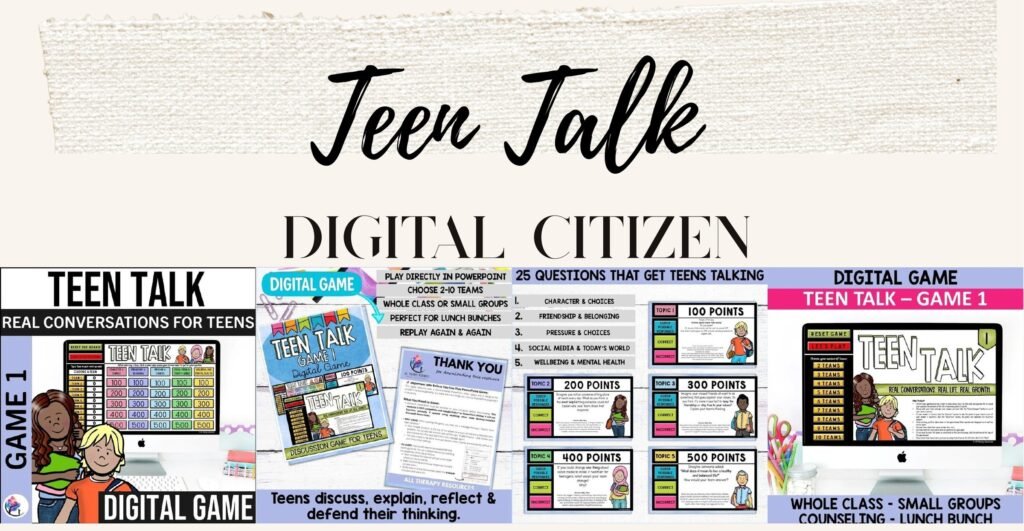
From our counseling room to yours: to get teens talking about online behavior without it feeling like a lecture, our Teen Talk Game 1: Friendships, Peer Pressures, Mental Health and Digital Citizenship is a no-prep PowerPoint discussion game for Grades 6–12. Its Social Media & Today’s World category explores online behavior, reputation and misinformation, while Friendships & Belonging covers inclusion and peer relationships. Try one category per session in a small group or advisory class. One reviewer shared, “The questions feel really relevant to what teens are actually dealing with, especially friendships, peer pressure and social media.”
Practical Ways to Address Gossip and Rumors With Teens
Telling teenagers to “be nice” is rarely enough. Students need practical ways to think through the social situations they are encountering. These seven approaches work well in individual sessions, small groups and classroom lessons.
1. Teach Students to Pause Before Passing Information On
One of the simplest skills we can teach is the pause. Before repeating something, students can ask: Do I know this is true? Does this need to be shared? Could sharing it hurt somebody?
That pause creates space between hearing information and acting on it. For teenagers caught up in a fast-moving conversation or group chat, even a few seconds of reflection can matter. Some students like a concrete cue, such as putting the phone face down for a moment before replying.
2. Talk About Privacy, Not Just Truth
Teenagers usually understand that spreading a lie is wrong. The more nuanced conversation is that sharing true private information can also cause harm. Ask students to think about information they would want control over. Who gets to know about a breakup, a family problem or a personal struggle? Who should decide when that information is shared?
These discussions move the conversation toward boundaries and consent rather than fact-checking alone.
3. Explore the Ripple Effect
Ask students what might happen after one rumor begins. Who could hear it? How might their behavior toward the person change? What might happen to friendships? What happens if the rumor reaches teachers, parents or the wider community? Students begin to see that one comment can create consequences they never intended.
4. Practice What to Say When Someone Starts Gossiping
Teenagers may know gossip is wrong but still have no idea how to respond when their friends start doing it. Give them language they can use, such as “I don’t know if that’s true,” “Maybe we shouldn’t talk about them when they’re not here,” or simply changing the subject. They can also choose not to add anything, or not to forward the message.
Students do not need to deliver a dramatic speech. Sometimes refusing to feed the conversation is enough. Bystander skills are worth the practice time: a meta-analysis by Polanin, Espelage and Pigott (2012) found that school-based bullying prevention programs increased bystander intervention overall, with larger effects in high school samples than in K–8 samples. We look at bystander choices in more depth in Bullying Is About More Than Being Mean: Teaching Students About Power, Pressure and Choices.
5. Use Scenarios Instead of Lectures
Scenario-based discussions work well with teenagers because they create a little emotional distance. Instead of asking, “Have you ever spread a rumor?”, we can present a situation involving somebody else. What should this person do? Who has been affected? How might the person the rumor is about feel? What could happen next?
Students can explore the issue without being required to disclose their own experiences, and their responses often lead naturally into deeper conversations.
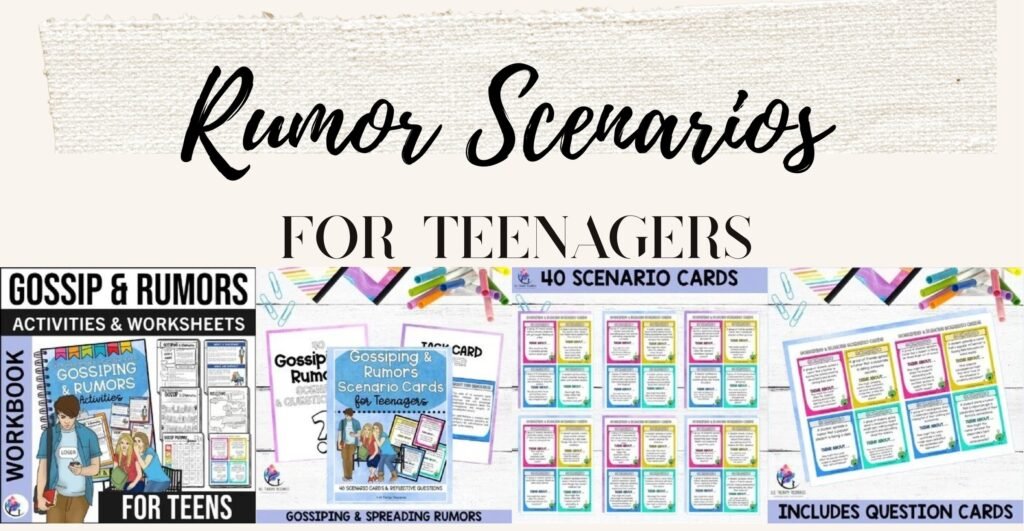
Try this in your next session: if you would rather not write scenarios yourself, our Gossiping & Spreading Rumors Scenario Cards for Teenagers include 40 situations that adolescents commonly encounter, each paired with a reflective question. They suit advisory classes, character education lessons and small groups: draw one card, ask students to respond individually first, then compare answers as a group. One educator wrote, “These situations fit in very well with the real-life experiences of my students…”
6. Talk About Repair
Teenagers need to know what to do when the damage has already happened. Taking responsibility might involve acknowledging what they shared, correcting false information, apologizing or stopping further spread. A simple script helps: “I shared something that wasn’t mine to share. I’m sorry. I’ve told the others it wasn’t true, and I won’t pass it on.”
Repair does not mean trust will immediately return, and that is an important lesson too. A sincere apology matters, but the other person is still allowed to feel hurt, and rebuilding trust can take time. Restorative practices offer a structured way to hold these conversations when both students are ready.
7. Build Empathy Without Using Shame
If a student has taken part in gossip, humiliating them is unlikely to teach the empathy we are hoping to develop. We can hold students accountable without defining them by one behavior. Ask questions instead: What do you think this was like for the other person? What happened after the information spread? If you could go back to that moment, what would you change?
Those questions encourage responsibility while keeping the focus on growth.
A Trauma-Informed Approach to Gossip and Rumors
A student sitting in your counseling group may already have been the subject of a humiliating rumor about their family, body, relationships, sexuality, mental health, finances or something else deeply personal. We do not always know.
That is why students should never be required to share personal experiences with gossip in front of a group. Scenarios help because they allow students to discuss difficult situations without announcing, “This happened to me.” Offer choices about how to participate (writing, discussing in pairs, or listening), and let students engage at the level that feels safe. We can still build empathy, explore consequences and teach healthier choices without requiring personal disclosure.
What Should a Teen Do When a Rumor Is About Them?
When teenagers are targeted by gossip or rumors, adults sometimes instinctively tell them to ignore it. Sometimes that works. Often it does not. The response needs to depend on what is happening, how widely the information has spread and whether the student’s safety or wellbeing is being affected.
When rumors are spread online, StopBullying.gov advises keeping evidence (screenshots, messages and the dates incidents happened), not responding to or forwarding the messages, reporting the behavior to the platform, and letting the school know. Students should also know which trusted adults at school they can approach.
It can help to remind students that they do not need to chase every person who has heard the rumor. Trying to personally correct an entire school is exhausting and can keep the story circulating. Instead, help them think strategically about what support they need, who needs accurate information and what would help them feel safer. A counselor might say, “Let’s work out the two or three people who need to hear the real story, and what you want to say to them.”
Most importantly, take their distress seriously. What sounds like “school drama” to an adult can feel enormous when you are the teenager walking into school wondering who has heard something about you.
When Gossip Becomes Bullying
Not every instance of gossip is bullying. Bullying is unwanted, aggressive behavior that involves a real or perceived power imbalance and is repeated, or has the potential to be repeated, over time. Social bullying (sometimes called relational bullying) involves hurting someone’s reputation or relationships, and spreading rumors is one of its examples (StopBullying.gov).
This is particularly concerning when information is deliberately used to isolate, humiliate or damage somebody’s reputation. School counselors should look beyond the individual comment and consider the pattern:
- Who is involved, and how long has it been happening?
- Is there a power imbalance, such as social status or access to private information?
- Is the student being excluded, threatened or harassed?
- Are rumors continuing online after the school day ends?
Understanding the wider context helps determine what support and school response may be needed, including following your school’s bullying and safeguarding policies. For a whole-school view, see our guide to bullying prevention activities for middle school, which covers bystander strategies, cyberbullying and restorative circles that also translate well to the early high school years.
Using Gossip and Rumors Activities in High School Counseling
Gossip and rumors activities can be used in several ways depending on the students you support. You might use a single scenario during an individual session when friendship issues are emerging, work through a full lesson with a small group, or include the topic in high school SEL lessons, character education, conflict resolution work or restorative conversations.
You do not need to complete everything at once. One scenario and three good questions can create a better session than racing through ten pages. Follow the conversation, listen to what students notice, and when they disagree, resist the urge to tell them immediately which answer is “correct.” Ask them why. Those conversations are often where the learning happens.
The goal is not for a teenager to leave knowing only that “gossip is wrong.” We want them thinking, “My words go somewhere after I say them, and I have some responsibility for what I choose to do with them.”
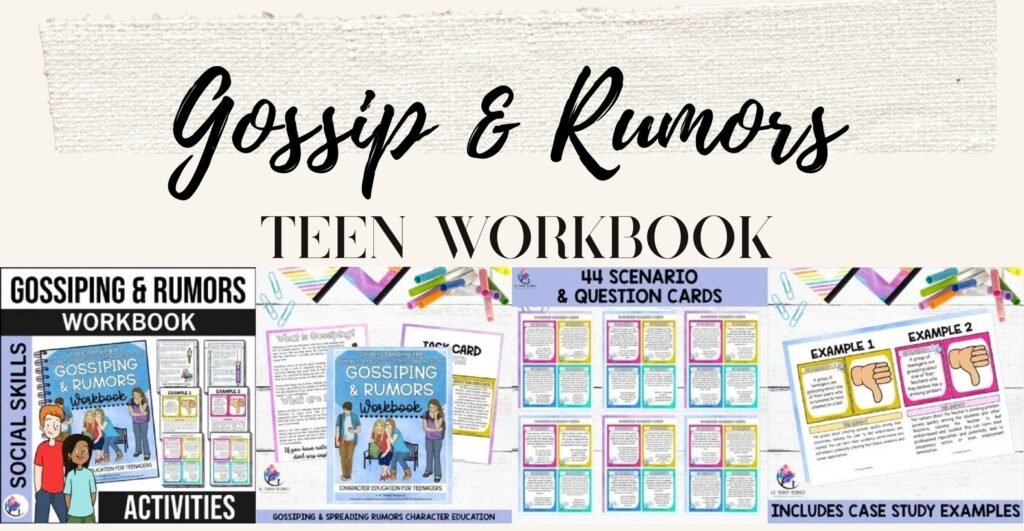
From our counseling room to yours: for a complete lesson, our Gossip and Rumors Workbook for Teenagers helps students explore what gossip and rumors are, the difference between them and the ripple effect. It includes The Rumor Game (an experiential activity showing how quickly information spreads and changes), four case study examples and 44 scenario and reflection cards. Use the Rumor Game to open a small group session, then choose two or three cards that match the issues your students are facing. One reviewer noted that “students in my small groups found this to be very engaging!”
Gossip and Rumors in High School Are Really About Relationships
When we look underneath the topic, gossip and rumors in high school are not only about words. They are about trust, belonging, privacy, boundaries, empathy and responsibility. They are also about understanding that we cannot always control what happens to information once we give it to somebody else.
That is a powerful lesson for teenagers. Not because we want them to be frightened of saying the wrong thing, but because we want them to understand that their words carry weight, and with that comes responsibility. Sometimes the most important message is also the simplest: before you pass something on, stop and think about where your words might go next.
Frequently Asked Questions
What is relational aggression in teenagers?
Relational aggression is non-physical behavior that damages someone’s relationships or social standing, such as spreading rumors, social exclusion, the silent treatment or threatening to end a friendship unless someone behaves a certain way. Because it is less visible than physical aggression, it helps to ask students directly about group chats and friendship dynamics.
Is spreading rumors considered bullying?
It can be. Spreading rumors is listed as a form of social bullying when it is part of unwanted, aggressive behavior involving a power imbalance that is repeated or likely to be repeated. A one-off piece of gossip may not meet that definition but still deserves a response.
What should a teen do if rumors are spread about them online?
Keep evidence such as screenshots and dates, avoid responding to or forwarding the messages, report the content to the platform, and tell a trusted adult at school. Schools in many states are required to address cyberbullying in their anti-bullying policies.
How can school counselors address gossip without shaming students?
Use fictional scenarios, focus on impact rather than labels, and ask reflective questions about what happened and what the student might do differently. Accountability and repair work best when the student is treated as someone capable of change.
References
- Children’s Hospital of Philadelphia Research Institute: Relational aggression
- National Center for Education Statistics: Fast facts on bullying (2021–22)
- Pew Research Center (2022): Teens and cyberbullying
- Polanin, Espelage & Pigott (2012): A meta-analysis of school-based bullying prevention programs’ effects on bystander intervention behavior
- StopBullying.gov: What is bullying
- StopBullying.gov: Report cyberbullying
Looking for practical, ready-to-use resources to support your gossip, friendship and bullying prevention work with teens? The All Therapy Resources Membership provides access to a growing collection of thoughtfully developed counseling activities, interactive games, and therapeutic tools designed to save preparation time while supporting meaningful, skill-focused learning.