
A student hears, “Time to line up,” and repeats, “Time to line up,” while walking toward the door. Another child recites a line from a favorite video when asked what they want for a snack. These moments can be confusing when adults are focused on getting a direct answer. Yet the repeated language may be doing meaningful work. Understanding what echolalia is helps professionals and caregivers respond with curiosity, support communication, and avoid treating all repetition as behavior to stop.
What is echolalia?
Echolalia is the repetition of words, phrases, sounds or sentences that a person has heard. The repeated language may come immediately after someone speaks, or it may appear later, sometimes hours, days or even longer after the original phrase was heard.
Repeating words and phrases is a familiar part of how many young children learn language. Echolalia can also continue in older children and adolescents, including many autistic children and people with other communication, developmental or neurological differences. Echolalia alone is not a diagnosis, and it should not be used to make assumptions about a child’s understanding, intelligence or motivation.
For professionals, the key question is usually not simply, “How do we reduce the repetition?” A more useful starting point is: “What might this child be communicating, practicing, remembering or regulating through these words?”
Immediate and delayed echolalia
Immediate echolalia happens right after language is heard. For example, an adult asks, “Do you want a turn?” and the child says, “Want a turn?” The child may be echoing because they are processing the question, agreeing, asking for a turn, or relying on a familiar language pattern while they work out a response.
Delayed echolalia occurs after a time gap. A child might repeat a phrase from a parent, teacher, book, movie or earlier experience. The phrase may seem unrelated on the surface, but context often reveals a connection. A student who says, “Buckle up, everyone,” when the schedule changes may be expressing that something feels uncertain or that they are preparing for a transition.
A repeated phrase can be exact or slightly changed. It may include the original speaker’s tone, rhythm or pronouns. This is one reason echolalia is easily misunderstood: language that sounds scripted may still carry a clear purpose. Some speech-language pathologists also describe delayed echolalia within a gestalt language processing framework; research on that framework is still developing, so decisions about intervention approach rest with the child’s speech-language pathologist.
Why children use echolalia
Echolalia is not one behavior with one cause. Its purpose can shift by setting, communication partner, demands, stress level and the child’s language skills. Echolalia was once widely seen as meaningless, but that view has been challenged by research; the American Speech-Language-Hearing Association (ASHA) notes that studies have identified communicative functions such as turn-taking, labeling, requesting, affirming and protesting. A phrase that works as a request in the classroom may become a way to self-regulate in a noisy hallway.
For some children, repetition supports language processing. They may need extra time to understand spoken information and use the words they heard as a bridge to a response. For others, echolalia may be an efficient way to communicate a need when putting together original language is hard in the moment.
It can also support participation. Repeating a familiar classroom phrase such as “My turn” or “All done” may help a child enter a routine, join peers, or signal that they want an activity to continue or end. At other times, repeated language may provide comfort, predictability or sensory regulation, especially during periods of excitement, anxiety, fatigue or overload.
This is why a phrase should not automatically be labeled “nonfunctional.” Even when its meaning is unclear, it may be helping the child organize their experience. The right response depends on whether the repetition is supporting connection, getting in the way of access, signaling distress, or doing several of these at once.
Look for meaning before redirecting
A simple observation process can stop well-intended adults from responding too quickly. Consider what happened just before the echolalia, what the child did while saying it, and what happened next. Note the setting, the people present, the task demands and the child’s body language.
For instance, if a student repeats, “Are you okay?” after bumping into a desk, they may be recalling a familiar caregiving phrase while also signaling discomfort. If they repeat, “First work, then break,” during a difficult assignment, they may be using learned language to cope with a demand. The words may not be a direct answer, but they are still information.
It also helps to notice patterns over time. Does echolalia increase during transitions, open-ended questions, group discussions or sensory-heavy activities? Does it decrease when visual choices are available, directions are shorter, or the child has more wait time? These observations guide support planning far better than a blanket goal of eliminating repetition.
Try this in your classroom: For one week, jot down three things each time you hear a repeated phrase: what was said, what was happening, and what the child seemed to want or need. Many teams find that two or three phrases account for most of the echolalia, and that each one has a fairly consistent meaning.
How to respond to echolalia in practice
When a child echoes a question, pause before repeating the question louder or adding more language. A brief wait gives them time to process. If a response does not come, offer a simple interpretation paired with a clear model. For example, if a child echoes, “Do you want the red marker?” an adult might say, “You can say, ‘Red marker, please,'” while holding up the red marker and another option.
The goal is not to demand a perfect response. It is to make the next communicative step easier. Visual supports, gestures, written choices, photographs and sentence starters can reduce language load and give the child more than one way to respond. In a counseling or therapy setting, an emotion scale, feeling cards or a choice board may be more accessible than an open-ended question such as, “Tell me how that made you feel.”
When the likely meaning is clear, respond to the meaning. A child who repeats, “Shoes on, shoes on,” while standing near the exit may be communicating readiness to leave. A helpful response could be, “You’re ready to go outside. Let’s put on shoes.” This validates the message without insisting that the child first restate it differently.
When the meaning is less clear, reflect what you observe and offer possibilities: “I hear you saying that phrase. Are you thinking about the video, or do you need a break?” Keep choices limited and concrete. If the child declines both options, keep observing rather than assuming noncompliance.
Support communication without overprompting
Well-meaning adults can accidentally turn communication into a performance by repeatedly asking, “Use your words,” “Say it again,” or “What do you mean?” Some children benefit from modeled language, but too much prompting can increase pressure and reduce spontaneous communication.
Use language models that are short, relevant and immediately useful. If a child repeats, “Want a snack?” while looking at crackers, model, “I want crackers,” or simply, “Crackers.” Match the model to the child’s developmental level and established communication system. For children who use augmentative and alternative communication (AAC), make sure their device or system is available and honored as a valid way to communicate.
It may also help to adjust adult questions. Questions that need a choice or a yes-or-no answer can be easier to process than broad prompts. Instead of “What do you want to do next?” try, “Blocks or drawing?” Instead of “Why are you upset?” try, “Did the noise feel too loud?” followed by visual options or a regulation support.
From our therapy room to yours: If yes-or-no questions are a helpful next step for a student, our Yes No Questions Picture Cards pair simple “Is this a…?” questions with a picture, so students can point to or circle yes or no. Use them in short, playful turns to build answer reliability before using yes-or-no questions in real moments like snack time. One reviewer shared that they have used the cards “for students with intellectual disabilities, autism as well as early learners in kindergarten and preschool.”

Collaboration matters when echolalia affects daily access
Echolalia may be one part of a child’s broader communication profile. When it affects participation, relationships, learning, emotional regulation or the ability to express needs, collaboration is valuable. Speech-language pathologists can assess receptive and expressive language, pragmatic communication and individualized communication supports. Occupational therapy practitioners, counselors, teachers, behavior specialists and caregivers may each notice different patterns related to sensory demands, transitions, emotional safety, routines and peer interactions.
A shared plan should describe what adults observe, which responses help, and what language or visuals are used consistently across settings. It should also protect the child’s dignity. Avoid framing repeated language as defiance, attention-seeking, or a problem to extinguish without understanding its purpose. If echolalia comes with a sudden loss of skills, major changes in functioning or significant distress, encourage caregivers to consult the child’s qualified healthcare or developmental providers.
For busy teams, a simple data note can be enough: the phrase used, the context, the likely function, the adult response and the outcome. Over several days, those brief notes can show whether a child needs more processing time, clearer visuals, a predictable script for a difficult routine, or a different way to communicate choice and discomfort.
| Phrase heard | Context | Possible meaning | Helpful adult response |
|---|---|---|---|
| “Do you want a turn?” | Adult asks during a game | Yes, I want a turn | “Your turn!” Hand over the game piece and model “My turn.” |
| “Buckle up, everyone!” | Assembly announced, schedule changes | This feels uncertain | “Something is changing. Here is what happens next,” and show the schedule. |
| “Shoes on, shoes on” | Standing at the door before recess | I am ready to go out | “You’re ready to go outside. Let’s put on shoes.” |
Shared visuals make this consistency easier. When home and school use the same picture cards for routines, a child does not have to learn a new system in each place.
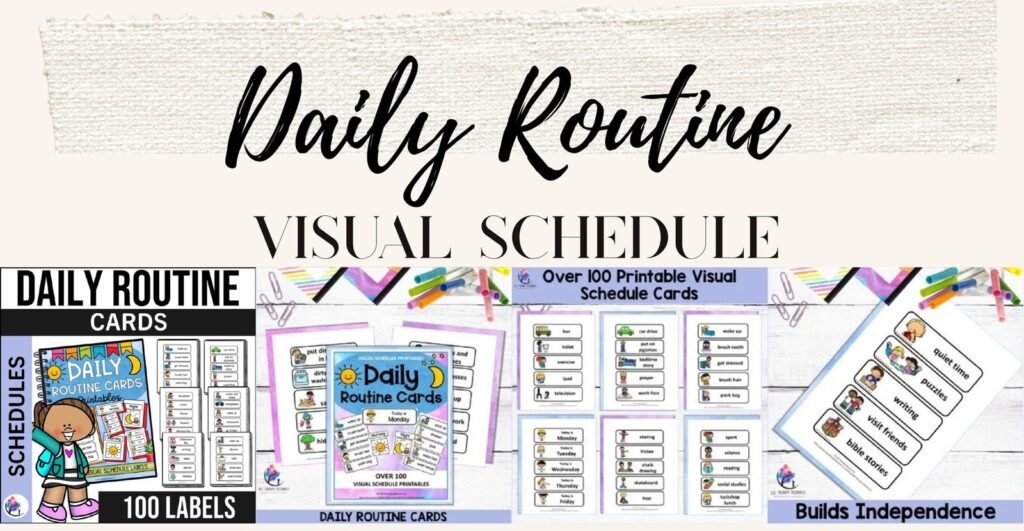
From our therapy room to yours: Our Daily Routine Visual Schedule Cards give school teams and families the same set of picture cards for morning and bedtime routines, with a template for adding your own. Sharing one set across home and school gives a child a consistent visual to point to when spoken language is hard. One reviewer described it as a “Super helpful resource that will make it much easier to communicate our schedule and activities.”
Children do not need to earn the right to be understood by speaking in a conventional way. When adults treat echolalia as meaningful information rather than noise, they create more room for safety, connection and authentic communication to grow.
Frequently asked questions
Is echolalia always a sign of autism?
No. Repeating words and phrases is a familiar part of how many young children learn language. Echolalia is common in autistic children, but it can also occur with other communication or developmental differences, and on its own it is not a diagnosis.
Should we try to stop echolalia?
Not as a blanket goal. Echolalia can serve communicative purposes such as requesting, turn-taking, affirming and protesting. A more helpful approach is to understand what the child may be communicating, respond to that meaning, and model useful language. A speech-language pathologist can guide individual goals.
What is the difference between immediate and delayed echolalia?
Immediate echolalia is repeating language right after hearing it. Delayed echolalia is repeating something heard earlier, sometimes much earlier, such as a line from a show or a phrase an adult often uses.
Looking for practical, ready-to-use resources to support your students’ communication? The All Therapy Resources Membership provides access to a growing collection of thoughtfully developed speech and language activities, interactive games, and therapeutic tools designed to save preparation time while supporting meaningful, skill-focused learning.