
A child who says, “I’m mad,” after being left out at recess may be naming only the most available word, not the whole experience. Underneath may be disappointment, embarrassment, loneliness, jealousy, or worry that no one wants to play with them. When professionals teach feeling vocabulary, they give children and adolescents more precise ways to communicate what is happening internally before distress has to come out through behavior, withdrawal, or conflict.
Emotional vocabulary is not about getting children to use sophisticated words on demand. It is about helping them notice body cues, connect those cues to emotions, and find language that feels accurate enough to share. This work supports counseling goals, social communication, self-regulation, behavior intervention, and classroom participation. It also helps adults respond to the need beneath the behavior rather than reacting only to the behavior itself.
Start with the feelings children already know
Many children enter a session, classroom, or support meeting with a small group of emotion words: happy, sad, mad, scared, and sometimes tired. Those words are a useful starting point, not a deficit to correct. Begin by accepting the word a child offers, then gently expand it.
For example, if a student says they are mad because a partner changed the rules of a game, a professional might respond: “Mad makes sense. I wonder if it also felt unfair or frustrating when the rules changed.” This approach models more specific language without insisting that the child adopt the adult’s interpretation.
A manageable goal is to introduce related words in small clusters. A child who understands mad can gradually learn annoyed, frustrated, disappointed, irritated, jealous, and furious. A student who knows sad might explore left out, discouraged, hurt, lonely, disappointed, or grief-stricken, depending on age and context. Connecting new words to familiar emotional categories reduces cognitive load and makes the vocabulary easier to retrieve later.
For younger children, focus first on a few high-frequency feelings that occur in daily routines. For older students, include words that reflect the social and academic pressures they actually describe, such as overwhelmed, self-conscious, conflicted, discouraged, pressured, relieved, or uncertain.
Teach feeling vocabulary through lived moments
Emotion words stick best when they are connected to a real experience. A worksheet can introduce language, but a meaningful moment gives that language context. Throughout the day, pause briefly to name what may be happening without assuming certainty: “Your shoulders got tight when the schedule changed. Are you feeling worried, frustrated, or maybe surprised?”
This type of question does two important things. It links feelings with observable signals, and it gives the child choices rather than requiring them to generate a word independently. For children with language differences, anxiety, trauma histories, or limited emotional awareness, choice-making can be far more accessible than an open-ended question such as “How do you feel?”
Try this in your next session: Keep a sticky note with three feeling words on it: one familiar word and two more precise neighbors, such as mad, frustrated and disappointed. When a child offers the familiar word, show the note and ask, “Is it more like this one, this one, or a mix?” Swap in new neighbors every few weeks so the word bank keeps growing.
Adults can also model their own emotional language in a regulated, boundaried way. “I felt concerned when I saw the rain starting because our outdoor activity might need to change. Now I have a backup plan, and I feel more settled.” This demonstrates that emotions are temporary, manageable experiences and that adults use coping strategies too. The goal is not to share adult problems with students. It is to make emotional language ordinary and safe.
Use body clues as a bridge
Some children notice physical sensations before they can identify an emotion. They may report a hot face, tight hands, a fast heartbeat, a stomachache, heavy shoulders, or an urge to leave. Body-based noticing is especially helpful when a child says, “I don’t know,” or appears disconnected from what they are feeling.
Try pairing body clues with a small set of possibilities: “When your stomach feels fluttery before reading aloud, does that feel more like nervous, excited, worried, or all of those together?” Children learn that one body sensation can relate to more than one feeling. A racing heart may signal excitement before a game, fear during a conflict, or anger when feeling cornered.
Avoid presenting body cues as a diagnostic shortcut. The same behavior or sensation can mean different things for different children and across situations. Curiosity is more supportive than certainty.
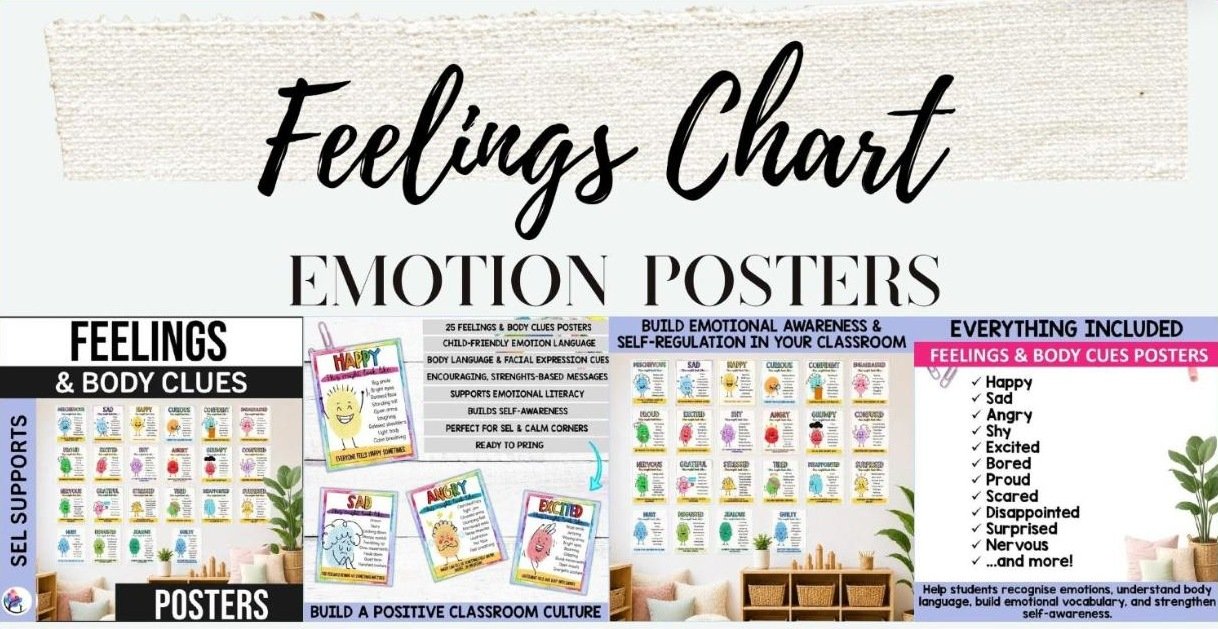
Our Feelings Chart Emotions Posters pair each feeling with the body clues that often come with it, which makes them a natural visual for this kind of bridging. Display them in a calm corner or counseling office, and when a child says “I don’t know,” invite them to find the body clue that matches theirs and then look at the feeling words nearby. One counselor shared that the posters “help students understand the connection between emotions and physical sensations.”
Make practice concrete, visual, and low-pressure
Feeling vocabulary is easier to practice when children do not have to talk directly about themselves right away. Visual tools, stories, images, role-play, and play-based activities create emotional distance while still building insight.
Use an emotion visual with clear facial expressions and words arranged by intensity. Rather than asking a child to identify every feeling on the page, choose one situation and explore it together. “A student studied hard but got a lower grade than expected. Which feeling words could fit?” There may be several reasonable answers, including disappointed, embarrassed, frustrated, worried, or discouraged.
Scenario cards are useful in individual sessions, classroom lessons, and small groups because they help professionals assess both vocabulary and perspective-taking. Invite students to explain why a character might feel a certain way, then ask what else could be true. This keeps the activity from becoming a quiz with one correct answer.
For younger children, use figures, puppets, drawing, or simple games. A child might draw an “annoyed face,” sort feeling words into broad groups, or match a body clue to an emotion. In play-based settings, a caregiver figure in a dollhouse scene might feel relieved when a child returns safely, while a child character may feel nervous about telling the truth. The story provides a natural opening for language without forcing personal disclosure.
For adolescents, visual supports should not feel overly childish. Consider emotion word banks, intensity scales, music-free journal prompts, social situations, or brief reflection cards. A teen may be more willing to circle “pressured,” “resentful,” or “drained” than to point to a cartoon face, particularly in a group setting.
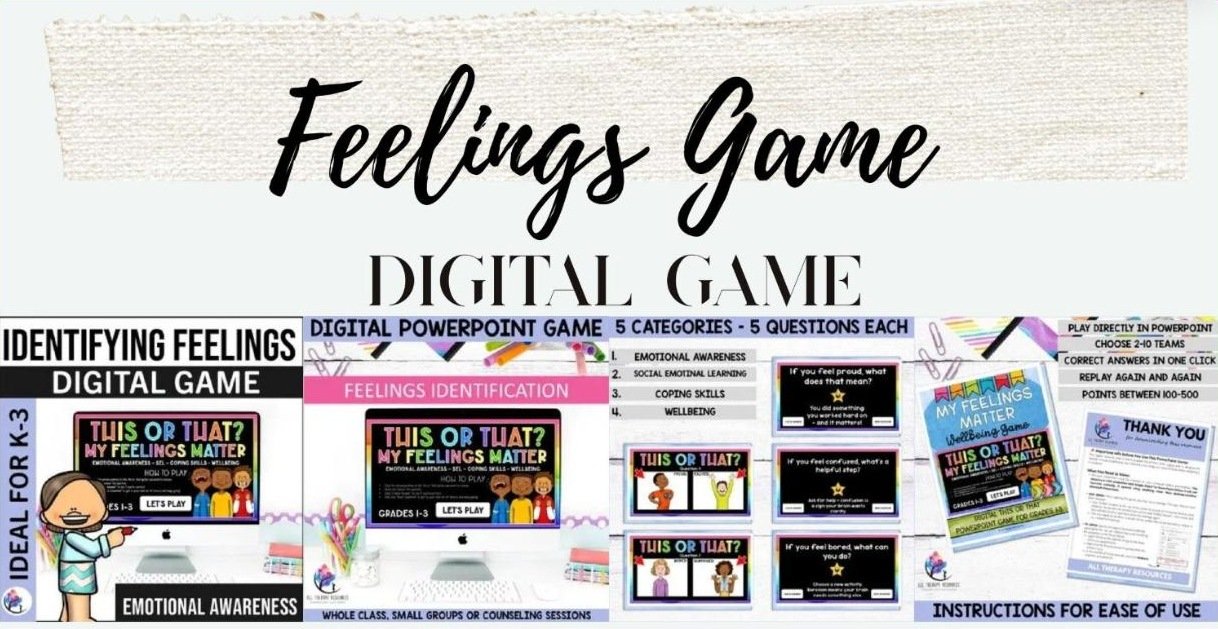
For younger students, our Feelings Identification PowerPoint Digital Game turns this practice into an interactive, low-pressure game you can play on screen with a small group or a whole class. Because the focus stays on the game rather than on personal disclosure, it suits early lessons and groups that are still building trust. One reviewer wrote that it “worked beautifully for helping students identify and talk about emotions,” and another adapted the colors to match the Zones of Regulation language their students already knew.
Move beyond basic feeling labels
Knowing the difference between angry and frustrated can help a child ask for a break before an outburst. Knowing the difference between embarrassed and ashamed can shape how a professional responds after a social mistake. Precision matters because different emotions may call for different supports.
Still, emotional vocabulary should not become a demand for perfect labeling. People can feel several emotions at once, and children may need time to make sense of an experience. A student can be excited about joining a new group and anxious about not knowing anyone. Another can feel proud of speaking up and regretful about how they said it.
Teach mixed emotions directly. Use phrases such as “two feelings can both be true” and “sometimes our feelings change quickly.” This is particularly valuable for adolescents, who may interpret emotional complexity as evidence that something is wrong with them. Naming ambivalence can reduce shame and support more thoughtful decision-making.
It can also help to distinguish feelings from thoughts, behaviors, and needs. “Nobody likes me” is a thought. Yelling is a behavior. Wanting reassurance or a chance to reconnect may be a need. A child may feel lonely, embarrassed, or rejected. This distinction is not meant to correct a child in the moment. It gives professionals a framework for helping students communicate more clearly over time.
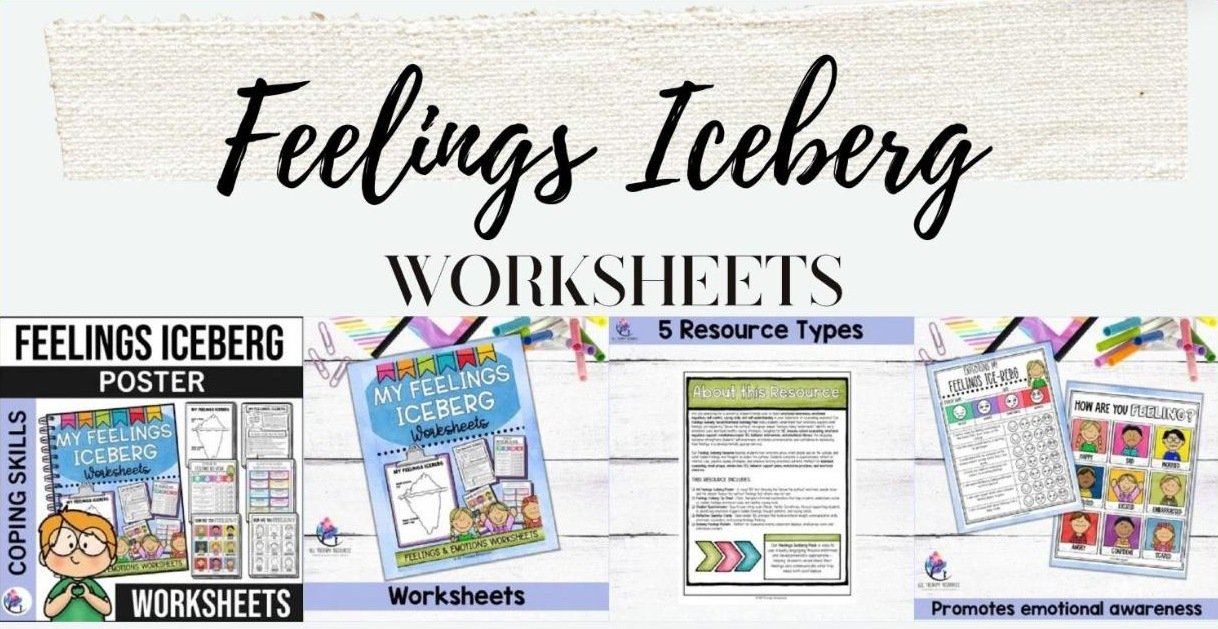
Our Feelings Iceberg Worksheets make the idea of “more than one feeling underneath” visual: students consider what others can see on the surface and the feelings that may sit below it. They work well once a student is ready to look past “mad” or “fine,” in individual sessions or small groups. As one counselor put it, “The feelings iceberg is an excellent way to help students understand that emotions often run deeper than what we see on the surface.” Another used it as a tracking tool to spot patterns in behavior across the school day.
Build emotional language into existing routines
The most sustainable approach is rarely a separate lesson once a month. Brief, repeated practice across everyday routines is more likely to generalize. A classroom check-in, counseling opening activity, transition prompt, behavior debrief, or family conversation can all become opportunities for emotional language.
When time is limited, choose consistency over complexity. Ask one or two questions: “What feeling showed up most today?” “What was one moment you felt more settled?” “Was that problem frustrating, disappointing, or both?” These prompts take little preparation but reinforce the habit of noticing and naming.
Collaboration across settings strengthens the work. School counselors, teachers, speech-language practitioners, occupational therapy providers, and caregivers may use different tools, but shared language can reduce confusion for the child. If a student is learning words for escalating frustration in counseling, classroom staff can reinforce those same words during a challenging assignment. If an occupational therapy provider is helping a child notice sensory overload, caregivers can connect that experience to feeling overwhelmed or irritable at home.
Try this in your classroom: Build a two-minute feelings check-in into the start of the day or the return from recess. Display a small word bank, invite students to point to or privately jot down one word, and model one yourself (“I’m feeling a little rushed this morning”). Keep it optional and quick, then reuse the same words in later conversations so the vocabulary carries across the day.
The tool matters less than the adult’s responsive use of it. A visual chart should invite conversation, not become another compliance task.
Respond in ways that keep language safe
Children are more likely to use feeling words when they believe those words will be met with calm attention. If a student says, “I hate everyone,” the immediate task is not to challenge the wording. Start by acknowledging the intensity: “Something feels really hard right now.” Once the student is more regulated, you can help them find language that is more specific and useful.
Be careful not to require emotional disclosure in front of peers. Group activities can teach vocabulary through fictional scenarios, but personal sharing should remain voluntary. Trauma-informed practice recognizes that naming feelings can feel vulnerable, particularly for children who have learned that emotions are ignored, punished, or used against them.
When a child cannot name a feeling, offer support without pressure. “You do not have to figure it out right now. We can notice what happened and come back to it later.” This communicates that emotional awareness is a skill developed through repetition, safety, and relationship.
A broader feeling vocabulary will not prevent every conflict or make every hard moment easier. It can, however, give a child one more path between an internal experience and an outward reaction. Each time a student can say “I felt left out,” “I got overwhelmed,” or “I was nervous to ask,” there is more room for connection, problem-solving, and support.
Frequently Asked Questions
At what age should children start learning feeling vocabulary?
Children can begin naming a few basic feelings in the preschool years, using simple words, pictures and everyday moments. Vocabulary keeps growing through adolescence, when words such as overwhelmed, pressured or conflicted become more relevant. Match the words you teach to the child’s developmental level and the situations they actually describe.
How many new feeling words should I teach at once?
Small clusters work best. Connect two or three new words to a feeling the child already knows (for example, frustrated and disappointed alongside mad) and revisit them across the week, rather than introducing a long list in one lesson.
What if a child always says “I don’t know”?
Treat it as information, not resistance. Offer two or three choices, start with body clues, or explore a character’s feelings in a story first. It is fine to say, “We can come back to it later,” so the child never feels pressured to produce a word.
Should students share their feelings in front of a group?
Personal sharing should always be voluntary. Group lessons can build vocabulary through fictional scenarios, stories and games, while individual check-ins give students a private way to name what they feel.
Looking for practical, ready-to-use resources to support your feelings and emotional literacy lessons? The All Therapy Resources Membership provides access to a growing collection of thoughtfully developed counseling activities, interactive games, and therapeutic tools designed to save preparation time while supporting meaningful, skill-focused learning.