A student who speaks freely at home may enter the classroom, office, or therapy room and become completely silent. They may nod, point, write, whisper to one trusted person, or appear frozen when addressed directly. To support selective mutism effectively, professionals need to recognize that this is not defiance, rudeness, or a lack of knowledge. It is an anxiety-based difficulty speaking in certain settings or with certain people.
Selective mutism can be confusing for adults because the child may look calm, compliant, or even uninterested. In reality, speaking can feel impossible in the moment. A well-meaning prompt such as, “Use your words,” can increase pressure and reinforce the child’s fear that everyone is waiting for them to perform. The most helpful support is patient, coordinated, and built around safety rather than immediate speech.
Understand What Selective Mutism Is Communicating
Selective mutism is typically associated with anxiety and involves a consistent inability to speak in specific social situations despite speaking in other settings. It can affect classroom participation, peer relationships, attendance, assessment, and access to support. Some children communicate comfortably at home but not at school. Others may speak with peers but not adults, whisper only to a caregiver, or use speech in one familiar location but not another.
The pattern matters. A child who is quiet in all settings may need a different assessment than a child who talks easily with family yet cannot respond to staff at school. Language differences, hearing concerns, speech and language needs, autism, trauma history, and other developmental or mental health factors may also shape communication. Professionals should avoid assumptions and collaborate with caregivers and appropriate clinical providers when concerns arise.
The goal is not to make a child talk on demand. The goal is to reduce anxiety, expand comfortable communication, and gradually build spoken participation in ways that protect dignity.
How to Support Selective Mutism Without Adding Pressure
The adult’s approach often changes the emotional temperature of an interaction. Children with selective mutism benefit when adults communicate, through both words and body language, that there is time, choice, and no penalty for being unable to speak.
Begin by reducing direct verbal demands. Rather than asking an open-ended question in front of others, offer a low-pressure option: “You can point, write it down, show me, or tell me later.” If a response is needed, ask a choice question that can be answered nonverbally: “Would you like the blue marker or the green marker?” Then accept the gesture without commenting on the lack of speech.
Avoid repeatedly asking, “Can you say hi?” or “Why aren’t you talking?” It is also best to avoid praising a child publicly for speaking, even when the intent is encouraging. Statements such as, “You talked! Everyone, did you hear that?” can make speech feel highly visible and risky. A quiet, matter-of-fact response is usually more effective: “Thank you for letting me know,” followed by continuing the activity.
Adults can also model comfortable communication without requiring reciprocity. Sit nearby while the student works. Narrate a shared activity lightly. Use parallel play with younger children, or complete a low-demand task alongside an older student. Familiarity develops when the child learns that an adult will not force conversation or interpret silence as a problem to fix immediately.
Build communication before speech
Speech is only one form of communication. Establishing reliable alternatives helps a child participate now while lowering the pressure that can block future speech. Depending on age and setting, this may include pointing, selecting from visual choices, rating scales, drawing, typing, written notes, communication cards, or a simple yes/no signal.
These supports should not be treated as permanent avoidance or removed abruptly. They are bridges. When adults consistently honor nonverbal communication, the child gains control and experiences successful participation. That sense of safety can make gradual verbal risk-taking more possible.
For example, a school counselor might begin a check-in with a feelings scale. The student circles an emotion, points to the intensity, and chooses a coping strategy card. Over time, the counselor may invite a whisper to a trusted caregiver, then a whispered response while the counselor is present, if the student is ready and an individualized plan supports that step.
Use Gradual, Individualized Steps
Progress with selective mutism is rarely linear. A student may speak in one setting and remain silent in another. They may use a stronger voice one day and revert to gestures the next. This does not mean the approach has failed. Anxiety fluctuates with transitions, fatigue, unfamiliar people, academic demands, and changes in routine.
A gradual exposure plan, developed with appropriate qualified providers and the family, can turn a large expectation into manageable steps. The starting point should be something the child can already do with only mild discomfort. For one student, that might be making eye contact with a familiar staff member. For another, it may be whispering to a parent in an empty classroom.
A progression might move from nonverbal responses, to making sounds during a game, to whispering to a trusted person, to speaking softly with one adult, and eventually to speaking in a small group. The sequence depends on the child. Advancing too quickly can increase distress, while staying at the same step indefinitely may limit growth. The child’s response, not an adult timeline, should guide pacing.
When practicing a step, keep the task brief and predictable. A child may tolerate two minutes of a structured game more easily than a prolonged conversation. End on a manageable success whenever possible. The message should be: “You are safe here, and we can practice one small step at a time.”
Make the School Day More Predictable
Selective mutism is often most challenging during high-demand moments: attendance, oral reading, introductions, lunch, group work, and interactions with unfamiliar adults. Practical accommodations can reduce unnecessary barriers while targeted support is underway.
For attendance, a student might place a name card in a designated spot, check in digitally, or give a prearranged hand signal. For classroom responses, teachers can allow written work, response cards, partner sharing, or digital submissions. These options are not lowered expectations. They allow the student to demonstrate knowledge without making speech the gatekeeper for participation.
It also helps to identify a small number of consistent adults. When every staff member approaches the student differently, the school day can feel unpredictable. A concise support plan can clarify what helps, what increases pressure, how the student prefers to communicate, and how adults will respond if the student becomes distressed.
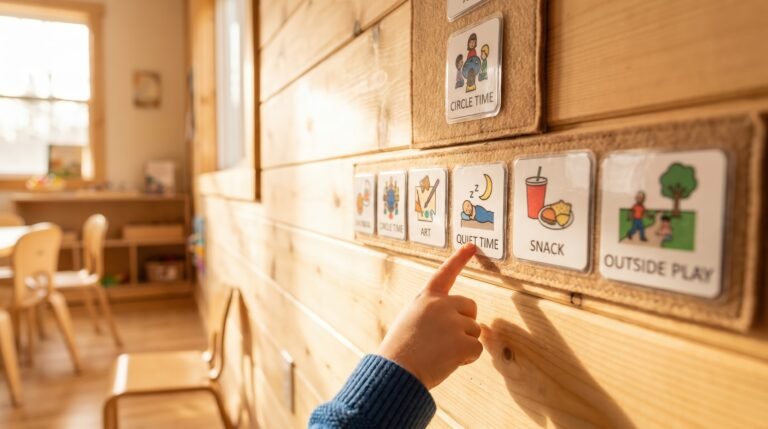
Think ahead about transitions. If a substitute teacher, school event, schedule change, or new group is expected, prepare the student privately when possible. A visual schedule, a brief preview, or a familiar adult available at arrival can reduce the uncertainty that often intensifies anxiety.
Coordinate Support Across Adults and Settings
Children make stronger progress when caregivers, educators, school-based staff, and outside providers use compatible approaches. Coordination does not require every adult to run the same intervention. It does require shared language and a shared commitment to reducing pressure.
Caregivers can offer valuable information about where, when, and with whom the child speaks. School staff can describe classroom demands, peer dynamics, and patterns across the day. Mental health professionals, speech-language pathologists, and other relevant providers may contribute within their scope when communication, anxiety, or language needs overlap.
Keep communication specific. Instead of reporting that a student “did better,” document what occurred: “She pointed to answer three questions during small group,” or “He whispered one word to his parent in the empty counseling room.” Specific observations help the team notice meaningful change without turning every interaction into a performance measure.
For professionals managing busy caseloads, a simple tracking form can be useful. Record the setting, people present, communication method, approximate anxiety level, and what support was offered. Patterns often become clearer over several weeks, making it easier to adjust supports thoughtfully.
Protect Peer Relationships and Dignity
Peers may be curious about why a classmate does not speak. The student should not be required to explain their experience or become the focus of a classroom lesson. Adults can set an inclusive tone without disclosing private information: “People communicate in different ways, and we give everyone time to respond.”
Structured partner activities can be helpful when they are carefully matched and do not require immediate talking. Choose calm, kind peers and provide a shared task with natural roles, such as sorting materials, building something, or completing a visual challenge. For some students, parallel participation is the right first step. Social connection can grow before conversation does.
Supportive adults also watch for subtle exclusion. A student who does not speak may be overlooked during group decisions, assumed not to understand, or left out of informal conversation. Gentle scaffolding can create access without placing the student on the spot. “Jordan can choose the first card,” is often more useful than, “Jordan, tell your group what you think.”
A child with selective mutism does not need more pressure to prove they are capable. They need adults who notice the communication already happening, respond with calm consistency, and make each next step feel possible.