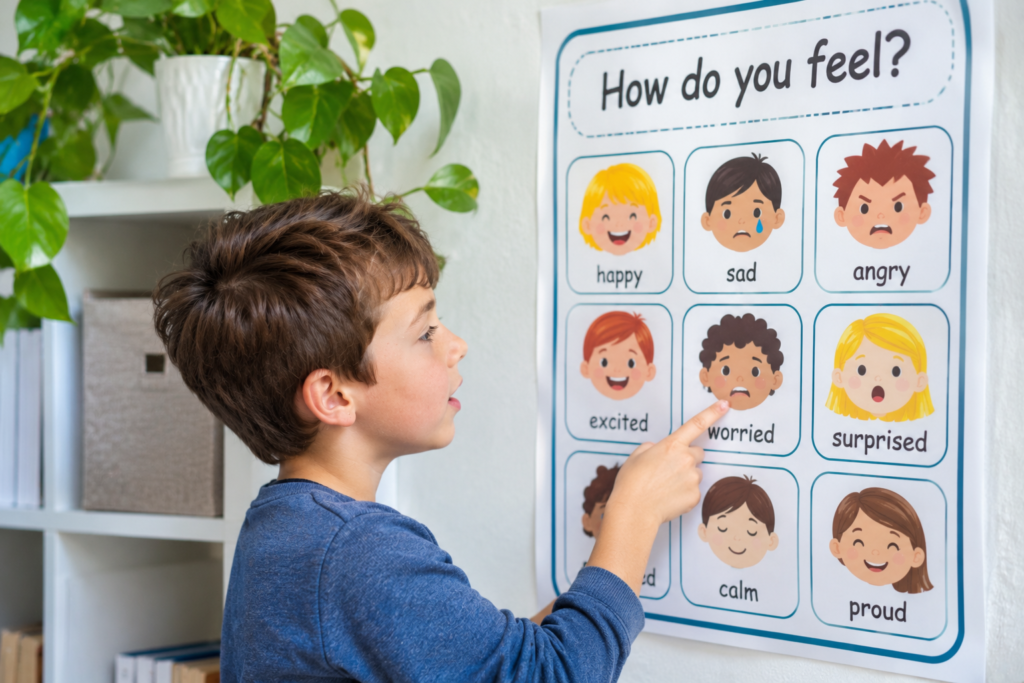
A student says, “I’m fine,” while pushing their chair back, avoiding eye contact and crumpling a worksheet. Another child calls every uncomfortable feeling “mad.” A teen describes a conflict as “nothing” but has stopped joining friends at lunch. These are not simply behavior or communication problems. They are moments when a child may need more words, more safety, and more practice connecting an inner experience to language.
When we teach emotional vocabulary, we give children and adolescents a usable map for experiences that can otherwise feel confusing, overwhelming or invisible. The goal is not to make every student talk at length about feelings. It is to help them notice emotional cues, choose words with growing accuracy, communicate needs, and pick support or coping strategies that fit the moment.
For busy school and clinical professionals, this work is often most effective when it is woven into routines, check-ins, stories, play and problem-solving rather than taught once as a separate lesson. (For structured lesson ideas, see our companion guide on teaching feeling vocabulary to children. This article focuses on the real moments in between.)
Why emotional vocabulary supports regulation
Emotional vocabulary is more than a list of feeling words. It includes the ability to tell related states apart, connect feelings to body signals and situations, and recognize that emotions can shift in intensity. A child who can say, “I’m disappointed because I thought I would get a turn,” gives adults a clearer starting point for support than a child who can only yell, leave, or say, “This is stupid.”
Research with adults suggests that putting feelings into words can reduce the intensity of emotional responses in the brain (Lieberman et al., 2007). Still, naming an emotion does not automatically regulate it, especially for children. A student may accurately identify panic, jealousy or frustration and still need co-regulation, sensory support, a break, or a trusted adult. What language does is reduce guesswork. It helps adults respond to the child’s actual experience instead of only the most visible behavior.
This matters across disciplines. School counselors may use feeling language during individual check-ins. Speech-language professionals may target vocabulary, perspective-taking and narrative skills. Occupational therapy-informed practice may connect words to interoceptive and sensory cues. Teachers and special educators can build emotional language into classroom routines, social problem-solving and literacy. The shared purpose is practical: helping students feel understood and better able to participate.
Start with words children can actually use
A large feelings chart can be useful, but presenting dozens of words at once may overwhelm a child who is still learning the difference between sad and angry. Begin with a small, meaningful set of emotion words that match the student’s developmental level, communication profile, culture and daily contexts.
For younger children or students with emerging language skills, start with familiar words such as happy, sad, mad, scared, worried, excited, tired and calm. Pair each word with a simple visual, facial expression, body cue or real-life example. The visual should support understanding, not become a test of whether a child can correctly read a face. People express emotions differently, and some children may mask, show a flat affect, or communicate distress through behavior rather than facial expression.
As students gain confidence, add words that create useful distinctions. Annoyed, frustrated, disappointed and furious might all be described as anger, but they can point toward different needs. A student who is annoyed may need a small adjustment. A student who is frustrated may need help, a new strategy or more time. A student who is furious may need space, safety support and co-regulation before problem-solving can begin.
With adolescents, avoid assuming that more sophisticated vocabulary means more emotional insight. Teens may know words like overwhelmed, insecure, numb or embarrassed but find it hard to use them honestly in the moment. Brief, low-pressure prompts often work better than direct questioning. Asking, “Was that more irritating, stressful, disappointing, or something else?” gives the student choices while leaving room for their own language.
From our counseling room to yours: For young learners, our Feelings Alphabet A-Z Crafts combine alphabet practice with feeling words in cut-and-paste crafts, so children meet new emotion words through hands-on making rather than drills. Introduce one or two letters a week during a check-in or literacy block and display the finished crafts as a growing feelings word wall. One reviewer used it with a K-2 autism class, and another wrote that it “gave my students a fun, hands-on way to talk about different feelings without it feeling too structured or clinical.”

Teach emotional vocabulary through context, not quizzes
Children learn feeling words best when the words are attached to recognizable experiences. Instead of asking a student to memorize definitions, use a brief scenario, a picture book moment, a conflict that has already settled, or an imagined school situation. Then explore what might be happening inside the person.
A helpful sequence moves from observation to interpretation: What happened? What clues do we notice in the body, thoughts, actions or situation? What feeling word might fit? Could more than one feeling be true? What might help next?
For example, after a student is not chosen for a game, an adult might say, “You were waiting to be picked, and then the game started without you. Some people might feel left out, disappointed, embarrassed or angry. What word is closest for you?” This validates the situation without telling the student what they feel.
Story characters and role-play offer emotional distance when direct discussion feels too exposing. A student might identify a character’s worries more easily than their own. Puppets, miniatures, drawing, comic-strip conversations and sand tray storytelling can serve a similar function. For students who communicate with AAC, make sure emotional vocabulary is available and modeled consistently in their communication system.
Avoid turning emotion identification into a right-or-wrong exercise. Context matters, and the same event can lead to very different emotional responses. One student may feel relieved after a canceled presentation, while another feels disappointed. The skill is not guessing the one correct answer. It is learning to notice clues, consider possibilities, and communicate one’s own experience.
Try this in your next session: After reading a picture book, pause on one page and ask, “What might this character be feeling? What clue tells you that?” Offer two or three words to choose from, then ask, “Has anything like that ever happened at school?” Students can answer or pass.
Connect words to the body and to intensity
Emotion language becomes more useful when students learn that feelings often come with physical signals. A child may notice a hot face, tight fists, fast heart, wiggly legs, heavy shoulders, a lump in the throat or a buzzing stomach before they can name the feeling. Body awareness can be especially valuable for students who tend to recognize distress only after it has reached a high level.
Use neutral, curious language. “What does your body do when you are worried?” is often more accessible than “Why are you anxious?” If a student does not know, offer possibilities without insisting: “Some people feel shaky, quiet, sick to their stomach or extra alert. Do any of those fit?”
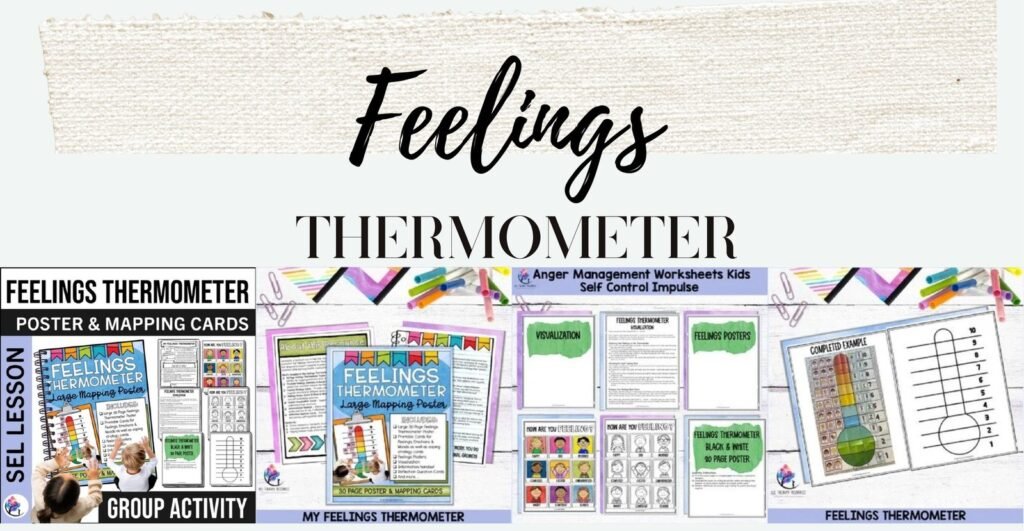
It also helps to teach intensity. Students can sort familiar emotions from low to high, such as bothered, annoyed, frustrated and furious. A 1-to-5 scale, color-coded continuum or simple visual thermometer can make the idea concrete. The purpose is not to convince a student that their feeling is too big. It is to help them notice when a feeling is growing and what kind of support may help at each level.
Be mindful that intensity scales are subjective. A level 4 for one student may look different from a level 4 for another. Treat the student as the expert on their internal experience while using observation to support safety and planning.
From our counseling room to yours: Our Feelings Thermometer Mapping Poster and Worksheets give students a visual for noticing how big a feeling is and choosing a calm-down strategy before it peaks. Build the thermometer together in a small group, adding the student’s own words at each level. One reviewer wrote that it “gave my students such a clear visual for understanding how emotions can build,” and another shared that they have used it “in both one-on-one and group sessions.”
Build the language into everyday routines
Brief repetition is more effective than an occasional long lesson. A predictable check-in can take less than two minutes: “What is one word for how you are arriving today?” Offer visual choices, allow students to pass, and accept answers that are not emotion words at first. “Tired,” “hungry” or “not ready” can open a useful conversation about needs and regulation.
Adults can also model precise, boundaried language. “I’m feeling concerned because our time is almost over, so I’m going to help us make a plan,” shows that emotions can be named without placing responsibility on students. In classrooms, staff might narrate characters’ emotions during reading, notice the feeling behind a problem-solving moment, or include a feeling word in morning meeting. In therapy, a closing routine can ask students to name one feeling they had during the session and one support they may use afterward.
Consistency matters more than elaborate materials. A small set of clear feeling cards, scenario prompts, sentence stems and regulation choices can be reused across individual sessions, groups, classrooms and home communication. Ready-to-use resources can reduce preparation time, but the relationship and responsive adult coaching are what give the tools meaning.
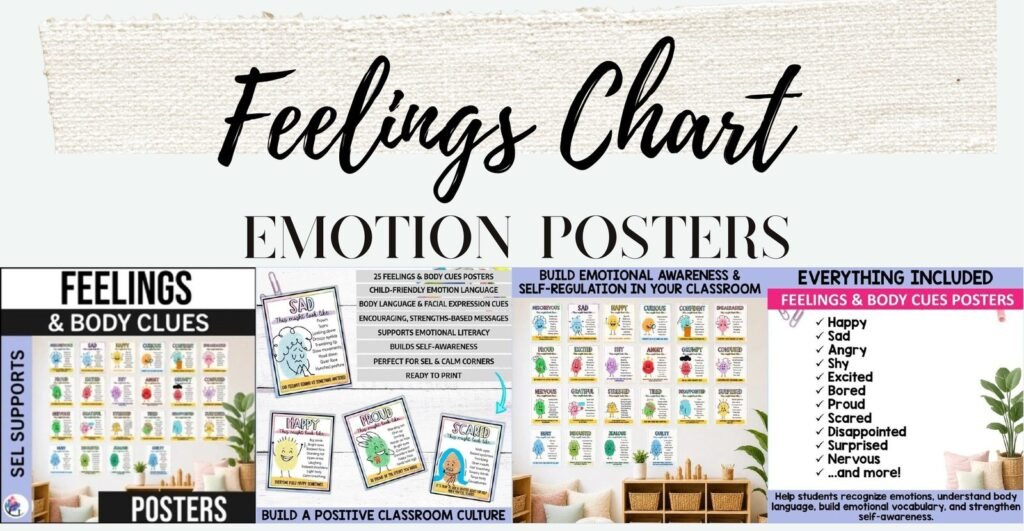
From our counseling room to yours: Our Calm Down Corner Feelings Chart and Emotions Posters (Pastel) show feelings alongside body clues for kindergarten to grade 6, giving students a shared visual for daily check-ins. Hang them where students arrive so the morning check-in becomes a quick point-and-name routine. One reviewer said they “give students a concrete way to recognize how emotions show up in their bodies, which has been so helpful during check-ins and emotional regulation lessons.”
Respond in ways that keep students safe and understood
When a child uses a feeling word, resist the urge to immediately correct, reassure or solve the problem. Start by reflecting what you heard: “You felt embarrassed when everyone looked at you.” Then, if needed, help the student refine the word or explore mixed feelings: “It sounds like you were embarrassed and also angry that someone laughed.”
Validation does not mean agreeing with every interpretation or allowing unsafe behavior. It means acknowledging that the emotion makes sense in context. From there, adults can set limits and offer choices: “It makes sense that you are furious. It is not okay to throw materials. We can take space, use the calm corner, or sit with me while your body settles.”
In trauma-informed practice, prioritize choice and avoid requiring disclosure. Some students will not want to explain why they feel afraid, shut down or upset. They can still practice choosing a word, communicating a need, or using a regulation strategy without sharing personal details. If a student’s distress, safety concerns or changes in functioning suggest a need for further assessment or support, follow your setting’s procedures and professional scope.
Emotional vocabulary grows through hundreds of small interactions: a supported repair after conflict, a visual check-in before group, a character discussion, a pause to notice body cues. Each one tells a child or teen that inner experiences can be named, held with care, and met with practical support.
Helpful extras
Picture books give children some emotional distance while they practice naming feelings. A few widely used titles that pair well with the story-based ideas above:
- The Way I Feel by Janan Cain: a simple introduction to a range of everyday feelings for young children
- In My Heart by Jo Witek: explores happiness, sadness, anger, bravery and other big emotions
- The Color Monster by Anna Llenas: a story about sorting out mixed-up emotions, useful for talking about having more than one feeling at once
As an Amazon Associate, we earn from qualifying purchases.
Frequently asked questions
What age should you start teaching emotional vocabulary?
You can begin in the preschool years with a few familiar words such as happy, sad, mad and scared, paired with pictures and real moments. Words that make finer distinctions, such as frustrated or disappointed, can be added as children’s language grows, and teens benefit from continued practice too.
How many feeling words should students learn at once?
Start small. A handful of words that students will actually use is more helpful than a large chart. Add new words gradually, especially ones that help tell related feelings apart.
What if a student refuses to talk about feelings?
Respect the choice and lower the pressure. Offer visual options to point to, allow students to pass, use story characters for distance, and never require disclosure. Many students will engage more over time once check-ins feel safe and predictable.
Looking for practical, ready-to-use resources to support your emotional vocabulary lessons? The All Therapy Resources Membership provides access to a growing collection of thoughtfully developed counseling and SEL activities, interactive games, and therapeutic tools designed to save preparation time while supporting meaningful, skill-focused learning.