“Relax, it’s just a joke.” If you work with boys in upper elementary or middle school, you have probably heard it many times, often from a group that is laughing while one student is not. Telling teasing vs bullying apart is one of the most useful skills we can teach boys, because so much of their friendship conflict hides behind banter, competition and “toughening up.” This post gives school counselors practical activities, scripts and group ideas to help boys spot where the line is and make braver choices when it gets crossed.
We focus here on the social pressures boys often describe: banter, locker room culture, rivalry and going along with the group. For general conflict skills like I-statements and repair conversations, see our conflict resolution activities for students. For the friendship dynamics many girls describe, see our post on girl drama activities for middle school.
Why Boys’ Conflict Often Hides Behind “Just Joking”
Many boys are taught, directly or indirectly, that showing hurt is a weakness. So when a joke stings, the safest move can feel like laughing along. Put-downs get passed off as banter, exclusion gets passed off as “he’s just not good at the game,” and a boy who says “stop” risks being called sensitive.
That makes boys’ conflict easy for adults to miss. There may be no tears and no complaint, only a student who stops coming to lunch, avoids the locker room or suddenly has a stomachache before PE. Giving boys clear words for what is happening, and permission to name it, is one of the most helpful things we can do.
Relational aggression is not only a girls’ issue either. Leaving someone out on purpose, spreading rumors and turning the group against a peer happen in boys’ friendship groups too, often wrapped in humor. Our guide to relational aggression activities for students covers these behaviors across grade levels.
Teasing vs Bullying: Where Is the Line?
Not every joke is bullying, and boys know it. Friendly teasing between friends who trust each other can be part of a healthy friendship. StopBullying.gov describes bullying as unwanted, aggressive behavior that involves a real or perceived power imbalance and happens more than once, or has the potential to (StopBullying.gov). That gives boys three useful questions: Is everyone laughing? Does it keep happening after someone wants it to stop? Is one person always the target?
| Friendly teasing | Crossing the line | Bullying | |
|---|---|---|---|
| Who is laughing? | Everyone, including the person being teased | The group, while one person goes quiet | Everyone except the target |
| What happens after “stop”? | It stops | It keeps going for a while | It gets worse or moves online |
| Who is the target? | It goes both ways | Often the same person | Always the same person, with less power in the group |
| What to do | Keep it kind, read the room | Say “that’s enough,” check in with your friend | Tell a trusted adult; this needs adult help |
Activity: Laughing With or Laughing At?
Read short scenarios aloud, such as a nickname a boy has asked his friends to stop using, a joke about someone’s family, or friends roasting each other after a game where everyone joins in. Boys hold up a card for “laughing with,” “laughing at” or “not sure,” then explain their choice. The “not sure” cards usually lead to the best discussion, because they show how the same words can land differently depending on who says them and how often.
Try this in your next group: Teach a short “read the room” check. Before a joke, ask: Would I say this if he was standing right here? Would I be okay if it was said about me? Has he laughed at this before, or just gone quiet? Then practice one line boys can use to pull back without losing face: “Okay, that one’s done. Let’s move on.”
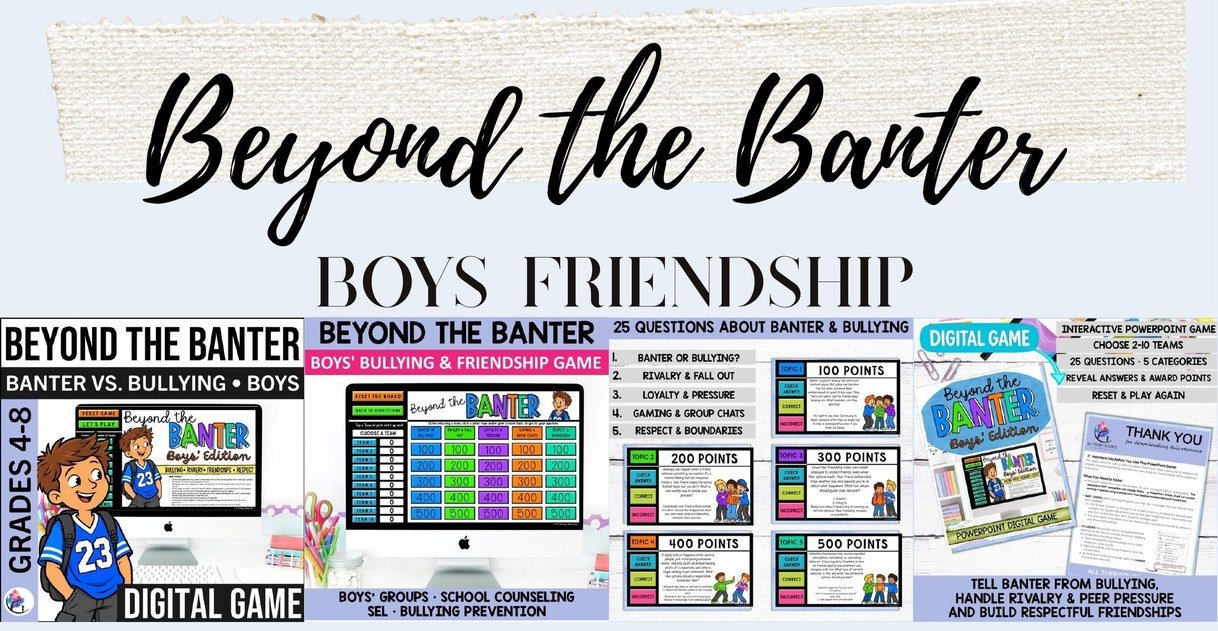
Our Beyond the Banter Boys Friendship Game is built around exactly this question. Teams of boys in grades 4-8 work through five categories (Banter or Bullying?, Rivalry and Fall Out, Loyalty and Pressure, Gaming and Group Chats, and Respect and Boundaries) using situations they see every day, like friends who keep going after someone says stop. Every answer comes with a teaching point, so the conversation stays on track. We like it as a first session with a new boys’ group, because it gives everyone shared words for “that went too far.”
Locker Room Pressure and Going Along With the Group
Some of the hardest moments for boys are not one-on-one conflicts but group moments: a put-down that everyone laughs at, a teammate being frozen out, or pressure to join in so you don’t become the next target. In these moments, the bystanders often hold more power than they realize.
Activity: The Bystander’s Choice
Set up a short role-play with four roles: the leader making the joke, the boy on the receiving end, a follower who laughs along, and a bystander who isn’t sure what to do. Pause the scene and ask each character, “What are you thinking right now? What are you afraid of?” Then replay it with the bystander trying a different choice. Boys quickly notice that one calm voice can change the direction of the group.
Give bystanders options that don’t require a big confrontation, because for many boys that feels too risky:
- Change the subject: “Anyway, who’s playing tonight?”
- Name it lightly: “Bro, that’s enough.”
- Check in later: “Hey, you good? That was a lot.”
- Get help: tell a coach, teacher or counselor when it keeps happening.
Try this in your next session: Picture a student who tells you, “I didn’t do anything, I just laughed.” Ask, “What do you think it was like for him when everyone laughed?” and “What’s one thing you could do next time that wouldn’t make you a target?” Keeping it about choices, not blame, helps boys stay in the conversation.
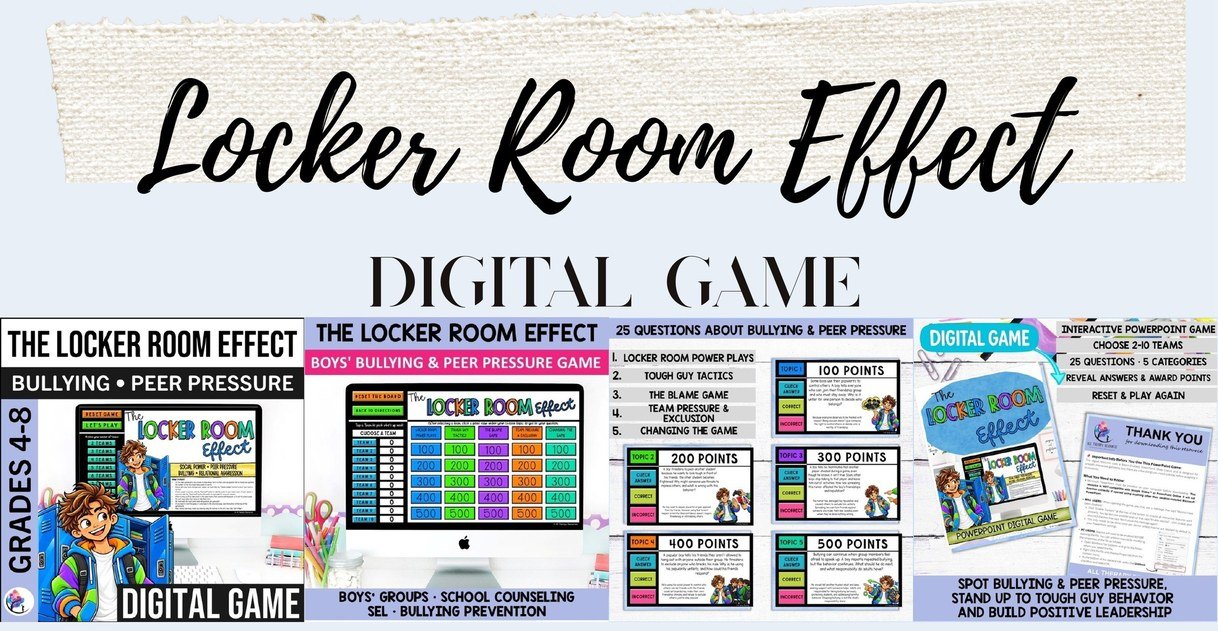
Our Locker Room Effect Digital Game helps boys in grades 4-8 spot the tough guy tactics, put-downs and exclusion that often get brushed off as banter. Its 25 questions cover topics including Tough Guy Tactics, Locker Room Power Plays, The Blame Game and Changing the Game, and teams play on an interactive board with a built-in scoreboard. Because boys are talking about situations on the screen rather than about each other, it opens up conversations about peer pressure and what real strength looks like without putting anyone on the spot.
Rivalry, Losing and Falling Out
Competition is a big part of many boys’ friendships, and it is often where conflict starts: a lost game, a blamed teammate, mocking the losing side, or a falling out over who gets picked. These moments are good teaching opportunities, because the feelings underneath (embarrassment, frustration, feeling left out) are easier to name when they are tied to something concrete.
Activity: After the Final Whistle
Ask boys to list things people say after winning and losing, then sort them into “keeps the friendship” and “costs the friendship.” Practice a few repair lines they can use after things get heated: “My bad, I was frustrated about the game, not you.” “Good game. Rematch tomorrow?” “I shouldn’t have blamed you for that.” Short, low-key repairs tend to feel more natural to boys than long apologies.
When a falling out keeps going, our post on teaching about power, peer pressure and choices has more ideas for whole-class lessons.
When Friendship Problems Need Adult Help
Boys are often reluctant to tell an adult, because they worry about being seen as a snitch or making things worse. Be clear with them about the difference between snitching (getting someone in trouble) and reporting (keeping someone safe). Let them know which situations always need an adult: repeated targeting, threats, physical harm, hazing, or anything shared online to humiliate someone. In those cases, follow your school’s bullying procedures. Our guide to bullying prevention resources for middle school covers whole-school approaches.
A simple rule helps: “If you are trying to keep someone safe, that’s not snitching. That’s being a good friend.”
Running a Boys’ Friendship Group
A short, structured group gives boys a place to practice these skills with less pressure than a whole class. A few tips that help:
- Keep it active. Games, team points and short role-plays keep boys engaged and make it easier to talk.
- Talk about situations, not people. Agree at the start that you discuss scenarios, not classmates.
- Mix the group thoughtfully. Avoid placing boys who are in active conflict together, and balance louder and quieter students.
- End with one skill. A line to pull back a joke, a repair phrase or one bystander move to try that week.
- Loop in coaches and teachers. Share the language you are using so they can reinforce it in PE, at lunch and on the team.
For more ideas on building friendships, see our friendship skills activities.
If you want a ready-made group plan, our Boys Friendship Bundle brings together three digital counseling games for grades 4-8: The Locker Room Effect, Beyond the Banter and the Friendship Temperature Check Game. Run it as a three-week boys’ group, one game a week, starting with peer pressure, moving to teasing vs bullying, and finishing with how to tell a small friendship bump from a real red flag and when to get help. It also works for lunch bunch, one category per session.
Frequently Asked Questions
What is the difference between teasing and bullying?
Friendly teasing goes both ways, everyone is laughing, and it stops when someone asks. Bullying is unwanted, aggressive behavior that involves a real or perceived power imbalance and happens more than once or is likely to. When the same student is targeted repeatedly, it needs adult help.
How do I get boys to open up about friendship problems?
Start with scenarios and games rather than direct questions about their own lives. Many boys find it easier to talk side by side, while doing something, than face to face. Keep the tone practical and focused on choices, not blame.
Should I run separate boys’ groups?
Boys’ groups can make it easier to talk about locker room culture, banter and pressure to act tough. These skills matter for every student, though, and the activities in this post also work in mixed groups and whole-class lessons.
What if a boy says it was “just a joke”?
Acknowledge the intent, then shift to the impact: “You might not have meant it that way. How do you think he felt?” Help him plan what to do differently next time. If the behavior is repeated or targeted, follow your school’s bullying procedures.
Looking for practical, ready-to-use resources to support your boys’ groups and bullying prevention lessons? The All Therapy Resources Membership provides access to a growing collection of thoughtfully developed counseling activities, interactive games, and therapeutic tools designed to save preparation time while supporting meaningful, skill-focused learning.