Mention puberty to a room of fifth graders and you will usually get giggles, groans and at least one student hiding behind a hoodie. Yet most of them have real questions they would never ask out loud. These puberty activities help school counselors, nurses and health teachers turn an awkward topic into a calm, low-pressure conversation, so upper elementary and middle school students get accurate answers and feel a little less alone with the changes they are going through.
Why Puberty Conversations Matter Before the Changes Start
Puberty starts earlier than many adults expect. KidsHealth from Nemours notes that puberty normally starts between ages 8 and 14 for girls and between 9 and 15 for boys, and recommends talking about it before the changes begin, with an ongoing conversation rather than one big talk. For girls, it is especially important to talk about periods before they start.
That timing puts upper elementary and early middle school right in the window where students need clear information most. Playful, structured activities help because they give students something to focus on besides their own embarrassment. A team game, a question box or a sorting task lets students engage with the content without having to share anything personal.
Setting Up a Safe, Comfortable Puberty Session
How you set up the session matters as much as the content. A few things we always put in place:
- Check your school or district policy. Many schools have rules about puberty education, parent notification and who delivers it. Let families know what is being covered so they can continue the conversation at home.
- Agree on ground rules. Questions are welcome, we use correct names for body parts, we don’t laugh at anyone’s question, and we don’t share personal stories about classmates.
- Use an anonymous question box. Students write a question on a slip of paper (everyone writes something, even “no question,” so no one stands out). You read and answer them at the next session.
- Keep it reassuring. Everyone goes through puberty, everyone’s timing is different, and there is no “right” pace.
- Know your limits. If you don’t know an answer, say so and find out. Refer medical questions to the school nurse, a parent or a doctor.
Try this in your next lesson: Open with a calm script such as, “Today we’re going to talk about puberty. It’s a normal part of growing up, and every single adult in this school went through it. Some of it might feel a bit awkward, and that’s okay. You can ask me anything in the question box.”
Puberty Activities for Girls
Girls often want practical, reassuring answers: what will happen, when, and what to do about it. Topics usually include body changes and growth, periods and menstrual care, personal hygiene, and emotions and self-confidence.
Activity: Myth or Fact?
Read statements aloud, such as “Everyone gets their first period at the same age,” “You can still play sports during your period” or “Everyone grows at a different speed,” and have students hold up a Myth or Fact card. Pause after each one to explain the accurate answer. It clears up misinformation quickly without anyone having to ask.
Activity: Be-Prepared Kit
Have students plan a small “be-prepared kit” for school: what they might pack (pads, a spare pair of underwear, wipes), where they could keep it, and which adults at school they could go to for help. Planning ahead turns a worry into a manageable next step.
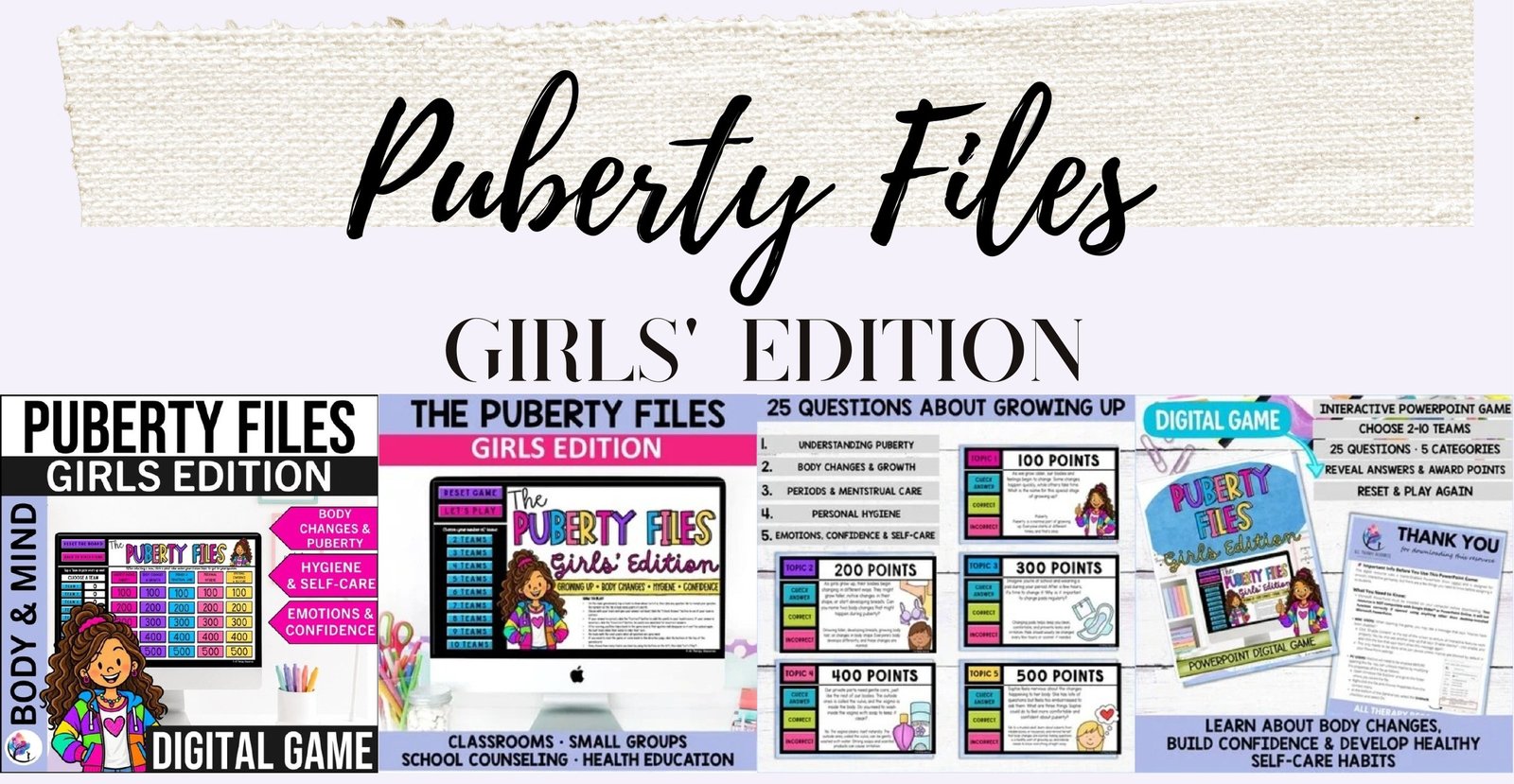
Our Puberty Files Girls’ Edition Digital Game turns these topics into a low-pressure team game for upper elementary and middle school girls. Teams choose question tiles across five topics (Understanding Puberty, Body Changes and Growth, Periods and Menstrual Care, Personal Hygiene, and Emotions, Confidence and Self-Care), talk them through and click to check the answer. We find the team format takes the spotlight off any one student, so girls in a small group or girls’ group can join in without feeling put on the spot.
Puberty Activities for Boys
Boys often have just as many questions but are even less likely to ask them. Many worry about whether their growth, voice or body is “normal” compared with their friends. Clear, matter-of-fact information and a bit of humor go a long way.
Activity: Build a Hygiene Routine
Give small groups a set of cards (shower, deodorant, wash face, brush teeth, clean clothes, wash hair) and a simple morning and evening timeline. Groups build a realistic routine together, then talk about which steps are new during puberty and why. Keep the tone practical and positive: this is about feeling confident, not about anyone being “smelly.”
Activity: Same Changes, Different Timing
Line up cards showing changes such as growth spurts, voice changes, body hair and stronger emotions. Ask students to sort them into “happens to most boys at some point” and “happens on exactly the same day for everyone.” The second pile stays empty, which makes the point clearly: everyone gets there in their own time.
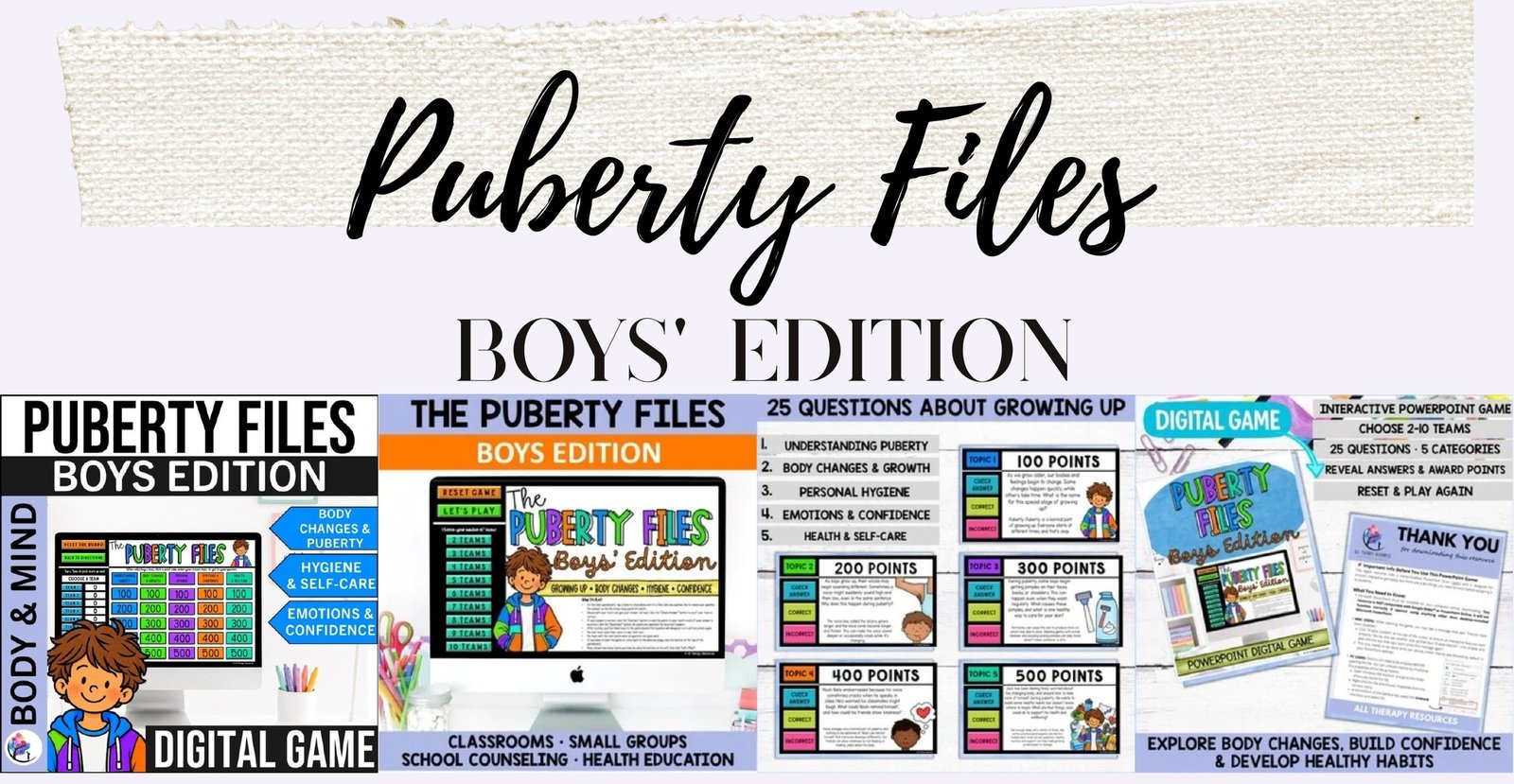
Our Puberty Files Boys’ Edition Digital Game covers body changes and growth, personal hygiene, emotions, confidence and healthy habits in 25 team questions. Answers are clear and age-appropriate, and the built-in scoreboard adds just enough friendly competition to keep boys engaged. It works well in a boys’ group, a health lesson or a small group before the transition to middle school.
Emotions, Confidence and Self-Care During Puberty
Puberty is not only physical. Students often notice stronger moods, more self-consciousness and new worries about how they look or fit in. Naming these changes helps students see them as part of growing up, not as something wrong with them.
| What students might notice | How it can feel | A helpful message |
|---|---|---|
| Changing faster or slower than friends | Embarrassed, left behind, self-conscious | “Everyone’s timing is different, and both early and later are normal.” |
| Bigger, quicker mood changes | Confusing, frustrating | “Strong feelings are common during puberty. Let’s find some ways to calm them.” |
| Worrying more about looks | Anxious, comparing | “Bodies come in all shapes and sizes. What does your body help you do?” |
| Questions they are too shy to ask | Worried, alone | “No question is silly. You can ask me, the nurse or a parent.” |
Puberty lessons are also a natural time to talk about body autonomy and boundaries. Our guide to how to teach consent K-12 and our post on safe and unsafe secrets pair well with this unit. If a student shares something during a puberty session that raises a safety concern, follow your school’s child protection procedures.
If you teach both boys and girls, our Puberty Activities Bundle brings both Puberty Files games together. It is handy for running parallel boys’ and girls’ groups, or for reviewing both sets of changes with each group, since students benefit from understanding what everyone is going through.
Frequently Asked Questions
What age should puberty activities start?
Because puberty can begin as early as age 8 for some girls and 9 for some boys, many schools start puberty education in upper elementary, often around grades 4 and 5, and continue it into middle school. Follow your school or district’s curriculum and policies.
Should boys and girls be taught separately?
Many schools run separate sessions so students feel more comfortable asking questions, then cover the basics of everyone’s changes so students understand each other. A mix of both approaches often works well.
How do I handle questions I’m not sure how to answer?
It is fine to say, “That’s a great question. Let me find out and get back to you.” Refer medical questions to the school nurse, a parent or a doctor, and stay within your school’s guidelines.
How can I involve parents?
Let families know when puberty lessons are happening and what will be covered, so they can keep the conversation going at home. Many parents appreciate a short list of topics and a few conversation starters.
Looking for practical, ready-to-use resources to support your puberty and health lessons? The All Therapy Resources Membership provides access to a growing collection of thoughtfully developed counseling activities, interactive games, and therapeutic tools designed to save preparation time while supporting meaningful, skill-focused learning.