When a student is referred for social skills support, the concern is usually framed around friendships: falling out at recess, feeling left out, struggling to join a game. Yet many of the same skills decide how that student copes in the classroom. Think of the child who takes over every group project, the one who shuts down when the plan changes, or the student who sits silently stuck on a worksheet rather than asking for help. These are social skills too, and they shape learning as much as they shape friendships.
This guide looks at social skills for school success: cooperation, flexible thinking, self-control, emotional awareness and self-advocacy, and how school counselors and teachers can teach them as classroom skills. If you are looking for the developmental picture behind social skills, our article on why social skills are about more than making friends covers it, and our friendship skills activities focus on peer relationships. Here, the focus is on the skills students need to learn, work and participate alongside others.
Why social skills matter for school success
Classrooms are social places. Students are asked to work in pairs, share materials, wait for a turn to speak, accept feedback, cope with a changed timetable and ask for help when they are confused. A student who finds these demands hard may know the content and still struggle to show it.
Research supports treating these skills as part of learning. A large meta-analysis of 213 school-based social and emotional learning programs, involving more than 270,000 K–12 students, found that participants showed improved social and emotional skills, attitudes, behavior and academic performance compared with controls, including an 11-percentile-point gain in achievement. A long-term study of kindergarten social competence found that teacher ratings of children’s prosocial skills were significantly associated with outcomes 13 to 19 years later, including education, employment and mental health. That study shows an association rather than cause and effect, but it is a useful reminder that these skills matter well beyond the playground.
CASEL’s SEL framework names many classroom social skills directly under relationship skills, including teamwork and collaborative problem-solving, resolving conflicts constructively and seeking or offering help when needed. Many of them also draw on executive function skills (working memory, mental flexibility and self-control), which the Harvard Center on the Developing Child describes as essential for school achievement and still developing through the teen years and into early adulthood.
Look for the skill beneath the classroom behavior
Classroom behavior is often where adults first notice a social skills gap, but the behavior is rarely where the story begins. Picture two students who both refuse to continue a partner task and insist it is unfair. One finds it hard to tolerate disappointment because emotional regulation is still developing. The other believes their partner ignored every idea because perspective taking is still hard for them. The behavior looks the same; the skill each student needs is different.
A helpful shift is to move from “How do I stop this behavior?” to “What skill is this student still building?” Curiosity leads further than correction because it points to something we can teach. The table below links common classroom concerns with the skill that may sit underneath them.
| What you see in class | Skill that may still be developing | What to practice | Suggested ATR resource |
|---|---|---|---|
| Takes over group work or refuses to share a role | Cooperation and perspective taking | Assigned roles, building on a peer’s idea | Castle Collaborations Teamwork Lesson |
| Melts down when the plan or schedule changes | Flexible thinking | Sizing the problem, “Plan B” thinking | Size of the Problem Workbook |
| Calls out answers or interrupts discussions | Impulse control | Pausing, waiting signals, “hold your thought” | Let’s Choose Impulse Control Game |
| Misses multi-step directions, then gets in trouble for being off task | Listening and working memory | Whole-body listening, repeating steps back | Active Body Listening Lesson |
| Sits silently stuck or gives up rather than asking | Self-advocacy and help-seeking | Help-seeking scripts, asking for a break | Asking for Help Activities |
Use the table as a starting hypothesis, not a diagnosis. A behavior can have several explanations, including learning needs, sensory needs, stress or trauma, so observation and conversations with the student, teacher and family come first.
Cooperation and group work skills
Group work asks a lot of students at once: sharing materials, taking turns to speak, listening to an idea they disagree with, accepting a role they did not choose and keeping the group on task. “Work nicely together” does not tell a student which of those steps to take, so name them and practice them.
Useful cooperation skills to teach explicitly include:
- Taking a turn and passing it on (“What do you think, Sam?”)
- Building on someone else’s idea (“I like that, and we could also…”)
- Disagreeing respectfully (“I see it differently. Can I explain why?”)
- Accepting a group decision that was not your first choice
- Checking in on progress (“What do we still need to finish?”)
Picture a third-grade group building a poster. One student holds all the markers and rewrites every heading. Rather than removing the student, the adult pauses the group and says, “Let’s give everyone a job. Who is the writer, who is the checker, who is the timekeeper?” Assigned roles turn an abstract expectation into a concrete one, and they give quieter students a clear way in.
Try this in your classroom: run a short, low-stakes group task (stacking cups, building a paper tower) with role cards for each student. Afterward, debrief with three questions: “What helped our group work well?”, “What was tricky?” and “What will we try next time?” Keep the focus on the group’s skills rather than any one student’s behavior.
Flexible thinking when plans change
Classrooms change constantly. An assembly replaces art, a substitute teacher arrives, a partner is absent or a favorite activity runs out of time. For students who find flexible thinking hard, these moments can feel enormous, and the reaction can look much bigger than the problem.
Telling a student “It’s not a big deal” usually comes from a caring place, but it can dismiss what they are feeling. A more helpful goal is perspective: every feeling is valid, and not every situation needs the same response. Students can learn to ask themselves:
- “Is this a small, medium or big problem?”
- “What is my Plan B?”
- “Who could help me if I need it?”
Picture a student who finds out at the last minute that indoor recess replaces the soccer game they were looking forward to. A brief script can help: “You were excited about soccer and now the plan has changed. That’s disappointing. Is this a small, medium or big problem? What could you do instead today?” Practicing this language when students are calm makes it easier to use in the moment.
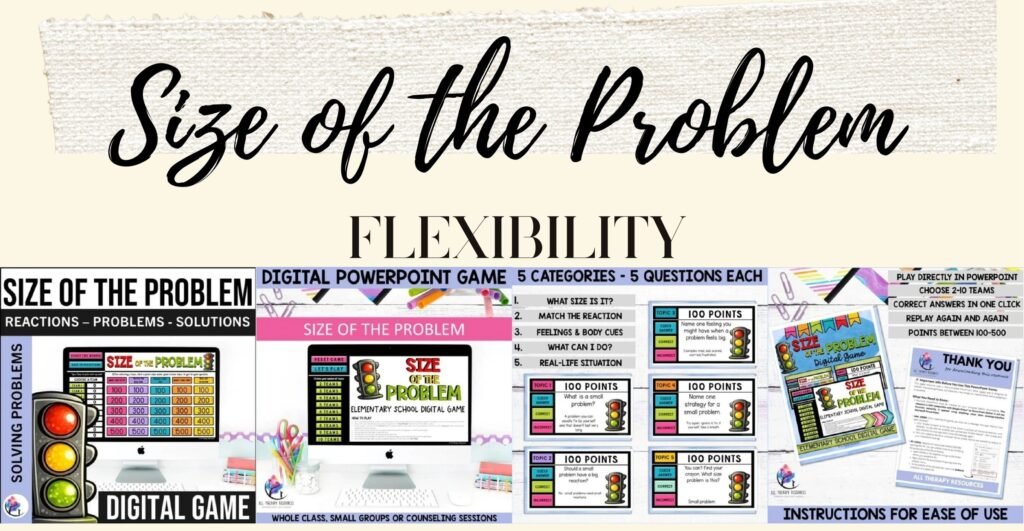
Try this in your next session: our Size of the Problem Digital Game is an interactive PowerPoint game for elementary students that helps them sort problems into small, medium and big, then choose a reaction that fits. It suits classroom guidance lessons and small groups because students work in teams, discuss each situation and practice matching their response to the problem. Play a round before a busy or unpredictable week, then refer back to the same small, medium and big language when plans change in class.
Self-control: learning to pause in class
Self-control is often taught as a list of things to stop: stop calling out, stop interrupting, stop arguing. A more useful way to think about it is creating space between an impulse and an action, long enough for a student to ask, “What just happened? What choices do I have? What might happen next?”
For younger students, that pause is often brief. Feeling and reacting happen almost at once, not because students are “naughty” but because the executive function skills that support self-regulation are still developing. With practice and support, the pause grows. Students begin to notice body clues, think about consequences and choose a response.
The way adults talk about these moments matters. Instead of “Why did you do that?”, try “What happened so quickly that your thinking brain didn’t have time to catch up?” Pair that with simple classroom supports: a “hold your thought” hand signal, a sticky note to write down an idea while waiting, or a brief stop, think, choose routine before group discussion.
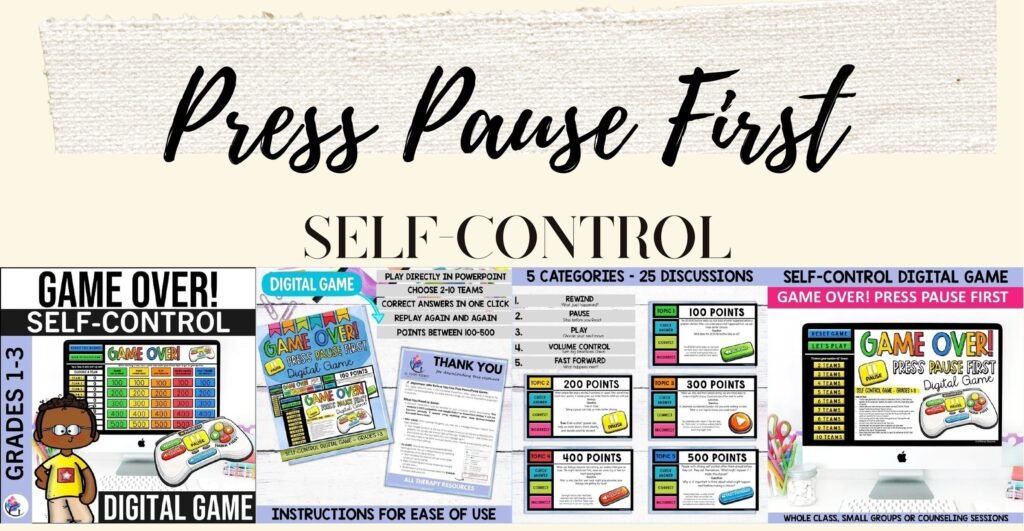
Try this in your next session: Game Over! Press Pause First is a video game-themed digital PowerPoint game that teaches students that the most powerful button is PAUSE. Its five categories (Rewind, Pause, Play, Volume Control and Fast Forward) guide teams through triggers, stopping before reacting, choices, calming big reactions and thinking about consequences, and it works with 2 to 10 teams for classroom lessons or small groups. There is also an upper elementary version for Grades 4–6. One reviewer shared, “It turned practicing impulse control and stopping to think before acting into something fun and engaging.”
Emotional awareness and coping as learning skills
A student who is frustrated by a hard math problem, embarrassed after a wrong answer or worried about a test has less attention left for learning. Many students have not yet learned the words for these experiences. Asked “What’s wrong?”, they shrug, say “I don’t know” or use one word for everything: “mad.”
Frustration, disappointment, embarrassment, worry and overwhelm call for different kinds of support. Helping students name what they feel makes it easier for them, and for the adults around them, to work out what would help. Rather than starting with calming strategies, start with curiosity:
- “Where do you notice frustration in your body?”
- “How can you tell when worry is starting to grow?”
- “What clues tell you a feeling is getting bigger?”
Once students can notice a feeling early, coping skills have a chance to work. In class, that might mean a pre-agreed break, a breathing strategy at the desk or a quiet signal to the teacher. Our guide to emotional regulation activities for kids has more ideas.
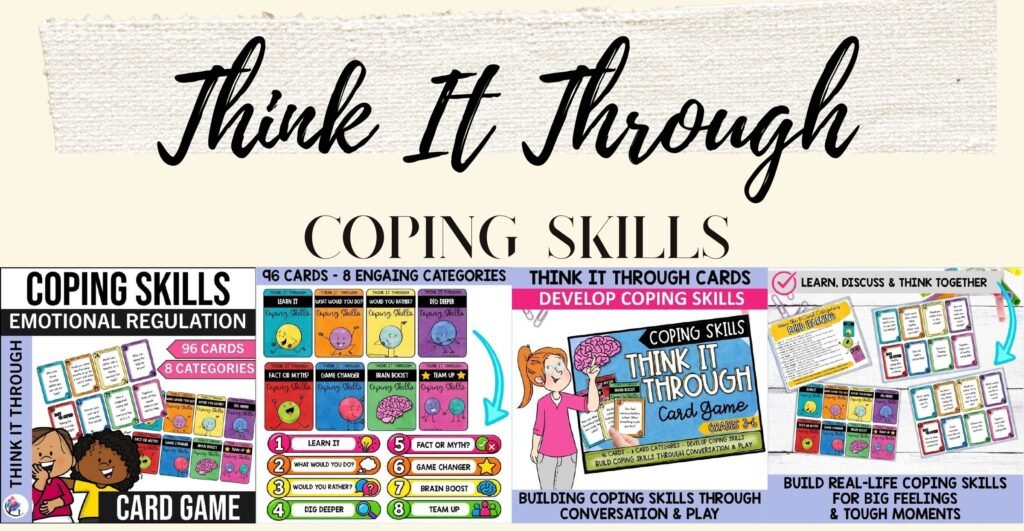
Try this in your next session: Think It Through Coping Skills is a conversation card game that helps students explore emotions, practice coping strategies and solve everyday challenges through play. Use it in a small group by drawing a card, linking it to a classroom moment (a hard assignment, losing a game at recess) and asking each student which strategy they would try. One counselor wrote, “I love the variety of coping strategies because students can explore what genuinely works for them instead of being given the same few suggestions.”
Self-advocacy: asking for help and speaking up
Self-advocacy is one of the most practical social skills for school success, and one of the least explicitly taught. Students who can say what they need are more likely to get support before frustration builds. Those who cannot may sit stuck, rush, copy or give up, and the behavior can be mistaken for lack of effort.
Give students words they can borrow and practice them in a calm setting first:
- “I’m stuck on number 3. Can you show me the first step?”
- “Could you say the directions again, please?”
- “I need a short break. Can I get a drink and come back?”
- “I’d like a different job in the group, please.”
Self-advocacy also includes healthy boundaries: saying “no” respectfully when a partner wants to copy, asking for personal space at the table, and knowing that kindness does not mean ignoring your own needs. Make sure students also know which adults they can go to when something feels unsafe or unfair.
Picture a student who quietly stops working whenever a task feels too hard. Instead of “Why haven’t you started?”, the adult might say, “It looks like this one feels tricky. Which part is stuck?” Then offer a choice of help scripts. For older students, our article on teaching self-advocacy to teens looks at how these skills grow in adolescence.
Help social skills transfer to the classroom
Students do not use these skills one at a time. A disagreement during group work may call on emotional awareness, self-control, flexible thinking and communication within a single conversation. A skill practiced once in the counseling office may also stay there unless adults help it travel.
A few practical ways to help skills transfer:
- Share the language. Give teachers the exact phrases taught in lessons (“small, medium or big”, “press pause”, “what’s my Plan B?”) so students hear them across settings.
- Pick one focus skill a week. Teachers can notice and name it during the day: “You built on Maya’s idea there. That’s great teamwork.”
- Set one small goal. End each lesson with one observable action, such as asking one question for help or using a role card in group work.
- Check in briefly. Ask what the student tried, what was easier or harder than expected and what they will adjust next time.
If you are building these skills into a series of group sessions, our guide to planning a small group counseling curriculum walks through the structure, and integrating social skills into the school curriculum offers ideas for whole-class work.
Frequently Asked Questions
What social skills do students need for school success?
Key skills include cooperating in groups, listening and following directions, flexible thinking when plans change, self-control, recognizing and coping with emotions, and asking for help. CASEL’s framework lists related skills such as teamwork, collaborative problem-solving and seeking or offering help under relationship skills.
Do social skills affect academic performance?
The research suggests they are linked. A meta-analysis of school-based SEL programs found improvements in academic performance as well as social and emotional skills and behavior. Results depend on how well programs are implemented, so consistent, explicit teaching matters.
How are classroom social skills different from friendship skills?
They overlap, but the setting and demands differ. Friendship skills focus on joining in, keeping and repairing peer relationships, while classroom social skills center on learning with others: group work, participation, handling change and asking for help. Our friendship skills activities cover the peer side.
How can school counselors and teachers work together on social skills?
Agree on one or two target skills, share the same language and visuals, and let teachers reinforce attempts during the day. Counselors can introduce and rehearse a skill in a lesson or small group, while teachers create real opportunities to use it in class.
References
- Durlak, J. A., et al. (2011). The impact of enhancing students’ social and emotional learning: A meta-analysis of school-based universal interventions. Child Development, 82(1), 405–432.
- Jones, D. E., Greenberg, M., & Crowley, M. (2015). Early social-emotional functioning and public health: The relationship between kindergarten social competence and future wellness. American Journal of Public Health, 105(11), 2283–2290.
- CASEL: The CASEL framework (SEL competencies)
- Center on the Developing Child, Harvard University: InBrief, Executive Function
Looking for practical, ready-to-use resources to support your classroom social skills lessons? The All Therapy Resources Membership provides access to a growing collection of thoughtfully developed counseling activities, interactive games, and therapeutic tools designed to save preparation time while supporting meaningful, skill-focused learning.