Empathy is one of the most talked-about social-emotional skills in schools, and one of the hardest to teach in a way that sticks. As school counselors, teachers and school psychologists, we often ask: how do we help students move beyond knowing the word empathy to practicing it in real situations, especially when emotions run high, conflicts arise or differences feel uncomfortable?
Teaching empathy in schools works best when we treat it as a set of skills students can practice, not a trait they either have or lack. This guide looks at what empathy means in a school setting, why a trauma-informed “walk in my shoes” approach helps, and the strategies, sample scripts and activities you can use to build compassion and perspective-taking across grade levels.
What Empathy Means in School Settings
Empathy is often confused with kindness or sympathy. Those matter, but empathy goes further: it is the ability to recognize, understand and respond to another person’s feelings, even when their experience is different from our own. Researchers often distinguish cognitive empathy (understanding what someone else may be thinking or feeling) from affective empathy (feeling with them). Students need both, and both grow with practice.
CASEL places empathy within social awareness, described as the ability to understand the perspectives of and empathize with others, including people from diverse backgrounds, cultures and contexts. In schools, empathy supports:
- Positive peer relationships
- Conflict prevention and resolution
- An inclusive classroom culture
- Self-awareness and emotional regulation
- Safer peer dynamics around bullying and exclusion
The bullying link is real but more nuanced than it first appears. A systematic review of 40 studies found that bullying others was associated with lower empathy (especially affective empathy), while defending peers was consistently associated with higher empathy. The authors also noted that the relationship is complex, so empathy lessons work best alongside clear expectations, adult supervision and a whole-school approach. Our guide to bullying prevention activities for middle school covers that wider picture.
Why “Walk in My Shoes” Works as an Empathy Framework
The phrase “walk in my shoes” captures the heart of perspective-taking. It invites students to pause, imagine another person’s experience and reflect before reacting. Used well, it helps students:
- Slow down impulsive reactions
- Consider emotions, context and unseen challenges
- Understand that behavior often communicates an unmet need
- Build compassion without excusing harmful behavior
That last point matters. Empathy is not the same as agreeing, and it never means a student has to accept unkind treatment. A helpful framing for students is: “I can understand why they might feel that way, and I can still say that what happened was not okay.”
In a lesson, the framework can be as simple as three questions on the board: What happened? How might they be feeling? What might help? Picture a small group discussing a fictional student who arrives late, drops their books and snaps at a classmate. Before anyone judges the behavior, the group lists what might be going on underneath (a rushed morning, embarrassment, worry about being in trouble) and then brainstorms a kind response that still respects everyone’s boundaries.
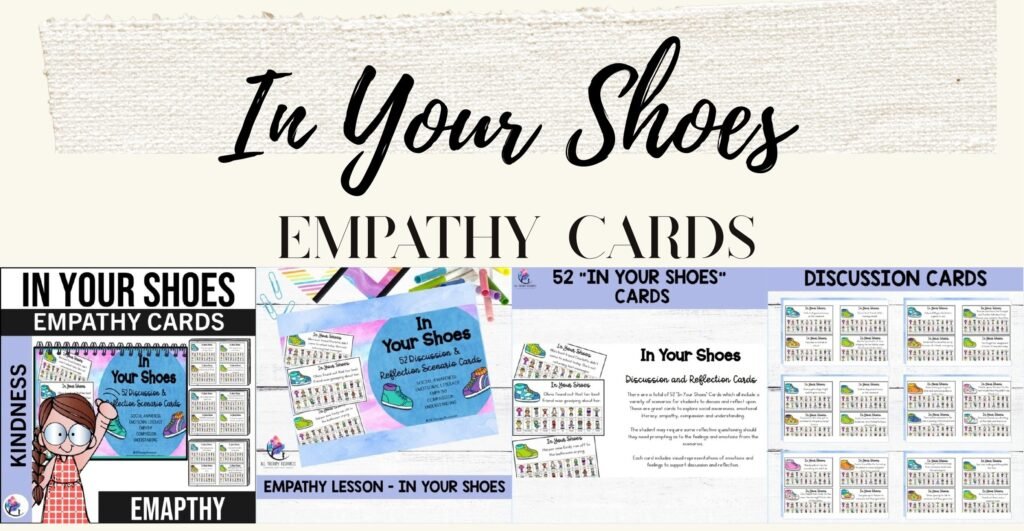
Try this in your next session: our Empathy Lesson: In Your Shoes Discussion Cards give you 52 ready-made scenarios, each with visual representations of feelings and emotions to support students who find it hard to name what someone else might feel. Draw one card at the start of a small group or class lesson, ask “How might they be feeling, and how do you know?”, and use reflective questions to prompt students who need more support. Because the scenarios are about other people, students can practice perspective-taking without having to share their own experiences.
Empathy as a Trauma-Informed Practice
Many students carry stressors adults cannot see: family changes, mental health concerns, learning differences, social anxiety or past trauma. Trauma-informed practice recognizes that these experiences shape how students read situations and respond to others. SAMHSA’s trauma-informed approach is built on principles such as safety, trustworthiness, choice and collaboration, and those principles translate directly into how we teach empathy:
- Build emotional safety and respectful dialogue first
- Normalize different perspectives
- Use fictional scenarios and never require personal disclosure
- Offer choices, including the choice to pass or observe
- Encourage curiosity instead of assumptions
- Teach empathy as a skill, not a personality trait
Picture a student whom peers describe as “mean” or “uncaring.” Labels like these tend to stick and rarely change behavior. When the same student is explicitly taught to notice facial expressions, name a peer’s possible feelings and practice a response, adults have something concrete to coach and acknowledge. For students who have experienced trauma, keep scenarios at a comfortable distance from real events and watch for signs that a topic feels too close. Our article on what trauma-informed classrooms require explores these foundations further.
Core Empathy Skills Students Need to Practice
Empathy is a collection of learnable abilities rather than a single skill. A meta-analysis of 18 randomized controlled trials found that structured empathy training tended to be effective overall, which supports teaching these skills explicitly rather than hoping students pick them up. Treat this as encouraging evidence for explicit practice rather than a promise of specific results from any one lesson.
| Skill | What practice looks like | Try saying | Suggested ATR resource |
|---|---|---|---|
| Naming feelings and reading cues | Students name a feeling from a face, posture or story picture, then check whether it could mean something else | “What clues did you notice? Could it mean something different?” | Interpreting Facial Expressions Brochure |
| Perspective-taking | Retell a conflict from each person’s point of view | “If you were in their shoes, what would you want the other person to know?” | Empathy Scenarios Choice Cards |
| Active listening | The listener reflects back one detail and one feeling before responding | “So you felt ___ when ___. Did I get that right?” | Reflective & Active Listening Handout |
| Empathy in action | Students choose a helpful response to a scenario and rehearse it | “What is one thing you could say or do that would help?” | Empathy Activities & Empathy Worksheets |
Students need chances to practice these skills in low-pressure, supportive settings before they can use them during a real conflict.
Practical Strategies for Teaching Empathy in Schools
Teaching empathy does not require long lectures. The most useful strategies are interactive, reflective and grounded in situations students recognize:
- Scenario discussions: use short, relatable situations, such as being left out of a game, a group chat misunderstanding or a new student at lunch.
- Guided reflection questions: “What might they need right now?” often works better than “How would you feel?” for students who struggle to step outside their own view.
- Role-play without forced performance: let students choose to act, direct or observe, and practice both sides of an exchange.
- Impact reflection: once a real conflict has calmed down, ask “Who was affected, and how?” rather than “Why did you do that?” This fits naturally with restorative practices.
- Adult modeling: narrate your own perspective-taking out loud: “I wonder if she’s quiet today because something is worrying her.”
Here is a short sample script for a small group. Adult: “Jordan’s friend didn’t save him a seat at lunch. Let’s put on Jordan’s shoes first. What might he be thinking?” After a few ideas: “Now let’s try the friend’s shoes. Is there another way to explain what happened?” Finish with: “What could either of them say next time?” The goal is flexible thinking, not one correct answer.
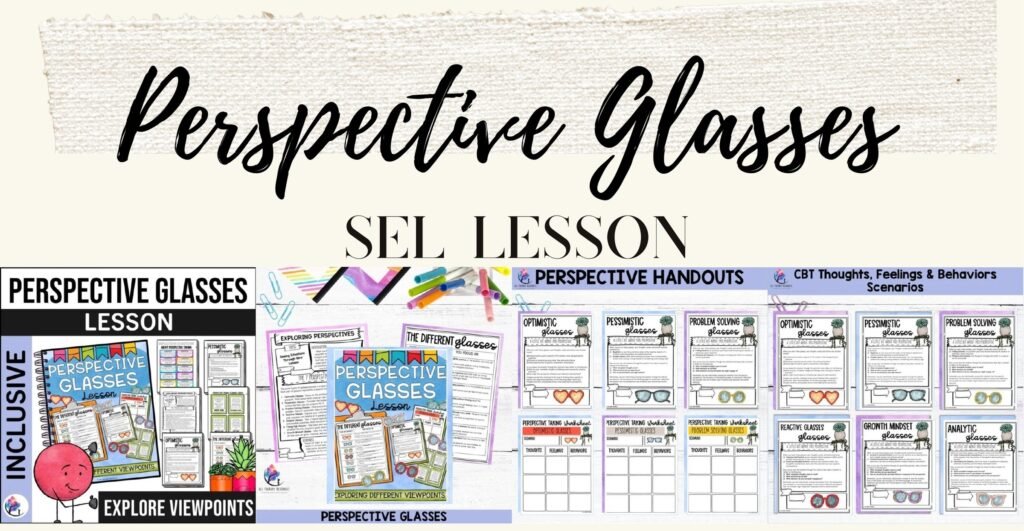
From our counseling room to yours: when students get stuck in one way of seeing a situation, our Perspective Taking Glasses Lesson gives them a concrete visual. Seven “lenses” (such as optimistic, pessimistic and problem-solving) come with handouts, worksheets, 20 scenario cards and 20 reflection questions that explore how each viewpoint shapes thoughts, feelings and behaviors. Try giving two students the same scenario card and two different pairs of glasses, then compare how each lens changes the response. It suits classroom SEL lessons, small groups and individual counseling.
Using Digital Games to Practice Empathy
Structured games can make empathy practice feel less like a lecture. They provide predictable structure, spread participation across a team so no single student is put on the spot, and turn abstract ideas into concrete choices. Keep the focus on discussion: the conversation after each question is where most of the learning happens.
If you would like a ready-made option, our Walk in My Shoes Digital Game runs in PowerPoint with up to 10 teams and five sections: What Is Empathy?, Reading Feelings, Walking in Someone’s Shoes, Empathy in Action and Real-Life Scenarios. Questions increase in difficulty, and the board resets so you can reuse it with individual students, small groups or whole classes.
Supporting Empathy Across Developmental Levels
Empathy looks different at different ages. Younger students usually start with naming feelings, noticing facial expressions and simple “how would they feel?” questions, supported by pictures and stories. Older elementary students can begin to consider that two people may feel differently about the same event. Middle and high school students can explore more complex emotions, group dynamics, online interactions and moral decision-making.
What stays consistent is the need for explicit teaching, ongoing practice rather than one-off lessons, adults who model empathy in everyday interactions, and safe spaces for discussion and reflection. When empathy is built into school culture, through morning meetings, restorative conversations and the way adults respond to mistakes, it becomes a shared value rather than a standalone lesson. For related ideas, see our posts on kindness lessons that change student behavior, recognizing stereotypes and building inclusion and friendship skills activities.
Frequently Asked Questions
Why is empathy important in schools?
Empathy supports positive relationships, helps students handle conflict, and is associated with students defending peers who are being bullied. It also helps adults respond to behavior with curiosity rather than judgment.
Can empathy be taught, or is it a personality trait?
Research on structured empathy training suggests empathy can be strengthened with practice. In schools, that means naming the skill, modeling it and giving students regular, low-pressure chances to use it.
How does empathy connect to trauma-informed teaching?
Both focus on understanding what may sit underneath behavior. Teaching empathy in a trauma-informed way means using fictional scenarios, offering choice and never requiring students to share personal experiences.
What age should you start teaching empathy?
Empathy skills can be taught from the early years, starting with naming feelings and reading facial expressions, then building toward perspective-taking and more complex social situations in later grades.
References
- CASEL: The CASEL 5 framework (social awareness)
- van Noorden et al. (2015): Empathy and involvement in bullying in children and adolescents, a systematic review
- Teding van Berkhout & Malouff (2016): The efficacy of empathy training, a meta-analysis of randomized controlled trials
- SAMHSA (2014): Concept of trauma and guidance for a trauma-informed approach
Looking for practical, ready-to-use resources to support your empathy and perspective-taking lessons? The All Therapy Resources Membership provides access to a growing collection of thoughtfully developed counseling activities, interactive games, and therapeutic tools designed to save preparation time while supporting meaningful, skill-focused learning.