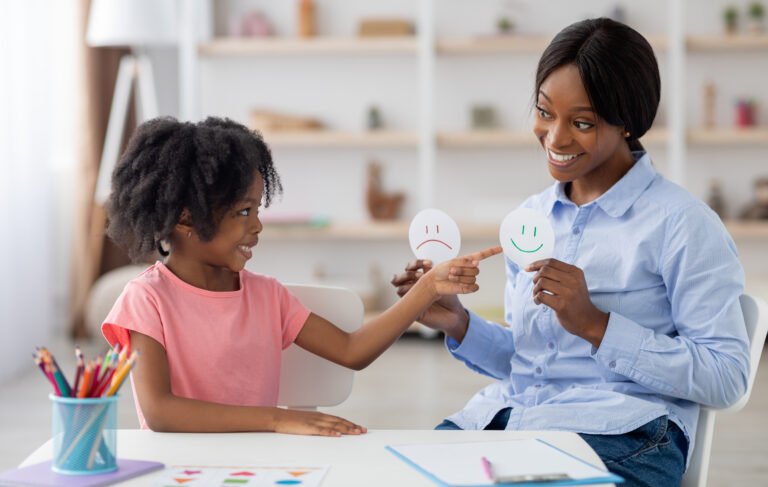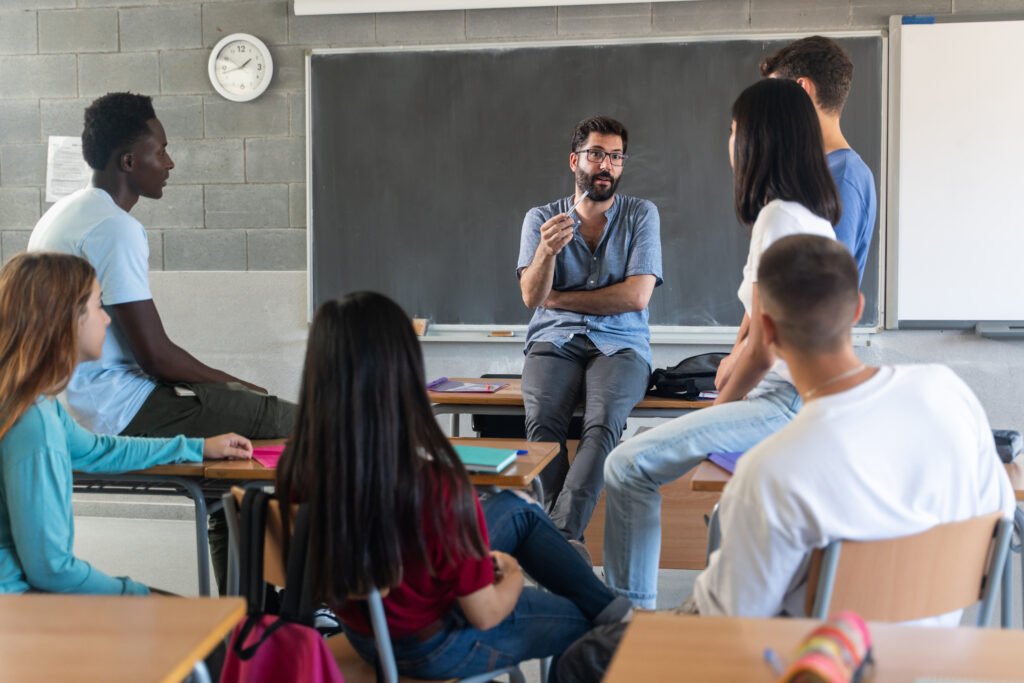
Community circles in schools can be one of the most practical ways to build safe, connected, emotionally responsive classrooms. Yet many school counselors, teachers, and school psychologists find themselves asking the same question: how do we run circles that feel authentic, structured, and sustainable when time is limited and student needs are complex?
When done well, community circles move beyond surface-level check-ins. They become spaces for voice, accountability, empathy, and repair. This guide explains how community circles support restorative practices, why a trauma-informed approach matters, and how to bring structure and engagement into your circles without overwhelming staff or students.
What Are Community Circles in Schools?
Community circles are structured group discussions grounded in restorative practices. Students and adults sit facing each other, take turns speaking (often with a talking piece), and respond to a shared prompt. Circles give students intentional opportunities to:
- Share thoughts and feelings in a safe, respectful space
- Build empathy and understanding
- Repair harm and rebuild trust
- Strengthen peer relationships
- Develop accountability and responsibility
In schools, circles are used in two ways. Proactive circles build relationships and shared norms before problems arise, for example a weekly advisory or morning meeting circle. Responsive circles address harm, misunderstandings, or a breakdown in classroom community after something has happened. Responsive circles tend to go more smoothly when students have already practiced the format in low-stakes proactive circles. For the wider picture of how circles fit into school discipline, see our guide to restorative practices as discipline alternatives.
Restorative Practices Through a Trauma-Informed Lens
A trauma-informed approach matters when implementing restorative practices. Many students carry experiences of stress, conflict, or exclusion that can make speaking in front of peers feel risky. SAMHSA’s key principles of a trauma-informed approach (safety, trustworthiness and transparency, peer support, collaboration and mutuality, empowerment, voice and choice, and attention to cultural, historical and gender issues) translate naturally into circle practice.
Trauma-informed community circles prioritize:
- Emotional safety and predictability (the same opening, format, and closing each time)
- Clear expectations and boundaries that students help create
- Choice and voice, including the option to pass
- Respectful listening without interruption
- Repair over punishment
Picture a student who freezes when the talking piece reaches them. In a rushed or performative circle, that moment can feel like being put on the spot. In a trauma-informed circle, the student already knows they can say “pass,” that the facilitator will come back to them only if they want, and that no one will be asked to share personal details. That sense of predictability is what makes honest participation possible. For more on building that kind of safety across the school day, see what trauma-informed classrooms actually require.
Try this in your next circle: before the first prompt, say: “In this circle, you can always pass. You can share as much or as little as you like. We listen without interrupting, and we keep each other’s stories respectful. If something is shared that tells me someone is not safe, I will need to get help from another adult, because keeping you safe is my job.” Naming the limits of confidentiality up front protects trust later.
If a student discloses harm during a circle: stay calm, thank them for telling you, and gently move the conversation out of the group so they are not sharing more in front of peers. Listen without pressing for details, and do not promise to keep it a secret. Follow your school or district protocol and your mandated reporting obligations, and check in with the student privately as soon as possible.
USA: 988 Suicide & Crisis Lifeline (call or text 988, or chat at 988lifeline.org); Childhelp National Child Abuse Hotline 1-800-422-4453; emergencies 911.
Australia: Lifeline 13 11 14 (text 0477 13 11 14); Kids Helpline 1800 55 1800; your state or territory child protection service; emergencies 000.
What the Research Says About Restorative Practices
Research on school-wide restorative practices is encouraging but mixed, and it is worth being honest about that with staff. In a randomized controlled trial in Pittsburgh Public Schools, RAND researchers found that suspension rates fell more in schools implementing restorative practices than in comparison schools, and teachers rated the overall school climate more positively. The same study found that academic outcomes did not improve, and they worsened for students in grades 6–8.
The practical takeaway: circles are best understood as a relationship and climate strategy, not a quick fix for achievement or every behavior concern. They work best when they are consistent, well facilitated, and part of a wider system of support.
The Core Skills Community Circles Build
Community circles give students repeated, structured practice with skills that support both wellbeing and behavior change, including:
- Emotional literacy and empathy
- Perspective-taking
- Accountability and ownership of actions
- Communication and active listening
- Conflict resolution and problem-solving
- Inclusion and belonging
These skills align closely with social-emotional learning (SEL) frameworks and positive behavior supports, which is why many schools use circles as a Tier 1 classroom strategy and adapt them for Tier 2 small groups.
Perspective-taking is often the skill that makes repair possible. Picture a circle where one student says, “I was only joking,” and another says, “It didn’t feel like a joke to me.” A facilitator might ask the group, “What might each person have been feeling in that moment?” and “What would help each of them feel okay coming back to class tomorrow?” Students are practicing empathy without anyone being shamed.
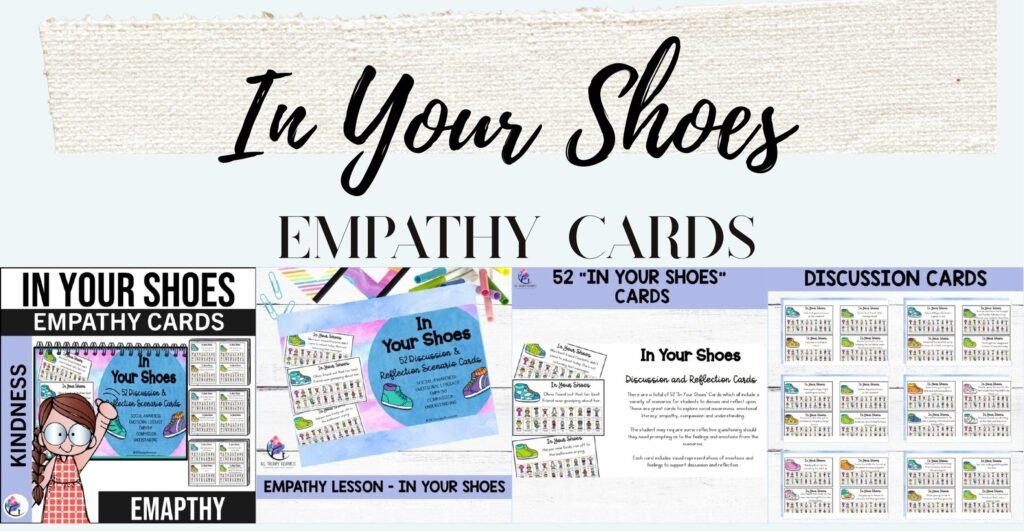
Try this in your next session: to build empathy before you need it in a responsive circle, our Empathy Lesson: In Your Shoes Discussion Cards include 52 scenario cards with visual emotion supports. Draw one card per round and ask, “How might this person be feeling, and what could someone do to help?” It is a gentle way to practice perspective-taking in small groups or classroom circles, because students talk about a scenario rather than about themselves.
Bringing Structure to Community Circles Without Losing Authenticity
One of the biggest challenges for school staff is knowing what to ask and how to guide the discussion so it stays focused and respectful. This is where clear prompts and a consistent format help.
Effective community circles:
- Use clear, purposeful questions
- Balance reflection with discussion
- Avoid shaming or interrogation
- Allow students to pass
- Include follow-up reflection
Prepared prompts and reflection sheets are especially helpful for staff who are new to restorative practices, because they reduce the pressure to improvise in the moment. In a responsive circle, restorative questions such as “What happened?”, “Who has been affected, and how?” and “What needs to happen to make things right?” keep the focus on repair rather than blame.
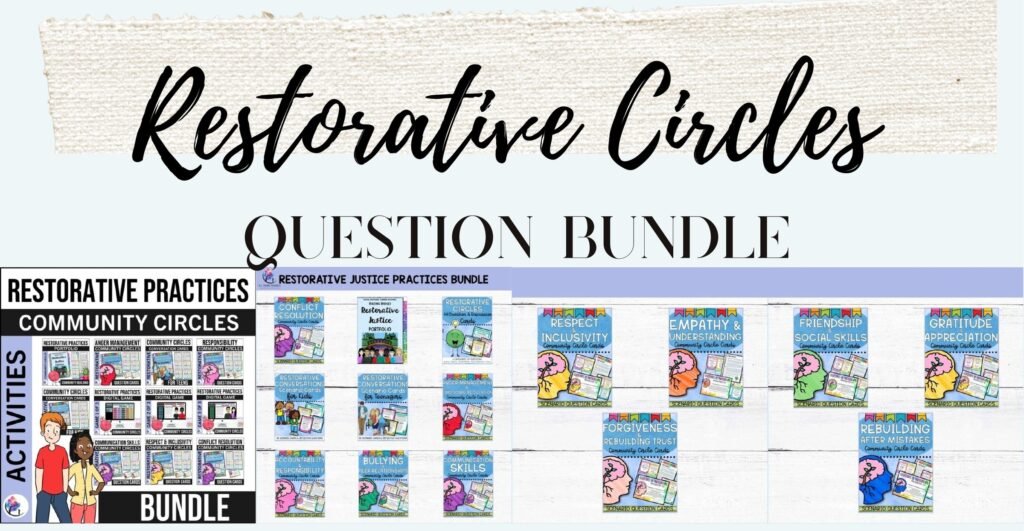
Try this in your next session: if you would like a ready-made structure, the Restorative Practices Questions Bundle: Community Circles & Reflection Sheet brings together a restorative practices portfolio, circle question and discussion cards with opening, reflective, empathy-building, repair and closing questions, teen scenario cards, and themed community circle cards. Use the opening and closing questions as your weekly routine, then pull a reflection sheet after a responsive circle so each student can put their next step in writing.
A Simple Community Circle Format
A predictable format helps students know what to expect, which supports emotional safety. This four-part structure fits into 15 to 30 minutes and works for both proactive and responsive circles.
| Circle stage | Purpose | Sample prompt or script |
|---|---|---|
| Opening | Signal the start and review norms | “Let’s remind ourselves of our circle agreements. Who would like to read one?” |
| Check-in round | Low-risk warm-up so every voice is heard once | “Share one word for how your week is going, or pass.” |
| Main round | Explore the topic, skill, or situation | “Think of a time someone helped you fix a mistake. What did they do?” |
| Closing | Reflect, name a next step, and end predictably | “One thing you will take with you from today’s circle is…” |
Want more prompts for the main round? Try themed question sets such as Conflict Resolution Restorative Circle Questions, Empathy & Understanding Restorative Circle Questions, or Rebuilding After Mistakes Restorative Circle Questions.
Using Digital Games to Support Restorative Community Circles
Discussion-based digital games can add energy to proactive circles, particularly with groups that find open-ended sharing hard at first. Team-based questions give students something concrete to respond to, and the game format can lower the stakes of speaking up. Keep the restorative purpose in view: the points are a hook, and the conversation that follows each question is the real work.
A sequenced series can also support a developmental progression across the year. The Community Circle Questions Digital Game series starts with understanding restorative practices, emotions and empathy, conflict and repairing harm, building community, and real-life scenarios in Game 1, then moves into accountability, fairness, trust and healing (Game 2) and respect, communication, inclusion and personal growth (Game 3). Each plays in PowerPoint and can be reset and reused with different groups.
Practical Ways to Use Community Circles in Schools
Community circles can be used flexibly across settings, including:
- Classroom morning meetings or advisory
- Counseling and therapy groups
- Restorative responses to conflict
- Re-entry meetings after suspension or absence
- Tier 1 school-wide SEL initiatives
- Tier 2 small group interventions
For responsive and re-entry circles, preparation matters. Meet with the students involved individually first, make sure participation is voluntary for the student who was harmed, and only bring people together when everyone is regulated enough to listen. Restorative practice reminds us that behavior is communication, and circles give students the language and space to communicate differently. If you are starting from scratch, our post on building classroom community at the start of the school year offers ideas for laying that foundation.
Frequently Asked Questions
What is the purpose of community circles in schools?
Community circles build connection, empathy, accountability, and communication. Proactive circles strengthen relationships and shared norms, while responsive circles help a group address harm and agree on how to make things right.
How are restorative practices different from traditional discipline?
Traditional discipline usually focuses on which rule was broken and what the consequence should be. Restorative practices focus on who was affected, what they need, and how the person responsible can help repair the harm and rebuild relationships.
Are community circles appropriate for all ages?
Yes, with adjustments. Younger students do well with short rounds, visual supports, and simple prompts, while middle and high school students can handle deeper discussion of fairness, trust, and real-life scenarios.
Who should facilitate community circles?
School counselors, teachers, school psychologists, administrators, and other trained staff can all facilitate circles. Responsive circles after serious harm are best led by someone with restorative practices training and time to prepare everyone involved.
Looking for practical, ready-to-use resources to support your community circles and restorative practices work? The All Therapy Resources Membership provides access to a growing collection of thoughtfully developed counseling activities, interactive games, and therapeutic tools designed to save preparation time while supporting meaningful, skill-focused learning.