

If you have ever sat across from a group of teenagers, asked what you thought was a fantastic discussion question and been met with three shrugs and an “I don’t know,” you are definitely not alone. Teenagers often have plenty to say, but getting the conversation started can be the tricky part.
Over the years, I have found that some of my best conversations with teens have happened when I stopped trying quite so hard to make the conversation happen. Give them some lunch, a game, something interesting to respond to and a little room to be themselves, and things often begin to unfold quite naturally.
This is one of the reasons I love Lunch Bunch groups with middle and high school students. They give us a relaxed way to build relationships while still creating opportunities to talk about friendships, emotions, mental health, relationships, decision-making and everything else that comes with being a teenager.
Why I Love Lunch Bunch with Teens
Lunch Bunch can look pretty simple from the outside. A group of students, their lunches, a counselor and some conversation starters might not look particularly therapeutic, but there can be a lot happening around that table.
For some teenagers, sitting across from an adult and being asked directly about their feelings can feel incredibly uncomfortable. Put the same teenager into a relaxed group with a shared activity, and suddenly the pressure is not entirely on them.
I think this is particularly important when we are trying to work in a trauma-informed way. Students need to know that they have choices, that their boundaries will be respected and that they are not going to be pushed into sharing something simply because an adult asked the question.
That is why I am always comfortable with a student passing on a question. Sometimes listening to everybody else is participation too, and a student who barely speaks during the first few sessions may eventually become one of the students who has the most to say.
Why Games Can Make Teen Conversations Easier
Teenagers are incredibly good at knowing when we are looking for the “right” answer. If every question sounds like a counseling question, it does not take long before we start hearing what students think adults want to hear.
A game changes the feeling of the conversation. We are all responding to something together rather than me sitting there asking one therapeutic question after another.
I have used our Teen Talk Games during Lunch Bunch, and this is probably what I enjoy most about them. I know where the conversation is starting, but I rarely know exactly where it is going to end.
A question about friendship might turn into a discussion about feeling left out. Something about social media might lead to comparison, rumors or pressure, while a question about the future might suddenly reveal that several students are quietly worried about what happens after high school.
And then you get those wonderful little moments when one student looks across the table at another and says something like, “Wait, you do that too?” I love those moments because sometimes simply discovering that somebody else understands is incredibly powerful.
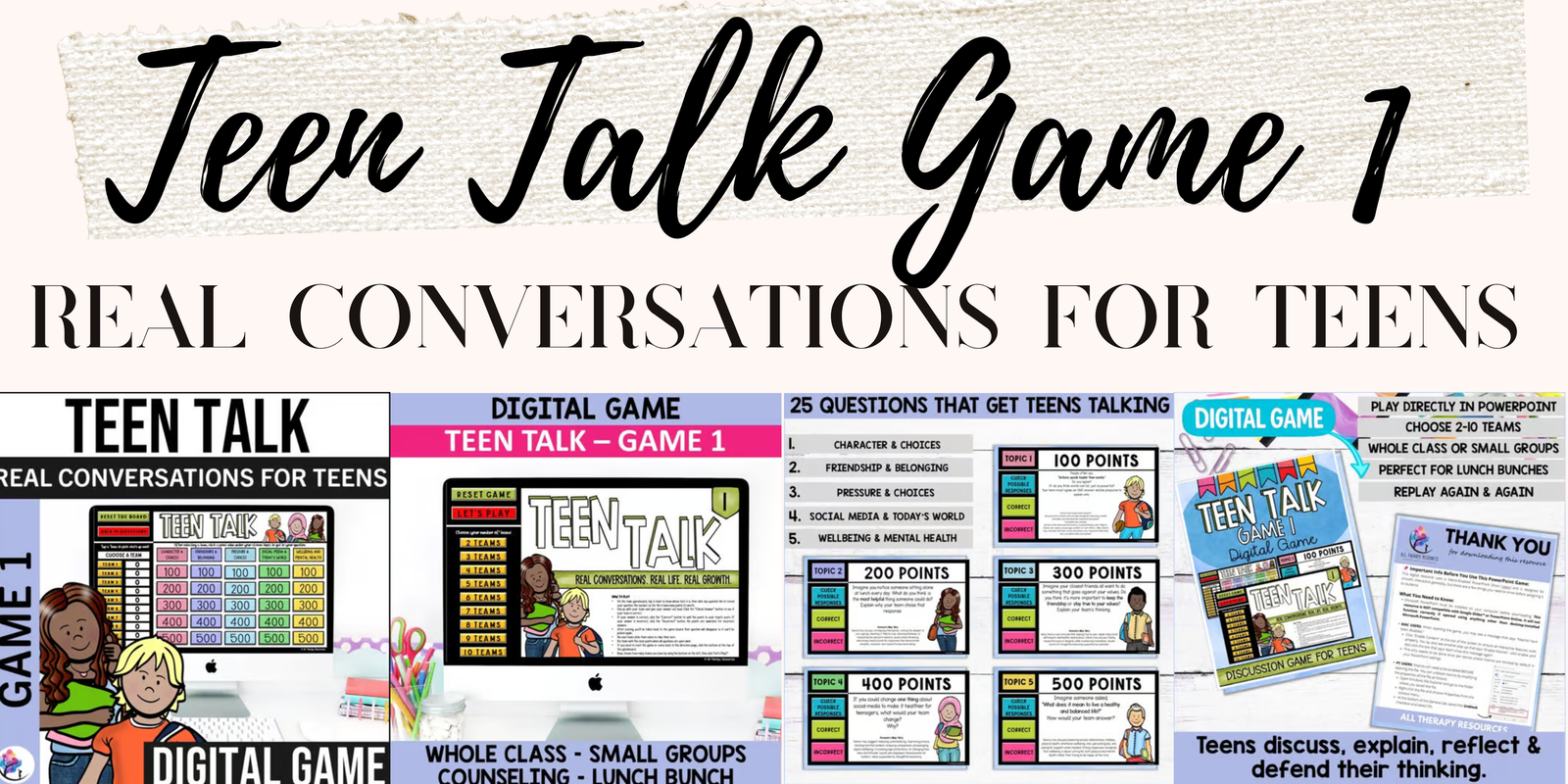
Teen Talk Game 1: Friendships, Choices, Social Media & Mental Health
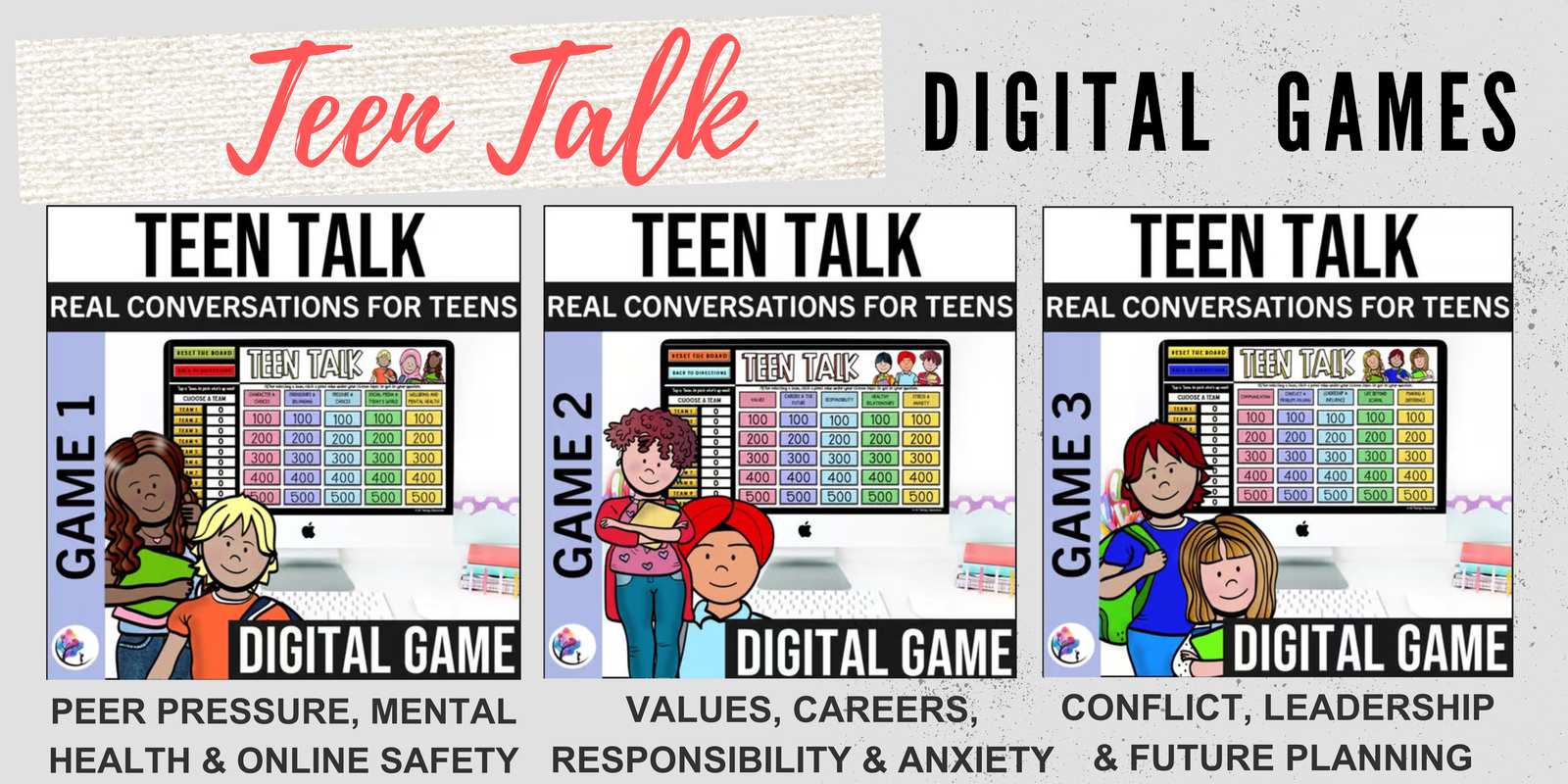
Teen Talk Game 1 focuses on Character & Choices, Friendship & Belonging, Pressure & Choices, Social Media & Today’s World, and Wellbeing & Mental Health. These are topics that sit right in the middle of everyday teenage life.
I particularly like the friendship and belonging conversations because fitting in can feel enormous during adolescence. Students are working out where they belong, which friendships feel good, how to handle changing relationships and what they are willing to do to be accepted.
The peer pressure and decision-making questions can also lead to some really interesting discussions. Instead of simply telling teenagers to “make good choices,” we can talk about why making a good choice can sometimes be genuinely difficult when friendships, emotions and the desire to belong are involved.
Social media is another area where I try very hard not to come in as the adult who is going to tell teenagers everything that is wrong with their phones. Their digital lives are part of their real social lives, so I would much rather hear what they think about online pressure, boundaries, comparison and how social media affects relationships.
The mental health and wellbeing conversations give us another gentle opening. We can talk about coping, emotions, stress and reaching out for help without waiting until a student is already struggling.
Teen Talk Game 2: Values, Relationships, Stress & The Future
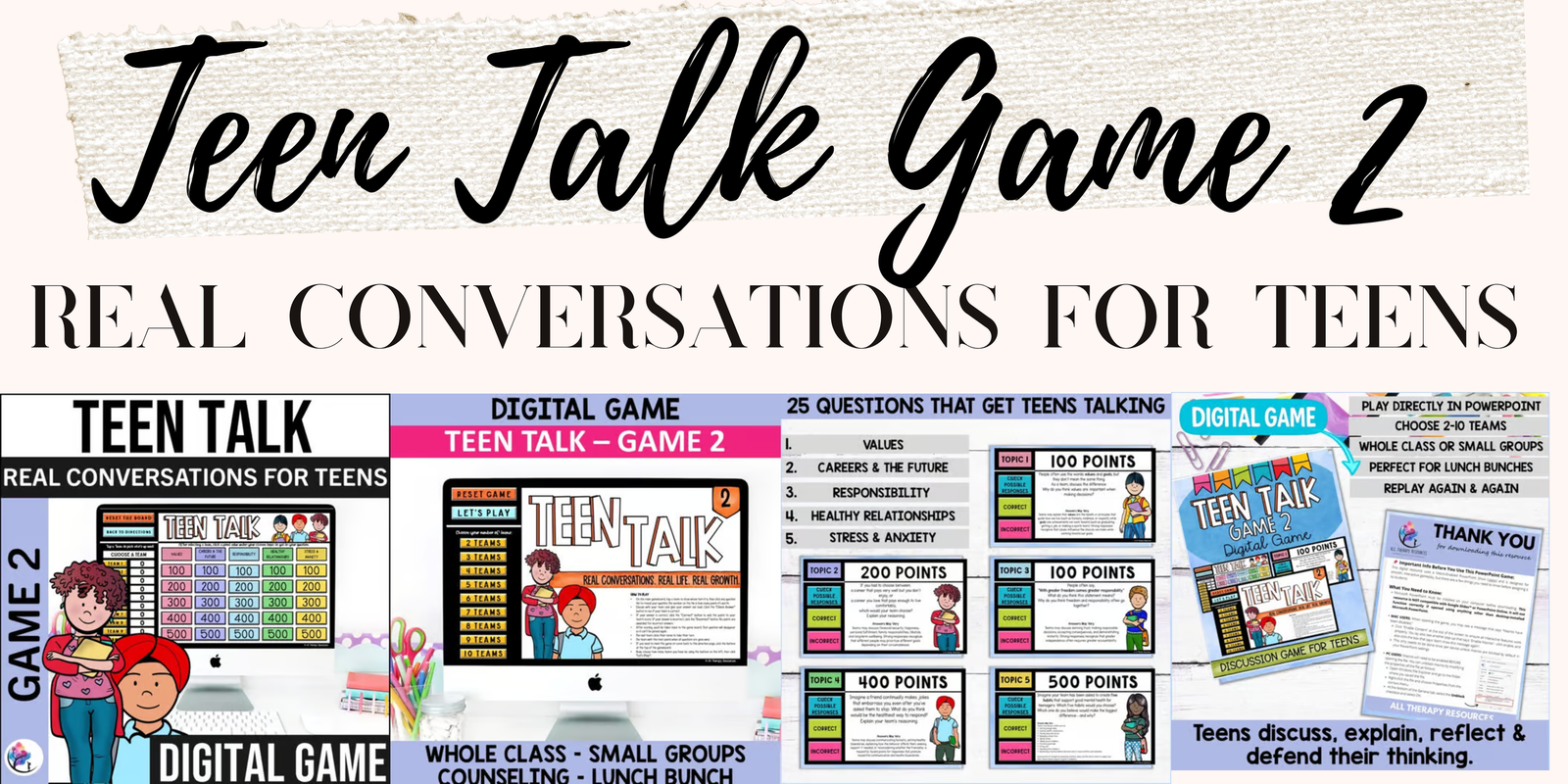
Teen Talk Game 2 explores Values, Careers & The Future, Responsibility, Healthy Relationships, and Stress & Anxiety. I think of this one as being very much about helping teenagers explore who they are becoming.
Adolescence is a time when young people start developing values and opinions that may not always be identical to those of the adults around them. Rather than telling students what their values should be, I like giving them opportunities to think about what genuinely matters to them and why.
The career and future questions are also fantastic conversation starters for high school students. Some teenagers already have their entire lives planned, while others have absolutely no idea what they want to do next, and both are perfectly normal places to be.
I much prefer conversations that move beyond simply asking, “What job do you want?” We can talk about strengths, interests, independence, goals, lifestyle and what students actually want their future to feel like.
The Healthy Relationships section can open up conversations about respect, boundaries, friendships and dating, while Stress & Anxiety gives us opportunities to explore coping strategies, emotional regulation and asking for support. These are important conversations, but the game format helps them feel much less like a formal lesson.
Teen Talk Game 3: Communication, Conflict, Leadership & Life Beyond School
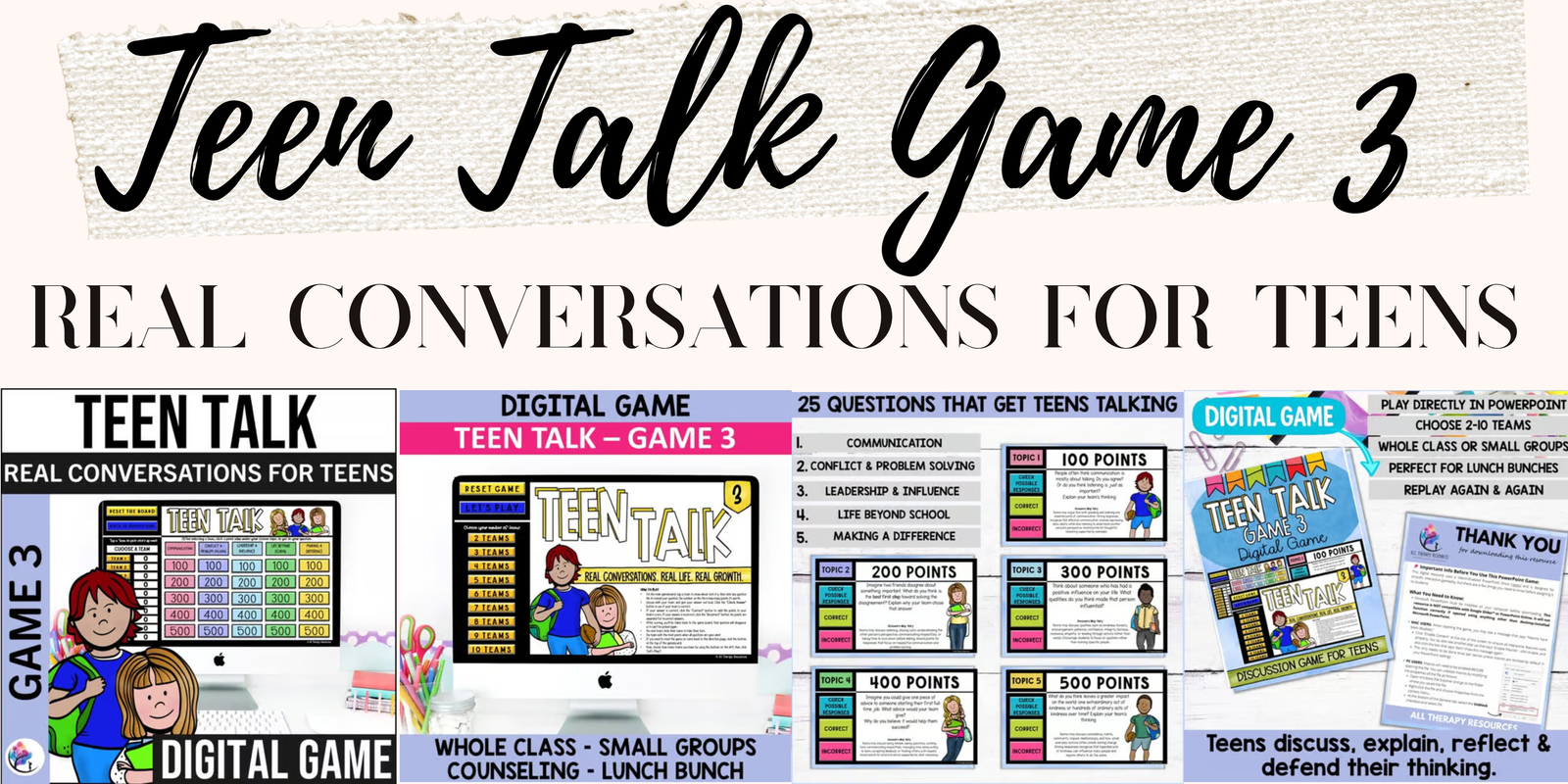
Teen Talk Game 3 focuses on Communication, Conflict & Problem Solving, Leadership & Influence, Life Beyond School, and Making a Difference. This one moves the conversation toward how teenagers interact with others and how they see their place in the wider world.
Conflict is a great example. We are never going to teach teenagers how to avoid every disagreement, nor should that really be the goal.
Instead, we can help them think about communication, perspective-taking, assertiveness and what they can actually do when a relationship becomes difficult. Sometimes hearing another teenager explain how they would handle the same situation is far more powerful than hearing an adult give them the answer.
I also really enjoy the leadership conversations because leadership does not always look the way teenagers expect it to. The loudest or most confident student in the room is not automatically the best leader.
Sometimes the quieter student gives the most thoughtful answer about fairness, empathy or what makes somebody worth following. Those conversations can help students recognize strengths in themselves that they may never have considered particularly important before.
The Life Beyond School and Making a Difference categories bring everything together beautifully. Students can begin thinking about independence, responsibility, goals, community and the kind of contribution they might want to make, both now and in the future.
A Simple Lunch Bunch Structure You Can Actually Use
You do not need an elaborate lesson plan to run a meaningful Lunch Bunch. I actually prefer having a loose structure because it gives students some predictability without making the group feel like another class.
Give them time to arrive and eat. Students are usually coming straight from a busy classroom or hallway, so I give them a few minutes to settle in before we begin. That little bit of ordinary conversation can also tell you quite a lot about how everyone is arriving that day.
Start easy. I usually begin with a lower-risk or more lighthearted conversation starter rather than jumping straight into something deeply personal. Once students are talking and laughing, it becomes much easier to move naturally into other topics.
Let students pass. Nobody should have to answer every question. Knowing that “pass” is always an option can actually make students feel safer about joining in.
Follow the good conversations. If you are on question three and suddenly everyone is talking about friendship pressure or something that happened at school, stay there. The aim is not to finish the game.
Ask simple follow-up questions. “Why do you think that?” or “Does anyone see it differently?” can completely change the depth of a conversation. You do not need to turn every response into a mini counseling session.
Pay attention to the quieter things. Notice who listens, who changes their answer after everyone else speaks and who seems particularly passionate about certain topics. These little observations can help you understand your students better without making assumptions about what any single response means.
End somewhere comfortable. If the conversation has become more serious, I like bringing things back to a lighter place before students leave. They are usually heading straight back into the school day, so that transition matters.
Not Everything Has to Become a Teachable Moment
This is something I have learned to appreciate more and more when working with teenagers. Not every funny comment needs to become a lesson, every silence does not need to be filled and every response does not need to be analyzed.
Sometimes the funny conversation can just be funny. Teenagers need spaces where adults enjoy their company and are interested in what they have to say without constantly trying to teach or correct them.
Interestingly, those lighter moments often help create the trust we need for the more meaningful ones. When students know that our counseling space is somewhere they can relax and be themselves, they are often much more willing to talk when something genuinely matters.
More Than Just Conversation Starters for Teens
The complete Teen Talk: Real Conversations for Teens Games 1, 2 & 3 Collection includes three interactive PowerPoint games with 15 real-life discussion categories and 75 conversation starters and discussion questions for teens.
The games can be used for high school counseling activities, middle school counseling, Lunch Bunch groups, small group counseling, SEL activities, advisory classes, social skills groups, life skills lessons and youth groups. I especially like that there is enough structure to make the activity easy to facilitate without controlling where every conversation needs to go.
For me, the real value is not getting through all of the questions. It is what happens around them.
It is the student who realizes someone else understands. It is the unexpected conversation about friendship that carries on long after the original question has been forgotten, or the teenager who starts out saying very little and eventually becomes comfortable enough to share their opinion.
Those are the moments I remember.
Looking for More High School Counseling Activities?
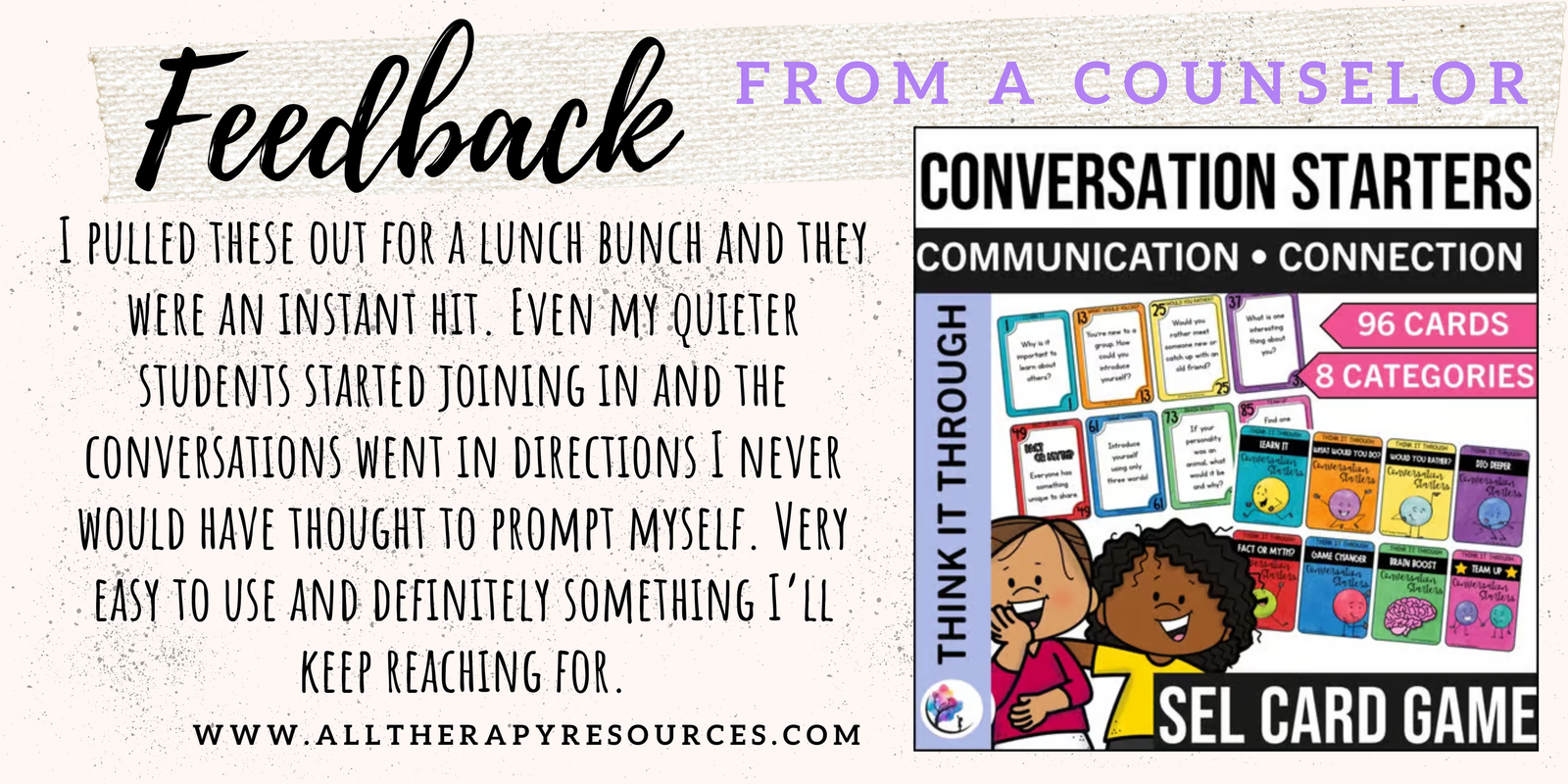
If you regularly find yourself searching for high school counseling activities, Lunch Bunch ideas, SEL activities for teens, small group counseling resources or therapeutic activities for middle and high school students, you might also love the All Therapy Resources Membership.
I created the membership to make life a little easier for counselors, therapists and educators who want meaningful resources without spending their evenings trying to create everything from scratch. Inside you will find a growing library of counseling games, therapeutic activities, SEL resources, worksheets, workbooks, small group counseling materials, conversation starters and practical tools for working with children and teenagers.
Everything I create comes back to the same idea: the resource should support the relationship, not replace it. A beautiful worksheet or an engaging counseling game can open the door, but it is what you notice, ask, hear and do with that moment that makes the difference.
If that sounds like the way you work too, I would love to welcome you into the All Therapy Resources Membership. And hopefully, the next time you have a Lunch Bunch group coming through the door and think, “What on earth are we doing today?”, you will already have something ready to go.
Because sometimes a really good counseling session starts with nothing more complicated than lunch, a game and one question that gets everybody talking.