This post contains affiliate links. As an Amazon Associate, ATR earns from qualifying purchases, at no extra cost to you.
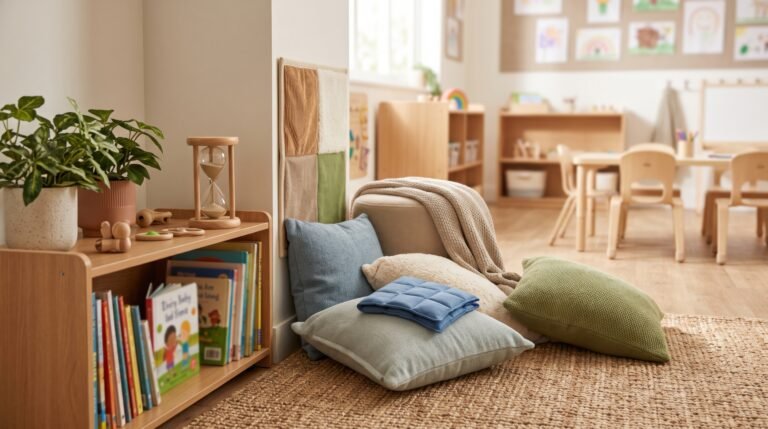
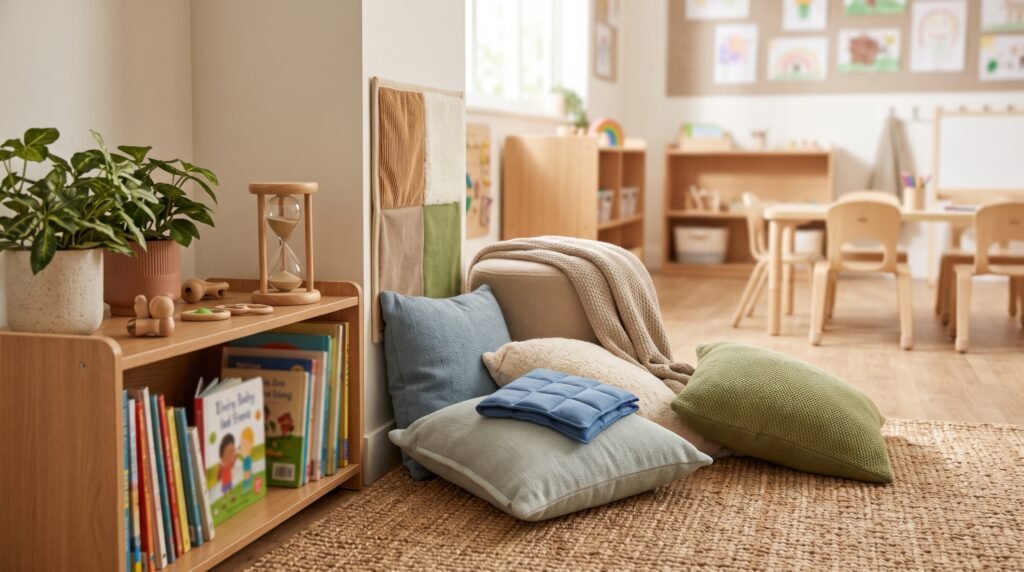
Calm down corners have become increasingly common in classrooms, counseling rooms, special education settings, and therapeutic spaces. They often include feelings posters, breathing exercises, coping strategies, sensory tools, comfortable seating, and visual reminders designed to help children regulate.
But simply having a calm down corner doesn’t teach a child how to calm down. We can create a beautiful space, laminate every poster, fill a basket with sensory tools, and still find that students don’t know what to do when they get there.
The real value of a calm down corner isn’t in having one. It is in teaching children how, when, and why to use it.
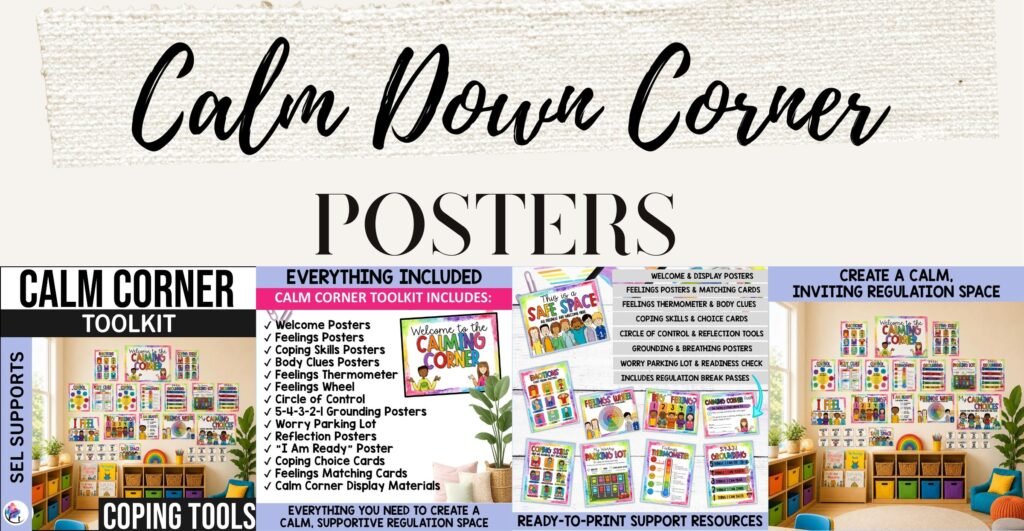
Our Calming Corner Toolkit was designed around this idea. It combines emotion identification, body awareness, coping strategies, grounding, breathing exercises, reflection, affirmations, feelings scales, and other visual supports so the space can be actively used to teach regulation rather than simply decorate a classroom.
The Goal Isn’t to Make the Feeling Disappear
One of the first things we need to reconsider is what we actually mean when we tell a child to “calm down.” Emotional regulation doesn’t mean replacing every uncomfortable emotion with happiness.
A child can still feel angry and be regulated enough to communicate safely. They can feel disappointed and remain able to problem-solve. They can feel nervous and still take the next step. They can feel sad and still have enough regulation to express what they need.
If the unspoken expectation of a calm down corner becomes “Come back when you’re happy,” we risk teaching children that some emotions are acceptable while others need to disappear.
Instead, a trauma-informed approach recognizes that all emotions are valid, even when certain behaviors require boundaries and support. Children benefit from learning to identify, understand, and express their feelings while developing strategies to manage their responses safely.
The goal isn’t to eliminate difficult emotions. It’s to help children experience those emotions without becoming overwhelmed by them.
Regulation Begins With Noticing
Before children can choose a coping strategy, they need to notice that something is happening.
A child may not recognize that they’re becoming angry until they’re already yelling. Another may not identify anxiety until they’re refusing to enter the classroom. A student might not recognize overwhelm until they’ve pushed their work away and completely disengaged.
This is why emotional regulation needs to include body awareness as well as emotional vocabulary. We can help children begin noticing the physical clues that often appear before their behavior escalates.
Maybe their hands become tight when they’re angry. Their stomach feels strange when they’re nervous. Their heart beats faster when they’re overwhelmed. They begin moving more quickly, talking louder, withdrawing, or finding it difficult to think clearly.
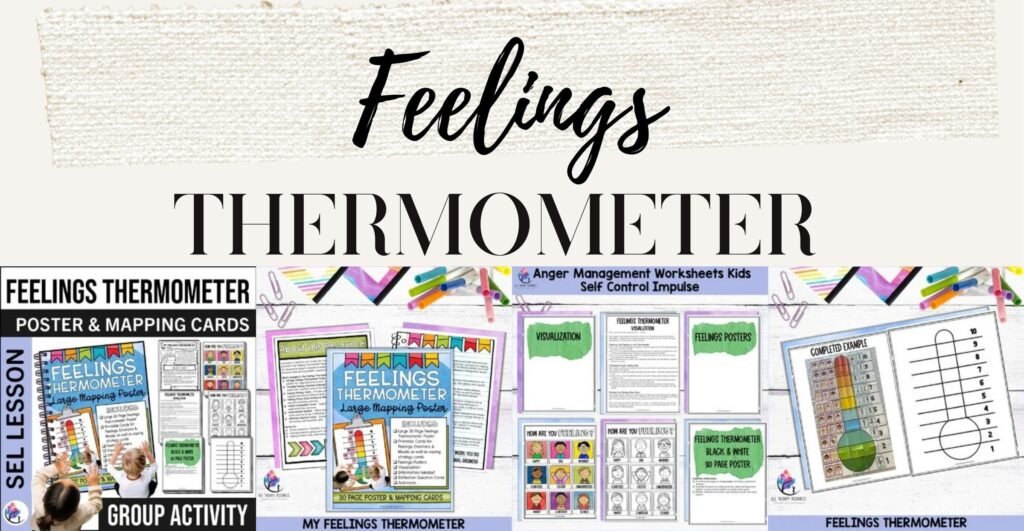
Visual tools, such as our Feelings Thermometer Poster & Mapping Cards can help children recognize changes in emotional intensity, connect feelings with physical sensations, and identify coping strategies before emotions escalate. By mapping their experiences along a visual scale, children can begin developing greater emotional awareness and recognizing when additional support may be needed.
Over time, we’re trying to move that point of recognition earlier. Instead of “I know I was angry because I threw something,” we want to help a child reach “My body is getting tense and my hands are tight. I think I’m getting angry.”
That earlier recognition gives the child something incredibly valuable: time to make a different choice.
Teach the Calm Down Corner When Nobody Needs It
One of the biggest mistakes we can make is waiting until a child is highly dysregulated before teaching them how to use a regulation space.
When a child is already overwhelmed, they may find it difficult to process instructions, learn unfamiliar coping strategies, or make decisions about what might help.
Calm down corners are most effective when their purpose and routines are explicitly taught during calm moments, rather than introduced for the first time during emotional distress.
Introduce the space to the whole class. Explain its purpose, explore the visual supports, practice breathing and grounding exercises, and demonstrate how different coping strategies might help in different situations.
Adults can also model emotional awareness by describing their own regulation process in developmentally appropriate ways. For example, “I’m noticing that I’m feeling frustrated, so I’m going to pause, take a breath, and think about what I need.”
Repeated practice helps children become familiar with the space and its routines, making those strategies easier to access when emotions become more intense.
A regulation space should feel familiar, predictable, and supportive, not like somewhere children only go when something has gone wrong.
Don’t Let the Calm Down Corner Become a Punishment
A calm down corner can very easily become a beautifully decorated time-out chair if we’re not intentional about how it’s introduced and used.
When students are consistently directed to a regulation space following challenging behavior, they may begin associating it with punishment, exclusion, or having done something wrong.
This can undermine its purpose as a supportive environment where children feel safe recognizing and responding to their emotional needs.
A trauma-informed regulation space should promote emotional safety, connection, and skill development rather than compliance through isolation.
Whenever appropriate, invite children to use the space rather than automatically directing them there. Our language can help communicate its purpose.
Instead of saying, “Go to the calm down corner,” we might say, “I’m noticing this is feeling really difficult right now. Would taking a regulation break help?”
Some children may need an adult to accompany them, offer reassurance, or help them identify what they need. Others may benefit from choosing to access the space independently.
Clear behavioral boundaries remain important, but emotional regulation should never be presented as a consequence for experiencing difficult feelings.
Children Need to Know What to Do When They Get There
Imagine an overwhelmed student arrives at the calm down corner and sits down.
Now what?
Without clear guidance, a child may simply sit there, become distracted by sensory materials, continue feeling distressed, or wait for an adult to tell them what to do next.
An effective calm down corner needs a predictable, developmentally appropriate regulation routine.
A simple process might involve three questions:
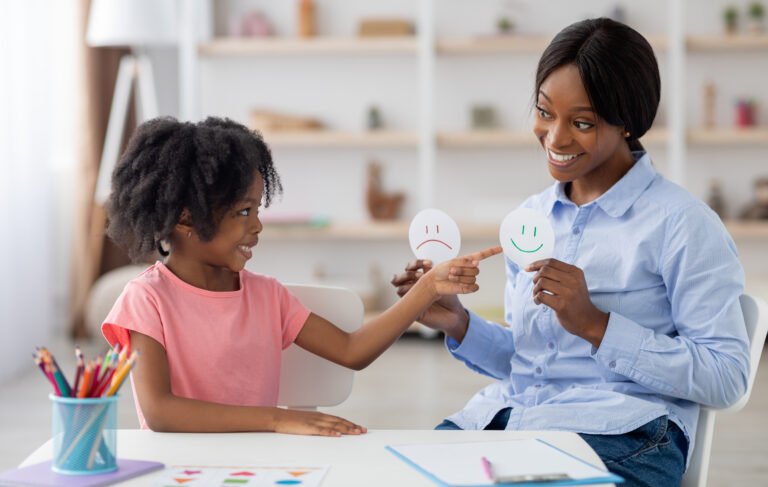
- What am I feeling? Help children recognize and name their emotions, using visual supports when needed.
- What might help me? Encourage children to explore familiar coping strategies, sensory supports, movement, grounding, or connection with a trusted adult.
- What do I need next? Support children in recognizing whether they’re ready to return to learning, need additional assistance, or require an adjustment to the situation.
These steps should be explicitly modeled and practiced, with adult guidance provided according to each child’s developmental and regulation needs.
The aim isn’t to create a rigid sequence that every child must follow. It’s to establish a familiar framework that supports emotional awareness, decision-making, and gradually increasing independence.
A calm down corner becomes more meaningful when children understand not only where to go, but also how to use the space to support their emotional regulation.
Not Every Child Calms Down the Same Way
Another common mistake is assuming that strategies adults perceive as calming will work for every child.
“Take some deep breaths.”
That may be extremely helpful for one student and do very little for another.
Emotional regulation is highly individualized, influenced by a child’s sensory preferences, developmental abilities, emotional state, previous experiences, and immediate environment.
Some children benefit from movement or proprioceptive input, such as stretching or pushing against a wall. Others may prefer drawing, listening to music, using a sensory tool, reading, or spending time in a quieter environment.
For some students, breathing exercises can be helpful. For others, particularly when highly distressed, focusing on their breathing may feel uncomfortable or increase their awareness of physical anxiety symptoms.
Children may also need relational support rather than an independent coping activity. A calm, responsive adult can provide reassurance and co-regulation when self-directed strategies are not yet accessible.
The important question isn’t “What is the best calming strategy?” It’s “What helps this particular child regulate in this particular situation?”
We discover those answers through observation, collaboration, explicit teaching, and opportunities to practice different approaches.
Teach Children to Match Strategies to Their Needs
Emotional regulation becomes more meaningful when children begin understanding that different emotional experiences may require different forms of support.
A child who feels restless or physically activated may benefit from movement before attempting a seated activity. A student experiencing racing thoughts may find grounding strategies helpful, while another who feels withdrawn or disconnected may need reassurance, connection, and co-regulation.
Teaching children to recognize the relationship between their body cues, emotional states, and coping strategies helps develop greater self-awareness and flexible regulation skills.
Rather than asking children to select a coping strategy at random, we can guide them through a simple process:
- Notice: What is happening in my body right now?
- Identify: What emotion might I be experiencing?
- Choose: What strategy or support could help?
- Reflect: Did that help, or might I need something different?
For younger children, these questions may initially require visual supports, modeling, and adult guidance.
Over time, children can begin recognizing patterns in their emotional responses and developing a personalized understanding of what helps them feel more regulated.
They may start to recognize, “When my body feels restless, movement helps me,” or “When my thoughts feel too busy, I need a quiet moment with someone I trust.”
This is an important step toward developing independent, flexible emotional regulation skills that children can use across different environments and situations.Emotional regulation becomes more meaningful when children begin understanding that different emotional experiences may require different forms of support.
A child who feels restless or physically activated may benefit from movement before attempting a seated activity. A student experiencing racing thoughts may find grounding strategies helpful, while another who feels withdrawn or disconnected may need reassurance, connection, and co-regulation.
Teaching children to recognize the relationship between their body cues, emotional states, and coping strategies helps develop greater self-awareness and flexible regulation skills.
Rather than asking children to select a coping strategy at random, we can guide them through a simple process:
- Notice: What is happening in my body right now?
- Identify: What emotion might I be experiencing?
- Choose: What strategy or support could help?
- Reflect: Did that help, or might I need something different?
For younger children, these questions may initially require visual supports, modeling, and adult guidance.
Over time, children can begin recognizing patterns in their emotional responses and developing a personalized understanding of what helps them feel more regulated.
They may start to recognize, “When my body feels restless, movement helps me,” or “When my thoughts feel too busy, I need a quiet moment with someone I trust.”
This is an important step toward developing independent, flexible emotional regulation skills that children can use across different environments and situations.
Co-Regulation Is Not a Failure of Independence
We often create calming spaces because we ultimately want children to regulate more independently. But independence doesn’t mean withdrawing adult support before the child has developed the necessary skills.
Some children will initially need an adult beside them. They may need help identifying the emotion, noticing body cues, choosing a strategy, slowing down, or making sense of what happened.
Instead of asking an overwhelmed child, “What coping strategy do you want?”, we may initially offer two manageable options: “Would you like to try the breathing card or take a short walk?”
As the child becomes more familiar with their own regulation patterns, we can gradually reduce that support.
Co-regulation can be part of the pathway toward self-regulation.
A Regulation Break Still Needs a Return
We also need to think carefully about what happens after a child has regulated.
If a student learns that asking for the calm down corner means permanently escaping every difficult task, we may unintentionally create another problem.
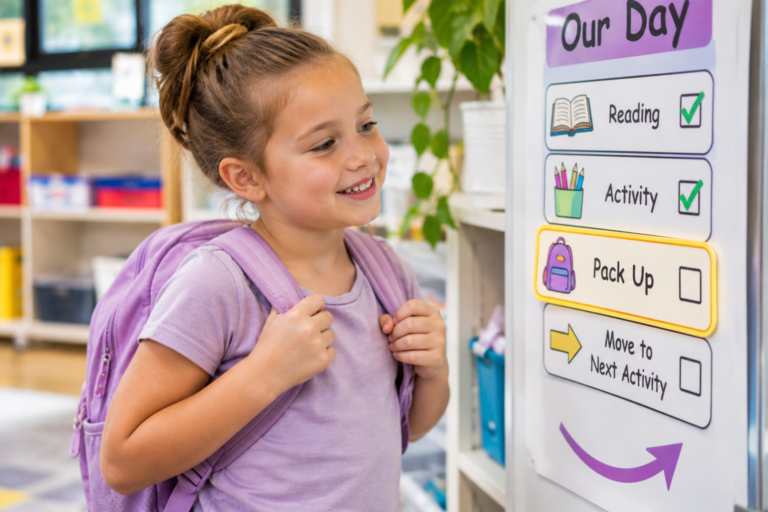
That doesn’t mean children shouldn’t be allowed to take breaks. It means that a regulation break should generally have a beginning, a purpose, and a return.
The passes included in our toolkit frame the space as a short break designed to help the child’s body and brain feel calm again, use a regulation strategy, and return ready to learn.
Importantly, returning doesn’t necessarily mean returning to exactly the same demand in exactly the same way. The child may need the task broken down, additional support, clarification, a sensory accommodation, or another adjustment.
Regulation gets the child back to a place where we can work out what they need next.
Pay Attention to What Keeps Sending the Child There
A calm down corner can also provide us with valuable information if we’re paying attention.
If the same student needs the regulation space every day during writing, we should become curious about writing.
If another child repeatedly becomes overwhelmed during transitions, we should look more closely at transitions.
If a student regularly needs regulation after lunch, during noisy activities, when working independently, or following interactions with particular peers, those patterns matter.
Instead of continually asking, “How do we get this child to calm down?”, we can begin asking a much more useful question: “What keeps making regulation difficult in the first place?”
Perhaps the task is too difficult. Maybe the environment is overwhelming. There may be anxiety, sensory demands, friendship problems, uncertainty, executive functioning difficulties, communication challenges, or something else happening beneath the behavior.
The calm down corner can support the child in the moment, but it should never stop us from looking at why the child repeatedly needs it.
Reflection Comes After Regulation
Once the child is regulated enough to think and communicate, there can be enormous value in briefly reflecting on what happened.
Our toolkit includes a Let’s Reflect visual that guides children through what happened, how they were feeling, what they noticed in their body, what helped, and what they could try next time.
The timing of that reflection matters. Trying to process the situation while a child is still highly distressed can simply become another demand.
Once they’re ready, however, reflection helps turn one difficult moment into information the child can use next time. We aren’t just reviewing what went wrong; we’re helping them build their own personal regulation plan.
The Real Goal Is for Children to Take the Skills With Them
Ultimately, we don’t want children to become dependent on the physical calm down corner.
The corner is a scaffold.
At first, a child may need the emotion poster to identify how they feel. Later, they may recognize the feeling themselves. Initially, they may need to look through the coping choices. Eventually, they may automatically know that walking helps when their body feels restless.
A student may begin by following a visual breathing exercise in the regulation space and eventually use that same breathing strategy quietly at their desk, in the playground, before a test, or somewhere completely outside school.
That is progress.
The success of a calm down corner shouldn’t be measured by how frequently children sit in it. It should be measured by whether children are gradually developing emotional regulation skills they can use beyond it.
How We Use Our Calming Corner Toolkit
Our Soft Pastel Calming Corner Toolkit was created to help professionals build a functional regulation space rather than simply an attractive classroom display.
It includes multiple naming options such as Calming Corner, Regulation Station, Peace Corner, Calm Down Spot, and Reset Zone, with matching passes so professionals can choose language that works for their particular setting.
The toolkit then provides the practical teaching supports that help children actually use the space, including emotion visuals, feelings intensity scales, body clues, coping choices, breathing strategies and mats, 5-4-3-2-1 grounding, affirmations, Circle of Control, a Feelings Wheel, Worry Parking Lot, reflection prompts, and readiness-to-return visuals.
We don’t expect every child to use every tool. The purpose is to give teachers, counselors, therapists, occupational therapists, and behavior professionals a range of strategies they can explicitly teach, model, practice, individualize, and revisit.
Because the poster itself isn’t the intervention. What we teach the child to do with it is.
A Calm Down Corner Should Build Skills, Not Just Look Calm
A calming corner can absolutely be beautiful, welcoming, and comforting. But that should be the beginning rather than the end.
A genuinely useful classroom calm down corner or regulation station helps children recognize emotions, notice body cues, understand the intensity of their feelings, choose appropriate strategies, ask for support, regulate, reflect, and eventually return to what they need to do.
It should be taught proactively, not introduced for the first time during a meltdown. It should support regulation rather than function as punishment. It should allow for co-regulation while gradually helping children develop greater independence.
Most importantly, it should move us beyond simply telling children to calm down.
We are teaching them to ask: What is happening inside my body? What am I feeling? What do I need? What can I try? Did it help? What might I do next time?
Those are skills children can carry far beyond the classroom.
The calm down corner is simply one place where we can begin teaching them.
Helpful tools for your calm corner
- Sand timer set: A visual timer helps children see how long their calm corner visit will last.
- Calm-down glitter bottles: Watching the glitter settle gives a child something calm to focus on while they breathe.
- Floor cushion or small bean bag: A soft, defined seat helps the corner feel safe and inviting.
- Noise-reducing headphones for kids: Useful for children who need a break from classroom noise.
- The Color Monster by Anna Llenas: A familiar feelings book children can look at while they settle.
Want More Ready-to-Use Emotional Regulation Resources?
Our Soft Pastel Calming Corner Toolkit is included in the All Therapy Resources® Membership, alongside our growing library of ready-to-use counseling, therapy, behavior, SEL, and educational resources.
Inside the membership, you’ll find practical resources for emotional regulation, coping skills, anxiety, anger management, behavior support, sensory regulation, impulse control, executive functioning, social skills, friendship challenges, self-esteem, resilience, trauma-informed support, school counseling, small groups, and much more.
The membership is designed for school counselors, teachers, psychologists, behavior professionals, occupational therapists, speech therapists, social workers, play therapists, and other helping professionals who want resources they can actually implement with the children they support.
Whether you’re creating a classroom calm down corner, developing an individual regulation plan, supporting a child who becomes easily overwhelmed, or proactively teaching emotional regulation skills, our goal is to give you tools that go beyond simply looking good on the wall.
Because we don’t just want children to have access to coping strategies. We want them to understand their emotions, recognize what their bodies are telling them, and learn how to use those strategies when they actually need them.
Join the All Therapy Resources® Membership and explore the complete resource library today.