The whispered comment as someone walks past. The group chat that suddenly goes quiet. The friend who is “just joking” when she tells everyone not to sit with you at lunch. This kind of hurt rarely leaves a mark you can see, which is exactly why it is so easy for adults to miss. These relational aggression activities give school counselors and teachers practical ways to help students recognize hidden social cruelty, understand its impact, and practice kinder, braver choices in their friendships.
Relational aggression is behavior that harms someone by damaging their relationships or social standing. It includes spreading rumors, excluding someone on purpose, giving the silent treatment, threatening to end a friendship, and turning others against a peer. StopBullying.gov describes this as social bullying, sometimes called relational bullying (StopBullying.gov).
Why Relational Aggression Is So Hard to Spot
Physical aggression is visible. A push in the hallway gets noticed. Relational aggression is quieter and often happens in spaces adults can’t see: group chats, sleepovers, the edge of the playground, or a look across the classroom. It is also easy to brush off as “girl drama” or “just friendship stuff.”
That label can leave students feeling unheard. For the student on the receiving end, being shut out of a friendship group can feel deeply threatening, because belonging matters so much in late elementary and middle school. And while relational aggression is often discussed in relation to girls, students of any gender can use it and be hurt by it.
Students often struggle to name what is happening. They may say, “Nobody is being mean to me exactly, but I feel left out all the time.” Giving them clear language is one of the most helpful first steps you can take.
Common Forms of Relational Aggression
Sharing a simple list with students helps them recognize patterns in their own friendships and in the friendships around them.
| What it looks like | What a student might notice |
|---|---|
| Exclusion | “They told me there was no room at the table, then let someone else sit down.” |
| Gossip and rumors | “People are saying something about me that isn’t true.” |
| Friendship threats | “She said she won’t be my friend anymore unless I stop talking to Maya.” |
| The silent treatment | “Everyone ignores me in the group chat, but they talk to each other.” |
| Cliques and control | “One person decides who is in and who is out.” |
| Jealousy-driven behavior | “Ever since I made the team, my friend has been cold and making comments.” |
Relational Aggression Activities for Upper Elementary Students
Students in grades 3 to 5 are starting to form tighter friendship groups. Keep activities concrete, use scenarios close to their daily lives, and focus on naming feelings and choosing kind actions.
1. Friendship Weather Report
Ask students to describe how their friendships feel today using weather words: sunny, cloudy, stormy, or foggy. Then read short scenarios and ask, “What would the weather be for each person in this story?” This gives younger students a gentle, non-threatening way to talk about how exclusion and unkind words feel.
2. Kind or Unkind? Sorting Cards
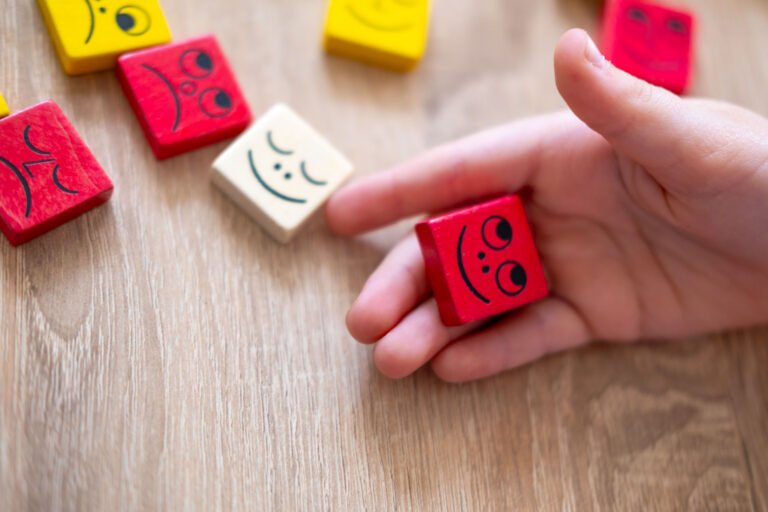
Create cards with friendship behaviors, such as “saving a seat for someone new,” “whispering about someone while looking at them,” and “inviting the whole group to play.” Students sort them into kind and unkind, then talk about the in-between cards that are harder to decide. These discussions help students notice the subtle behaviors that often go unnamed.
3. The Upstander Script
Teach students a few short phrases they can use when they see someone being left out: “Come sit with us,” “That’s not true, let’s not spread it,” or “Let’s include everyone.” Practice them out loud until they feel natural. Our article on friendship skills activities has more ideas for building these skills early.
Relational Aggression Activities for Middle School Students
Middle school is often when relational aggression peaks, as social status, group identity, and online communication all become more important. Students in this age group respond well to realistic scenarios, games, and discussions that respect their growing independence.
4. Gossip Chain Reflection
Start a whispered message around the circle and compare how it changed by the end. Then shift the discussion to real life: “What happens to a rumor as it travels? Who gets hurt? Who has the power to stop it?” Close by asking each student to name one thing they can do when gossip reaches them.
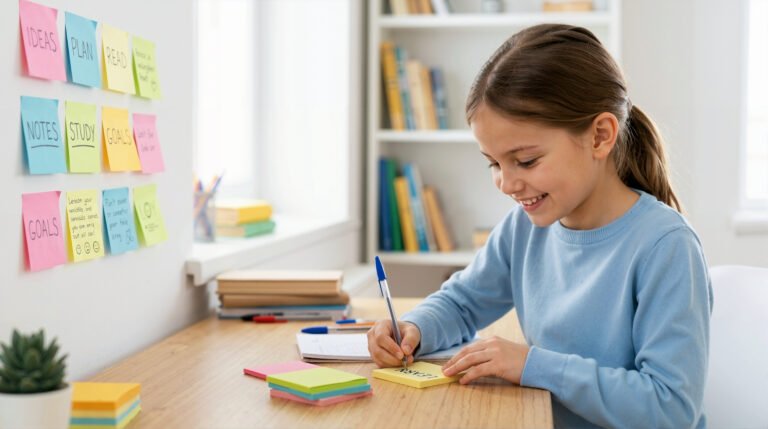
Try this in your next group: After the gossip chain, give each student a sticky note and ask them to write one sentence they could say to stop a rumor without starting an argument. Read a few aloud (anonymously) and add the best ones to a class “stop the rumor” poster.
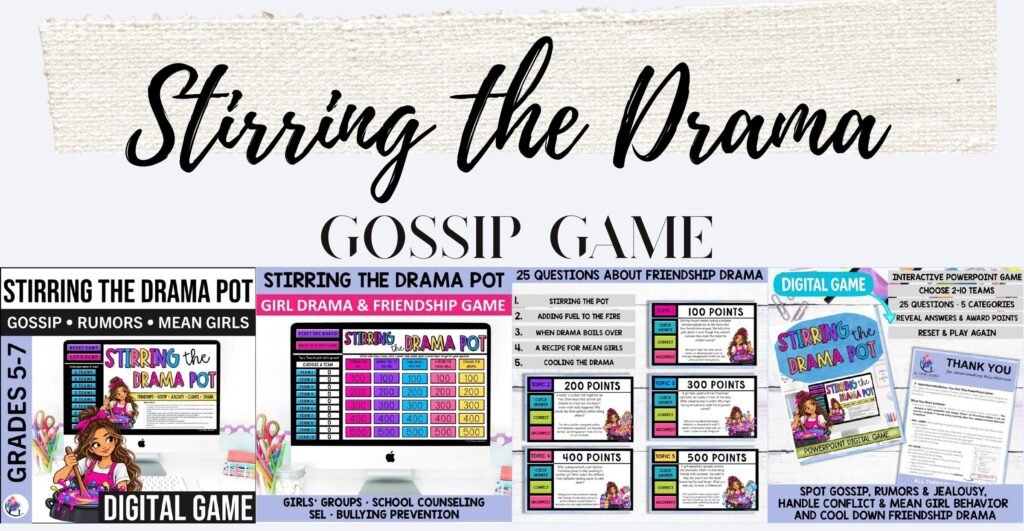
Our Stirring the Drama Pot Digital Game turns this topic into an interactive game, with scenario-based questions about gossip, rumors, and cliques that get students talking about how drama starts and how it can be calmed down. It is ready to use with a small group or a whole class, so you can run a meaningful lesson on gossip without building one from scratch.
5. Inside the Clique
Give small groups a scenario about a friendship group where one person controls who is included. Assign roles: the leader, the follower who goes along with it, the student who is excluded, and the bystander. Ask each student to describe what their character is thinking and feeling, then discuss what each person could do differently. This helps students see that everyone in the group has choices, not only the person leading.
For deeper work on cliques and social power, our Queen Bee Effect Digital Game explores friendship hierarchies, peer pressure, and the roles students play in a group. It fits well in a small group counseling series on friendships, and the scenarios give students a safe distance to talk about situations they may be living through.
6. Naming the Green-Eyed Monster
Jealousy often sits underneath relational aggression. A friend makes a new friend, wins an award, or gets attention, and suddenly comments and exclusion begin. Help students name jealousy as a normal feeling, then separate the feeling from the behavior: “It’s okay to feel jealous. It’s not okay to make someone else feel small because of it.” Brainstorm healthy ways to handle jealousy, such as talking to a trusted adult, journaling, or telling a friend, “I’m happy for you, and I’m also feeling a bit left behind.”
Our Green-Eyed Monster Digital Game gives students a fun, low-pressure way to explore jealousy in friendships and practice healthier responses, making it a natural partner to this activity.
Relational Aggression Activities for High School Students
Teens benefit from conversations that connect relational aggression to the relationships they care about most, including friendships, dating relationships, and online communities. Our article on gossip and rumors in high school explores this age group in more depth.
7. Healthy vs. Controlling Friendships
Ask students to brainstorm what a healthy friendship looks like (trust, respect, room for other friends) and what a controlling one looks like (guilt trips, threats to leave, jealousy over other friendships). Then discuss how to set a boundary with a friend: “I care about you, and I’m also going to keep hanging out with other people.”
8. Beyond the Screen
Much relational aggression now happens online, through group chats, being left out of photos, or comments that seem harmless but aren’t. Invite students to reflect on their own online habits: “Have you ever been left out of a chat? Have you ever left someone out?” Talk about the impact and what a kinder online choice might look like.
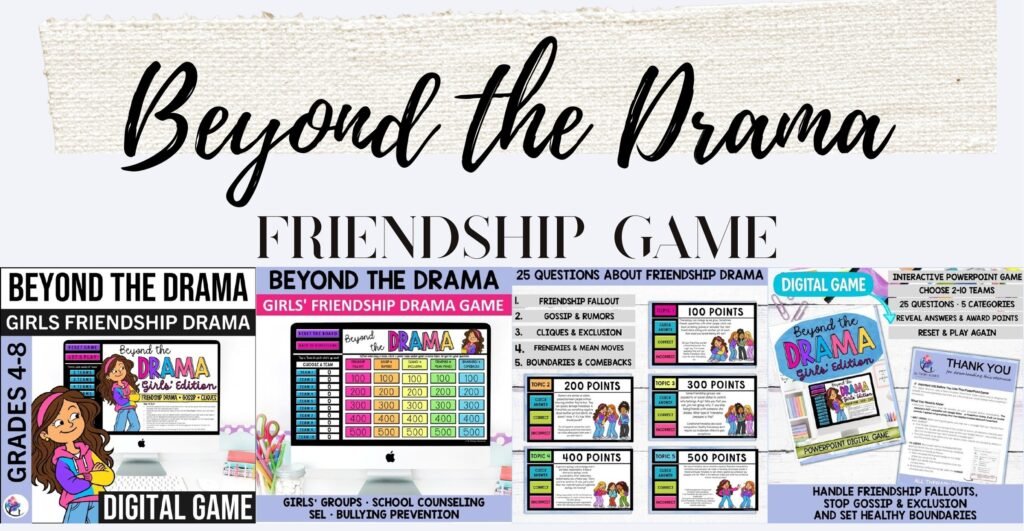
For a structured friendship lesson, our Beyond the Drama Friendship Game covers cliques, gossip, and healthy friendship choices through realistic scenarios, so students can practice what they would say and do before a real situation comes up.
Tips for Responding to Relational Aggression
- Take it seriously. Avoid labels like “drama.” Listen to the student’s experience and validate how much it hurts.
- Look at the whole group. Relational aggression usually involves leaders, followers, and bystanders, not only one “mean” student.
- Teach skills, not just rules. Students need words they can use to include others, stop rumors, and set boundaries.
- Know when it becomes bullying. When behavior is repeated and involves a power imbalance, follow your school’s bullying response procedures. See our guide to bullying prevention resources for middle school.
- Keep families in the loop. Share the language you use at school so families can support the same skills at home.
Frequently Asked Questions
What is relational aggression?
Relational aggression is behavior that harms someone through their relationships or social standing, such as spreading rumors, excluding someone on purpose, or threatening to end a friendship.
Is relational aggression the same as bullying?
It can be. When relational aggression is repeated and involves a power imbalance, it is considered social or relational bullying and should be handled using your school’s bullying procedures.
At what age does relational aggression start?
Early forms, such as “you can’t come to my party,” can appear in early elementary school. It often becomes more frequent and more complex in upper elementary and middle school, as friendship groups and social status become more important.
Is relational aggression only a problem for girls?
No. It is often discussed in relation to girls, but students of any gender can use relational aggression and be affected by it. Activities work best when they focus on behaviors and choices rather than on gender.
Looking for practical, ready-to-use resources for your friendship and relational aggression lessons? The All Therapy Resources Membership provides access to a growing collection of thoughtfully developed counseling activities, interactive games, and therapeutic tools designed to save preparation time while supporting meaningful, skill-focused learning.