Teaching safety to elementary students means balancing vigilance with psychological security. When we introduce stranger danger activities for elementary students, the goal is empowerment, not anxiety. Safety education has moved away from alarming stories that heighten fear in young children, toward approaches that build confidence and situational awareness. We want students to recognize unsafe situations without treating every unfamiliar face as a threat.
This shift lines up with trauma-informed practice, which treats emotional safety as part of physical safety. Focus on boundary setting, body autonomy, and identifying trusted adults, and you get personal safety activities kids actually remember. The strategies below show how to weave road safety and body safety lessons into your existing curriculum without causing panic.
Reframing Stranger Safety for Elementary Classrooms
Safety education often falls short when it relies on vague warnings that leave children feeling vulnerable instead of prepared. Johns Hopkins Medicine guidance on stranger safety recommends helping children identify a safety net of trusted adults and places, and teaching them to recognize and respond to threatening situations rather than warning them about certain types of people. This gives students concrete anchors if they feel lost or uncomfortable, instead of a fuzzy sense of threat with nowhere to put it.
Moving Beyond Fear-Based Messaging
Fear and stress make it harder for children to think clearly, take in new information, and make decisions. Teach safety through intimidation, and some students may freeze or shut down rather than act. Effective instruction focuses on what students can do, replacing helplessness with agency.
Calm, everyday practice and role-play let children use their voice and rehearse safe choices without triggering panic. This respects child development while still meeting health and safety standards.
Defining Safe Strangers vs. Unsafe Situations
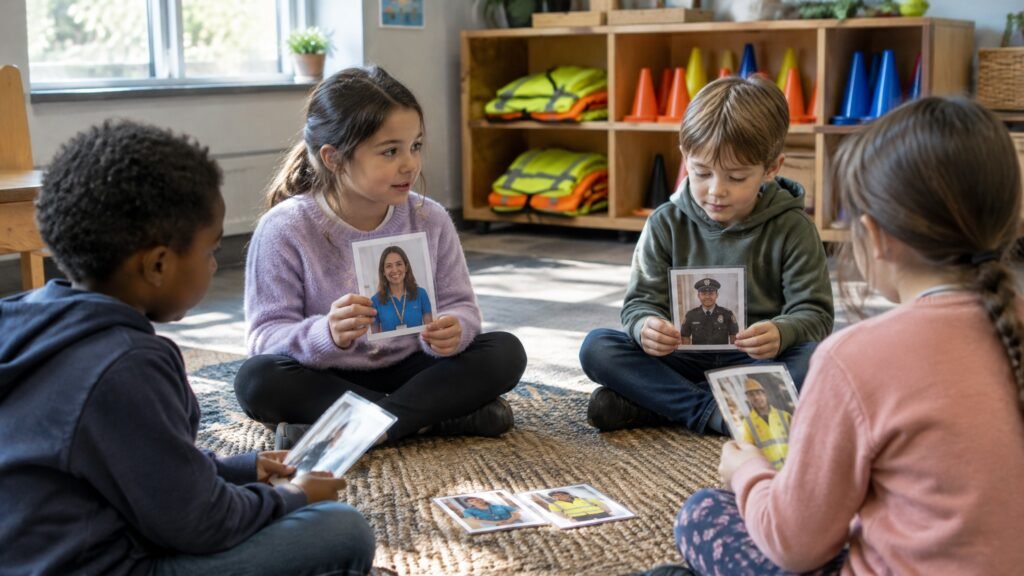
The traditional “stranger danger” message has a gap: Johns Hopkins Medicine notes that most children who are abducted are taken by someone they know, so avoiding strangers alone does not keep children safe. Teaching students to find “safe strangers,” such as a police officer, a store employee with a name tag, or a parent with children, gives them real options when they need help. Pair this with a simple, practiced response: say no, move away, and tell a trusted adult.
Make it clear that unsafe behavior can come from anyone, familiar or not. Shift the focus from who a person is to what they are asking or doing, and students learn to judge risk by behavior instead of appearance.
Try this in your classroom: Draw a large “My Safety Hand” outline and have each student write or draw one trusted adult on each finger (a parent or carer, a teacher, the school counselor, a relative, a neighbor). Then ask, “If you were lost at the store, who could you ask for help?” and practice the answer together: “I would find a worker with a name tag and say, I’m lost, can you help me find my grown-up?”
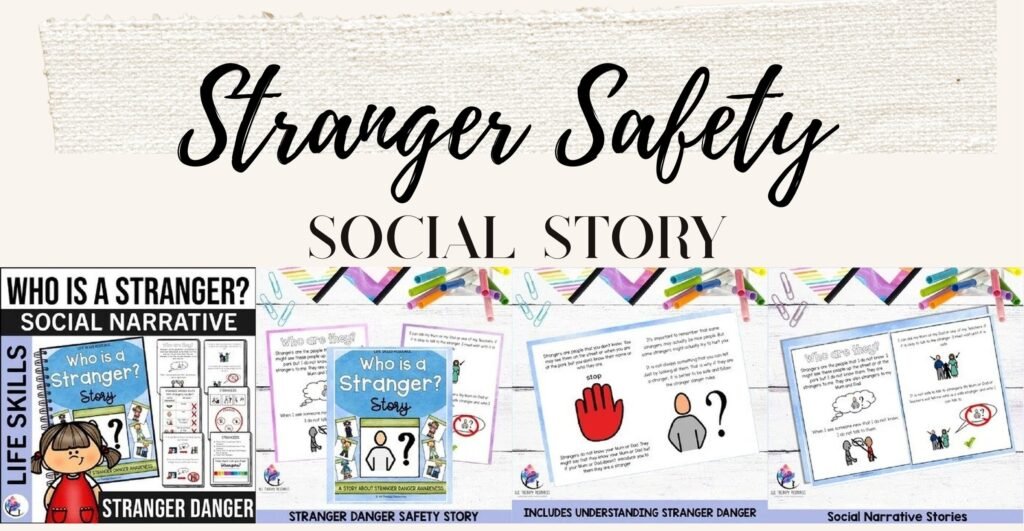
To make the “who is a stranger” idea concrete, especially for younger students or learners with autism, our Stranger Danger Safety Story uses simple language and clear visuals to explain the difference between strangers, familiar people, and family. It works well as a lesson opener or for one-to-one review in a life skills or special education setting. One counselor shared that the “visuals and simplified language make it easy to use as an opener for my lessons with students,” and another printed it, put it in sheet protectors, and kept it in a binder for repeated reading with a student who found the concept hard to grasp.
Personal Safety Activities Kids Can Practice Safely
Abstract discussions about boundaries rarely stick with elementary learners. Students need chances to rehearse skills in a setting that feels secure and structured.
Interactive Safety Games
Game-based learning turns a heavy topic into a manageable skill-building exercise. Digital formats also offer a real advantage for sensitive content: students can make a mistake and try again without social embarrassment, and the correct response is reinforced through repetition and feedback.
Role-Playing Boundaries Without Re-traumatization
Role-play builds confidence, but it has to be scaffolded carefully so it never simulates a threatening encounter. Keep scripts focused on the student’s voice and actions, not on the other person’s behavior. Practicing phrases like “No, thank you,” “I don’t like that,” or “I need space” builds verbal assertiveness that can carry over into real life.
Always build in an opt-out. Some students carry trauma histories that make even simulated conflict distressing, so offering another way to take part (being the “coach” who reminds the group of the steps, or drawing the safe choice) keeps the activity psychologically safe.
Try this in your next session: Picture a small group of second graders practicing “No, Go, Tell.” You read a short, neutral prompt (“Someone you don’t know offers you a puppy if you come to their car”), and each student practices the response in a strong voice: “No!”, takes three steps toward the “safe adult” chair, and says, “I need to tell you something.” Celebrate the strong voice, not the scenario.
If a student discloses something worrying: Safety lessons sometimes prompt a child to share that someone has hurt them or made them feel unsafe. Stay calm, listen, and thank them for telling you. Do not promise to keep it a secret, and avoid asking leading questions. Follow your school or district child protection protocol and your mandated reporting obligations straight away.
USA: Childhelp National Child Abuse Hotline 1-800-422-4453; 988 Suicide & Crisis Lifeline (call or text 988, chat at 988lifeline.org); in an emergency, call 911.
Australia: Kids Helpline 1800 55 1800; Lifeline 13 11 14 (text 0477 13 11 14); your state or territory child protection service (see the AIFS reporting contacts); in an emergency, call 000.
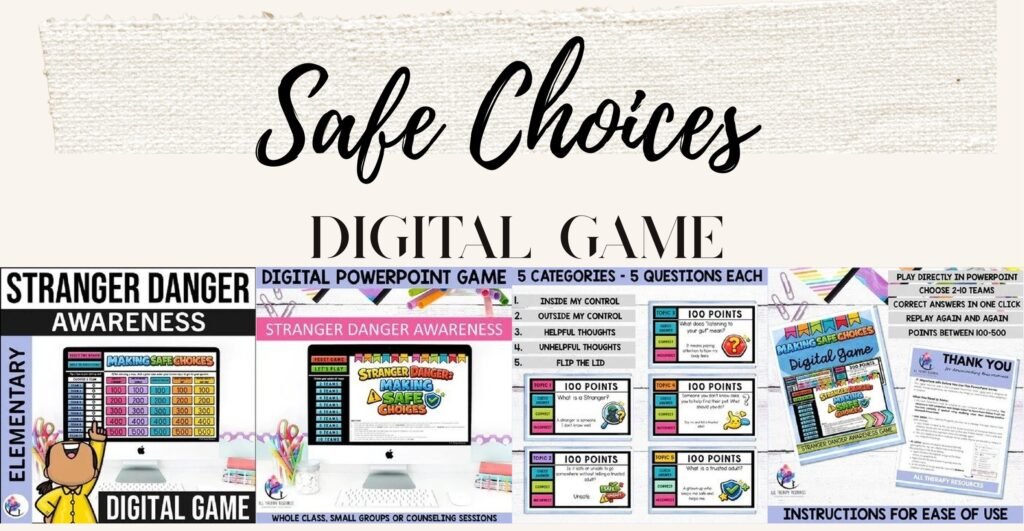
For a ready-made, calm way to practice these choices, our Stranger Danger Safety Digital Game is an interactive PowerPoint game for elementary students that explores safe and unsafe situations, trusting your instincts, and when and how to seek help, without fear-based messaging. Play it as a whole class on the board or with a small group, pausing after each scenario to ask, “What would you do, and who could you tell?” One elementary counselor said it was “an excellent way to introduce personal safety in a student-friendly and engaging format,” noting that it sparked great discussion with very little preparation.
Road Safety Lessons for Elementary Students
Pedestrian safety takes more than memorized traffic rules. It also asks children to stop, pay attention, and manage impulses. Connecting road safety to self-regulation helps students understand why stopping and looking matters once they are outdoors.
Multisensory activities bridge classroom instruction and real-world application. Visual mapping exercises, where students draw their safe route to school, reinforce safety habits in a concrete way. Active listening drills help students practice stopping their bodies and tuning in to sounds and adult instructions, a skill that carries over to traffic signals and crossings.
You can tie these ideas back to emotional regulation. A student who finds it hard to calm their body indoors may also find it hard to pause at a crosswalk. Building in trauma-informed classroom support tools strengthens the foundation that road safety depends on.
Try this in your classroom: Play “Traffic Light Bodies.” Call out red (freeze), yellow (slow walk), and green (march in place), then add “Stop, look, listen, think” before every green. Finish by asking, “When do we need our red-light body outside?” and list answers such as the curb, the parking lot, and when a car is backing out.
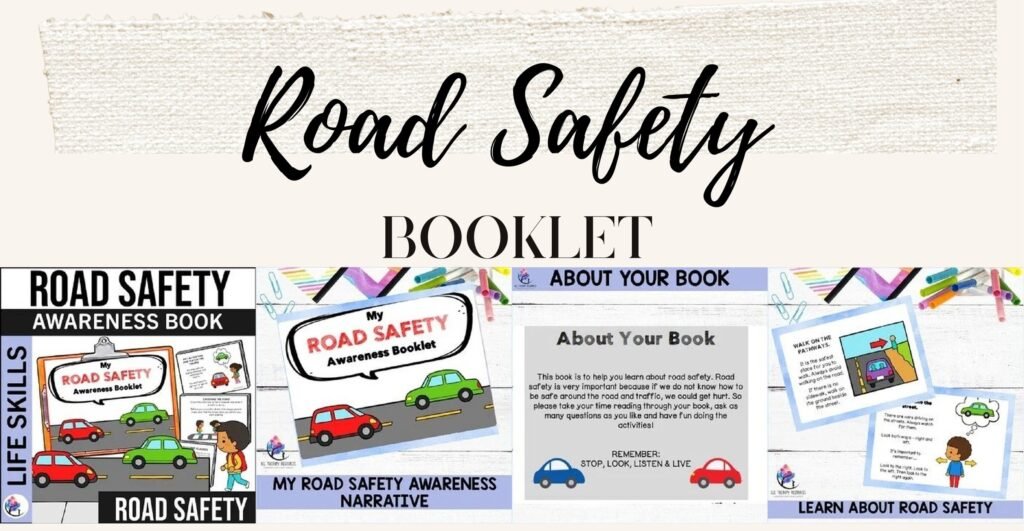
When you want students to take the learning home, our Road Safety Awareness Booklet covers crossing the street, traffic lights, and bike safety with simple text, clear pictures, hands-on activities, and a certificate to celebrate. It suits preschool through early elementary, as well as special education and OT sessions. One reviewer printed it for every class from kindergarten and preschool to grade 3 and said each child “really enjoyed getting their certificate of completion at the end.”
Using a Stranger Safety Worksheet for Critical Thinking
Worksheets serve a specific purpose in safety education: they let students process ideas at their own pace. Unlike live discussion, written activities give anxious learners time to think before responding.
Sorting Safe vs. Unsafe Scenarios
Sorting tasks help students build a mental map for evaluating risk without the pressure of answering on the spot. Students read a short situation and decide whether it is safe, unsafe, or “check with a trusted adult,” which strengthens decision-making through deliberate practice.
Varying the scenarios over time prevents rote memorization and keeps students thinking flexibly. They learn to read context instead of applying a rigid rule that falls apart in a nuanced situation.
Character Traits and Values Reflection
Safety education connects with identity when you link it to character development. Exploring values like responsibility, respect, and fairness helps students understand why safety rules exist, beyond “because an adult said so.” The Character Traits List Worksheets give students structured reflection that connects personal values to protective choices.
When students see safety as an expression of self-respect and care for others, the rules start to feel like their own. That foundation supports safety habits well beyond elementary school.
Integrating SEL Into Body Safety Lesson Plans
Social-emotional learning is the inner groundwork that outward safety skills depend on. Students are better able to notice what is happening around them when they have first learned to notice what is happening inside them.
Mindfulness for Body Awareness
Mindfulness practice helps children tune in to body signals, such as a tight tummy or a racing heart. Naming these “uh-oh feelings” gives students words for the sense that something is not right, and a cue to move away and tell an adult. The Mindfulness Activities Wheel offers an accessible entry point through coloring and guided reflection.
Regular calming practice can also help students tell the difference between ordinary nervousness (like before a spelling test) and an “uh-oh” feeling that means they should get help.
Kindness and Community Safety Connections
Kindness and community safety reinforce each other. Where students practice kindness and look out for one another, classrooms feel safer and children are more likely to speak up for a peer. Kindness lessons, writing prompts, and buddy systems all help students turn empathy into action.
Connection matters too. The CDC describes school connectedness as an important protective factor for students’ health and well-being, and students who feel connected to trusted adults at school have more people to turn to when something feels wrong.
Supporting Safety Education With Therapeutic Tools
Effective safety instruction depends on underlying skills that some students are still developing. Find and address those gaps, and the rest of your safety lessons become accessible to every learner.
Active Listening for Safety Instructions
Verbal safety instructions rely on listening and attention skills that many elementary students are still building. The Active Body Listening Lesson teaches students what listening looks like with their whole body, which helps during drills and safety instruction. Without that foundation, even a well-designed safety lesson can miss students who struggle with focus or sensory processing.
Teaching listening explicitly, as a body-based skill, supports neurodivergent learners who may not intuitively know what “pay attention” means. Visual and movement cues alongside verbal instructions make the lesson more accessible.
Data Tracking for Intervention Progress
Documenting student progress in safety understanding informs tiered supports and shows stakeholders where growth is happening. A quick pre and post check (for example, “Name two trusted adults” and “What would you do if you got lost?”) helps identify which students have taken in the key ideas and which need more support through small group counseling. Simple measures keep us from assuming understanding based only on quiet compliance.
Progress monitoring also keeps safety education responsive to what students actually need, instead of letting it become a once-a-year checkbox.
Building a Comprehensive Safety Curriculum
Isolated safety units rarely produce lasting change. Stronger protection comes from stranger awareness, road safety, and social-emotional learning working together as part of school climate, not as standalone topics.
Viewing safety through a developmental lens prevents premature exposure to frightening content while still building age-appropriate skills. Elementary students benefit most from lessons that emphasize empowerment, trusted relationships, and concrete skills over abstract warnings. As students mature, these foundations support more complex topics, including bullying prevention resources and digital citizenship.
Your safety curriculum can grow alongside your students, with skills building across grade levels instead of resetting each year.
Frequently Asked Questions
How do I teach stranger safety without scaring elementary students?
Focus on empowerment and specific skills rather than frightening warnings. Teach students to identify trusted adults and safe places, and to practice a simple response such as “No, Go, Tell.” Use games, sorting activities, and positive language that builds confidence instead of anxiety.
What personal safety activities work best for elementary-age children?
Interactive games and structured role-plays let students practice boundary-setting in a low-stakes way. Sorting worksheets help them sort safe and unsafe situations without pressure. Keep activities focused on the student’s voice and choices rather than on acting out threatening encounters.
How does SEL improve road safety lessons for kids?
Stopping, looking, and waiting near traffic all draw on self-regulation and impulse control. Calming and attention practices give students the skills to notice what is around them and follow safety steps, which makes road rules more meaningful and memorable.
Is “stranger danger” still the right message?
Many safety experts now favor teaching children to judge situations and behaviors, and to know their trusted adults and safe strangers, rather than fearing all strangers. Johns Hopkins Medicine notes that most children who are abducted are taken by someone they know, so a behavior-based approach covers more real-life situations.
Looking for practical, ready-to-use resources to support your safety lessons? The All Therapy Resources Membership provides access to a growing collection of thoughtfully developed counseling activities, interactive games, and therapeutic tools designed to save preparation time while supporting meaningful, skill-focused learning.