Picture a third grader whose best friend has started sitting with someone new at lunch. She stops talking to both of them, says something unkind on the playground, and then tells you she “doesn’t care.” Underneath, she is jealous, and she does not have the words or the tools for it yet. These jealousy activities for kids give school counselors practical, low-prep ways to help elementary students name jealousy, understand where it comes from, and choose kinder ways to handle it in their friendships.
This post focuses on jealousy itself as an emotion students can learn to manage, especially in grades 3-5. If you are working with older students on the wider picture of gossip, exclusion and cliques, see our guides to relational aggression activities for students and girl drama activities for middle school.
What Jealousy Looks Like in Elementary Friendships
Jealousy is a normal human emotion. It often shows up when a child is afraid of losing something that matters to them, such as a best friend’s attention, a place in the group, or feeling special to a teacher or parent. Envy is a close cousin: wanting something someone else has, like a new toy, a talent or a spot on the team. Young students usually use the word “jealous” for both, and that is fine. What matters is helping them notice the feeling before it turns into hurtful behavior.
In upper elementary, jealousy often looks like:
- Sulking, withdrawing or saying “I don’t care” when a friend plays with someone else
- Bossiness or trying to control who a friend can play with
- Put-downs or “joking” comments about a classmate’s success
- Leaving someone out, or getting others to take sides
- Constant comparing: “Why does she always get picked?”
Learning to identify our own emotions is part of self-awareness, one of the five social and emotional competencies in the CASEL framework. Jealousy activities give students a safe, concrete way to practice that skill with a feeling many of them find embarrassing to admit.
Activity: Where Do I Feel It?
Give each student a simple body outline. Read a short scenario, such as “Your best friend gets invited to a birthday party and you don’t,” and ask students to color where they might feel jealousy in their body: a tight chest, hot cheeks, a heavy stomach, clenched fists. Then ask, “What thoughts might come with that feeling?” Students quickly see that jealousy is something that happens to everyone, not a sign that they are a bad friend.
Try this in your next session: Normalize before you teach. You might say, “Everyone feels jealous sometimes. Grown-ups too. The feeling is okay. What we are going to practice is what we do next.” Students are far more willing to talk about jealousy once they know they won’t be judged for having it.
The Comparison Trap
A lot of jealousy grows out of comparison. Children compare belongings, grades, talents, looks and how many friends someone seems to have. Comparison is natural, but when it becomes a habit, students tend to notice only what they lack and miss what they bring.
Activity: Noticing, Not Comparing
Pair students and give each pair a short list of prompts: “Something I’m working on getting better at,” “Something I’m proud of,” “Something my friend is great at.” Each student shares one strength of their own and one of their partner’s. Finish by asking, “Can two people both be good at something? Does your friend being great at soccer make you less great at drawing?”
For older students who are starting to compare themselves online, our post on the comparison trap and social media goes further.
When Jealousy Takes Over a Friendship
The feeling itself is not the problem. The trouble starts when jealousy drives choices that hurt a friendship. A simple “feeling, thought, choice” table helps students slow down and see that they have options.
| The situation | A jealous thought | A hurtful choice | A kinder choice |
|---|---|---|---|
| Your friend plays with someone new at recess | “She likes her more than me.” | Ignore them both or tell others not to play with the new student | Ask to join in, or tell your friend, “I missed playing with you today.” |
| A classmate gets the part you wanted in the class play | “It’s not fair. I’m better than him.” | Make fun of him when he practices | Feel disappointed, then say “Good job,” and ask what part you could try for next time |
| Your friend gets a new game you really want | “She always gets everything.” | Say the game is babyish | Say, “That looks fun. Can you show me how it works?” |
| Your best friend is invited to a party and you are not | “Nobody wants me there.” | Spread a rumor about the party | Talk to a trusted adult about the left-out feeling and plan something fun of your own |
For more help with the conflicts jealousy can spark, see our conflict resolution activities for students.
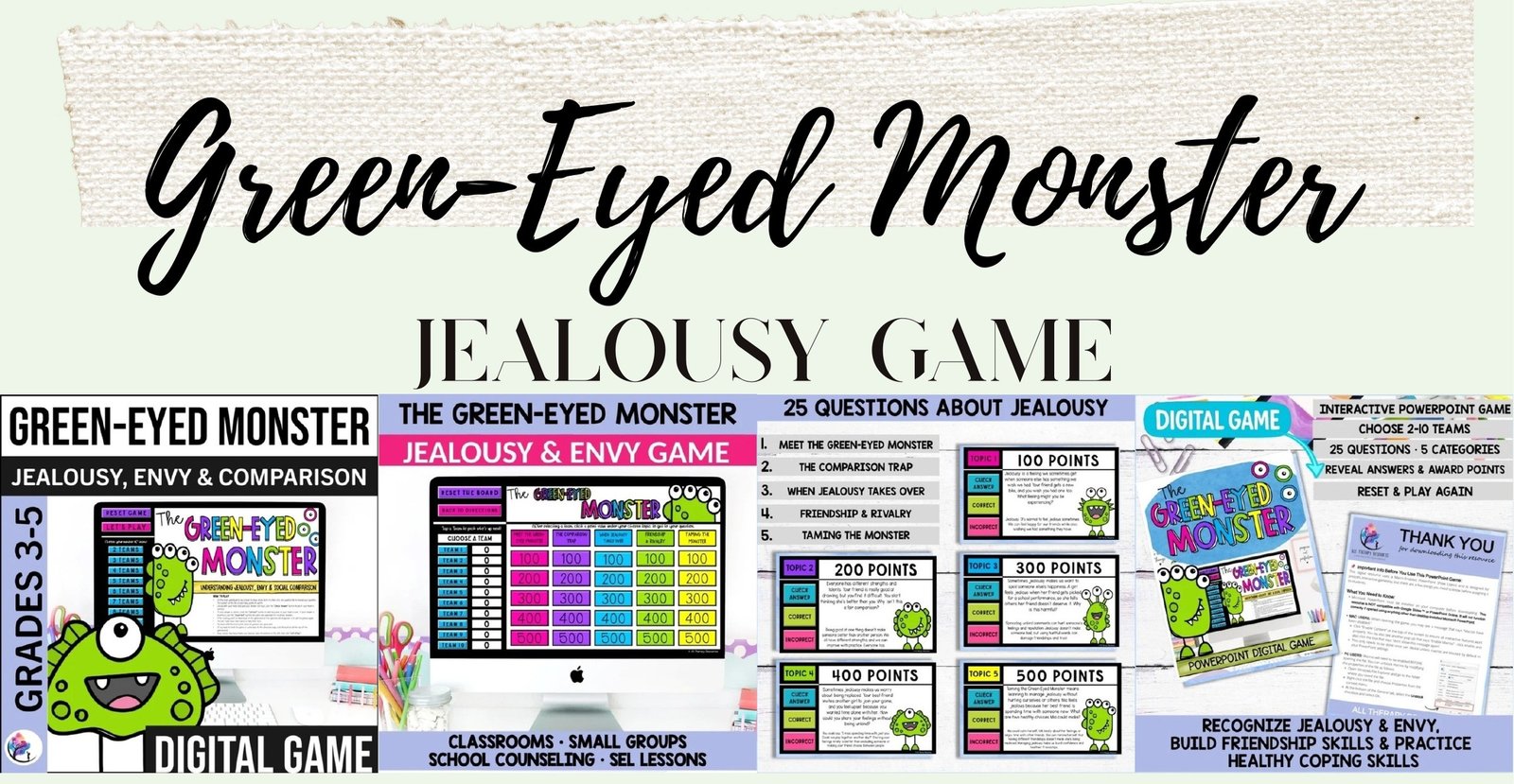
Our Green-Eyed Monster Digital Game was made for exactly this conversation with girls in grades 3-5. Teams choose question tiles across five topics (Meet the Green-Eyed Monster, The Comparison Trap, When Jealousy Takes Over, Friendship and Rivalry, and Taming the Monster), talk each one through and reveal the answer with a click, while a built-in scoreboard keeps track of points. We like to use it in a girls’ friendship group or a small group on feelings, because the friendly monster character makes jealousy something students can laugh about and look at from a little distance, which makes it much easier to talk about honestly.
Taming the Green-Eyed Monster: Coping Steps Kids Can Use
Once students can name jealousy, give them a short, memorable plan for what to do next. Keep it to a few steps and practice them with role-play, not just discussion.
- Name it. “I’m feeling jealous.” Saying it, even silently, puts a little space between the feeling and the action.
- Notice your body. Is your face hot? Are your fists tight? That is your signal to slow down.
- Calm it down. Take a few slow breaths, get a drink of water or count to ten.
- Check the thought. Ask, “Is it true that she doesn’t like me anymore, or is she just playing with someone else today?”
- Choose a kind action. Join in, ask to play, say congratulations, or talk to a trusted adult.
Try this in your next session: Practice a “both are true” sentence. Students finish the sentence “I feel jealous that ___, and I can also ___.” For example: “I feel jealous that Mia got picked first, and I can also be happy for her.” It teaches students that two feelings can sit side by side.
To build the feelings vocabulary that sits underneath these steps, our post on teaching feeling vocabulary to children has more ideas.
Running a Small Group on Jealousy and Friendship
A short small group of four to six sessions works well for students whose jealousy keeps causing friendship trouble. A few tips:
- Start with the feeling, not the behavior. Students open up when they don’t feel they are in trouble.
- Use characters and scenarios. Talking about “a student who…” feels safer than talking about a real classmate.
- Practice the words. End every session with one sentence students can try that week.
- Loop in teachers. Share your coping steps so teachers can prompt them in the moment, at recess and in class.
- Watch for patterns. If jealousy is part of repeated exclusion or targeting of one student, follow your school’s bullying procedures.
If you work with older students too, our Relational Aggression Bundle includes The Green-Eyed Monster alongside three more of our digital counseling games (Beyond the Drama, Queen Bee Effect and Stirring the Drama Pot). It gives you a ready-made path from jealousy into gossip, cliques and group power as students move into upper elementary and middle school.
Frequently Asked Questions
Is jealousy normal for kids?
Yes. Jealousy is a normal emotion for children and adults. The goal is not to stop students feeling jealous, but to help them notice the feeling and choose how they respond to it.
What is the difference between jealousy and envy?
Jealousy usually involves fear of losing something you have, such as a friend’s attention. Envy is wanting something someone else has. With younger students, it is fine to use “jealous” for both and focus on the feeling and the choices that follow.
What age are these jealousy activities for?
The activities in this post are written for upper elementary students, around grades 3-5, and can be simplified for younger children. For middle school, pair them with work on gossip, cliques and social media comparison.
When should I be concerned about a student’s jealousy?
If jealousy leads to repeated targeting, exclusion or threats toward one student, treat it as possible bullying and follow your school’s procedures. If a student seems persistently distressed or withdrawn, consider a check-in with their family and further support.
Looking for practical, ready-to-use resources to support your friendship and feelings groups? The All Therapy Resources Membership provides access to a growing collection of thoughtfully developed counseling activities, interactive games, and therapeutic tools designed to save preparation time while supporting meaningful, skill-focused learning.