
Does my child need speech therapy? It is one of the most common questions parents ask teachers, pediatricians and school teams, and it often comes with a mix of worry and uncertainty. Maybe your child is hard to understand, uses fewer words than other children their age, or gets stuck on sounds when they are excited. Children vary in how quickly they develop speech and language, so a single difference is not a diagnosis. Knowing the signs that are worth a closer look, and what to do next, can help you act early and with confidence.
This guide, for parents and the educators and therapists who support them, covers what speech therapy involves, the signs worth checking, and how to get an evaluation.
What Speech Therapy Involves
Speech therapy is provided by a speech-language pathologist (SLP), often called a speech therapist. It covers more than clear pronunciation. The National Institute on Deafness and Other Communication Disorders (NIDCD) describes speech as talking, one way of expressing language, while language is the shared set of rules we use to express and understand ideas through words, writing, signing or gestures. A child can have difficulty with one or both.
Depending on the child, an SLP may work on:
- Speech sounds: saying sounds clearly so others can understand.
- Language: understanding what others say (receptive language) and putting thoughts into words and sentences (expressive language).
- Fluency: the smooth flow of speech, including stuttering.
- Voice: pitch, volume and vocal quality.
- Social communication: using language with others, such as taking turns in conversation or asking for help.
Signs Your Child Might Benefit from a Speech and Language Evaluation
The signs below are not a checklist for diagnosis. They are reasons to talk to your child’s doctor or an SLP, who can look at the whole picture. ASHA’s communication milestones are a helpful reference, and ASHA notes they are not meant to be a screening or diagnostic tool.
Speech Sounds That Are Hard to Understand
Many sounds develop gradually, so some errors are expected in young children. The NIDCD milestones give a useful guide: between 2 and 3 years, many children speak in a way that family members and friends can understand, and between 4 and 5 years, most children say most sounds correctly except for a few, such as l, s, r, v, z, ch, sh and th. If your child is much harder to understand than other children their age, or sound errors continue beyond the expected range, it is worth asking for an evaluation. For a closer look at how SLPs practice sounds, see our guide to articulation activities for speech therapy.
Understanding and Using Language
Watch how your child understands and uses words, not only how they sound. The NIDCD milestones note that between 2 and 3 years many children use two- or three-word phrases to talk about and ask for things, and between 3 and 4 years they use sentences with four or more words. Signs worth discussing include a small vocabulary compared with peers, difficulty learning new words, trouble following simple directions, or difficulty answering simple questions such as “What is this?”
If your family speaks more than one language, this is not a cause of speech or language problems. ASHA explains that children all over the world learn more than one language without developing speech or language problems; a child who is having difficulty in both languages may need professional help.
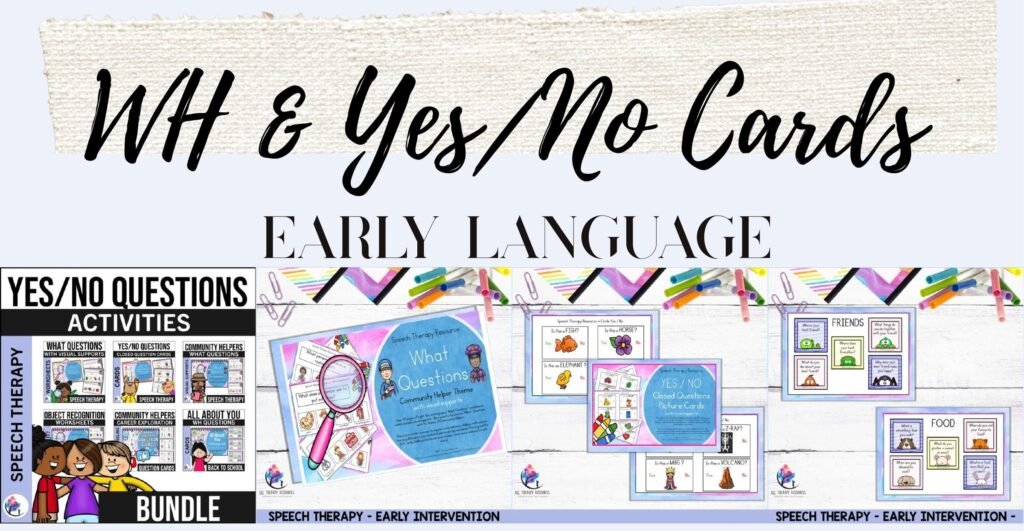
Try this in your next session: The Early Intervention Speech Therapy Bundle: What, Yes/No Questions and Objects combines picture-based yes/no question, object recognition and “What” question cards for early learners and students who need visual support. Start with object recognition, then ask “What is this?” and simple yes/no questions with the same pictures, so the child practices understanding and answering in small, predictable steps.
Stuttering That Persists or Worsens
Many young children go through periods of bumpy speech, repeating words or sounds as their language grows. The Stuttering Foundation reports that between 75% and 80% of children who begin stuttering show improvement within 12 to 24 months without speech therapy. It also lists factors that make a speech screening worthwhile: stuttering that has lasted longer than six months or has worsened, a family member who stutters, and stuttering that begins after age 3½. Signs of tension, struggle or avoiding talking are also worth raising with an SLP. Our article on fluency therapy activities for stuttering explains how SLPs support fluency in school sessions.
Social Communication and Voice
Some children have the words but find it hard to use them with others: starting or joining a conversation, taking turns, staying on topic, or asking for help. Eye contact is sometimes listed as a sign, but expectations around eye contact differ across cultures and between individuals, so it is best looked at alongside other communication skills rather than on its own. A voice that is often hoarse, very quiet or strained is also worth mentioning to your doctor.
How Speech Therapy Can Help Your Child
Speech therapy builds the specific skills a child needs to communicate more clearly and confidently, such as clearer sounds, a growing vocabulary or stronger conversation skills. Because communication underpins learning and friendships, progress can support a child in class and with peers, although every child’s pace is different.
Parents and educators are an important part of the team. Picture a kindergartner working on the /k/ sound: the SLP practices it in short, playful bursts during the session, then sends home a few picture cards and a two-minute game so the child can practice “cup”, “cake” and “key” at snack time. Small, regular practice in everyday settings helps new skills carry over beyond the therapy room. Our guide to speech therapy in schools explains how school teams and families can work together.
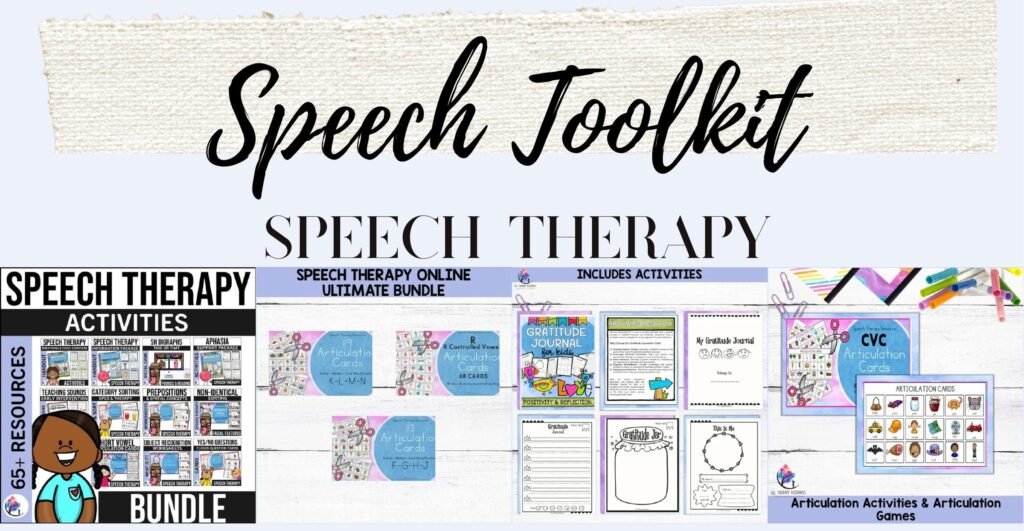
Try this in your next session: The Speech Therapy Activities Bundle is a broad toolkit for SLPs and special educators working with early intervention and elementary students: articulation cards with visual cues, strategies for teaching sounds, language cards and home practice handouts. Choose one target per session, practice it with the cards, and send home the matching handout so families keep the same target going between sessions.
Practical Tips for Parents: What to Do If You Are Concerned
If something about your child’s speech or language does not feel right, you do not need to wait and see. The CDC’s Learn the Signs. Act Early. guidance encourages families not to wait. In the United States, these steps can help:
- Talk to your child’s doctor. Share what you have noticed. The NIDCD notes that a hearing test is often part of an evaluation, because a hearing problem can affect speech and language development.
- Under 3 years: contact your state’s early intervention program. According to the CDC, you do not need to wait for a doctor’s referral or a medical diagnosis to make this call.
- 3 years and older: call your local public elementary school, even if your child does not attend it, and ask for an evaluation. For school-age children, speak with the classroom teacher and ask about a speech and language evaluation.
- Stay involved. Ask the SLP what your child’s goals are and how you can practice them at home.
- Build talk into everyday routines. Name objects during bath time, talk about what you see on a walk, read together, and give your child time to respond without rushing to finish their sentences.
- Notice effort and progress. Praise your child for trying, not only for getting a word right, so practice feels safe and positive.
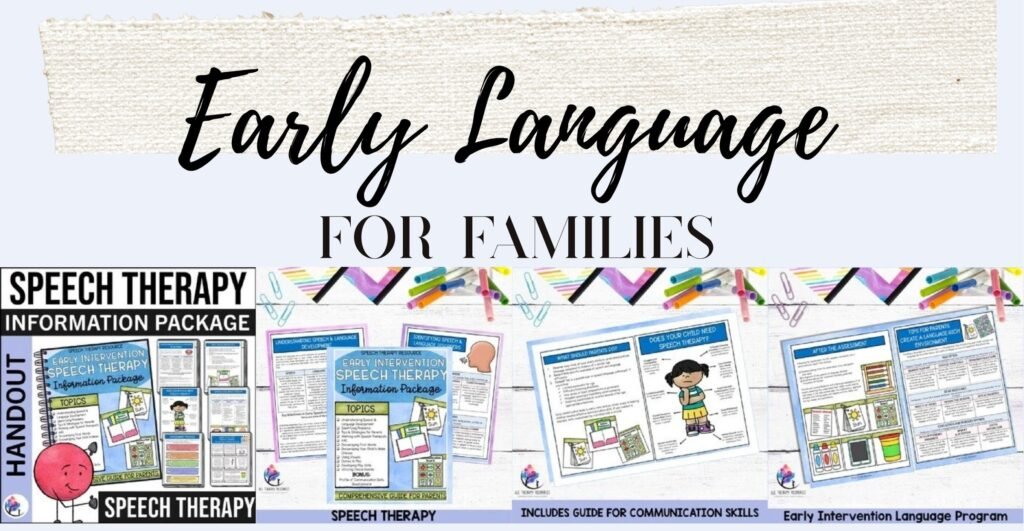
Try this with families: The Early Intervention Language Program is a parent-friendly information package on speech and language development, assessment, working with an SLP, AAC and everyday home strategies, written for families of children from infancy through preschool. Go through one section with a family after an evaluation, then send it home to revisit at their own pace. As one reviewer put it, these are “Great resources to send to families, lots of ideas for EI at home and easy to follow!”
Frequently Asked Questions
What age should my child start speech therapy?
There is no single starting age. Speech therapy can help toddlers, school-age children and teens. If you are concerned, ask for an evaluation rather than waiting: the SLP can tell you whether therapy is needed now, whether to monitor, or whether home activities are enough for the moment.
How long does speech therapy last?
It depends on the child, the type of difficulty and the goals. Some children work on one or two sounds for a short period, while others benefit from longer-term support for language or communication. Your SLP will review progress and goals with you regularly.
Will my child outgrow speech difficulties on their own?
Some differences resolve with time, and many young children who stutter show improvement without therapy. Others persist without support, and it is hard to tell which is which without an evaluation. An SLP can help you decide whether to monitor or start therapy.
What happens in a speech therapy session?
Sessions are tailored to each child’s goals. For young children they are usually play-based, using games, picture cards and books, and many SLPs share ideas for practicing at home.
Looking for practical, ready-to-use resources to support your speech and language sessions with children and families? The All Therapy Resources Membership provides access to a growing collection of thoughtfully developed speech and language activities, interactive games, and therapeutic tools designed to save preparation time while supporting meaningful, skill-focused learning.