What helps children grow into kind, resilient people? There is no single formula, but gratitude is one skill worth teaching on purpose. Gratitude lessons for kids help children notice the good in their day, recognize the people who support them, and find words to express appreciation. For school counselors, these lessons fit naturally into classroom SEL, small groups and individual sessions.
This guide covers why gratitude matters, practical lesson ideas you can use this week, and simple ways to involve teachers and families so the skill carries beyond your counseling room.
Why Gratitude Matters for Kids
Gratitude is more than saying “thank you.” Researchers at UNC-Chapel Hill describe it in four parts: notice, think, feel and do. A child notices something good, thinks about who made it possible and why, feels the emotion that comes with it, and then does something to show appreciation. Seen this way, gratitude is a set of skills children can practice, not a personality trait.
Research with children and early adolescents is encouraging, though still developing:
- Well-being: In a classroom study, middle school students who listed things they were grateful for each day for two weeks reported more optimism, greater life satisfaction, fewer negative feelings and greater satisfaction with school than comparison groups (Froh and colleagues, summarized by the Greater Good Science Center).
- Relationships: In an elementary curriculum for 8- to 11-year-olds, children taught to think about the kindness behind a benefit became more grateful and wrote more thank-you notes than a comparison group (Froh et al., 2014).
It is worth holding these findings lightly. A review of gratitude research with young people noted that measures and study designs vary and that school-based results have been mixed. Gratitude lessons are a supportive practice within a broader SEL program, not a stand-alone fix. For more on the evidence across age groups, see our article on teaching gratitude in schools and therapy.
Practical Gratitude Lessons for Kids
Each idea below can be adapted for a whole class, a small group or one student. You will find more ready-made options among our gratitude resources.
Stories and Gratitude Journals
Age-appropriate picture books give children a safe distance to talk about appreciation. After reading, ask: “Who helped the main character? What did they give that you can’t hold in your hand?” This moves the conversation toward people, time and kindness rather than things.
Journals build the habit. Invite children to record one to three things they are grateful for each day or week; younger students can draw. Keep it low-pressure. Picture a student who writes “my dog” every day. That is fine, and you might gently stretch it: “What did your dog do today that you liked?”
Gratitude Arts and Crafts
Crafts make gratitude visible. Thank-you cards, gratitude trees and bouquets where each petal names a person or moment all work well, and they give quieter students a way to take part without speaking first. Close with: “Choose one petal you would like to tell the group about, or pass.”
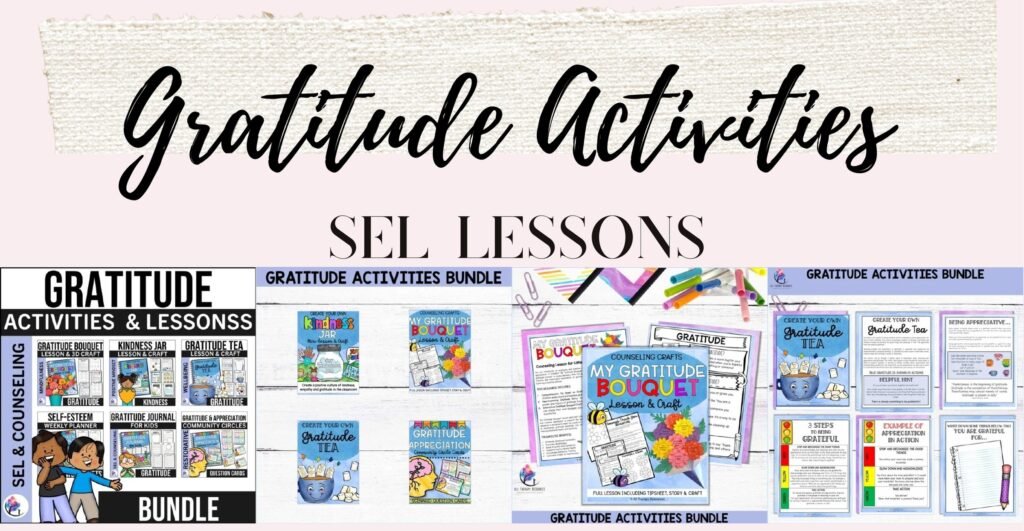
Try this in your next session: our Gratitude Activities Bundle brings several gratitude lessons together, including a Gratitude 3D Bouquet craft with a tip sheet and story, a gratitude brochure for kids with reflective questions, and a Kindness Jar lesson. Read the story, then have each child build a bouquet where every flower names someone who helped them and how. Having a sequence of related activities lets students revisit gratitude over several weeks instead of meeting it once.
Mindful Noticing
Gratitude and mindfulness share a core skill: paying attention to the present moment. Try a two-minute “noticing walk” where students look for one thing that makes their day easier, such as a shady bench or a friend who saved them a seat. Or end a breathing exercise with, “As you breathe out, think of one good thing from today.” Our post on integrating mindfulness into school curriculums has more ideas.
Try this in your classroom: our Mindfulness Coloring Sheets, Activities, Relaxation and Breathing Exercises Bundle includes social narratives, calming strategy cards, finger tracing calming cards and posters for classrooms, groups and individual sessions. Pair a finger tracing card with a gratitude prompt: students trace slowly, then name one person or moment they appreciate. Calm first, then reflection, gives children space to notice more.

Supporting Teachers and Parents
Gratitude grows best when children hear the same language at school and at home, and school counselors are well placed to connect the two.
Bringing Gratitude Into the Classroom
Work with teachers on short, regular routines rather than one-off lessons: a weekly gratitude circle, a two-minute Friday reflection, or an appreciation board where students note specific helpful actions (“Thank you for explaining the math problem to me”). If you use a shared board, check notes before posting and make sure every child is included. Our post on kindness lessons that change student behavior offers more ideas for a caring class culture.
Try this in your classroom: for a structured gratitude circle, our Gratitude and Appreciation Community Circle Questions include 49 everyday scenario cards and 48 reflection questions. Draw one scenario, let students respond in turn, then close with a reflection question. Scenarios give students something concrete to discuss, which is easier than sharing personal feelings on the spot.

Partnering With Parents and Modeling Gratitude
A short parent workshop, newsletter tip or take-home sheet can introduce the notice, think, feel, do steps for use at dinner or bedtime. Encourage parents to ask, “Who helped you today?” rather than reminding children to be grateful; asking invites reflection, while reminders can feel like correction. Adults at school can model it too, with specific thanks: “Thank you for holding the door, that helped me carry these books.”
Keeping Gratitude Lessons Sensitive
Gratitude should never be used to dismiss a child’s difficult feelings. Avoid “You should be grateful for what you have,” especially with students facing hardship, loss or stress at home. Children can feel sad or angry and still notice something good. Focus prompts on people, moments and small kindnesses rather than possessions, and always allow students to pass.
Frequently Asked Questions
What age can children start gratitude lessons?
Preschool and early elementary children can begin with simple noticing and saying thank you, supported by pictures and modeling. Older elementary students can explore why someone helped them and choose ways to show appreciation. Match activities to each child’s developmental level.
How often should gratitude lessons be taught?
Short, regular practice usually fits school routines better than occasional long lessons. A weekly circle or brief journal entry is a realistic start. In one elementary study, a weekly version of a gratitude curriculum was linked with greater gratitude up to five months later (Froh et al., 2014).
What if a child is resistant to gratitude activities?
Resistance is normal, especially when life feels unfair. Offer choices, start with neutral prompts (a favorite snack, a sunny recess), allow passing, and avoid pressuring children to feel a certain way.
Looking for practical, ready-to-use resources to support your gratitude lessons for kids? The All Therapy Resources Membership provides access to a growing collection of thoughtfully developed counseling activities, interactive games, and therapeutic tools designed to save preparation time while supporting meaningful, skill-focused learning.