Picture a student who walks into class, sees two classmates laughing, and decides, “They’re laughing at me.” Within seconds her face is hot, her stomach drops, and she puts her head down for the rest of the lesson. Nothing in the room changed. What changed was the story she told herself, and that story shaped both how she felt and what she did next.
The CBT triangle (also called the cognitive triangle) gives students a simple map of that moment: thoughts, feelings, and behaviors are connected, and a change in one can shift the others. This guide explains the CBT triangle for school counselors, therapists, and educators, with four teaching strategies and key considerations for different ages.
What Is the CBT Triangle?
Cognitive behavioral therapy (CBT) is built on the idea that how we interpret a situation influences how we feel and how we respond. The American Psychological Association describes CBT as resting on a few core principles: psychological problems are based, in part, on unhelpful ways of thinking and on learned patterns of unhelpful behavior, and people can learn better ways of coping with them. The CBT triangle turns those principles into a picture students can remember. One helpful way to describe it: the triangle works like a hanging mobile, so when you move one piece, the other two move with it.
A quick note on terms: the CBT triangle is not the same as Beck’s “cognitive triad,” which describes negative views of the self, the world, and the future often seen in depression. Using “CBT triangle” or “thoughts, feelings, and behaviors” with students avoids confusion.
Thoughts
Thoughts are the words and pictures that pop into our minds, often automatically. They shape how we interpret what is happening. A thought such as “I always mess up” can fuel self-doubt and anxiety, while “This is hard, but I can ask for help” leaves room for confidence and problem-solving.
Feelings
Feelings are our emotional and physical responses: worry, excitement, frustration, sadness, a racing heart, or tight shoulders. Students need to hear that all feelings are valid and worth noticing. The goal is to understand uncomfortable emotions, not get rid of them.
Behaviors
Behaviors are what we do, or avoid doing, in response to our thoughts and feelings. Seeking help, taking a break, or trying again can support well-being and learning. Avoidance or withdrawal may bring short-term relief but often keeps the worry going.
| Situation | Thought | Feeling | Behavior |
|---|---|---|---|
| Classmates laugh as a student walks in | “They’re laughing at me.” | Embarrassed, anxious | Puts head down, avoids the group |
| Same situation | “Maybe someone told a joke.” | Curious, a little unsure | Sits down, joins in later |
| Low score on a math quiz | “I’m bad at math.” | Discouraged | Stops trying on homework |
| Same situation | “I haven’t learned this part yet.” | Frustrated but hopeful | Asks the teacher for help |
Want more ways to practice? Explore our Cognitive Distortions CBT Negative Self-Talk activities, the CBT Brochure: Thoughts, Feelings & Actions, or the full range of CBT-based resources.
Practical Strategies for Teaching the CBT Triangle
CBT is one of the most researched approaches for young people. A 2020 Cochrane review of CBT for anxiety disorders in children and adolescents found it was associated with higher remission rates than waitlist or no treatment, although the certainty of the evidence was low to moderate. Teaching the triangle in a classroom or small group is psychoeducation rather than therapy, but the same building blocks apply. The strategies below are professional recommendations you can adapt to your setting.
1. Notice and Name Before You Change
Students cannot work with a thought they have not noticed. Brief awareness practices (a slow breath, then “What is my mind saying right now?”) help students observe thoughts and feelings without judging them. Keep expectations realistic: the large MYRIAD trial found universal school-based mindfulness training was no more effective than usual teaching for adolescent mental health, so treat noticing as one skill, not a stand-alone program.
Sample script: “Let’s press pause. What happened? What did your mind say about it? Where do you feel it in your body?”
2. Cognitive Restructuring: Catch, Check, Change
Cognitive restructuring teaches students to question a thought and find a more balanced one. A simple three-step routine works well with most ages:
- Catch it: “What is the thought?”
- Check it: “What is the evidence? Is there another way to see this? What would I tell a friend?”
- Change it: “What is a more helpful and realistic thought?”
Aim for balanced thoughts, not forced positivity. “Everyone will love my presentation” is no more accurate than “I’ll embarrass myself.” A balanced thought might be, “I’m nervous, and I’ve practiced. I can get through it.” Watch for common thinking traps such as catastrophizing (expecting the worst), all-or-nothing thinking, and personalization (blaming yourself for things outside your control).
Try this in your next session: sorting is a concrete first step before students rewrite their own thoughts. Helpful vs Unhelpful Thoughts: Automatic Negative Thoughts and Framing Your Thoughts includes a tip sheet, kid-friendly thought cards such as “I can try my best” and “Nobody likes me,” and two sorting mats. Ask students to sort the cards, then choose one unhelpful card and rewrite it as a helpful thought together. It suits younger students and visual learners in individual, small group, or classroom settings. One counselor shared, “I have used this resource in both individual and small counseling groups with great success.”

3. Emotion Regulation: Calm the Body So the Mind Can Think
When feelings run high, it is hard to examine a thought. Help students identify triggers and early warning signs, and practice calming strategies while they are calm so the skills are ready when needed. Movement, slow breathing, drawing, music, and talking to a trusted adult are all good options. For more ideas, see our guide to coping skills activities for students.
4. Behavioral Activation: Change What You Do
The behavior corner of the triangle is often the easiest place to start, especially with younger students. Behavioral activation means planning and doing small, meaningful activities, particularly when a student feels low or wants to withdraw. Doing something first often shifts feelings and thoughts afterward. Help students choose one small, specific step linked to what matters to them (for example, “Sit with one friend at lunch on Tuesday”), then check in on how it went and what they noticed. Celebrate effort and treat setbacks as information, not failure.
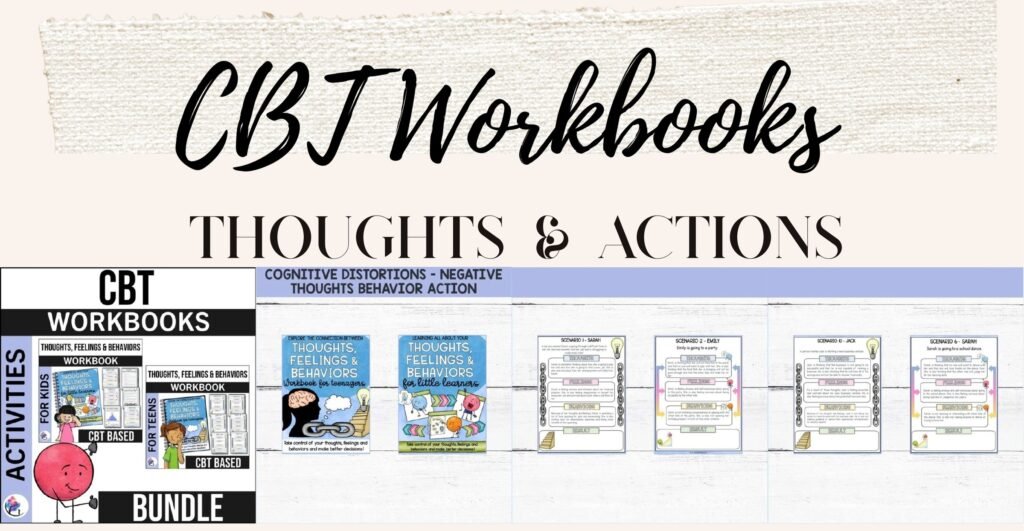
Try this in your next session: structured worksheets help students connect all three corners. The CBT Workbooks Bundle: Cognitive Distortions, Negative Thoughts, Behavior and Action brings together workbooks on cognitive distortions, reframing negative self-talk, and how thoughts affect feelings and behaviors, with reflection questions and scenarios. Use a behavior and action page to plan one small step, then review it the following week. It works for individual counseling, small groups, classrooms, or home practice.
Key Things to Keep in Mind When Teaching the CBT Triangle
- Developmental considerations: younger children often do best starting with feelings and behaviors, using pictures and concrete examples. Older students can handle thinking traps, evidence-checking, and more abstract reflection.
- Normalize all emotions: create a safe space where every feeling is welcome. The aim is a more helpful response, not a “happy” feeling.
- Use interactive activities: role-plays, scenario cards, and group discussion help students see how thoughts, feelings, and behaviors connect in real situations.
- Invite self-discovery: guide students to explore their own patterns rather than telling them what they “should” think.
- Be patient: learning the triangle is gradual. Notice progress and expect setbacks along the way.
- Connect it to daily life: practice with academic challenges, friendships, and family situations so the skill carries over beyond your office.
- Collaborate and refer when needed: share the same language with teachers and families. Teaching the triangle is not a substitute for therapy; students with persistent anxiety, low mood, or safety concerns need a referral for further support. Trauma-informed practice also means not challenging thoughts that reflect a student’s real experience of danger or unfairness.
Try this in your next session: perspective-taking makes the triangle visible in a way students can play with. The Perspective Taking Glasses Lesson: CBT Thoughts, Feelings & Behaviors Scenarios uses seven “lenses,” such as optimistic, pessimistic, and problem-solving glasses, with 20 scenario cards and a worksheet for each lens. Give a small group one scenario and have each student “try on” a different pair of glasses, recording the thought, feeling, and likely behavior. It is designed for classrooms, counseling sessions, and SEL programs.

Frequently Asked Questions
What is the CBT triangle?
The CBT triangle (or cognitive triangle) is a simple model from cognitive behavioral therapy showing that thoughts, feelings, and behaviors influence one another. Changing one corner, such as a thought or an action, can shift the other two.
At what age can students learn the CBT triangle?
Elementary students can start with concrete activities linking feelings and behaviors, using pictures and simple language. Middle and high school students can explore thinking traps and practice reframing thoughts in more depth.
Is teaching the CBT triangle the same as providing CBT?
No. Teaching the triangle in classrooms or groups is psychoeducation and skill-building. CBT as a treatment is delivered by trained mental health professionals. Students with ongoing or significant difficulties should be referred for further assessment and support.
Looking for practical, ready-to-use resources to support your CBT triangle lessons? The All Therapy Resources Membership provides access to a growing collection of thoughtfully developed counseling activities, interactive games, and therapeutic tools designed to save preparation time while supporting meaningful, skill-focused learning.