
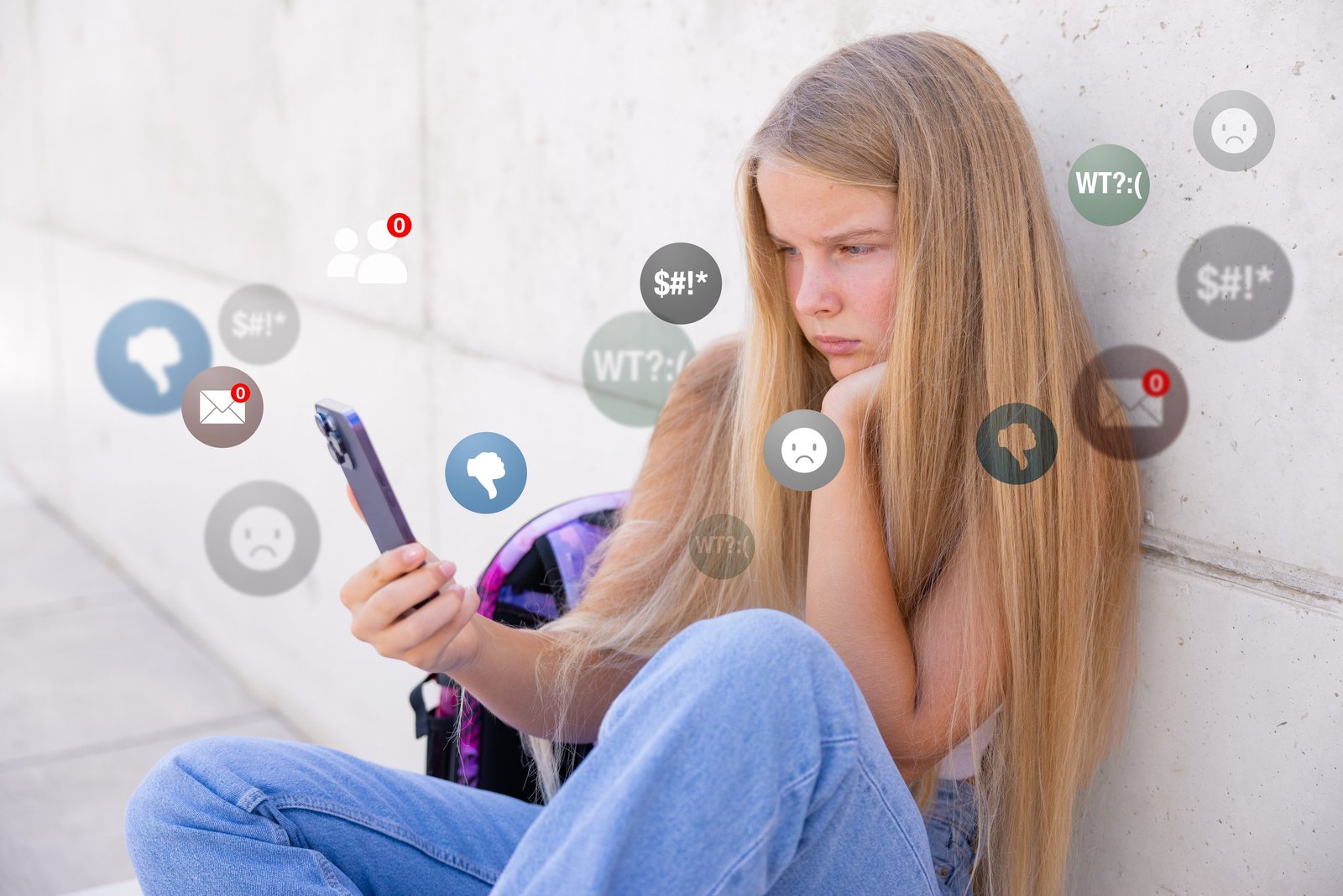
There has never been a generation with more opportunities to compare themselves to others. Not just at school. Not just on weekends. Not even just within their friendship group. Today’s children and teenagers carry thousands of carefully edited lives in their pockets.
Every swipe introduces another smiling face. Another perfect vacation. Another flawless body. Another achievement. Another friendship group. Another reminder—whether accurate or not—that someone else appears happier, more successful, more attractive, or more accepted.
The challenge isn’t simply that young people spend time on social media. It’s that social media has transformed comparison from an occasional human experience into something that can happen hundreds of times every single day.
And while comparison itself isn’t new, the scale, frequency, and intensity certainly are. As school counselors, psychologists, educators, and parents, we’re increasingly supporting young people who quietly wonder:
“Why isn’t my life like theirs?”
“Why don’t I look like that?”
“Why does everyone else seem happier?”
“What’s wrong with me?”
These questions rarely stay on a phone screen. Over time, they begin shaping identity, confidence, self-worth, and emotional wellbeing. Understanding the comparison trap isn’t just about teaching internet safety. It’s about helping young people develop healthier thinking patterns before comparison quietly becomes the lens through which they view themselves.
Why Our Brains Naturally Compare
One of the biggest misconceptions about comparison is that it’s something social media created. It didn’t. Comparison is part of being human. Long before smartphones existed, our brains were constantly scanning the world around us. Who belongs? Who’s safe? Who’s successful? Where do I fit?
Psychologists have long understood this through Social Comparison Theory, first proposed by Leon Festinger in 1954. The theory suggests that people naturally evaluate themselves by comparing themselves with others, especially when they’re trying to understand their own abilities, appearance, or social standing.
In many ways, comparison serves an important purpose. It helps us learn. It motivates improvement. It provides information about the world around us. The problem isn’t that young people compare. The problem is who they’re comparing themselves with.
Previous generations compared themselves to classmates. Neighbors. Teammates. Perhaps a few celebrities they occasionally saw on television.
Today’s adolescents compare themselves with carefully curated images of thousands of people every single week. Their brains were never designed for that level of comparison.
Adolescence Is the Perfect Storm for Comparison
If social media creates opportunities for comparison, adolescence creates the conditions where comparison becomes especially powerful. During adolescence, young people are asking one of life’s biggest questions:
Who am I?
Identity is developing. Friendships become increasingly important. Peer approval carries greater emotional weight. Belonging feels essential.
At the same time, the adolescent brain is still developing the executive functioning skills needed to pause, evaluate information critically, and challenge unhelpful thoughts. This means many young people don’t simply see social media.
They internalize it.
A perfectly edited photo doesn’t remain someone else’s picture. It quietly becomes evidence. Evidence that they aren’t attractive enough. Popular enough. Successful enough. Interesting enough.
Without realizing it, comparison shifts from something they do into something they believe.
The Highlight Reel Problem
Imagine watching the trailer for a movie. It contains the funniest moments. The most exciting scenes. The biggest victories.
Now imagine believing that trailer represented every minute of that person’s life. It sounds unrealistic. Yet that’s often exactly what social media encourages. People naturally share:
Achievements. Celebrations. Vacations. Awards. Special occasions. Perfect angles. Filtered moments.
They rarely post: Arguments. Loneliness. Failure. Self-doubt. Stress. Anxiety. Ordinary Tuesday afternoons.
Young people begin comparing their everyday reality with someone else’s carefully selected highlights. It’s an impossible comparison to win.
As Theodore Roosevelt famously observed, “Comparison is the thief of joy.” Today, social media gives that thief unlimited access.
The Comparison Trap Isn’t About Social Media—It’s About Thoughts
One reason I believe conversations about social media sometimes miss the mark is that they focus almost entirely on screen time. But screen time isn’t always the problem. Two teenagers can spend the same amount of time online and have completely different experiences.
Why?
Because it’s not simply what they see. It’s what they think about what they see.
This is where Cognitive Behavioral Therapy (CBT) offers such valuable insight. CBT teaches us that situations don’t directly create emotions. Instead, our thoughts about those situations shape how we feel and how we respond. Imagine a teenager scrolling through social media and seeing a group photo from a party they weren’t invited to.
One student thinks: “That looks fun. I hope they had a good time.” Another thinks: “Nobody likes me.” The situation is identical. The emotional experience is completely different. The difference lies in the automatic thought.
The Comparison Cycle
One of the most powerful concepts I teach students is that comparison often follows a predictable cycle. It usually begins with something completely ordinary. A photo. A post. A video. A comment. Almost instantly, the brain generates an automatic thought.
“I’m not good enough.”
“I’ll never look like that.”
“Everyone else has better friends.”
Those thoughts create emotions. Perhaps sadness. Jealousy. Loneliness. Embarrassment. Those emotions influence behavior. Students may begin withdrawing socially. Editing every photo. Seeking more likes. Deleting posts that don’t receive enough attention. Avoiding activities they once enjoyed.
The result? Lower confidence. Lower self-esteem. Greater sensitivity to comparison. Which then makes the next comparison even more powerful. The cycle repeats. Unless something interrupts it.
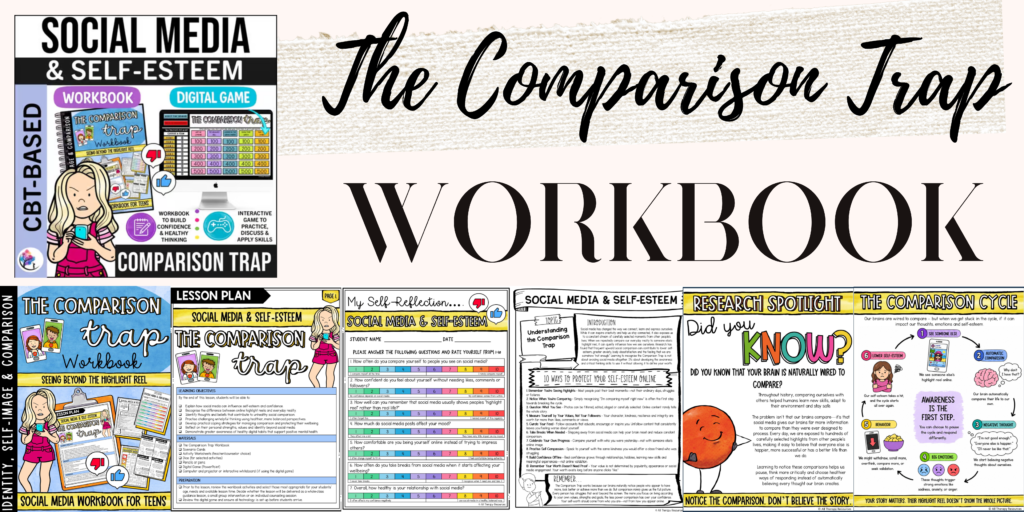
One of the strengths of The Comparison Trap workbook is that it helps students recognize this cycle visually and understand that they are not “broken” for experiencing it. Instead, they learn that comparison follows recognizable thinking patterns—and once we understand those patterns, we can begin to change them through healthier, more balanced thinking.
Not Every Thought Deserves to Be Believed
One of the most empowering ideas within CBT is surprisingly simple: Thoughts are not facts.
Our brains generate thousands of thoughts every day. Some are accurate. Some are helpful. Some are neither. Yet many young people treat every automatic thought as though it were objective truth.
“Nobody likes me.”
“Everyone else is happier.”
“I’ll never be enough.”
The goal isn’t to replace every negative thought with forced positivity. The goal is to help students become curious.
Is this thought completely true?
What evidence supports it?
What evidence challenges it?
Is there another way of looking at this situation?
Helping students develop this habit is one of the most valuable gifts we can offer them—not only for navigating social media, but for navigating life.
When Likes Become a Measure of Self-Worth
Social media platforms were designed to encourage engagement. Likes. Comments. Views. Shares. Followers.
On their own, there’s nothing inherently wrong with these features. They allow people to connect, celebrate achievements, and share experiences.
The challenge arises when these numbers begin to shape how young people see themselves. For many adolescents, likes slowly become more than feedback. They become evidence. Evidence that they’re funny enough. Pretty enough. Popular enough. Accepted enough. Or, when engagement is lower than expected…Evidence that they aren’t. The danger isn’t simply the number itself. It’s the story the brain begins telling. A photo that receives fewer likes than expected may quietly trigger thoughts such as:
“People don’t like me.”
“I’m not interesting.”
“I don’t fit in.”
Over time, confidence can become increasingly dependent on external validation rather than internal values, strengths, and identity. Helping students recognise this shift is one of the first steps toward healthier digital habits.
The Cognitive Distortions Behind the Comparison Trap
One reason comparison feels so convincing is because our brains often rely on thinking shortcuts. In Cognitive Behavioral Therapy (CBT), these are known as cognitive distortions—unhelpful thinking patterns that influence how we interpret situations. Several cognitive distortions commonly appear when young people compare themselves on social media.
Mental Filtering
Students focus on one perceived weakness while overlooking everything that is going well.
“Everyone else’s life looks amazing… mine doesn’t.”
Mind Reading
Young people assume they know what others think.
“They probably think I’m boring.”
All-or-Nothing Thinking
Life becomes viewed in extremes.
“If I’m not popular, I’m a failure.”
Fortune Telling
Students predict negative outcomes without evidence.
“Nobody will like my photo.”
Discounting the Positive
Achievements, compliments, and successes are dismissed.
“They’re just being nice.”
Teaching students to recognise these thinking patterns doesn’t eliminate comparison overnight. It gives them something incredibly valuable: Awareness. And awareness creates choice.
Helping Students Challenge Their Automatic Thoughts
One of the greatest strengths of CBT is that it teaches students they don’t have to believe every thought their brain produces. Instead of asking, “Is this thought true?” We can teach students to ask,
“Is this thought helpful?”
“Is there another explanation?”
“What evidence supports this thought?”
“What evidence challenges it?”
This shift encourages flexibility rather than rigid thinking. For example…
Instead of: “Everyone else is happier than me.”
A student might begin thinking: “I’m only seeing a small part of other people’s lives.”
Instead of: “I’ll never be good enough.”
They might ask: “Compared to who?”
“What does ‘good enough’ actually mean?”
These conversations don’t simply improve confidence. They strengthen lifelong thinking skills.
One of the reasons I developed The Comparison Trap workbook was to help students practice this exact process. Through guided reflection, automatic thought activities, and structured CBT exercises, students learn to notice, question, and reframe the thoughts that quietly influence their confidence and self-esteem. Rather than telling students to “think positively,” the activities encourage balanced, evidence-based thinking that feels authentic and achievable.
Building an Identity Beyond the Screen
Perhaps the most important question we can ask young people isn’t: “How much time do you spend on social media?” Instead, we might ask: “Who are you when no one is watching?” Confidence grows when identity becomes rooted in something deeper than appearance, popularity, or online approval. Young people benefit from opportunities to explore:
- Their values.
- Their strengths.
- Their interests.
- Their goals.
- Their relationships.
- Their character.
These qualities remain stable whether a post receives ten likes or ten thousand. Helping students discover who they are away from the screen creates resilience that no algorithm can provide. When identity is grounded internally rather than externally, comparison begins to lose its power.
Helping Students Curate Their Digital World
While we can’t eliminate social media, we can help students become more intentional about how they use it. Encourage students to ask themselves:
- Does this account inspire me or make me feel inadequate?
- Do I leave this app feeling encouraged or discouraged?
- Am I connecting—or simply comparing?
- Does this content reflect my values?
Just as we teach healthy friendships, we can also teach healthy digital environments. Sometimes the healthiest choice isn’t deleting social media. It’s changing what—and who—we choose to follow.
Start Conversations Instead of Lectures
Young people rarely respond well to lectures about phones. They do respond to curiosity. Instead of asking, “How much time are you spending online?” Try asking:
“How does social media make you feel?”
“Have you ever compared yourself to someone online?”
“What do you think people don’t see behind the photos?”
These conversations invite reflection rather than defensiveness. Often, students already know comparison affects them. They simply haven’t had the language to explain it.
Clinical Perspective
One pattern I’ve noticed over years of working with children and adolescents is that comparison rarely begins with low self-esteem. More often, it begins with uncertainty. Young people are trying to answer one of life’s biggest questions: “Who am I?”
Social media doesn’t create that question. It simply provides an endless stream of people to compare themselves against while they’re trying to answer it. That’s why our work as helping professionals is so important. We’re not simply teaching internet safety. We’re helping young people build an identity strong enough to withstand comparison.
Bringing CBT to Life Through Interactive Learning
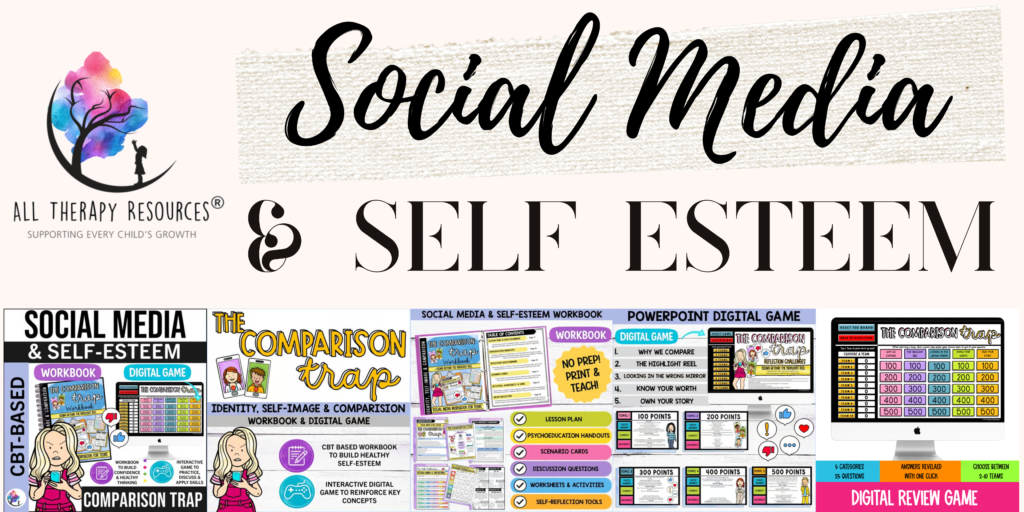
Understanding the comparison trap is one thing. Practicing new thinking habits is another. That’s why we wanted The Comparison Trap: Social Media & Self-Esteem to be more than a workbook students complete once and forget. Every activity was designed with a purpose.
Students explore why comparison happens, examine how social media influences thoughts and emotions, identify common cognitive distortions, and learn practical CBT strategies for interrupting unhealthy thinking patterns.
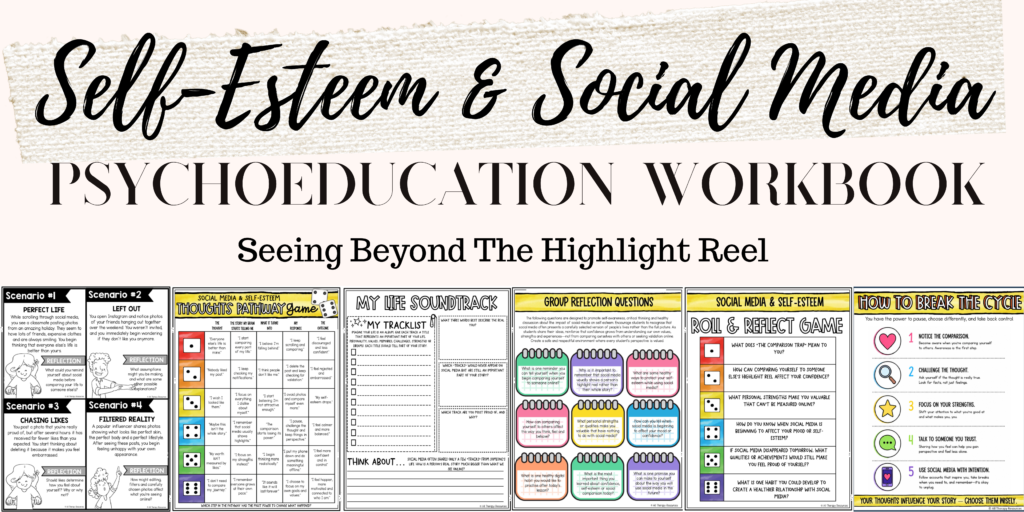
Interactive discussion scenarios encourage students to explore real-life situations they may encounter online, while reflection activities help them examine their own beliefs, values, and experiences. The digital PowerPoint game reinforces these concepts in an engaging, low-pressure way, making it ideal for classroom lessons, small groups, or individual counseling sessions.
Rather than telling students, “Don’t compare yourself,” the goal is to help them understand why comparison happens and give them practical tools to respond differently.
When students understand their own thinking, they become far better equipped to protect their confidence in an increasingly digital world. The workbook and digital game intentionally combine psychoeducation, CBT, self-reflection, scenarios, and interactive learning to help students build healthier thinking patterns and stronger self-esteem.
Final Thoughts
Comparison is part of being human. It always has been. But today’s young people are navigating comparison on a scale no previous generation has experienced. As educators, school counselors, psychologists, and parents, we cannot eliminate comparison. What we can do is help students understand it.
When we teach children to recognise automatic thoughts, challenge cognitive distortions, strengthen their identity, and anchor their self-worth in values rather than validation, we’re giving them skills that extend far beyond social media. We’re helping them build resilience. Confidence. Self-awareness. And perhaps most importantly, the freedom to stop measuring their worth against someone else’s highlight reel.
Featured Resource: The Comparison Trap – Social Media & Self-Esteem
If you’re looking for a structured, research-informed way to explore these concepts with upper elementary, middle school, or high school students, The Comparison Trap – Social Media & Self-Esteem combines a comprehensive CBT workbook with an interactive digital game designed to make these conversations engaging and meaningful.
Rather than focusing solely on internet safety, students explore the psychology of comparison, identify automatic thoughts, examine cognitive distortions, reflect on their own experiences, and practice healthier thinking through interactive activities, discussion scenarios, and practical CBT strategies.
Whether you’re working with an individual student, a small counseling group, or an entire classroom, these resources provide opportunities for students to move beyond awareness and begin developing lifelong habits that support confidence, resilience, and healthier relationships with social media.
Frequently Asked Questions
How does social media affect self-esteem?
Social media can influence self-esteem by increasing opportunities for comparison. While comparison is a normal human process, repeated exposure to carefully curated online content may contribute to negative automatic thoughts, reduced confidence, and lower self-worth for some young people.
Why do teenagers compare themselves on social media?
Adolescence is a period of identity development. During this stage, peer relationships and belonging become increasingly important. Social media provides constant opportunities to compare appearance, achievements, friendships, and lifestyle, making comparison more frequent and emotionally significant.
How can CBT help with social media comparison?
Cognitive Behavioral Therapy (CBT) helps students recognise automatic thoughts, identify cognitive distortions, evaluate evidence, and develop more balanced ways of thinking. These skills can reduce the emotional impact of unhealthy comparison and strengthen self-esteem.
How can school counselors teach healthy social media habits?
School counselors can help students understand how comparison works, explore the difference between online highlight reels and real life, teach CBT strategies, encourage values-based identity development, and create opportunities for reflection through classroom lessons, small groups, and interactive activities.
What age is The Comparison Trap resource designed for?
The Comparison Trap – Social Media & Self-Esteem is designed primarily for upper elementary, middle school, and high school students, making it suitable for classroom guidance lessons, small group counseling, and individual interventions focused on confidence, digital wellbeing, and healthy thinking patterns.
Want Even More Research-Informed Counseling Resources?
If you’re a school counselor, psychologist, social worker, behavior specialist, or educator looking to save planning time while delivering engaging, evidence-informed lessons, the All Therapy Resources® Membership gives you instant access to an ever-growing library of counseling resources.
Inside you’ll find:
- CBT workbooks
- Interactive digital counseling games
- DBT and ACT resources
- Emotional regulation lessons
- Anxiety and resilience programs
- Self-esteem activities
- Social-emotional learning curricula
- Small group counseling resources
- New resources added regularly throughout the year