
Do your students know what to do when they feel anxious during a test, but still struggle to use it in the moment?
This is one of the most common gaps in test anxiety support. Students are often taught coping strategies in isolation, as a list to remember. Then the pressure hits, their mind goes blank, their body takes over, and those strategies feel out of reach.
Effective test anxiety coping strategies are not only about what to do. They are about helping students know when and how to use each one. This article walks through a structured, clinically informed approach to supporting students before, during and after a test, with sample scripts you can use in classrooms, small groups and individual sessions. If you would like the bigger picture first, including how to assess test anxiety, start with our guide to understanding test anxiety in students.
What Happens in the Brain During Test Anxiety
Before we look at strategies, it helps to understand what is happening for students. When a student perceives a test as threatening, the body’s stress response switches on. Research summarized by the Arnsten Lab at Yale describes how even mild, uncontrollable stress can quickly weaken the functioning of the prefrontal cortex (the “thinking brain” that supports planning, focus and working memory), while more reflexive emotional responses linked to the amygdala are strengthened.
Test anxiety research points in the same direction. Attentional control theory (Eysenck and colleagues, 2007) proposes that anxiety makes it harder to control attention, so worried thoughts and threat cues compete with the task in front of the student.
This is why students so often say:
- “My mind went blank.”
- “I knew it, but I couldn’t remember it.”
From a clinical perspective, this is not a lack of ability or effort. It is a stress response. So our role is not to eliminate anxiety completely, but to help students:
- Regulate their body and nervous system
- Keep access to their thinking brain
- Feel a sense of control over what happens next
Why Timing Matters: Teaching Test Anxiety Coping Strategies as a Timeline
One of the most useful shifts you can make in your practice is to stop teaching strategies as one long list and start teaching them as a timeline. Anxiety unfolds in stages, and the strategy that helps the night before a test is rarely the one a student needs when they freeze on question 6.
Sorting strategies by stage gives students a clear, usable framework: what helps before the test, what helps during it, what to do when they feel stuck, and what helps afterward.
| Stage | What it can look like | Strategies to practice | Suggested ATR resource |
|---|---|---|---|
| Before the test | Trouble sleeping, stomach aches, avoidance, “What if I fail?” | Sleep, breakfast, short review sessions, writing worries down, encouraging self-talk | Test Anxiety Activities & Tips |
| During the test | Racing heart, rushing, rereading the same question | Slow breathing, starting with easier questions, pacing, focusing on their own work | Test Anxiety Digital Game |
| When stuck | Freezing, “I can’t do this,” wanting to give up | Pause and breathe, skip and return, break the question into steps | My Worry Tree Worksheets |
| After the test | Replaying mistakes, catastrophizing, carrying worry into the next test | A calming break, talking to a trusted adult, reflecting on what helped | Test Anxiety Sorting Activity |
Before the Test: Preparing the Brain and Body
What students do before a test affects how well they can think during it. Preparation is not only academic. It is physical and emotional too. Strategies that support regulation and readiness include:
- Getting enough sleep
- Eating beforehand
- Reviewing content in short, spaced sessions rather than cramming
- Using encouraging self-talk (“I can try my best”)
- Taking a few quiet moments to settle before starting
Writing worries down can also help. In a study published in Science, Ramirez and Beilock (2011) found that ninth-grade students with high test anxiety who spent 10 minutes writing about their worries before a final exam performed about as well as their less anxious classmates, while highly anxious students who did not write scored lower. It is one study, so treat it as a promising strategy rather than a sure fix, but it is simple, free and easy to try.
When students feel prepared, the test can feel less threatening. The goal is to help students shift from “I hope I don’t fail” to “I know what to do.”
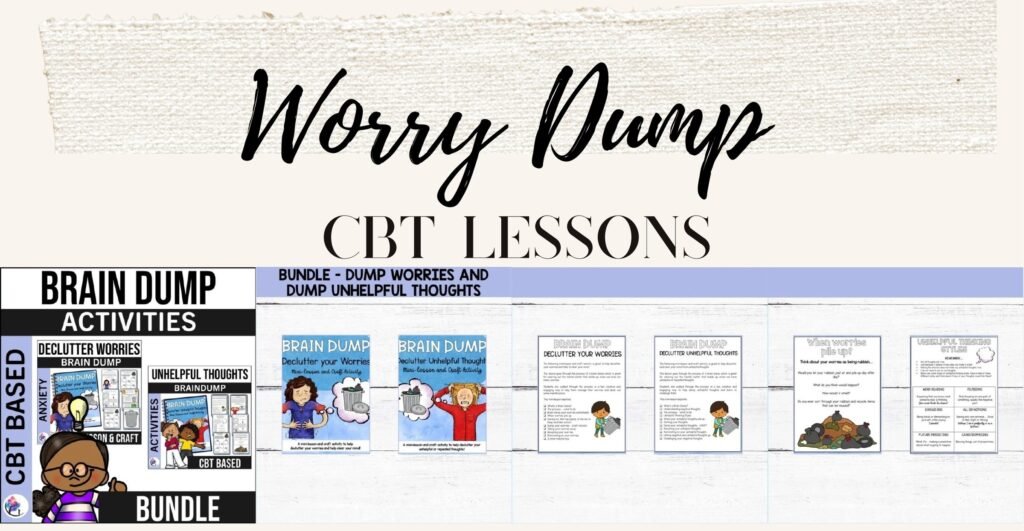
Try this in your next session: a few minutes before a practice test, invite students to “empty their worry backpack” onto paper. Say, “Write down anything your brain is worried about. You don’t have to share it. When you’re done, fold it up and put it aside. Your worries can wait here while you work.” If you would like a structured version, our Dump Worries and Dump Unhelpful Thoughts Bundle pairs our worries “Dump” lesson with our unhelpful thoughts “Dump” lesson, two creative, CBT-informed activities that help students get their worries out of their heads and then notice the unhelpful thoughts that can feed test stress. It works well as a pre-test small group session or a whole-class lesson before testing season.
During the Test: Regulating in the Moment
This is where students often need the most support. In the moment, strategies need to be simple, easy to reach and already practiced. A strategy a student has only heard about once is unlikely to be there when their heart is pounding.
Helpful strategies during a test include:
- Taking slow breaths, with a longer breath out
- Starting with easier questions to build momentum
- Skipping tricky questions and returning later
- Slowing down rather than rushing
- Breaking the test into smaller parts
- Using encouraging self-talk (“I can do this step by step”)
- Focusing on their own work, not how fast others are finishing
These strategies are useful because they reduce overload, give the student something concrete to do, and restore a sense of control. Slow breathing is a widely used regulation strategy in counseling and classrooms, and it is most helpful when students have rehearsed it many times when calm.
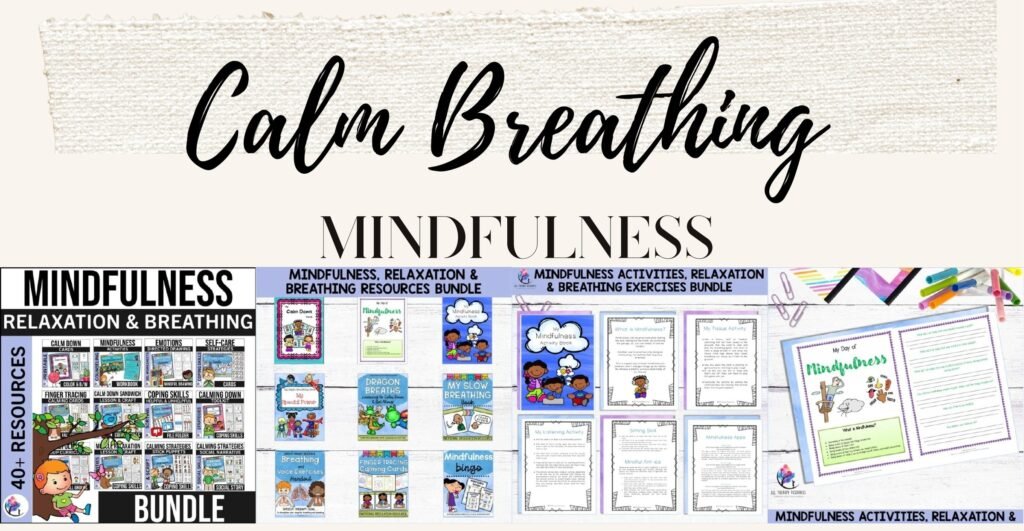
Try this in your classroom: practice a “test-ready breath” for one minute at the start of class for a week before testing. Picture a student who notices their hands shaking on the first page. Because they have practiced, they can put their pencil down, breathe in for four, breathe out slowly for six, and start again. For ready-made practice, our Mindfulness Coloring Sheets, Relaxation & Breathing Exercises Bundle includes calming strategy cards, finger tracing calming cards, social narratives, posters and coloring sheets you can rotate through as short daily routines, so calming skills are familiar long before students sit down to a test. The helpful vs. unhelpful calming skills file folder activity is a nice follow-up for students who need to practice choosing a strategy.
When Students Feel Stuck: The Critical Moment
There is often a moment in a test when anxiety peaks. Students might think:
- “I don’t understand this.”
- “I’m going to fail.”
- “I want to give up.”
This is the moment that can decide whether a student shuts down or keeps going, so it deserves its own plan. Strategies include:
- Pausing and taking a breath
- Reminding themselves they do not need to know every answer
- Moving on and coming back later
- Breaking the question into smaller steps
A short, rehearsed script makes this easier to reach. You might teach students to say to themselves: “Stuck is okay. Breathe. Skip it. I’ll come back.” In a session, have students practice it out loud with a deliberately tricky question, so the script becomes familiar before it is needed.
After the Test: Where Growth Happens
This is the stage that is most often overlooked. After a test, students need support to reflect, regulate and reframe. Helpful strategies include:
- Checking their work (if time allows)
- Taking a break and doing something calming or enjoyable
- Talking to someone they trust
- Reflecting on which strategies helped
- Letting go of worry about the result once the test is done
Post-test reflection gives students a chance to process the experience and notice what worked, so they can plan for next time. Without it, students can carry the same worries into the next test.
Try a two-minute reflection after any test: “What was one thing that helped? What was hard? What will I try next time?” Keep the focus on strategies, not scores.
Turning Strategies Into a Personal Coping Plan
Sorting activities are more than a cut-and-paste task. When students sort strategies by stage, they are organizing what they know into a plan they can use. This helps them:
- Categorize strategies in a meaningful way
- Connect strategies to real situations
- Build a personalized coping toolkit
This approach draws on cognitive behavioral principles (noticing thoughts, choosing helpful responses) and on executive functioning skills such as planning and sequencing. Structured, CBT-based support for test anxiety has research behind it: in a randomized controlled trial with highly test-anxious secondary students, Putwain and von der Embse (2020) found that a six-session cognitive behavioral small group program led to a large reduction in test anxiety. Sorting activities are not a substitute for a full program like that, but they fit well within one.
The aim is for students to move from “I know some strategies” to “I know when and how to use them.”
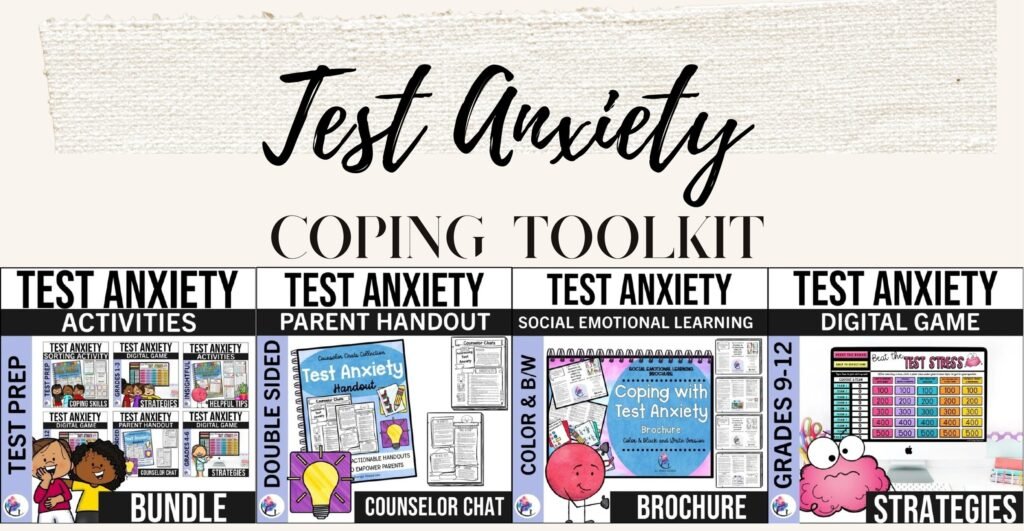
From our counseling room to yours: if you would like everything for a test anxiety unit in one place, our Test Anxiety Bundle brings together the Test Anxiety Sorting Activity, questionnaires and tips, a student brochure, a Coffee with the Counselor parent handout, and three digital games for Grades 1–3, 4–8 and 8–12. One way to use it: open with the brochure, run the sorting activity in a small group so each student builds their own before, during and after plan, use the game for review, and send the handout home so families use the same language. (The digital games need the desktop version of Microsoft PowerPoint.)
A Trauma-Informed Perspective on Test Anxiety
Test anxiety is often about far more than academics. For many students, tests can activate fears around failure, embarrassment, judgment, disappointing others, losing control or not feeling “good enough.” What looks like avoidance, shutdown, perfectionism, emotional outbursts or disengagement may be a nervous system responding to stress and perceived threat.
That is why trauma-informed support for test anxiety focuses on emotional safety, regulation, reassurance and connection, not only performance. A trauma-informed approach helps students:
- Normalize feelings of anxiety and stress
- Reduce shame around struggling
- Experience predictability and emotional safety
- Strengthen coping and regulation skills
- Separate self-worth from academic performance
- Feel supported rather than judged during difficult moments
Sometimes students do not need more pressure. They need calm support, co-regulation, encouragement and reminders that mistakes are part of learning, that one test does not define them, and that they are more than a score.
If a student’s anxiety is intense, persistent or spreading beyond tests (for example, school refusal, panic symptoms or ongoing sleep problems), it may be time to involve the school counselor, family and, where appropriate, a mental health professional. Our article on how school counselors help with student anxiety covers that wider support.
Practical Ways to Use This in Your Setting
You can teach test anxiety coping strategies in:
- Whole-class test preparation lessons
- Small group counseling sessions
- Individual support
- Targeted intervention for students with high test anxiety
Use a sorting activity to introduce strategies, revisit it before each major test to reinforce them, and finish with each student’s personal coping plan on an index card they can keep in a pencil case. For more ideas that build regulation skills all year, see our guide to coping skills activities for students.
Helping Students Stay in the Game
Test anxiety does not have to remove students from learning. When students understand what is happening in their brain and body, have practiced coping strategies for each stage of a test, and feel safe enough to keep trying during difficult moments, they are better placed to stay engaged.
The goal is not to eliminate all anxiety. It is to help students feel supported enough to move through it. Sometimes confidence does not sound like “I’m not nervous.” Sometimes it sounds like “I feel nervous, but I know what to do.”
Frequently Asked Questions
What are the best test anxiety coping strategies for students?
Strategies that are simple, practical and practiced ahead of time tend to be the easiest for students to use under pressure. Slow breathing, encouraging self-talk, writing worries down, starting with easier questions, skipping and returning, and breaking tasks into smaller steps are common examples. The most useful strategy is one the student has rehearsed and chosen for themselves.
Why teach coping strategies before, during and after a test?
Test anxiety can show up at different stages. Some students struggle most beforehand, others freeze during the test, and others feel overwhelmed afterward. Teaching strategies for each stage gives students a predictable plan and helps them match the right tool to the moment.
Can these strategies be adapted for different ages?
Yes. Younger students do well with simple visuals, one or two strategies and lots of practice. Older students can work with more detail, such as identifying unhelpful thoughts and building a written coping plan. Keep the supports age-appropriate, emotionally safe and easy to access in the moment.
When should test anxiety be referred for further support?
Consider involving the school counselor, family and, where appropriate, a mental health professional if anxiety is severe, lasts over time, or affects school attendance, sleep or daily functioning beyond testing situations.
References
- Arnsten Lab, Yale School of Medicine: Uncontrollable stress and the prefrontal cortex
- Eysenck, M. W., Derakshan, N., Santos, R., & Calvo, M. G. (2007). Anxiety and cognitive performance: Attentional control theory. Emotion, 7(2), 336–353.
- Ramirez, G., & Beilock, S. L. (2011). Study published in Science, January 14, 2011: Writing about worries eases anxiety and improves test performance (ScienceDaily summary).
- Putwain, D. W., & von der Embse, N. (2020). Cognitive-behavioral intervention for test anxiety in adolescent students: Do benefits extend to school-related wellbeing and clinical anxiety? Anxiety, Stress and Coping, 34(1), 22–36.
Looking for practical, ready-to-use resources to support your test anxiety lessons and groups? The All Therapy Resources Membership provides access to a growing collection of thoughtfully developed counseling activities, interactive games, and therapeutic tools designed to save preparation time while supporting meaningful, skill-focused learning.