What if we stopped viewing teen anger as a problem to be fixed and started seeing it as a signal to be understood? Many teenagers feel overwhelmed, out of control, or emotionally “on edge.” They might act out in class, shut down in conversation, or seem to explode over something small. Beneath those outbursts there are often unmet needs, unspoken fears, and feelings they do not yet have words for.
Emotional regulation for teens is not about teaching students to swallow their anger. It is about helping them notice what is happening inside, name it, and choose a response that matches their values. This guide is for school counselors, therapists, and educators working with middle and high school students. It covers why big emotions feel so intense in adolescence, five skills that help teens manage anger and self-control, and sample scripts you can use in your next session.
Why Big Emotions Feel So Big in Adolescence
Teenagers are still building the brain-based capacity for regulation and reflection. According to the National Institute of Mental Health, the prefrontal cortex (the area behind the forehead involved in planning and impulse control) is one of the last parts of the brain to mature, and the brain continues developing into the mid-to-late 20s. NIMH also notes that teens may respond to stress differently than adults. For teens who have also experienced trauma, instability, or chronic stress, staying regulated under pressure can take even more effort.
Too often, teens are met with judgment instead of understanding. They are labeled “aggressive,” “lazy,” or “disrespectful,” when they may be:
- Lacking the language to name their feelings
- Operating from a stressed or dysregulated nervous system
- Reacting with survival responses rather than bad intentions
The encouraging news is that the same NIMH guidance describes the teen brain as resilient and ready to learn and adapt. Adolescence is a window for building skills, not a phase to wait out.
Picture a ninth grader who slams a book shut when a teacher asks him to redo an assignment. Instead of “That attitude is unacceptable,” the adult might say quietly, “Looks like that hit hard. Take a minute, and then let’s figure out what you need.” The boundary still stands, but the student’s nervous system has a chance to settle before the problem-solving starts.
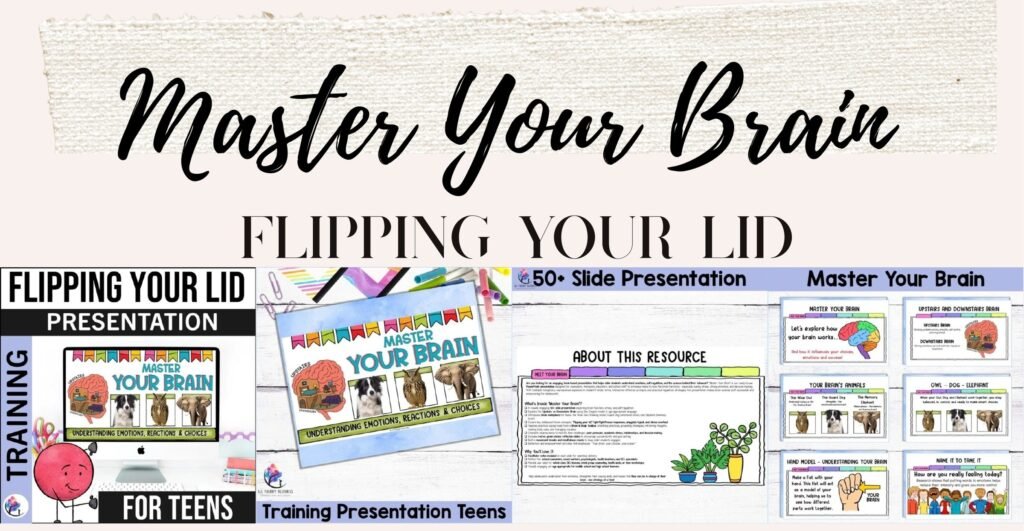
Try this in your next session: teens are more open to regulation strategies once they understand what their brain is doing under stress. Our Flipping Your Lid Training: Master Your Brain for Teens is a ready-to-use presentation that explains the upstairs and downstairs brain, “flipping your lid,” and fight-flight-freeze responses in student-friendly language, then moves into practical tools such as breathing, grounding, and reframing thoughts. It works well as an opening lesson for a middle or high school small group or an advisory class, giving everyone shared language (“I think my lid just flipped”) before you start the skill practice.
Five Skills That Help Teens Manage Anger and Big Emotions
Rather than focusing only on behavior correction, effective support helps teens understand why they react the way they do and gives them chances to practice something different. A meta-analysis of cognitive-behavioral therapy for anger in children and adolescents (Sukhodolsky, Kassinove, & Gorman, 2004) found that skills-development approaches were more effective than emotional education alone, and that outcomes were stronger with more modeling, feedback, and homework. In practice, that means teens need to see a skill, try it, and get feedback, not only talk about feelings.
| # | Skill | What it looks like | Try saying |
|---|---|---|---|
| 1 | Building insight | Noticing triggers, thoughts, and early body cues | “What was the first sign that you were getting angry?” |
| 2 | Naming feelings | Finding the feelings underneath anger | “If anger is on top, what might be underneath it?” |
| 3 | Regulating in the moment | Using a practiced pause, breath, or break | “Which calming tool do you want to try first?” |
| 4 | Reflecting and repairing | Taking responsibility without shame | “What would you want to do differently next time?” |
| 5 | Staying connected | Knowing who to go to and what is in their control | “Who could you check in with when this happens at school?” |
Want more ready-made practice? Our Teen Anger Management Worksheets, Coping Strategies Scenario Cards for Teens, and High School Mindfulness Small Group Curriculum cover many of these skills.
1. Build Insight, Not Only Control
Teens are more likely to use a strategy when they understand their own pattern. Help them track what happened before, during, and after an outburst: the situation, the thought that showed up (“He’s trying to make me look stupid”), what they felt in their body, and what they did. Over time, students start to recognize their early warning signs, such as a hot face, clenched jaw, or racing thoughts, while there is still time to choose a different response.
Picture a student who says, “I just snapped.” A curious follow-up such as, “Let’s rewind. What was happening five minutes before?” turns a vague event into something the student can learn from. Anger becomes information about what matters to them, rather than proof that they are a “bad kid.”
From our counseling room to yours: games lower the pressure when teens are wary of anything that feels “too clinical.” Our Volcano, Cloud & River Anger Management Game for Teens uses three symbols to explore anger: the volcano for intense feelings and triggers, the cloud for calming and letting go, and the river for channeling anger into constructive problem-solving. Use it in a small group after you have introduced early warning signs, inviting each student to share one “volcano” moment and one “river” response they could try. One reviewer shared, “My students enjoyed playing the game after learning more about anger and how to deal with it in their lives.”

2. Give Language to What They Feel
Emotional literacy is a key part of regulation. Anger is often the feeling that shows on the surface, while embarrassment, hurt, worry, or disappointment sit underneath. Tools such as a feelings wheel, behavior labeling activities, and short journal prompts help teens move from “I’m mad” to something more precise. If you use visual supports, our post on therapeutic wheels for counseling has practical ideas.
Try a quick check-in at the start of a session: “Pick the word that fits best right now, and one word that might be hiding underneath it.” Keep it optional and low-stakes. Some students will write it rather than say it aloud, and that is fine.
3. Practice Regulation Skills Before They Are Needed
Grounding exercises, breathing strategies, and short mindfulness practices are most useful when they are short, clear, and rehearsed while the student is calm. A strategy that has only been explained, not practiced, is hard to reach in the middle of a conflict. Offer choices so teens can find what fits them, and avoid anything that feels patronizing.
Help each student build a simple plan: “When I notice my warning sign, I will say, ‘I need a break,’ go to the agreed spot, and use my breathing or grounding tool for a few minutes before I come back.” Agree on the break plan with teachers in advance so the student is not penalized for using it.
Try this in your next group: if you would like a structured series for high school students (ages 14–18), our Let’s Pause Impulse Control Small Group Counseling Curriculum for High School runs across ten sessions, from Pause/Think/Act and coping strategies to perspective taking, conflict resolution, and what is in and out of your control. Each session uses hands-on activities, so practice comes before lecture. One counselor wrote, “Love that I can use each session as a stand-alone if I wanted but as a whole curriculum it is absolutely amazing.”

4. Encourage Reflection Without Shame
Teens can take responsibility without being shamed. A simple four-part apology gives them a structure: name what happened, acknowledge the impact, take responsibility, and say what you will do differently. For example: “I yelled at you in front of the class. That was embarrassing for you. That was on me. Next time I’ll ask to talk after class.”
“I-messages” offer a similar bridge for the moments before anger boils over: “I feel frustrated when plans change at the last minute, because I had already told my mom. Can we figure out another time?” Practice with fictional scenarios first, and keep the focus on growth rather than guilt. An apology does not have to be accepted right away, and no one should be pressured to accept one before they are ready.
5. Support Connection and Agency
Whether you are working one-to-one, in a small group, or alongside families, regulation grows through relationships. Invite students to map their support system: who they can go to at school, at home, and in the community when emotions run high. A “things in my control vs. out of my control” sort can also help a teen who feels powerless focus their energy on the choices they do have.
Picture a student who feels anxious and angry about a family situation they cannot change. Sorting the worries into two columns, then choosing one small action from the “in my control” side, such as talking to a trusted adult or planning their morning, can restore a sense of agency. For students where anxiety is a big part of the picture, our guide to teen anxiety coping skills offers further ideas.
Making It Work in Schools: A Trauma-Informed Approach
These skills can be taught in individual counseling, small groups, advisory periods, or SEL classes. A few principles help them land:
- Regulate before you reason. Problem-solving works best once a student is calm. Your own steady tone and pace matter, and our post on co-regulation explores this further.
- Offer choice. Let teens choose strategies, seating, and whether to share aloud. Avoid requiring personal disclosure in groups.
- Use realistic scenarios. Adolescents engage more with situations that reflect their lives, such as group chats, sports, part-time jobs, and family expectations.
- Look beyond the behavior. If anger is frequent, intense, or linked to safety concerns, consult your school’s referral and crisis procedures and involve families and appropriate mental health professionals.
Teenagers are learning skills, values, and a voice they will carry into adulthood. While their emotional world may feel overwhelming, they do not have to navigate it alone. For more strategies focused on calming anger, see our article on anger management for teenagers.
Frequently Asked Questions
What is emotional regulation for teens?
Emotional regulation is the ability to notice, understand, and manage feelings so that responses fit the situation. For teens, it includes recognizing triggers and body cues, naming emotions, using calming strategies, and repairing relationships after a conflict. It is a set of skills that can be taught and practiced, not a personality trait.
Is anger normal for teenagers?
Yes. Anger is a normal emotion, and adolescence brings many physical, emotional, and social changes. Anger becomes a concern when it is frequent, intense, leads to harm, or gets in the way of school, friendships, or family life. In those cases, a referral for further assessment and support is appropriate.
How can school counselors help teens manage anger?
Start with connection and curiosity, then teach specific skills through modeling, role-play, and feedback. Small groups, individual sessions, and classroom lessons all work. Coordinating with teachers on a consistent break plan helps students use their strategies outside the counseling office.
How can parents support a teen with big emotions at home?
Parents can stay calm, wait until everyone has cooled down before problem-solving, and use the same language the teen is learning at school, such as naming feelings or taking a break. Listening without rushing to fix the problem often helps teens feel understood.
Looking for practical, ready-to-use resources to support your teen emotional regulation and anger management work? The All Therapy Resources Membership provides access to a growing collection of thoughtfully developed counseling activities, interactive games, and therapeutic tools designed to save preparation time while supporting meaningful, skill-focused learning.