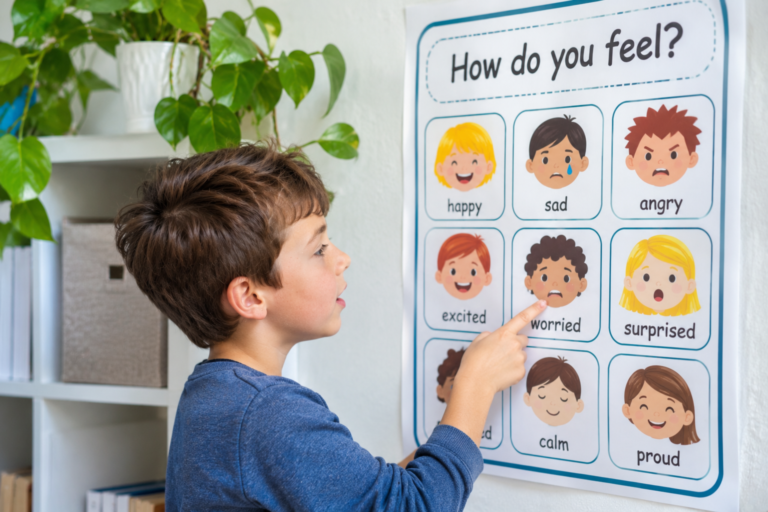
Picture a fourth grader who walks into your room and sees that the usual game has been swapped for a new one. His shoulders go up, he says “This is dumb,” and for the next ten minutes he can’t let it go. He isn’t trying to be difficult. He’s stuck. These flexible thinking activities for kids give school counselors, teachers and therapists practical, low-prep ways to help students in grades 3-6 notice stuck thinking, cope when plans change, and see more than one way forward.
What Is Flexible Thinking?
Flexible thinking (often called cognitive flexibility) is the ability to shift gears: to see a situation from another angle, try a different strategy when the first one doesn’t work, and adjust when circumstances change. In a widely cited review, developmental neuroscientist Adele Diamond describes cognitive flexibility as one of three core executive functions, alongside inhibitory control and working memory, and links it to seeing things from different perspectives and adapting to changed circumstances (Diamond, 2013).
In school, flexible thinking shows up in small moments all day long: a substitute teacher, a canceled recess, a friend who wants to play a different game, a math problem that needs a second approach. Students who find these moments hard aren’t being defiant. Many are anxious, overwhelmed or still developing the skills to shift, and some students, including many autistic students, may find unexpected changes especially difficult. That makes flexible thinking something we teach and practice, not something we demand.
Think of flexible thinking like a navigation app. When a road is closed, the app doesn’t stop working. It says “rerouting” and finds another way to the same destination. We can teach students to do the same thing: keep the goal, change the route.
Can Flexible Thinking Be Taught?
There is encouraging evidence that it can. In a randomized trial with third to fifth graders on the autism spectrum, students who received a school-based executive function curriculum focused on flexibility (Unstuck and On Target) showed greater improvements in problem-solving, flexibility and planning, and in classroom behaviors such as following rules and making transitions, than students in a social skills comparison group (Kenworthy et al., 2014).
That is one study with a specific group of students, so we shouldn’t overstate it. It does support what many of us see in practice: flexibility grows when students learn the language for it, see it modeled, and practice it in low-stakes moments before they need it in high-stakes ones. The ideas below are professional recommendations built on that principle.
Signs a Student Is Getting Stuck
Stuck thinking can look like a lot of different behaviors. You might notice a student who:
- Insists there is only one right way to do a task or play a game
- Becomes upset, argues or shuts down when a plan changes
- Repeats the same strategy even when it isn’t working
- Struggles to accept a compromise or a friend’s idea
- Finds transitions between activities or settings hard
These signs describe a skill that is still developing. They aren’t a diagnosis, and they look different from one student to the next. If rigid thinking is significantly affecting a student’s learning, friendships or wellbeing, it’s worth talking with the student’s family and school team about a broader look at what is going on.
Teach the Language: Stuck Thinking and Flexible Thinking
Students can’t use a skill they can’t name. Start by giving them two simple ideas: stuck thinking (“There’s only one way. It has to be my way.”) and flexible thinking (“There’s more than one way. I can try something else.”). Keep the language neutral. Everyone gets stuck sometimes, including adults.
Model it out loud during your own day. You might say, “I planned to use the projector, but it isn’t working. I’m feeling a bit stuck. Okay, Plan B: I’ll draw it on the board instead.”
Try this in your next session: Give students a “Plan B” phrase they can borrow. Write three on the board: “That’s okay, I can try another way,” “It’s not what I expected, but I can handle it,” and “Let’s find a different way to get there.” When a small change happens in your session, pause and ask, “Which Plan B phrase could we use right now?”
Flexible Thinking Activities for the Counseling Room and Classroom
These activities work in small groups, individual sessions and whole-class SEL lessons. Each one gives students a chance to practice shifting in a setting that feels safe and playful.
| Activity | How it works | Skill it builds |
|---|---|---|
| Change the Rule | Play a simple card or board game, then announce a silly new rule halfway through (e.g. “Now we move backward”). Talk about how it felt to adjust. | Coping with unexpected change |
| Many Ways to Get There | Give a simple goal (e.g. “Get everyone a turn at the whiteboard”) and challenge the group to find three different ways to reach it. | Seeing more than one solution |
| Stuck or Flexible Sort | Read short statements aloud (“I’m never playing again!” / “Maybe we can take turns choosing”) and have students sort them. | Noticing stuck thinking |
| What Else Could It Be? | Show an everyday object and ask students to name as many uses for it as they can, then link it to “What else could this situation mean?” | Shifting perspective |
| Plan B Planning | Before a known change (field trip, assembly, substitute), have students write or draw a Plan A and a Plan B. | Preparing for transitions |
For students who need more structured practice, discussion-based games give you a ready supply of scenarios to talk through together.
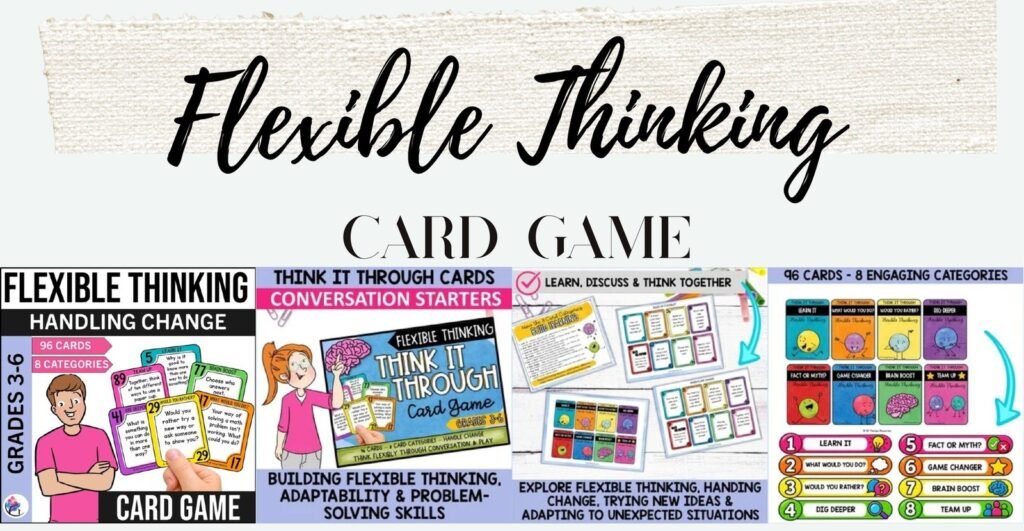
From our counseling room to yours: Our Flexible Thinking Think It Through Card Game was made for exactly these conversations. It’s designed for grades 3-6 and includes 96 discussion cards across 12 mini topics, with card types such as Learn It, What Would You Do?, Would You Rather? and Fact or Myth?. Students practice noticing stuck thinking, coping with unexpected changes and transitions, seeing more than one way to solve a problem, and compromising with friends. Try pulling three or four What Would You Do? cards as a warm-up in a small group, then ask, “What would your Plan B be?” It’s a print-and-play resource that works well in lunch bunch groups, individual sessions, whole-class SEL lessons and SEL centers.
Supporting Students When Plans Change in Real Time
Teaching flexible thinking in a calm session is one thing. Supporting a student in the moment, when the plan has just changed and their feelings are big, is another. In that moment, regulation comes before reasoning. A student who is dysregulated usually can’t access problem-solving yet.
A simple sequence can help:
- Connect first. Get down to the student’s level and keep your voice calm: “This wasn’t what you expected.”
- Name the feeling. “It looks like you’re feeling really disappointed.”
- Help them regulate. Offer a familiar strategy such as slow breathing, a movement break or a calm spot.
- Then offer the shift. “Once your body feels calmer, let’s think of a Plan B together.”
If you’d like more ideas for the regulation step, our guide to emotional regulation games for kids has practical options for sessions and classrooms.
Try this in your classroom: Warn students about changes when you can. A short heads-up (“After lunch, our schedule is going to look a little different. Here’s what will happen.”) gives students time to prepare, and it models flexible thinking at the same time.
Some of the hardest flexible thinking moments for younger students are about disappointment: being told no, not getting a turn, or not getting the color they wanted. Our Managing Emotions: Being Told No resource helps young learners practice managing disappointment when they don’t get their way, which makes it a helpful starting point before you move on to bigger changes and transitions.
A Sample Four-Session Small Group Plan
If you’d like to run flexible thinking as a short small group, here is a simple outline you can adapt for grades 3-6. For help building a full group, see our guide on how to plan a small group counseling curriculum.
| Session | Focus | Sample activity |
|---|---|---|
| 1 | What is flexible thinking? | Introduce stuck and flexible thinking; Stuck or Flexible Sort |
| 2 | Coping with change | Change the Rule game; build a Plan B phrase list |
| 3 | More than one way | Many Ways to Get There; discussion scenarios |
| 4 | Flexible with friends | Role-play compromise; each student sets a Plan B goal for the week |
Close each session by asking students to name one place they might use flexible thinking before you meet again. At the next session, start by asking how it went. That simple check-in helps carry the skill out of your room and into the rest of the school day.
Frequently Asked Questions
What is an example of flexible thinking for kids?
A student planned to play soccer at recess, but it’s raining and recess is indoors. Flexible thinking sounds like, “I’m disappointed, but I could play a board game with my friends instead.” The student keeps the goal (having fun with friends) and changes the plan.
At what age can children learn flexible thinking?
Cognitive flexibility keeps developing throughout childhood and adolescence, so children can practice it at every age with support that matches their development. Younger children benefit from simple language and concrete practice, while students in grades 3-6 can start to reflect on their own thinking and choose strategies more independently.
Is rigid thinking a sign of a disability?
Not necessarily. All children get stuck sometimes, especially when they’re tired, anxious or overwhelmed. Rigid thinking can be more common for some students, including many autistic students and some students with ADHD or anxiety, but it isn’t a diagnosis on its own. If it is significantly affecting a student’s daily life, talk with the family and your school team.
How can parents support flexible thinking at home?
Families can model flexible thinking out loud, give a heads-up before changes, and praise effort when a child adjusts (“You were disappointed, and you still found a Plan B”). Small, low-stakes practice at home builds the same skills students practice at school.
Looking for practical, ready-to-use resources to support your flexible thinking lessons? The All Therapy Resources Membership provides access to a growing collection of thoughtfully developed counseling activities, interactive games, and therapeutic tools designed to save preparation time while supporting meaningful, skill-focused learning.