
Picture a student who stares at a blank goal sheet for ten minutes, then writes “get straight A’s” and pushes the page away. Or the teen who shrugs and says “I don’t care about goals,” while quietly dreading another plan they expect to fail. For many children and teens, goal setting is not a neutral planning task. It touches fear of failure, perfectionism, anxiety and, often, shame.
That is why compassionate goal setting matters. The structure of a good goal (small, specific, realistic) stays the same, but the emotional tone changes: mistakes become information, flexibility is expected, and a student’s worth is never on the line. If you are new to the SMART framework itself, start with our step-by-step guide on how to teach SMART goals to students. This article focuses on the students for whom setting a goal feels risky, and how to help it feel possible again.
Why Goal Setting Feels Risky for Students With Perfectionism, Anxiety or Shame
Many students who look “unmotivated” are not short on motivation so much as short on safety around failure. Children rarely say, “I’m afraid I’ll disappoint everyone if I try and fail.” Instead, we tend to see avoidance, shutting down, work refusal, distraction, irritability or a sudden “I don’t care.”
For a student who has repeatedly experienced learning as stressful or exposing, a goal can feel like one more chance to prove they are not good enough. Avoidance then works as protection: if you never fully try, you never fully fail. Perfectionism can look different on the surface (overworking, redoing, refusing to hand in work that is “not good enough”), but the fear underneath is often similar. Our article on perfectionism in kids and teens explores those patterns in more depth.
The pressure young people feel also appears to be rising. A meta-analysis by Curran and Hill of more than 41,000 college students in the US, Canada and the UK found that perfectionism increased between 1989 and 2016, with the largest rise in socially prescribed perfectionism: the sense that other people expect you to be perfect. That research involved college students rather than children, but it is a useful reminder that many students feel judged before they have even started.
Seen through this lens, the question shifts from “Why won’t they try harder?” to “What would make trying feel safe enough?”
What Compassionate Goal Setting Looks Like
Compassionate goal setting keeps the useful structure of SMART goals and changes the relationship students have with them. Psychologist Kristin Neff describes self-compassion as three linked parts: being understanding rather than self-judgmental, seeing struggle as part of a shared human experience, and being mindful of difficult feelings rather than ignoring or being swept away by them. Each part translates directly into goal work:
- Kindness instead of judgment: a missed goal is reviewed with curiosity (“What got in the way?”) rather than criticism (“You didn’t even try”).
- Common humanity: students hear that everyone, adults included, sets goals that need adjusting.
- Mindful awareness: students learn to notice “I’m worried about this goal” as a feeling, not a verdict.
Some adults worry that being gentle about missed goals will lower standards. The research points the other way. In a series of experiments with adults, Breines and Chen (2012) found that people encouraged to respond to a setback with self-compassion showed more motivation to improve, and spent longer studying after an initial test failure, than people in comparison conditions. With young people, a meta-analysis of 19 studies of adolescents found that higher self-compassion was strongly associated with lower anxiety, depression and stress. Most of those studies were cross-sectional, so they show a link rather than cause and effect, but together they support teaching a kinder inner voice alongside planning skills.
Try this in your next session: before writing any goal, ask, “When a goal doesn’t go to plan, what does your inner voice usually say?” Write the answer down, then ask, “What would you say to a friend who missed the same goal?” Students often notice the gap themselves. Add the “friend voice” sentence to the top of their goal sheet and return to it at every check-in.
Start Smaller Than Feels Necessary
For an anxious or perfectionistic student, a big goal can feel like being asked to cross a fast-moving river in a single leap. All they can see is the far bank and how far there is to fall. Compassionate goal setting lays down stepping stones instead: each one close enough that the next step feels manageable, and steady enough to stand on while they catch their breath. If a student slips, the stone they were standing on is still there. They do not go back to the riverbank and start over; they steady themselves and try the next step again. Over time, they learn that the crossing is made of small, survivable steps.
There is long-standing research behind this idea. In a classic study, Bandura and Schunk (1981) worked with children aged about 7 to 10 who were struggling with, and uninterested in, math. Children who set small daily subgoals progressed faster, mastered more of the skill, and reported greater confidence and interest in math than children who had only a distant end goal. The distant goal on its own did no better than having no goal at all.
In practice, this means helping students move from “I need to fix everything” to “What is one small step I can take this week?” The table below shows how a pressure-based goal can be reworded into one that is specific, realistic and kinder to try.
| Pressure-based goal | Compassionate version | Why it helps |
|---|---|---|
| “Get straight A’s this semester.” | “Start my math homework within 10 minutes of sitting down, 4 nights this week.” | Focuses on a behavior the student can control |
| “Never forget my homework again.” | “Check my planner before I leave class, and ask a friend if I’m unsure.” | Allows for slip-ups and builds in support |
| “Stop getting nervous before tests.” | “Use my breathing plan once before each quiz and notice how it went.” | Treats anxiety as something to manage, not eliminate |
| “Make my project perfect.” | “Hand in a finished first draft by Thursday, even if it isn’t perfect.” | Practices “good enough” on purpose |
| “Be more confident.” | “Ask one question in class this week.” | Turns a feeling into a small, observable step |
Want more ready-made goal-setting practice? Browse our SMART Goal Setting resources, including digital goal-setting games for different grade levels, or use Picture Your Goals to help students plan short-term and long-term goals.
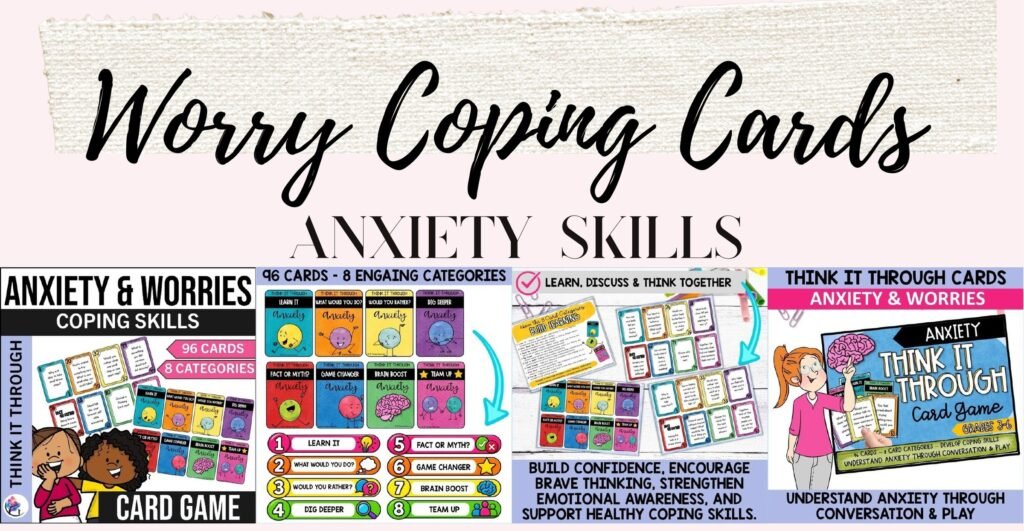
From our counseling room to yours: for elementary students whose goals are held back by worry, our Anxiety & Worry Coping Skills Cards turn anxiety education into a conversation game. Categories such as “What Would You Do?” and “Dig Deeper” help children recognize worry thoughts, practice calming strategies and plan small brave steps. Use a few cards at the start of a session, then ask the student to choose one brave step as this week’s goal. One reviewer wrote that the cards “make it so much easier to start meaningful conversations about anxiety and coping skills.”
Celebrate Effort, Coping and Recovery, Not Only Outcomes
Small wins matter. The student who finally starts the assignment. The child who asks for help instead of shutting down. The teen who hands in work they are worried about. These moments can look minor to adults, yet for a student with perfectionism or anxiety they are often the hardest part of the goal.
Make those steps visible at check-ins. Instead of asking only “Did you meet your goal?”, try:
- “What did you try?”
- “What got in the way?”
- “What helped, even a little?”
- “What would make next week’s step a bit easier?”
Picture a student who planned to start homework within 10 minutes on four nights and managed two. A pressure response focuses on the two missed nights. A compassionate response might sound like: “You got started twice this week. What was different on those two nights? Let’s keep what worked and decide whether four nights is the right goal for next week.” The expectation stays clear, but the student leaves with a plan rather than a sense of failure.
Try this in your next session: our Self-Esteem Activity Mats & Worksheets give elementary students a structured way to recognize their strengths, practice positive self-talk and celebrate progress rather than perfection, with goal-setting and future-focused reflection tasks included. Use a strengths mat before setting a new goal so students start from what they already do well. One counselor shared, “I especially liked that students could work through the activities while we talked, which made some of the conversations feel much more natural.”

Adapting Compassionate Goal Setting by Age
Younger students
With younger children, goals work best when they are concrete, visual and immediate: a picture of the next step, a simple chart for “I tried the first problem on my own,” or a goal that lasts one day rather than one term. Children at this age are still building their sense of “I can do hard things,” and the way adults respond to their mistakes helps shape it. Collaborative planning, simple visual supports and encouragement around effort and persistence keep goals hopeful rather than stressful.
A sample script: “Your goal today is to try the first two problems before asking for help. If you get stuck, that’s okay. Getting stuck is part of learning something new.”
Teens
Older students are often managing academic expectations, social comparison, worries about the future and questions of identity all at once. Many quietly believe, “If I can’t do it perfectly, there’s no point trying.” For teens, compassionate goal setting includes:
- Letting them lead: ask what matters to them before offering suggestions, so the goal belongs to the student rather than the adult.
- Treating plans as drafts: goals can change, plans can adapt, and progress is rarely a straight line.
- Separating worth from achievement: a missed goal says something about the plan or the week, not about who they are.
A sample script: “Let’s treat this as a first draft. If it turns out to be too big, adjusting it is part of the skill, not a sign you failed.” For teens who are also struggling with worry, our guide to teen anxiety coping skills pairs well with this approach, and these executive functioning activities for teens can help when planning itself is the barrier.
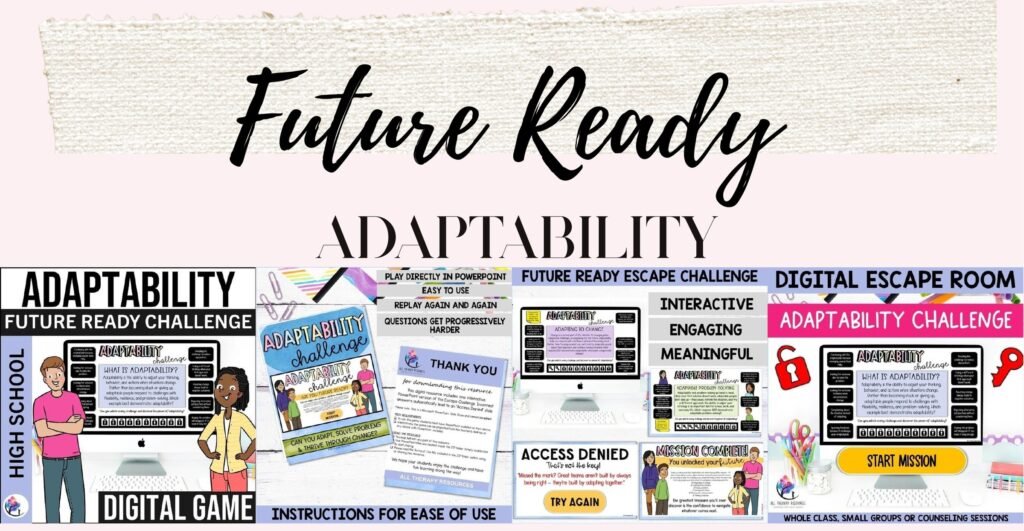
For high school students: flexibility is easier to practice before it is needed. Our Future Ready: Adaptability Challenge is a digital escape challenge in which teens work through realistic scenarios about change, setbacks and uncertainty, collecting keys as they go. Run it with a small group, then ask each student how they could build a “Plan B” into their own goal. One high school counselor noted that “The scenarios encouraged meaningful discussions about adaptability, resilience, and flexible thinking while keeping students engaged through the game format.”
Why Interactive, Low-Pressure Activities Help
Students who feel anxious or judged often engage more openly when practice feels like a game or a conversation rather than a performance. Interactive activities let them explore planning, rehearse what to do after a setback and talk about mistakes through fictional scenarios before applying the skills to their own goals. That distance gives students room to think without feeling exposed.
Our perfectionism resources include digital SEL games for elementary and high school students that help them practice letting go of “perfect” in a low-stakes format, and they work well alongside a goal-setting unit.
Get the Tea with Angie
Children carry invisible stories about themselves: “I’m not smart.” “I always mess things up.” “I’ll never catch up.” Adults often see only the behavior sitting on top of those beliefs: the procrastination, the shutdown, the perfectionism, the refusal.
Underneath, there is often a child quietly wondering, “What if I try and still fail?” Some students have experienced goals as painful for so long that they no longer connect growth with hope. That is why small, achievable wins matter so much. Not because every child needs to become highly organized or high-achieving, but because every child deserves the chance to feel capable, supported and hopeful about themselves again.
Healthy goal setting is not about creating perfect students. It is about helping children and teens trust that growth can happen slowly, that mistakes do not erase worth, and that they can do this one step at a time.
Frequently Asked Questions
What is compassionate goal setting?
Compassionate goal setting uses the structure of SMART goals (specific, measurable, achievable, relevant and time-bound) while treating setbacks as information rather than failure. Goals are small and flexible, check-ins focus on effort and problem-solving, and students learn to respond to themselves with kindness rather than harsh self-criticism.
How do you help a student with perfectionism set goals?
Start with a goal that feels almost too small, focus it on a behavior the student controls (starting, submitting, asking for help) rather than a grade, and build in a planned “good enough” step. Review progress with curiosity, and adjust the goal together rather than raising the bar after every success.
Does self-compassion make students less motivated?
The evidence so far suggests not. In experiments with adults, Breines and Chen (2012) found that self-compassion after a setback increased motivation to improve. Research with adolescents links higher self-compassion to lower anxiety, depression and stress, although most of those studies show an association rather than cause and effect.
How can goal setting be trauma-informed?
Trauma-informed goal setting prioritizes emotional safety, choice and collaboration. Students help choose their goals, expectations are predictable, setbacks never lead to shame or public comparison, and adults pay attention to stress signals before pushing for progress. Our article on creating trauma-informed environments for students offers more ideas.
References
- Bandura, A., & Schunk, D. H. (1981). Cultivating competence, self-efficacy, and intrinsic interest through proximal self-motivation. Journal of Personality and Social Psychology, 41(3), 586–598.
- Breines, J. G., & Chen, S. (2012). Self-compassion increases self-improvement motivation. Personality and Social Psychology Bulletin.
- Curran, T., & Hill, A. P. (2019). Perfectionism is increasing over time: A meta-analysis of birth cohort differences from 1989 to 2016. Psychological Bulletin, 145(4), 410–429.
- Marsh, I. C., Chan, S. W. Y., & MacBeth, A. (2018). Self-compassion and psychological distress in adolescents: A meta-analysis. Mindfulness.
- Weir, K. (2011). Golden rule redux. Monitor on Psychology, 42(7). American Psychological Association.
Looking for practical, ready-to-use resources to support your goal-setting work with students who struggle with perfectionism and anxiety? The All Therapy Resources Membership provides access to a growing collection of thoughtfully developed counseling activities, interactive games, and therapeutic tools designed to save preparation time while supporting meaningful, skill-focused learning.