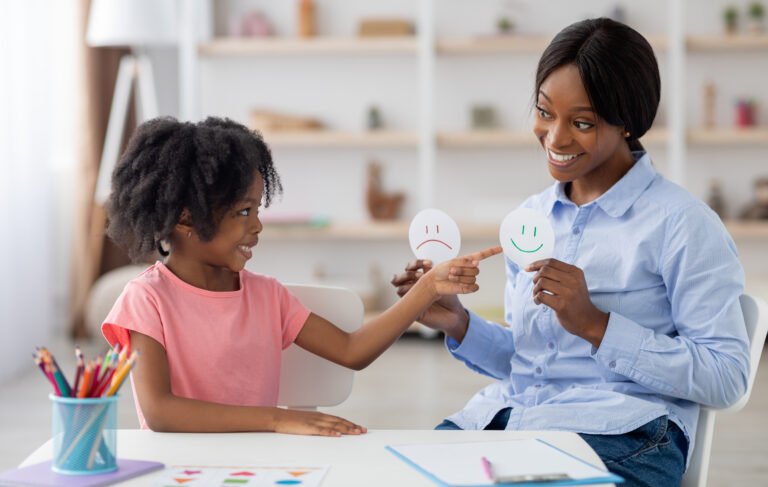
Picture a student who knocks over a chair when a game does not go their way, then sits in your office a few minutes later saying, “I don’t know why I did that.” Many children do not yet have words for what happens inside them when a feeling takes over. Teaching the “flip your lid” idea gives kids a simple, concrete way to understand their brain, notice when big emotions are in charge, and learn what helps them find their calm again.
This guide walks through how to teach flip your lid for kids in counseling sessions, small groups and classrooms: the hand model of the brain, kid-friendly language, a six-session teaching sequence, calming tools, and ways to keep the language alive across the school day.
Why teaching kids about their brain helps
When children understand that big reactions have a reason, the conversation can shift from “What’s wrong with you?” to “What happened in your brain and body, and what helps?” That shift matters. It reduces shame, gives adults and students a shared language, and makes coping strategies feel purposeful rather than random.
A popular framework for this comes from Daniel Siegel and Tina Payne Bryson’s The Whole-Brain Child, which describes an “upstairs brain” and a “downstairs brain”. The upstairs brain (the thinking, planning part, linked to the prefrontal cortex) helps us pause, problem-solve and make choices. The downstairs brain watches for danger and drives quick emotional reactions. The upstairs brain is still developing throughout childhood and adolescence, so it makes sense that children need adult support, practice and patience to manage strong feelings.
Many educators also use child-friendly characters to make these ideas memorable:
- Wise Owl (prefrontal cortex): helps us stop, think and choose.
- Guard Dog (amygdala): barks fast when it senses danger or stress, even when the “danger” is a lost game or a tricky worksheet.
- Memory Elephant (hippocampus): helps store memories, including memories of strong feelings.
These characters are teaching metaphors, not literal neuroscience, and that is fine. Their job is to help a seven-year-old say, “My Guard Dog is barking,” instead of shutting down or lashing out. For a deeper look at the reasoning behind brain-based lessons, see our article on brain-based SEL and teaching emotional regulation through neuroscience.
Flip your lid for kids: teaching the hand model of the brain
Dr. Dan Siegel’s hand model of the brain is one of the easiest ways to show children what “flipping your lid” means. Children can carry it with them anywhere, because the model is their own hand.
- Open your hand. The wrist stands for the brainstem, the part that keeps us awake, breathing and keeping our heart beating.
- Fold your thumb into your palm. The thumb represents the feeling brain (the limbic area), home of the Guard Dog and the Memory Elephant.
- Fold your fingers over your thumb. The fingers are the thinking brain, where Wise Owl lives. When the fist is closed, all the parts are connected and working together.
- Lift your fingers up. This is “flipping your lid.” When a feeling gets too big, the thinking brain becomes harder to reach, and the Guard Dog takes charge.
- Close your hand again slowly. Calming strategies, such as slow breathing, help the parts reconnect so Wise Owl can help again.
A short script for a session might sound like: “Everyone’s lid flips sometimes, grown-ups too. It doesn’t mean you’re bad. It means your Guard Dog is working hard to protect you. Our job is to learn how to help it calm down so Wise Owl can come back.”
It helps to be honest with older students that the hand model is a simplified picture. Real brains are far more connected than five fingers can show. The value of the model is that it gives children a quick, visual way to name what is happening and to remember that calm is possible.
Try this in your next session: before you teach the hand model, read a short social narrative together so the ideas feel familiar and safe. Our Flipping Your Lid Narrative: Upstairs and Downstairs Brain Social Story Activities explains the thinking and feeling brain in kid-friendly language and introduces the Wise Owl, Guard Dog and Memory Elephant. It suits elementary students in individual or small group sessions. Read one page, pause to show it on your hand, then invite students to share a time their Guard Dog barked. One educator noted, “The Wise Owl, Guard Dog, and Memory Elephant metaphors made brain science so accessible and fun.” Another found it helpful when teaching Flipping Your Lid to older students.

A six-session sequence for teaching kids about their brain
Children rarely learn emotional regulation from a single lesson. A short series, revisited across several weeks, gives them time to connect the ideas to real moments. The sequence below works for a small group, a classroom unit or individual sessions, and each session can also stand alone if your schedule is tight. Sessions of around 30 to 40 minutes suit most elementary groups.
| Session | Focus | What kids practice | Suggested ATR resource |
|---|---|---|---|
| 1 | Meet your brain | Upstairs and downstairs brain, the brain characters, the hand model | Upstairs Downstairs Brain Poster |
| 2 | Big feelings and reactions | Noticing triggers and what fight, flight or freeze can look like | Flip Your Lid, Find Your Calm Workbook |
| 3 | Calm your brain | Slow breathing, grounding and a personal calm plan | Shapes Breathing Exercises |
| 4 | Name it to tame it | Feelings vocabulary and body clues | Feelings Chart Emotions Posters |
| 5 | My brain, my choices | Sorting helpful (green) and unhelpful (red) choices | Flip Your Lid, Find Your Calm Workbook |
| 6 | Review and celebrate | Brain crafts, a review game and sharing calm plans | Flipping Your Lid Digital Game for Kids |
A note on Session 4: “name it to tame it” is a strategy from Siegel and Bryson. It fits with research showing that, in adults, putting feelings into words was linked to reduced amygdala activity in a brain imaging study. That study involved university students rather than children, so present labeling feelings to families as a helpful, research-informed strategy rather than a quick fix.
In Session 5, keep “red choices” about actions, never about the child. “Hitting was a red choice. You are still a good kid, and we can plan a green choice for next time” protects the relationship while still holding the boundary.
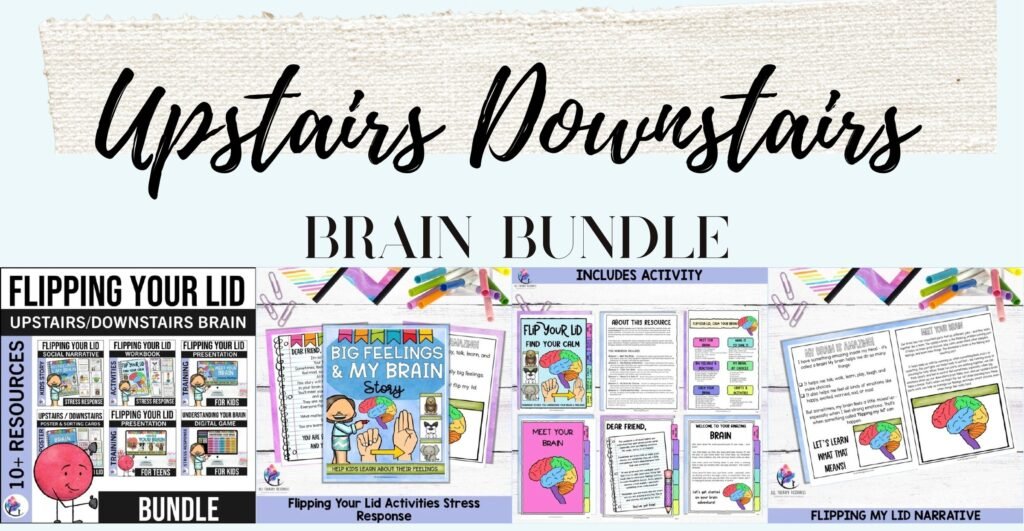
Try this in your next group: if you would like every piece of this sequence in one place, our Upstairs Downstairs Brain Bundle: Flipping Your Lid Activities brings together the Flip Your Lid, Find Your Calm six-lesson workbook, early childhood and elementary social narratives, the Upstairs and Downstairs Brain mapping poster with scenario sorting cards, a Meet Your Brain slide presentation and bilingual English and Spanish posters. It suits counselors and teachers planning a full emotional regulation unit for early years and elementary students. Start with the narrative in Session 1, build the mapping poster together across the unit, and use the bilingual posters in your calm corner so the language stays visible between sessions.
Calming tools for when the Guard Dog barks
Understanding the brain is only half the work. Children also need a small set of calming tools they have practiced when they are already calm, so the tools are easier to reach when a feeling is big. Offer choices rather than one “right” way to calm down, and let students notice which tools feel helpful in their own bodies.
- Slow breathing: “smell the flower, blow out the candle,” or tracing a shape with a finger while breathing in and out.
- Grounding: the 5-4-3-2-1 senses check (five things you see, four you can touch, three you hear, two you smell, one you taste).
- Movement: wall push-ups, a short walk with an adult, or squeezing and releasing fists.
- A feelings check-in: rating the feeling from 1 to 5 before and after a strategy, so children can see that feelings change.
Picture a student who comes in from recess furious after a disagreement. Instead of asking “What happened?” straight away, you might say, “I can see your Guard Dog is barking. Let’s help it settle first, then we’ll figure it out together.” Problem-solving waits until the upstairs brain is back online. A predictable, well-stocked regulation space makes this much easier; our guide to creating a calm down corner students actually use covers the setup, and our coping skills activities for students offer more ideas to practice.
Keeping the language alive across the school day
The real progress happens when the language moves beyond your office. Share the hand model and the brain characters with teachers, support staff and families so children hear the same words at school and at home. A one-page summary, a hand-model poster in the classroom, or a quick demonstration at a staff meeting can go a long way.
A few reminders keep the approach trauma-informed and respectful:
- Use “flipping your lid” to describe and support, never to blame. Avoid phrases like “You flipped your lid again.”
- Remember that some children’s Guard Dogs bark more often for good reasons, such as past adversity, sensory differences or anxiety. Their reactions are protective, not deliberate.
- Model it yourself: “My lid is starting to flip, so I’m going to take three slow breaths.”
- Review often. Short, playful repetition helps the ideas stick far better than one long lesson.
For more ways to practice these skills, our list of emotional regulation activities for kids pairs well with this unit.
Try this in your classroom: for a quick, no-prep review, our Flipping Your Lid Digital Game for Kids is a PowerPoint team game where students earn points by answering questions about their brain, big feelings and calming strategies. It suits elementary classrooms and counseling groups, and you can reset it to play again. Use it at the end of a unit, or for ten minutes at the start of a session to warm up the brain language. One reviewer shared that it “worked really well in a small group and sparked great discussions about emotional regulation.”

Frequently Asked Questions
What does “flip your lid” mean for kids?
It is a kid-friendly way to describe what happens when a big feeling takes over and the thinking part of the brain becomes harder to use. Using the hand model, children lift their fingers to show the “lid” flipping and close their hand again to show calm returning.
What age is the hand model of the brain best for?
Many educators use it from early elementary onward. Younger children do well with the characters and simple language, while older elementary students can learn the brain part names and discuss what helps them personally.
Is the upstairs and downstairs brain scientifically accurate?
It is a simplified teaching model rather than a precise map of the brain. It draws on real ideas about how thinking and emotional systems interact, and it is useful because it gives children clear, memorable language. Older students can be told it is a simplified picture.
Can flip your lid lessons support neurodivergent students or students who have experienced trauma?
Often, yes, when they are adapted. Visuals, predictable routines and body-based awareness can be helpful, but follow the child’s lead, offer choices about participation and avoid pushing anyone to share personal experiences. Consult the student’s support team for individual needs.
Looking for practical, ready-to-use resources to support your brain-based emotional regulation lessons? The All Therapy Resources Membership provides access to a growing collection of thoughtfully developed counseling activities, interactive games, and therapeutic tools designed to save preparation time while supporting meaningful, skill-focused learning.