You have probably seen it: a child gripping the pencil so tightly their knuckles turn white, or letters drifting above and below the line like a secret code. Handwriting difficulties are common in the early school years, and when writing is slow and effortful, children have less energy left for spelling and ideas.
This guide explains how occupational therapy for handwriting works: what may sit underneath a child’s struggles, the strategies OTs commonly use, and how teachers and parents can keep practice consistent at school and home.
Understanding Handwriting Difficulties
Handwriting draws on several skills at once, so difficulties can come from more than one source:
- Grip and hand strength: a tense grip or tired hands after a few lines, leading to frustration and avoidance.
- Letter formation: letters started in different places each time, making writing slower and harder to read.
- Motor coordination: difficulty controlling the small movements of the fingers, hand and wrist.
- Visual-motor skills: difficulty copying letters accurately, spacing words or staying on the line.
- Attention and regulation: a tired or unsettled child may struggle to sustain the focus legible writing needs.
Picture a student whose writing is neat for two lines and then falls apart. The issue may be endurance or posture rather than letter knowledge, which is why an OT looks at the whole child first. Our article on why not every child with poor handwriting needs more handwriting practice explores these underlying factors further.
Occupational Therapy Strategies for Handwriting
A systematic review of handwriting interventions (Hoy, Egan and Feder, 2011) found that interventions without handwriting practice were not effective, and neither were those with fewer than 20 practice sessions. Supporting activities work best alongside regular, purposeful handwriting practice, not instead of it.
1. Hand strengthening and fine motor warm-ups
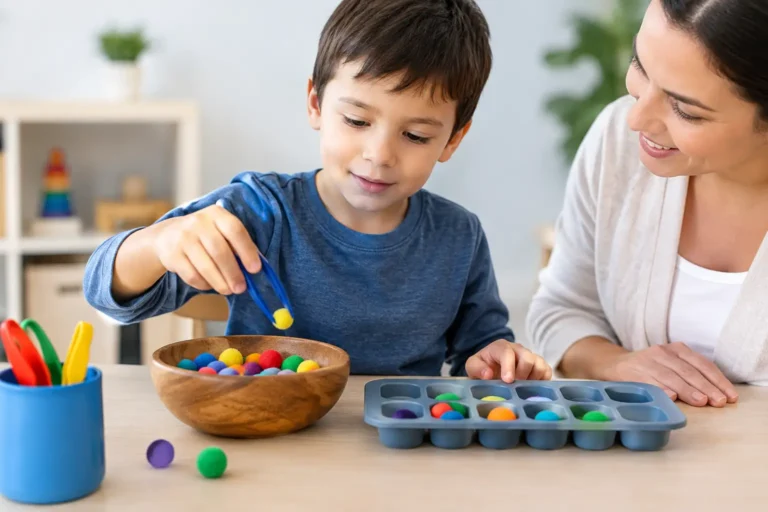
Squeezing therapy putty, using tweezers to move small objects, tearing paper and working with clothespins all build hand strength and control. A two to three minute warm-up before writing helps children settle into the task. For more ideas, see our guide to fine motor activities for therapy.
Try this in your next session: set up two quick fine motor stations before writing. Our Fine Motor Skills Activities: Handwriting Task Boxes bundle includes pre-writing and pencil control pages, scissor practice, play dough and pom pom mats for preschool to early elementary students. Pair a pom pom mat for pincer grasp with a pencil control page so warm-up and writing feel connected.

2. Explicit letter formation practice
Children benefit from being shown exactly where each letter starts and which way the pencil travels. A meta-analysis of handwriting instruction (Santangelo and Graham, 2016) found that handwriting instruction improved legibility and fluency, and individualized instruction improved legibility. Grouping letters with the same starting stroke (c, a, d, g, o) makes formation easier to remember. A simple modeling script: “Watch where I start. Top, pull down, stop on the line. Now say the steps with me as you write.”
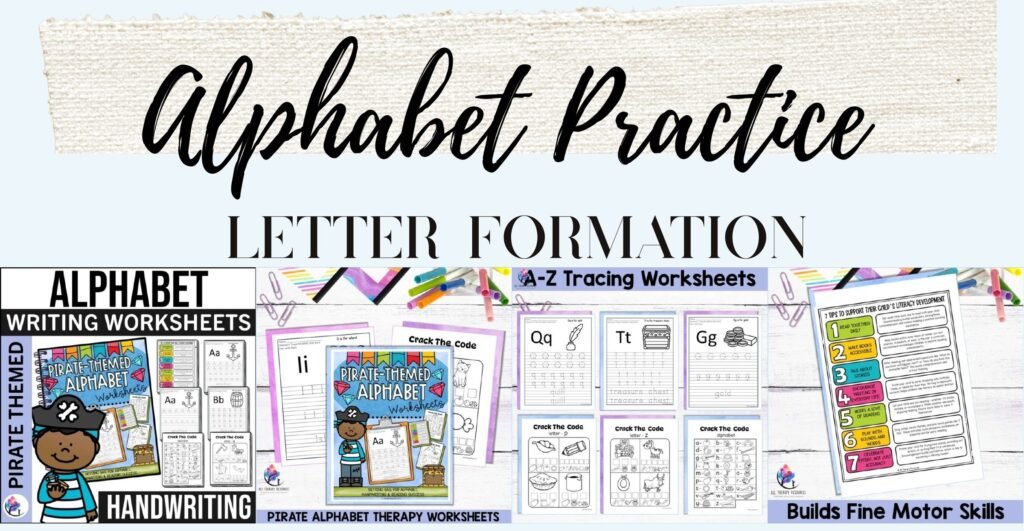
From our OT toolkit to yours: for PreK to first grade, our Alphabet Practice Worksheets (Pirate Theme) move from tracing each letter to writing it independently, paired with a themed vocabulary word. Model the formation first, then ask the child to circle their best letter on the page, a small step that builds self-monitoring.
3. Seating and posture
Check that the child’s feet rest flat on the floor or a footrest, the desk sits at about elbow height, and the paper is angled slightly for the writing hand. Some children benefit from a slanted surface. An OT can advise on the individual child.
4. Visual-motor integration activities
In one study of kindergarteners, visual-motor integration was strongly correlated with copying letters legibly (Daly, Kelley and Krauss, 2003). Tracing paths, joining dots, copying shapes and cutting along lines all practice guiding the hand with the eyes. A correlation is not proof that these activities alone improve handwriting, so pair them with letter practice.
Try this in your classroom: our Tracing and Scissor Skills Bundle combines tracing and cutting practice for preschool, kindergarten and special education. Start with wide, straight paths, then move to curves and corners. Ask the child to keep the pencil “on the road,” then talk about which turns felt tricky.

5. Technology as a support
For older students with persistent difficulties, keyboarding or speech-to-text can reduce the load of getting ideas down. It works best alongside continued handwriting practice, with decisions made by the school team and the child’s OT.
Putting Strategies Into Practice at Home and School
- Keep it consistent: use the same letter formation language at home and school.
- Give specific feedback: “Your letters are sitting right on the line” teaches more than “Good job.”
- Try tools thoughtfully: pencil grips or slanted boards may help some children. A grip does not always need changing: one study of fourth graders found four common mature pencil grasps performed similarly for speed and legibility (Schwellnus and colleagues, 2012).
- Add movement: forming letters with the body or in sand keeps younger children engaged. Our Human Alphabet Form the Letter Worksheets do exactly this; one reviewer’s students “worked in pairs and did show and share of their letter!”
- Work with the OT: regular check-ins keep goals current. Our guide to occupational therapy in schools explains how school-based OT works.
Progress is often gradual. Understanding what sits underneath the struggle and keeping practice regular and consistent helps children write with more comfort and confidence.
Frequently Asked Questions
How often should children practice handwriting?
Short, regular practice (around 10 to 15 minutes, several times a week) is usually more manageable than occasional long sessions. Research suggests handwriting interventions need a meaningful number of practice sessions, so consistency matters more than intensity.
Can occupational therapy help older children with handwriting?
Yes. Older children can still improve legibility and speed, and can often use self-monitoring strategies. An OT may also recommend keyboarding alongside practice.
Do pencil grips or weighted pencils help?
They help some children, but not all, and evidence for many tools is limited. Trial them with guidance from an occupational therapist.
References
- Daly, Kelley and Krauss (2003): Relationship between visual-motor integration and handwriting skills of children in kindergarten
- Hoy, Egan and Feder (2011): A systematic review of interventions to improve handwriting
- Santangelo and Graham (2016): A comprehensive meta-analysis of handwriting instruction
- Schwellnus et al. (2012): Effect of pencil grasp on the speed and legibility of handwriting in children
Looking for practical, ready-to-use resources to support your handwriting and fine motor sessions? The All Therapy Resources Membership provides access to a growing collection of thoughtfully developed OT activities, interactive games, and therapeutic tools designed to save preparation time while supporting meaningful, skill-focused learning.