If you have ever stood in front of a new school year with a blank calendar and a long list of needs, you are not alone. A clear school counseling curriculum turns that blank calendar into a year of connected, developmentally appropriate lessons, so every class visit builds on the last one instead of standing on its own.
This guide walks through how to plan a K-12 school counseling curriculum that is ready to use, research-informed and realistic for a busy counselor. It focuses on Tier 1, the classroom lessons every student receives. If you are planning targeted groups, our guide to planning a small group counseling curriculum covers Tier 2 in detail.
What a School Counseling Curriculum Is (and What It Is Not)
A school counseling curriculum is the planned, sequenced set of lessons a counselor delivers to whole classes across the year. It sits inside your wider comprehensive school counseling program, alongside small groups, individual counseling, consultation and crisis support.
It is not a folder of favorite activities. The difference is intention: each lesson has a clear student objective, it connects to the lessons around it, and it reflects what students at that age are ready to learn. The American School Counselor Association (ASCA) frames this through the ASCA Student Standards: Mindsets & Behaviors for Student Success, which describe the attitudes and skills students need for academic, career and social/emotional development.
Try this in your planning: Before choosing any activity, write one sentence for each grade level that begins “By the end of the year, students in this grade will be able to…” Those sentences become the backbone of your curriculum, and every lesson should move students toward one of them.
Why a Planned K-12 Curriculum Matters
ASCA recommends a student-to-school counselor ratio of 250:1 and notes that this ratio reflects the goal of counselors spending 80% of their time in direct and indirect services to students (ASCA, The Role of the School Counselor). With caseloads often far higher than that, a planned curriculum is one of the most efficient ways to reach every student.
There is also a strong research base for teaching social and emotional skills universally. A widely cited meta-analysis of 213 school-based, universal social and emotional learning programs involving more than 270,000 K-12 students found improved social and emotional skills, attitudes and behavior, along with an 11-percentile-point gain in academic achievement in the subset of studies that measured it (Durlak et al., 2011). Results vary with program quality and how well a program is delivered, which is exactly why careful planning matters.
Picture a fourth grader who learned a calm-down strategy in second grade, practiced naming feelings in third grade and now uses both to work through a friendship problem. That is what a connected curriculum makes possible: skills that grow with the student rather than resetting every year.
Planning by Grade Band: Themes That Fit Each Age
A strong K-12 school counseling curriculum spirals. Core themes return each year, but the depth, language and activities change with development. The table below shows one way to organize a year by grade band.
| Grade band | Developmental focus | Sample themes across the year | Practice it with |
|---|---|---|---|
| K-2 | Naming feelings, simple coping, school routines, friendship basics | Meet the counselor, feelings words, calm-down tools, kind choices, safe bodies, size of the problem | School Counseling Curriculum Map (free) |
| 3-5 | Regulation strategies, empathy, problem solving, growth mindset | Self-regulation, perspective taking, conflict resolution, bullying prevention, study habits, transitions | 7 Collaborative SEL Lessons |
| 6-8 | Identity, peer relationships, stress, organization | Executive functioning, healthy friendships, online safety, stress management, career interests | School Counseling Curriculum Map (free) |
| 9-12 | Independence, decision making, wellbeing, postsecondary planning | Coping with pressure, help-seeking, healthy relationships, goal setting, college and career readiness | School Counseling Curriculum Map (free) |
Want more for each grade band? Explore our school counseling curriculum map resources or browse the ATR shop by grade level.
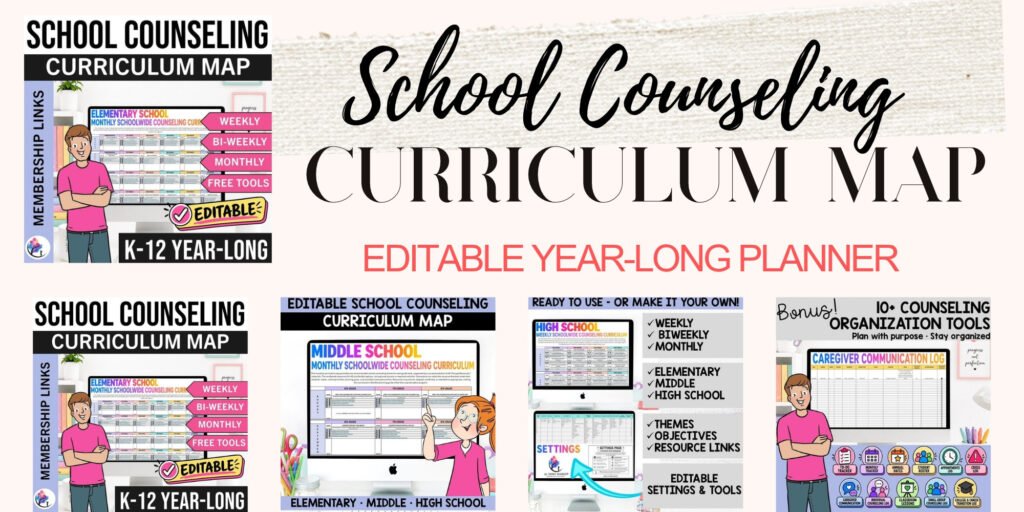
From our counseling room to yours: the School Counseling Curriculum Map is a free, editable year-long plan for elementary, middle and high school counselors. It includes weekly, biweekly and monthly map options, developmentally appropriate themes, clear student objectives and direct links to suggested resources, plus bonus organization tools such as an appointments log and a caregiver communication log. One counselor described it as “such a practical and well-designed resource.”
How to Build Your Year in Five Steps
1. Start with your data and your school’s needs
Look at attendance, referral patterns, needs assessments and teacher input. If many referrals involve peer conflict in grade 4, that theme deserves more than one lesson there.
2. Choose your delivery rhythm
Weekly lessons build momentum, biweekly lessons balance class time with other duties and monthly lessons work for counselors serving large or multiple schools. Pick the rhythm you can sustain, not the one that looks best on paper.
3. Map themes to the calendar
Front-load relationship building and routines in the first weeks, place stress and coping skills before testing seasons and save transition lessons for the end of the year. Monthly awareness dates can be useful planning prompts for themes like kindness or bullying prevention, without making the day itself the focus.
4. Write one objective per lesson
Keep it observable: “Students will name two calm-down strategies and practice one.” Clear objectives make pre and post checks simple and help you show the impact of your program.
5. Plan how you will measure and adjust
A short exit ticket or a three-question pre and post check is enough. Review results each quarter and adjust. A curriculum is a living plan, not a contract.
Try this in your next lesson: End with a one-minute exit ticket. Ask students to write or draw one thing they learned and one place they could use it this week. You might say, “Show me where in your day this skill could help.” Their answers tell you what stuck and what needs a second visit.
Making Lessons Ready to Use the Very Next Day
The most common reason a curriculum stalls is preparation time. Ready-to-use lessons share a few features: a short hook, explicit teaching of one skill, guided practice, a chance to apply it and a quick reflection. Collaborative activities are especially useful because students practice the skill with each other while you facilitate.
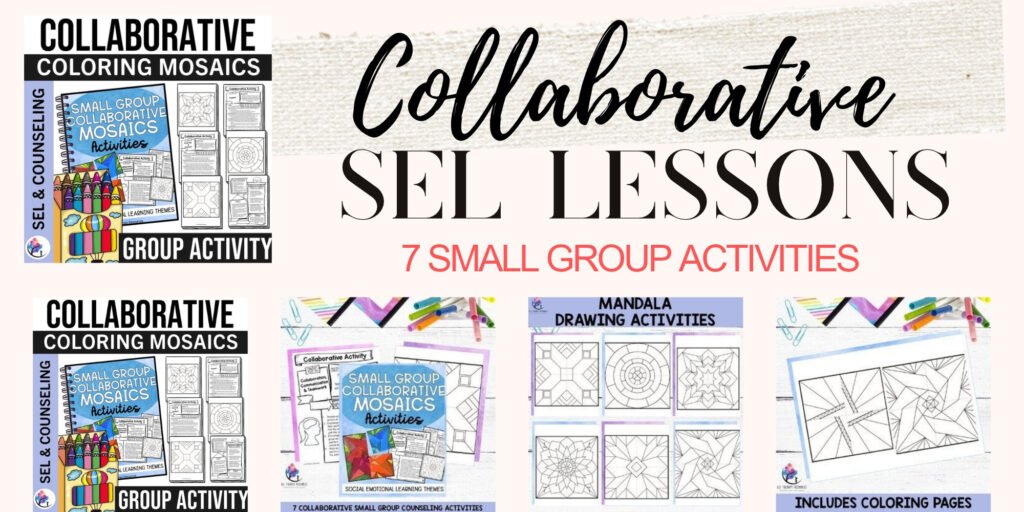
Try it in a class lesson: the 7 Collaborative SEL Lessons are designed for students to work together on shared posters around core social and emotional themes, which suits Tier 1 class visits as well as community-building groups. A reviewer shared that it “was a great resource when starting a community group lesson with students,” and another called the activities “incredibly creative and so versatile.”
Closing the Year With Intention
The final weeks of the school year are part of your curriculum too. Reflection lessons help students recognize the skills they built, name the people who support them and plan for the summer or the next school. This matters especially for students who rely on the routines and relationships school provides.
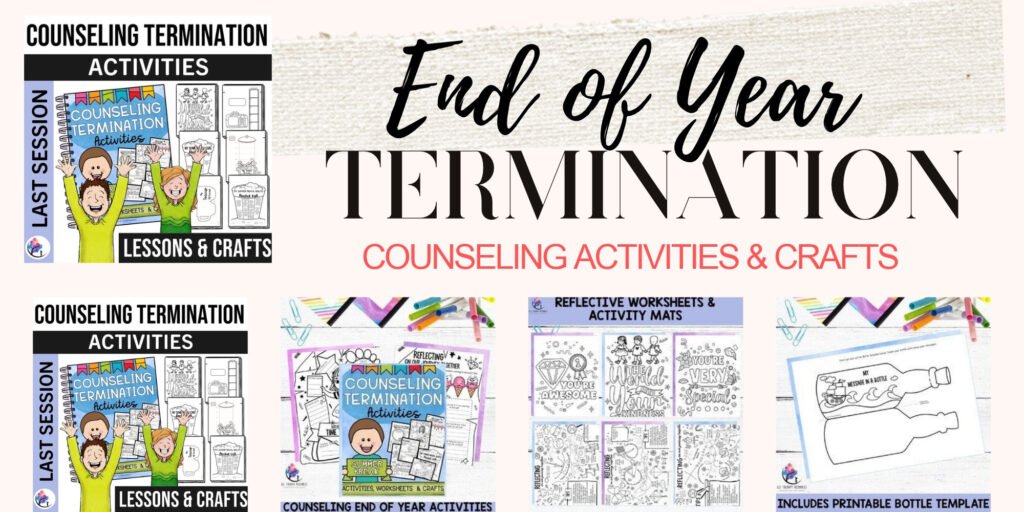
For your end-of-year unit: the Counseling Termination Activities: End of Year SEL Crafts & Lessons give you reflection crafts and lessons for closing a counseling relationship or a school year. One counselor wrote, “I love using this at the end of a counseling journey OR at the end of the school year, it’s nice to give everyone closure before leaving for the summer.”
Frequently Asked Questions
How many classroom lessons should a school counselor teach each year?
There is no single required number. It depends on your ratio, schedule and school priorities. Many counselors aim for a consistent rhythm (weekly, biweekly or monthly) per grade and adjust based on data. A planned rhythm you can sustain is more effective than an ambitious one you cannot.
Is a school counseling curriculum the same as an SEL curriculum?
They overlap but are not identical. A school counseling curriculum covers academic, career and social/emotional development, guided by the ASCA Student Standards. SEL is a major strand within it. Our article on core social-emotional skills for kids explores the SEL side further.
Can I adapt a ready-made curriculum to my school?
Yes, and you should. Ready-made maps save planning time, but your data, your community and your students’ needs should shape the final plan. Editable maps make this much easier.
How do I show the impact of my curriculum?
Use simple pre and post checks, exit tickets and referral or attendance trends. Share a short summary with your administrator each semester to advocate for your program.
Looking for practical, ready-to-use resources to support your school counseling curriculum? The All Therapy Resources Membership provides access to a growing collection of thoughtfully developed counseling activities, interactive games, and therapeutic tools designed to save preparation time while supporting meaningful, skill-focused learning.