A Guest Contribution by Alinka Avendaño
This article was written by Alinka Avendaño, a psychologist and therapist in León, Nicaragua, who runs the ARIE Psychological Center and translates resources for All Therapy Resources. Drawing on her work with children and families in her community, Alinka reflects on why a trauma-informed approach matters for every adult in a child’s life, not only the school counselor, and how the “What Can I Say?” toolkit she translated can help teachers and parents respond to what a child’s behavior is communicating.
For most of us working in mental health and counseling, a trauma-informed approach is familiar; however, for the adults who spend their entire day with our children, it is often something new. I know this is certainly the case in my own country.
Shifting the way we understand children—moving from asking, “Why are you being so difficult?” to “What might be happening that is causing you to act this way?”—represents a complete change in mindset for many teachers and parents.
An ATR insight: Try a “curiosity pause.” Before responding to challenging behavior, take three seconds and silently ask, “What might this child need right now: safety, connection, or a break?” That small pause is often enough to shift our tone from correcting to connecting.
When I began translating the “What can I say?” tool, I knew it was the next resource I wanted to bring to my community. “What can I say?” is an empowering tool; it shows us that we can all serve as a safe space, a source of grounding, and a means of co-regulation for the children we work with.
While working on this resource, I couldn’t help but think of “Client A.,” whose caregivers consult me at least once a year, whenever they are on the verge of being expelled from school due to behavioral issues. Predictably, they focus only on the behavior—no one looks at what lies beneath it. I can only imagine how things might change if everyone—both at school and at home—integrated the elements of “What can I say?” and viewed Client A’s behavior as an indicator of an unmet need—a need that could guide them toward the co-regulation and sense of safety he lacked during his early years.
Try this with your staff: At your next staff meeting, share one supportive phrase, such as “I can see this is really hard right now. I’m here.” Invite every adult to try it once this week and notice what changes. When students hear the same calm, caring language in every room, school starts to feel safer.
Teachers and parents who believe that learning such tools is unnecessary—assuming that the school counselor’s office is the only place for that—are missing out on a resource that is incredibly valuable in all aspects of life, not just in our interactions with children or students. Viewing people through a trauma-informed lens makes us more compassionate, empathetic, conscious, and kind—and we all need more kindness, both to ourselves and others. I am convinced that a trauma-informed approach could have saved the life of Student M —a nine-year-old child who recently died by suicide in the capital. A trauma-informed teacher would have noticed that Student M was not doing well; they would have shown interest, curiosity, and compassion. They would have given the statement “I am being bullied” the serious attention it deserves, understanding that the best approach is one rooted in awareness and genuine concern—avoiding the dismissive phrases I have so often heard directed at young survivors of bullying, such as “just ignore it,” “you’re too sensitive”, “let it roll off your back,” “be strong,” or “it’s not that big a deal.” A trauma-informed teacher would also know how to guide a student experiencing suicidal thoughts—approaching them with love rather than desperation, and certainly avoiding the use of religious-based guilt, a tactic all too common in these countries.
An ATR insight: When a student says “I am being bullied,” the first response matters. Thank them for telling you, let them know you believe them and that it is not their fault, and explain what will happen next. Then follow your school’s bullying and student safety procedures, and check back in with them.
I share these words to honor those children—not to assign blame, but to remind us that we bear a responsibility for childhoods and, to a certain extent, for the futures of these young ones. If resources like these exist, why not explore them? Once you read through them, you realize they reconnect you with your own humanity and heart, fostering personal growth—an aspiration I believe we should all strive for.
Share it with families: Phrases like “You’re safe. I’m right here. We’ll figure this out together” work just as well at home. Consider adding two or three to your next parent newsletter so the same support carries from school to home.
“What can I say?” is designed for those who wish to explore a different way of responding to their students. It acknowledges that, at first, shifting from a behavior-focused mindset to one that seeks to understand what that behavior is communicating requires a great deal of patience and awareness. It takes practice—but as with everything in life, practice leads to progress. In this case, it also fosters the connection so essential for a child’s healthy emotional development.
Explore the “What Can I Say?” Scripting Toolkit
If Alinka’s words resonate with you, our “What Can I Say?” Scripting Toolkit is a collection of trauma-informed scripts, conversation prompts and supportive responses for the moments when you know a student needs you but aren’t sure what to say. It’s written for school counselors, psychologists, social workers, teachers and support staff, and covers social-emotional, behavioral, relationship, school and safety-related situations.
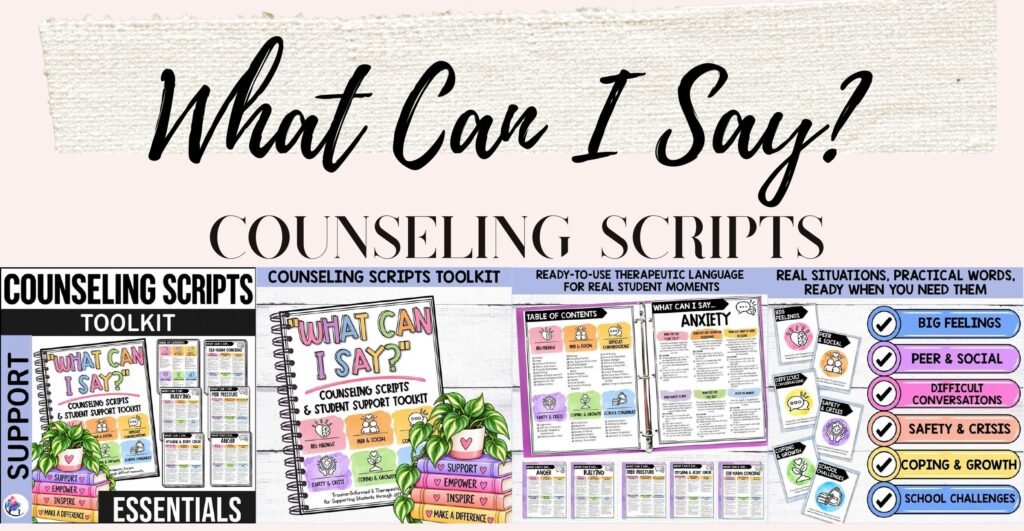
Get the “What Can I Say?” Scripting Toolkit
If you are worried about a student
If a student talks about suicide or you are worried about their safety, do not leave them alone. Follow your school’s crisis and suicide risk protocol, involve your administrator, and contact parents or guardians as your policy directs.
In the USA: students, families, and staff can call or text 988 (the 988 Suicide & Crisis Lifeline), any time, free and confidential. In an emergency, call 911.
In Australia: call Lifeline on 13 11 14, or young people can call Kids Helpline on 1800 55 1800. In an emergency, call 000.
About the Author – Alinka Avendaño | Psychologist and ATR Translator
Alinka is a therapist in her hometown León, Nicaragua. She is also a translator and volunteer, and she runs her ARIE Psychological Center (Centro Psicológico ARIE, León, Nicaragua).
Alinka has been part of the ATR team for a number of years now, and she is one of our most treasured and well-loved team members. As our translator, she helps bring our resources to Spanish-speaking children, families and educators, and her perspective as a practicing psychologist shapes the care she brings to every translation.
Alinka is also in the process of writing and publishing her own book, and we could not be prouder of her. We are so grateful to have her as part of the ATR family.
If you support Spanish-speaking families or educators, especially in the Latin American community, Alinka offers affordable sessions and would love to hear from you. You can contact her at centropsicologicoarie@gmail.com.
Looking for practical, ready-to-use resources to support your work with students? The All Therapy Resources Membership provides access to a growing collection of thoughtfully developed counseling activities, interactive games, and therapeutic tools designed to save preparation time while supporting meaningful, skill-focused learning.