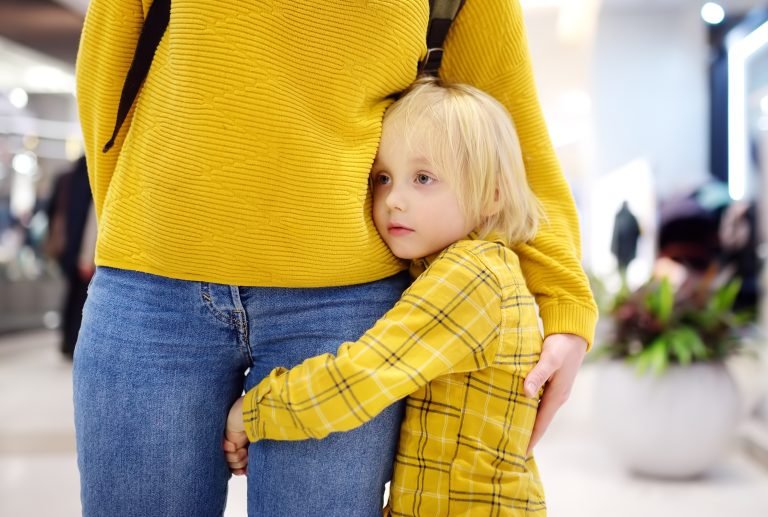
When we talk about creating safe classrooms, most of us think first about physical safety: locked doors, clear procedures, supervision and rules. These matter. For students affected by trauma, though, they are only one part of the picture, and often not the part that decides whether a student can settle and learn.
To help traumatized students feel safe, we need to look at safety the way their bodies experience it. For many of these students, safety is not a conclusion they reach logically. It is something their nervous system judges, moment by moment, often before they are aware of it.
School counselors, teachers and school psychologists often ask, “Why does this student still seem on edge when nothing bad is happening?” This guide explores what safety means for students with trauma histories, how it shows up in the classroom, and what adults can do, practically and consistently, to create spaces where students can regulate, connect and learn. If you are looking at whole-school practice, our article on what trauma-informed classrooms require is a helpful companion.
Safety Is a Nervous System Experience, Not a Policy
Researcher Stephen Porges coined the term neuroception to describe how neural circuits distinguish whether situations or people are safe, dangerous or life threatening, largely outside conscious awareness (Porges, 2004). Neuroception comes from polyvagal theory, and some of that theory’s physiological claims are debated by researchers (Grossman, 2023). The practical point for schools still holds: much of our threat detection is fast and automatic, and it is shaped by experience.
A helpful way to picture it is a smoke detector. For many students, the detector is set at a sensible level. For a student who has lived through repeated danger, it may go off at the smell of toast. The alarm is not misbehaving; it became sensitive because sensitivity once helped the student stay safe.
In the classroom, that can mean:
- A raised voice registers as danger, even when it is directed at someone else
- A sudden transition sets off alarm
- A stern facial expression feels like a warning sign
- Inconsistency feels unsafe, even without any conflict
When the alarm is sounding, the brain prioritizes protection over learning.
Try this in your classroom: Picture a student who freezes every time the room gets loud during group work. Instead of “You’re fine, keep going,” try lowering your own voice, standing beside the student rather than face to face, and saying, “It got loud in here. You can finish this part at the back table if that helps.” You are offering cues of safety rather than an argument for it.
Why “You’re Safe” Often Isn’t Enough
One of the most common, and most well-intentioned, responses adults reach for is reassurance: “You’re safe here.” There is nothing wrong with saying it. The challenge is that words alone often do not land when a student is in a threat state.
Research on stress and the brain helps explain why. Exposure to uncontrollable stress can cause a rapid loss of prefrontal cortex function (the part of the brain we rely on for reasoning, attention and flexible thinking), while strengthening more automatic emotional responses and habits linked to the amygdala and striatum (Arnsten Lab, Yale School of Medicine). In practice:
- Reasoning and listening skills are less available during high stress
- Safety is hard to talk someone into when their body is braced for threat
- Survival responses tend to win over explanations in the moment
For traumatized students, safety needs to be experienced, not only explained. That is why trauma-informed classrooms rely less on reassurance and more on consistent, felt signals of safety: tone, pace, predictability and relationships. Our article on why the students who get in trouble most often need the most safety explores how this plays out with behavior.
What Safety Looks Like in the Brain and Body
When a student feels safe enough:
- Threat signaling settles
- The body can shift toward a calmer state
- Attention, memory and reasoning become easier to access
- The student can tolerate challenge, mistakes and feedback
When a student feels unsafe:
- The stress response stays switched on
- Stress hormones rise
- The body prepares for fight, flight or freeze
- Learning becomes much harder, because attention is pulled toward scanning for danger
Excessive or prolonged activation of the stress response can disrupt healthy development, and supportive relationships with caring adults can help buffer a child’s stress response (Center on the Developing Child at Harvard University). In short: regulation comes before learning.
Try this in your classroom: Before a demanding task, build in a one-minute “landing” routine: a predictable breathing or stretching cue, a quiet moment, then the task. Say, “We’ll land first, then we’ll start.” Over time, the routine itself becomes a signal that this room is steady.
Predictability Is One of the Strongest Safety Signals
For many traumatized students, unpredictability feels more threatening than difficulty. When a student can anticipate what comes next, there is less need to stay on high alert. Our article on the power of predictability goes deeper into routines and visuals for behavior.
Practical ways to increase predictability include:
- Clear daily routines
- Visual schedules
- Warnings before transitions (“Two more minutes, then we clean up”)
- Consistent responses from all the adults involved
- Following through on what you said would happen
- Previewing changes such as a substitute teacher, an assembly or a fire drill, where possible
Predictability does not mean rigidity. It means reliability.
Try this in your next session: If you would like ready-made tools for this, our Predictable Routines Handout and Daily Routine Cards Bundle pairs a handout explaining why routines support safety, structure and consistency with visual daily routine cards. It suits counselors, teachers, special education staff and parents supporting children who benefit from visual supports. Use the handout with staff or caregivers to agree on one shared routine, then invite the student to help sequence the routine cards for their morning or a tricky transition, so the schedule becomes something they know rather than something that happens to them.

Emotional Safety Matters as Much as Physical Safety
Emotional safety refers to whether a student feels safe to:
- Make mistakes
- Express emotions
- Ask for help
- Be seen without being shamed
Traumatized students often watch adults closely for signs of judgment or rejection, and even subtle cues can raise their guard. Emotionally safe classrooms:
- Avoid public correction or humiliation
- Use private, calm redirection
- Normalize emotional experiences
- Separate feelings from behaviors
- Emphasize repair over punishment
SAMHSA’s guidance on trauma-informed approaches lists safety as its first key principle, describing settings where people feel “physically and psychologically safe” (SAMHSA, 2014). When emotional safety is present, students are more willing to engage and take learning risks.
Try this in your classroom: Swap a public correction for a private one. Instead of calling across the room, crouch beside the student and say quietly, “Looks like that’s tough right now. What would help you get started?” Follow up later with a moment of connection, such as “Thanks for getting back on track,” so the relationship, not the correction, is what the student remembers.
Adult Regulation Is a Primary Safety Signal
From a nervous system perspective, adults are walking safety cues. Many traumatized students rely on co-regulation with a calm adult before they can regulate on their own. The adult’s tone, posture, facial expression and pacing often matter more than the words being spoken. For a closer look, see our article on co-regulation and matching energy to build trust.
Calm, regulated adults communicate:
- “You are not alone”
- “I can handle this”
- “You don’t need to escalate to be seen”
Dysregulated adults, even unintentionally, can increase a student’s sense of threat and escalate behavior. This is not about being endlessly calm. It is about noticing your own state and having a plan to steady it.
Try this in your classroom: Choose one personal reset you can use in the moment: a slow exhale before responding, dropping your shoulders, or lowering your voice by half. Pair it with a go-to script, such as “I’m here. We’ll sort this out together.” Having the words ready means you do not have to search for them while your own stress response is rising.
Boundaries Create Safety, Not Fear
A common misconception is that trauma-informed practice means avoiding boundaries. In reality, clear, consistent boundaries can be deeply regulating for traumatized students. From a practice perspective, well-held boundaries:
- Reduce uncertainty
- Create structure
- Lower the mental load of guessing what will happen
- Build trust over time
What matters is how boundaries are delivered. Trauma-informed boundaries are:
- Calm
- Predictable
- Explained when students are regulated
- Followed by opportunities for repair
Boundaries delivered through fear increase threat. Boundaries delivered through consistency increase safety.
Try this in your classroom: Use a calm “when/then” boundary: “When the scissors are back in the tub, then we can go to recess.” Say it once, in an even tone, and wait. Later, when the student is settled, explain the reason briefly and invite repair: “Let’s figure out what would help next time.”
Choice and Autonomy Reduce Threat Responses
Trauma often involves a loss of control, and a sense of control matters to the stress response: the rapid loss of prefrontal function described earlier is linked specifically to uncontrollable stress (Arnsten Lab). SAMHSA’s trauma-informed principles likewise include empowerment, voice and choice. Offering appropriate choices can restore a sense of agency and help a student lower their guard.
Even small choices matter:
- Where to sit
- Which task to start first
- How to take a break
- Which coping strategy to use
Choice communicates, “You have some control here.” Keep choices genuine and limited (two or three options), especially when a student is already stressed.
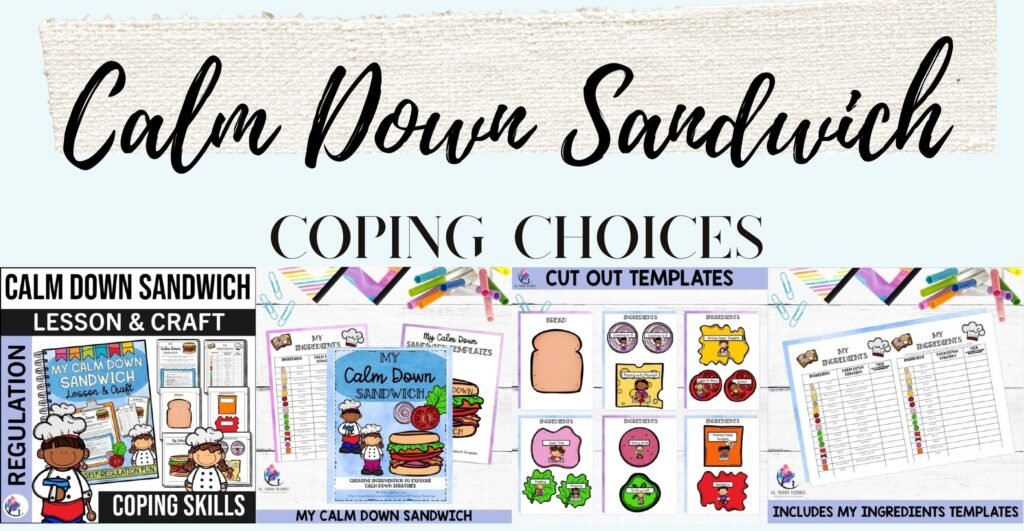
Try this in your next session: Our Calm Down Corner Printables: Coping Skills Sandwich Activity turns choice into something hands-on. Students build a “calm down sandwich” from bread and ingredient pieces that represent different calming and coping strategies, then reflect on real situations that cause stress or overwhelm. It works in individual counseling, small groups, classroom SEL lessons and lunch bunch groups, and the pieces can be laminated and reused with whiteboard markers in your calm corner. Because each student chooses their own layers, the finished sandwich becomes a personal menu of options to return to when they need a break.
Why Some Students Resist “Safe” Environments
A difficult reality is that safety can feel unfamiliar, or even threatening, to students whose nervous systems are used to chaos. For these students:
- Calm may feel unsafe
- Kindness may feel suspicious
- Structure may feel restrictive
This is not defiance. It is adaptation. Trauma-informed classrooms recognize that safety may take time to register, and that steady, repeated experiences are what gradually shift a student’s expectations.
Picture a student who becomes more disruptive after a warm, settled week. Rather than reading it as a setback, the team names the pattern privately, keeps routines steady and responds with the same calm script as always. The consistency is the message: this room stays the same, even when you test it.
From our counseling room to yours: For school counselors and therapists supporting these students individually, our Trauma-Informed, Behavior and Play Therapy Bundle brings together tools for slower, relationship-first work. It includes the Understanding My Worldview workbook, which helps students explore how trauma can influence the way they see themselves and the world, along with a complex trauma intake tool, coping scenario cards and a Creating a Sense of Belonging brochure for trauma-sensitive classrooms. A gentle way to begin is one worldview page per session, letting the student set the pace.

Safety Signals at a Glance
Use this quick guide to spot common classroom moments that can feel threatening, and a simple signal of safety you can offer instead.
| Classroom moment | What can feel threatening | A safety signal to try |
|---|---|---|
| Transitions | Sudden change, an unclear next step | A two-minute warning plus a visual of what comes next |
| Correction | Public attention, a sharp tone | Quiet, private redirection beside the student |
| Conflict or upset | Raised voices, crowding | A lower voice, more space, one clear choice |
| Unexpected change | Substitute teachers, drills, assemblies | Preview the change ahead of time where possible |
| After a hard moment | Fear of rejection or lasting blame | A brief repair conversation and a fresh start |
Want more support with this? Explore our Discussion Safety Signals counseling tool and the Trauma-Informed Framework of Behavior Support Strategies.
Final Thoughts: Safety Is Felt, Not Declared
For traumatized students, safety is not created through posters, rules or reassurances alone. It grows through repeated experiences of calm, consistency and connection.
When we understand safety through a nervous system lens, our responses can shift from control to care, and from correction to regulation. The question becomes less “Why doesn’t this student feel safe?” and more “What signals of safety does this student’s nervous system need right now?”
Frequently Asked Questions
Can safety look different for different students?
Yes. What feels safe is shaped by each student’s experiences, culture and relationships. SAMHSA’s guidance gives high priority to understanding safety as defined by the people being served, so it helps to ask students (and families) what makes a space feel safe for them.
Does creating safety mean removing consequences?
No. It means delivering boundaries and consequences in calm, predictable ways, with a clear path back to repair.
How long does it take for a traumatized student to feel safe at school?
There is no fixed timeline. Some students settle within weeks, while others need many months of consistent experiences. If a student’s distress is intense or persistent, involve your school counselor, school psychologist or mental health team.
Is trauma-informed practice evidence-based?
It is best described as evidence-informed. Trauma-informed practice draws on research about stress, development and relationships, and on guidance such as SAMHSA’s. However, a systematic review of trauma-informed approaches in schools found no studies that met its criteria for rigorous evaluation (Maynard et al., 2019), so research on school-wide outcomes is still developing.
References
- Arnsten Lab, Yale School of Medicine: Uncontrollable stress and prefrontal cortex function
- Center on the Developing Child at Harvard University: Toxic stress
- Grossman, P. (2023). Fundamental challenges and likely refutations of the five basic premises of the polyvagal theory. Biological Psychology.
- Maynard, B. R., Farina, A., Dell, N. A., & Kelly, M. S. (2019). Effects of trauma-informed approaches in schools: A systematic review. Campbell Systematic Reviews.
- Porges, S. W. (2004). Neuroception: A subconscious system for detecting threats and safety. Zero to Three, 24(5), 19–24.
- SAMHSA (2014): SAMHSA’s Concept of Trauma and Guidance for a Trauma-Informed Approach
Looking for practical, ready-to-use resources to support your trauma-informed classroom and counseling work? The All Therapy Resources Membership provides access to a growing collection of thoughtfully developed counseling activities, interactive games, and therapeutic tools designed to save preparation time while supporting meaningful, skill-focused learning.