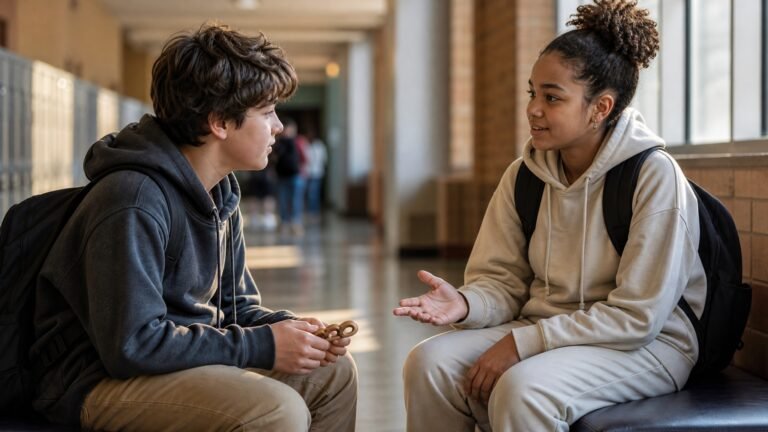
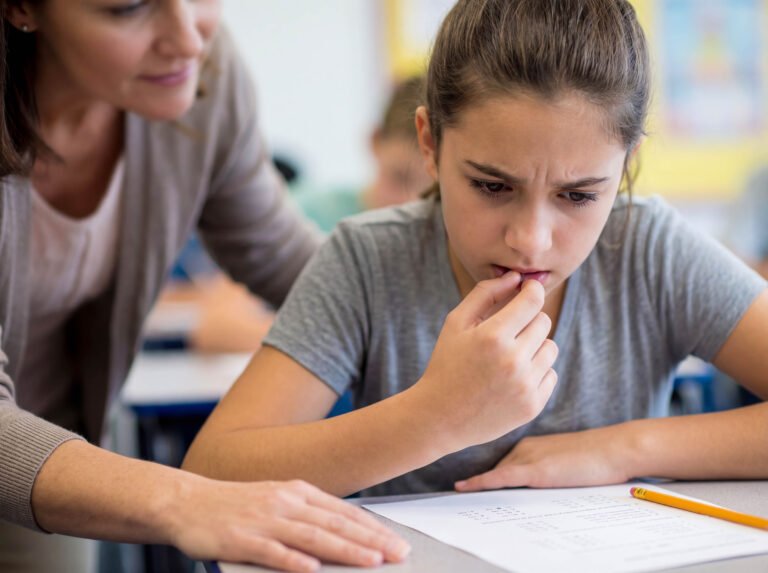
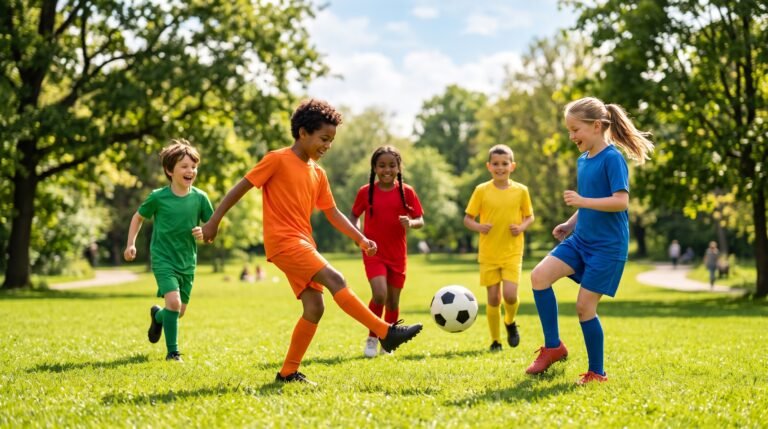
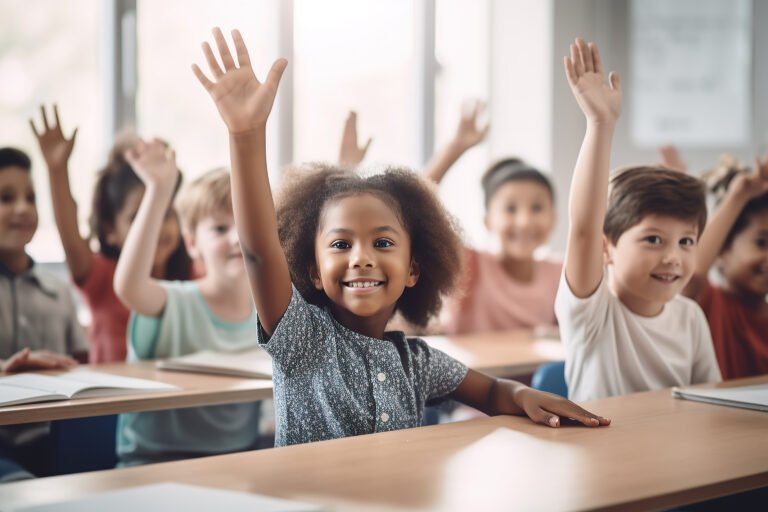
Middle school social skills can look simple on paper: say hello, take turns, be kind. In real life, a sixth grader is reading a crowded lunch table, a seventh grader is working out what a group chat message meant, and an eighth grader is deciding whether to go along with a joke that doesn’t feel right. Friendship skills in middle school are a set of social, emotional and communication skills that students need explicit chances to practice, not only reminders to “be a good friend.”
This guide is for school counselors, school psychologists, social workers and educators supporting students in Grades 6–8. It covers why peer relationships feel so high-stakes at this age, the core friendship skills worth teaching, practical activities with sample language, and how to structure a middle school social skills group.
Why Middle School Social Skills Matter So Much
Early adolescence is a period of rapid change in identity, independence and relationships. Peer groups become a powerful influence, and students can struggle with peer pressure, exclusion, miscommunication and strong emotional reactions when they don’t yet have the skills to manage them.
Developmental research helps explain why. In a review of studies on the teenage brain, Somerville (2013) notes that peer relationships take on heightened importance during adolescence and that teens appear especially sensitive to being evaluated by peers. In lab studies, adolescents often reported stronger reactions to social rejection and acceptance, and more embarrassment when they believed a peer was watching them, than children or adults did. The author describes this evidence as preliminary, but it matches what many middle school staff see every day: a small social moment can feel enormous to a twelve-year-old.
CASEL describes relationship skills as the ability to establish and maintain healthy, supportive relationships, including communicating clearly, listening actively, cooperating, resolving conflict constructively and resisting negative social pressure. A large meta-analysis of school-based SEL programs (213 studies, more than 270,000 students) found that students in SEL programs showed improved social skills and positive social behavior, with fewer conduct problems, compared with control groups. Results were strongest when programs were well implemented, which is a good reminder that structure and consistency matter.
Core Friendship Skills to Teach in Grades 6–8
Rather than asking students to “make better choices with friends,” name the specific skill and show what it looks like at this age. This quick reference can help you choose a starting point for a lesson or group.
| Skill | What it can look like in middle school | Quick practice idea |
|---|---|---|
| Starting conversations | Joining a lunch table, asking a classmate to partner on a project | Practice three opening lines and one follow-up question |
| Reading social cues | Noticing when a friend seems bored, upset or ready to end a conversation | Watch a short role-play and list the clues |
| Empathy and perspective-taking | Considering how a comment or post might land for someone else | Retell a scenario from another person’s point of view |
| Assertive communication | Saying no, sharing an opinion or setting a boundary respectfully | Compare passive, aggressive and assertive responses |
| Handling peer pressure | Responding when friends push a risky or unkind choice | Rehearse refusal phrases in pairs |
| Conflict resolution and repair | Working through a misunderstanding without involving the whole grade | Use a simple “I noticed, I felt, I need” script |
| Digital friendships | Group chats, being left out of online plans, screenshots and tone | Rewrite a message so its tone is clear and kind |
| Respecting differences | Including peers with different interests, backgrounds or communication styles | Find one shared interest and one difference with a partner |
Want more ready-to-use practice? Browse our social skills resources, our middle school resources, or the Social Smarts middle school curriculum.
Practical Friendship Skills Activities for Middle School
The activities below work in small groups, classroom lessons or individual sessions. Keep each one short, concrete and repeatable. Many students can name a social skill on a worksheet but find it much harder to use it in a fast-moving peer interaction, so rehearsal matters as much as discussion.
Starting Conversations and Joining In
For many middle schoolers, the hardest part of friendship is the first step. Give students a few low-pressure openers they can adapt: “Is anyone sitting here?” “What did you think of the assignment?” “I saw you’re into soccer. What position do you play?” Then practice the follow-up, since a conversation usually lasts longer when the first person asks a second question and listens to the answer.
Picture a student who wants to work with a classmate on a project but never quite asks. In group, they rehearse one sentence (“Do you want to be partners for the science project?”), practice a friendly response if the answer is no (“No problem, maybe next time”), and set a small goal to try it that week. The goal is the attempt, not a guaranteed outcome.
Reading Social Cues and Body Language
Run a short, scripted role-play and ask students to act as “social detectives.” What did each person’s face, posture and tone of voice suggest? Was the listener interested, distracted or uncomfortable? What could the speaker do next? Keep the focus on noticing and checking, not on one “correct” way to make eye contact or stand. Students with different communication styles, including neurodivergent students, benefit from learning that it’s okay to ask directly: “Are you busy, or is now a good time?”
Peer Pressure and Assertive Refusals
Middle school peer pressure is often subtle: a dare, a joke at someone’s expense, or a nudge to share something online. Teach students the difference between passive (“Um, I guess”), aggressive (“That’s so stupid”) and assertive (“No thanks, I’m going to head out”) responses. Then let pairs practice refusal phrases out loud, including how to suggest an alternative or leave the situation. For a student-friendly overview of strategies, see our guide on resisting peer pressure in school.
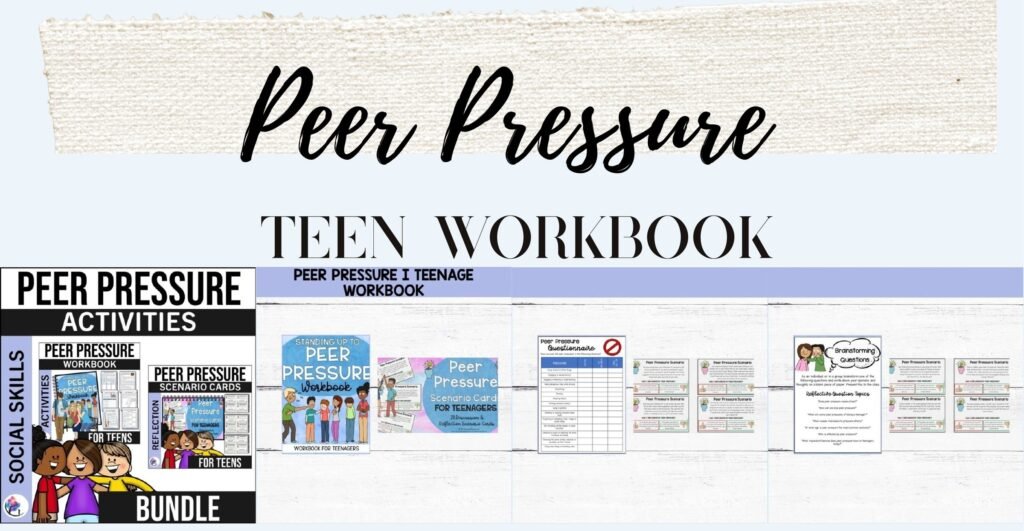
Try this in your next session: our Peer Pressure Teenage Workbook and Scenarios Bundle pairs a CBT-informed workbook with realistic scenario cards, so students can explore peer influence and then rehearse safe, confident responses. It suits middle and high school counseling groups, health lessons or individual sessions. Start with one scenario card, ask the group to identify the pressure and the thought behind it, then have each student script and role-play an assertive reply.
Conflict Resolution and Repairing Friendships
Conflict is a normal part of friendship, and middle schoolers benefit from learning that a disagreement doesn’t have to end a relationship. Teach a simple repair structure: “I noticed… I felt… I need…” For example: “I noticed you stopped sitting with us at lunch. I felt confused and a bit hurt. I’d like to talk about what happened.” Practice the listening side too, including how to apologize without shifting blame (“I’m sorry I said that in front of everyone”) and how to recognize when a friendship is unhealthy and it’s okay to step back.
Help students tell ordinary conflict apart from bullying, which involves repeated behavior and a power imbalance. Our guide to bullying prevention activities for middle school covers that conversation in more depth.
Navigating Digital Friendships
A large part of middle school social life now happens online. Group chats, shared posts and screenshots can make misunderstandings spread quickly, and tone is easy to misread without a face or voice. Practice by giving students a neutral message (“ok.” or “whatever you want”) and asking how it might be read in different moods. Then have them rewrite it so the meaning is clear and kind. Discuss what to do when they are left out of an online plan, when a chat turns unkind, and when to step away or ask a trusted adult for help. Our article on social media, comparison and self-esteem offers more ideas for these conversations.
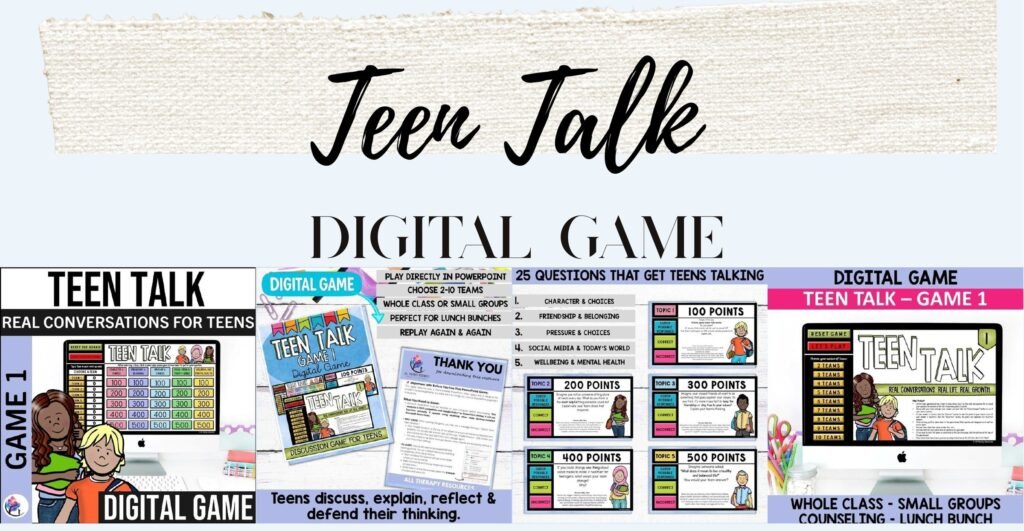
Try this in your next session: Teen Talk Game 1: Friendships, Peer Pressures, Mental Health and Digital Citizenship is a no-prep digital discussion game for Grades 6–12, with categories that include Friendships and Belonging, Pressure and Choices, and Social Media and Today’s World. Use one category as a warm-up, let students answer in pairs before sharing with the group, and follow up on any question that sparks strong opinions. One reviewer noted, “The questions feel really relevant to what teens are actually dealing with, especially friendships, peer pressure and social media,” and shared that it worked well for small groups and counseling sessions.
How to Run a Middle School Social Skills Group
A structured small group gives students a safe place to practice these skills with peers who are working on similar goals. A few elements help a group run well:
- Clear goals and screening: use teacher or counselor referrals and a brief pre-group conversation to match students whose needs fit the group.
- Consent and communication: send parent or guardian information and permission forms, following your school or district policy.
- Group agreements: set expectations for respect and privacy, and explain the limits of confidentiality in language students understand.
- A predictable session structure: check-in, skill focus, modeling, practice, reflection and a small goal to try before the next session.
- Choice and safety: offer choices, let students observe before joining a role-play, and avoid requiring personal disclosure. These are core parts of a trauma-informed approach.
- Data: use simple pre and post measures (student and teacher) to see what changed and to share the impact of your group.
- Generalization: end each session with one observable goal for the hallway, lunchroom or group chat, and check in on it next time.
If you are planning the sequence of sessions from scratch, our guide to planning a small group counseling curriculum walks through the structure step by step.
If a student shares something concerning: friendship and peer pressure discussions can sometimes lead to disclosures about bullying, online exploitation, self-harm or abuse. Stay calm, listen, and thank the student for telling you. Don’t promise to keep it a secret. Follow your school or district protocol and your mandated reporting obligations. In the USA: 988 Suicide & Crisis Lifeline (call or text 988, or chat at 988lifeline.org), Childhelp National Child Abuse Hotline 1-800-422-4453, or 911 in an emergency. In Australia: Lifeline 13 11 14 (text 0477 13 11 14), Kids Helpline 1800 55 1800, your state or territory child protection service, or 000 in an emergency.
Try this in your next group: our Social Skills and Friendship Small Group Counseling Curriculum Bundle includes Social Smarts, a 10-session program for Grades 6–8 covering reading social cues, communicating with confidence, empathy and perspective-taking, peer pressure, conflict resolution, digital friendships and inclusion. It also includes developmentally tailored programs for elementary and high school, which is helpful if you support students across grade levels or want a next step for students moving up. Each curriculum comes with planning sheets, parent letters and permission forms, confidentiality agreements, student and teacher pre and post assessments, and certificates. Start with Session 1 to build group agreements, then follow the sequence or pull individual sessions to target a specific skill.

Frequently Asked Questions
What social skills should middle school students learn?
Key middle school social skills include starting and maintaining conversations, reading social cues, empathy and perspective-taking, assertive communication, handling peer pressure, resolving conflict, navigating online friendships and respecting differences. CASEL groups many of these under relationship skills.
How many students should be in a middle school social skills group?
There is no single right number. Many counselors keep groups small enough that every student can take part in role-plays and discussion each session. Consider students’ needs, how well they work together, and your school’s guidelines when deciding on group size.
How long should a social skills group run?
Many school-based groups run weekly for around 6 to 10 sessions, often within a class period. A predictable schedule gives students time to learn, practice and try skills between sessions. Adjust the length to fit your students’ goals and your school timetable.
How can I tell if a social skills group is working?
Use brief pre and post measures from students and teachers, track the small weekly goals students set, and look for changes in real settings such as lunch, group work and online interactions. Gains in knowing about a skill don’t always carry over to everyday situations, so watch for how often students use skills outside the group.
References
- Somerville, L. H. (2013). The teenage brain: Sensitivity to social evaluation. Current Directions in Psychological Science, 22(2), 121–127.
- CASEL: The CASEL 5 framework (relationship skills)
- CASEL: The benefits of school-based social and emotional learning programs (Durlak, Weissberg et al. meta-analysis, Child Development, 2011)
Looking for practical, ready-to-use resources to support your middle school social skills groups? The All Therapy Resources Membership provides access to a growing collection of thoughtfully developed counseling activities, interactive games, and therapeutic tools designed to save preparation time while supporting meaningful, skill-focused learning.