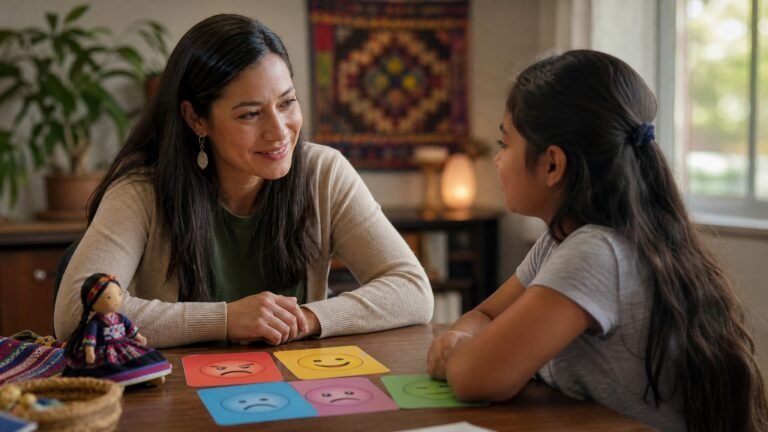
A student may return to school after a death asking whether they can have a snack, then become tearful when a routine changes later that afternoon. Another child may talk openly about the person who died, while their sibling says almost nothing. Child grief support begins with recognizing that neither response is a measure of how much a child cared. Grief is not a straight path, and children often move in and out of it while continuing to play, learn, argue, laugh, and need ordinary structure.
For school counselors, therapists, teachers and caregivers, the goal is not to find the perfect words or to make grief disappear. It is to create enough safety, predictability, and connection that a child does not have to carry a major loss alone. That support looks different across ages, developmental profiles, family cultures, relationships, and the circumstances surrounding the death. This guide covers what grief can look like, what to say, gentle activities, how to coordinate support across the school day, and when a child needs more help.
Grief Often Shows Up Sideways
Children do not always identify their experience as grief. A preschooler may repeatedly ask when a person is coming back. An elementary-aged child may worry about another caregiver dying, become unusually clingy, or have more frequent stomachaches. The American Academy of Pediatrics notes that grieving children are often afraid that other people they rely on may also die and leave them alone (Schonfeld & Demaria, 2016). Adolescents may seem detached, irritable, preoccupied with fairness, or eager to spend more time with peers.
These reactions are not automatically signs of a mental health disorder. They can be understandable responses to a profound disruption in a child’s sense of security, routine, and identity. At the same time, grief may intensify existing anxiety, sensory needs, learning challenges, communication differences, or behavioral concerns. A trauma-informed response avoids assuming that every change in behavior is intentional defiance or that every quiet child is coping well.
Children also grieve more than the death itself. They may miss familiar routines, a shared activity, a sense of financial stability, a caregiver’s availability, or the version of family life they knew. Some losses are not widely recognized at all, which we explore in Grief That Isn’t Recognized: Supporting Children Through Ambiguous Loss. In school, grief can affect attendance, concentration, work completion, friendships, and tolerance for correction. These impacts may emerge immediately or months later, especially around milestones, family changes, or everyday reminders.
Build Child Grief Support Around Safety and Clarity
A calm, honest adult presence is often more helpful than a polished speech. Children generally benefit from clear, age-appropriate language. The AAP advises avoiding euphemisms and, especially with younger children, using the words “dead” and “died” (Schonfeld & Demaria, 2016). Phrases like “went to sleep” or “we lost him” can lead young children to fear sleep, travel, or separation. Adults do not need to provide every detail. They do need to answer direct questions truthfully, in a way the child can understand, and acknowledge when they do not know an answer.
Offer a simple opening rather than expecting a child to initiate. A school counselor might say, “I know someone important to you died. You do not have to talk about it, but I am here to listen and help school feel manageable.” In a therapy setting, the invitation might be, “We can talk, draw, use the sand tray, or focus on something else today. You get to choose.” Choice supports a child’s sense of control when much of life feels out of their control.
Try this in your next session: Picture a seven-year-old who asks, “Is Grandpa still sick?” A clear, gentle answer might be: “Grandpa died. That means his body stopped working and he can’t come back. It’s okay to feel sad, mixed up, or even nothing much right now. You can ask me questions any time.” Then pause and let the child lead. If they change the subject to recess, follow them. You have still opened the door.
Predictability matters, too. Maintain familiar expectations where possible, while making room for flexibility. A child may need a planned check-in, extra time to begin work, a quiet place after a difficult phone call, or a discreet signal for requesting a break. Supports should be specific enough that staff can follow them consistently without making the child feel singled out.
Avoid putting children in charge of adults’ feelings
It is appropriate for children to see that adults are sad. It is less helpful when a child feels responsible for comforting a grieving parent, teacher, or provider. Professionals can model emotional honesty with boundaries: “I feel sad hearing that, and I can still be here with you.” This communicates that feelings are manageable and that the adult remains steady.
If you would like ready-made options for these early conversations, our Grief & Loss Activities Resources Bundle brings together a grief and loss workbook, a kid-friendly social narrative that explains grief, a favorite memories activity, a worry tree lesson for separating worries in and out of a child’s control, and several gentle crafts. It suits elementary and middle school students in individual sessions or small groups. Many counselors start with the social narrative to give a child shared, simple language, then let the child choose one activity from the bundle for the next session.

Use Expression Activities as Invitations, Not Assignments
A worksheet, art activity, or discussion prompt can make grief feel more approachable, especially for children who communicate best through play, visuals, movement, or brief concrete tasks. The activity should open a door, not demand disclosure. A child should be allowed to pass, change the subject, or create something that does not appear directly connected to the loss.
In individual sessions, small groups, classrooms, or home-based support, these approaches can be adapted to the child’s age and communication style:
- A feelings map can help children identify where sadness, worry, anger, numbness, or tension shows up in their body.
- A memory page, memory box, or drawing can give a child a private way to preserve stories, favorite sayings, shared activities, or important objects.
- A “hard moments and helpful supports” plan can identify triggers and list concrete options such as water, movement, a check-in, quiet work, or calling a caregiver.
- A timeline can help older children place the death alongside other changes and identify moments when grief has felt especially strong or slightly more manageable.
The adult’s response matters more than the finished product. Reflect what you notice without interpreting too quickly: “You chose a lot of dark colors here,” or “It sounds like mornings are especially hard.” Then allow the child to correct, expand, or move on. Avoid requiring children to share personal work with a group or presenting a grief activity as a one-time event that should produce closure.
Keep play and ordinary interests available
A child who spends a counseling session playing a familiar game may still be using the relationship and predictable routine as support. Adolescents may prefer music, sports, humor, gaming, or practical problem-solving before they are ready to talk directly. Following the child’s lead does not mean avoiding grief forever. It means pacing the work so connection comes before pressure.
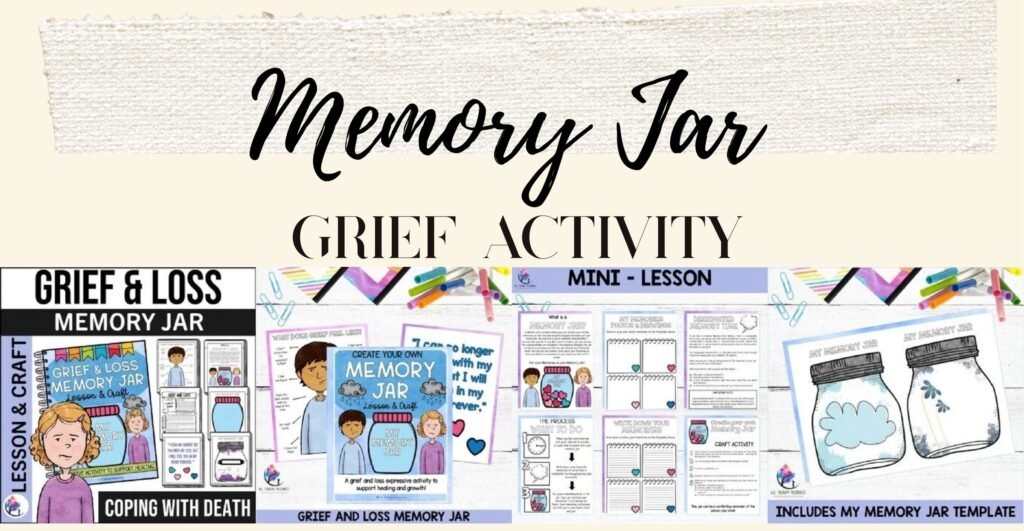
For a gentle, structured memory activity, the Grief and Loss Memory Jar pairs a short mini-lesson on what grief is with a memory jar craft, reflection prompts, a coping support wheel, and a self-care goals tracker. Educators have used it with a whole class after the loss of a schoolmate and after the death of a class pet, and one reviewer on our shop said the way it is written “is like a warm hug providing reassurance.” It works well in elementary classrooms and small groups, and the reflection pages can be adapted for older students.
Coordinate Support Across the Child’s Day
Grief support is strongest when the adults around a child share a small, respectful plan. With appropriate permissions and attention to confidentiality, identify who will check in, what the child can access when overwhelmed, and how caregivers and staff will communicate meaningful changes. A plan does not need to be elaborate. It needs to be reliable.
In schools, this may include a designated trusted adult, a temporary adjustment to workload, and a clear re-entry plan after appointments or absences. The AAP recommends that schools and families coordinate early and modify academic expectations as needed, for example by reducing homework or adjusting tests, and suggests a simple plan so a student knows they can leave the classroom if they need to (Schonfeld & Demaria, 2016). Teachers benefit from knowing that grief can affect stamina and behavior, but they do not need private details that are not relevant to their role. In clinical work, ask caregivers what changes they are seeing at home and what language the family uses to describe the loss. Consistency across settings can reduce confusion for the child.
Try this in your school: Keep a one-page grief support plan with four lines: the student’s trusted adult and check-in time, the signal they can use to leave class and where they go, any temporary changes to work or tests, and who updates the family. Review it after two weeks, then again before known reminders such as birthdays, holidays, or the anniversary of the death.
Be attentive to dates and transitions without making assumptions. Birthdays, performances, school events, moves, changes in custody, and the start of a new school year can all reactivate grief. A quiet advance check-in such as, “This week may bring up some reminders. Would it help to make a plan?” gives the child an option without forcing a reaction. For more ideas on whole-school approaches, see Teaching Grief and Loss in Schools.
When several students are grieving, a small group can offer connection with peers who understand. Our Grief and Loss Counseling Activities Curriculum Bundle includes three 8-session small group curriculums, one each for elementary, middle and high school, with counselor planning guides, parent and guardian letters, consent forms and teacher nomination forms. Choose the edition that matches your students’ grade level, and use the planning guide to pace sessions around the needs of your group.

Know When to Increase Support
Many grief responses fluctuate and soften with compassionate support over time. Still, a child may need additional assessment or a higher level of care when distress is persistent, worsening, or significantly disrupting daily functioning. Concerns may include ongoing inability to participate in school or home routines, severe withdrawal, intense guilt or self-blame, escalating aggression, substance use, major sleep or eating changes, trauma symptoms, or repeated statements about wanting to die or be with the person who died.
Any concern about self-harm, suicide, abuse, neglect, or immediate safety requires prompt action according to organizational procedures, professional responsibilities, and local crisis protocols. Do not leave a child to manage an acute safety concern alone. For non-acute but significant concerns, collaborate with caregivers and qualified mental health providers to determine appropriate individualized support.
If a child talks about wanting to die or be with the person who died: Stay calm and listen. Thank them for telling you. Do not promise to keep it a secret. Stay with the child and follow your school or district protocol right away, including your mandated reporting duties.
USA: 988 Suicide & Crisis Lifeline (call or text 988, or chat at 988lifeline.org). Childhelp National Child Abuse Hotline 1-800-422-4453. In an emergency, call 911.
Australia: Lifeline 13 11 14 (text 0477 13 11 14). Kids Helpline 1800 55 1800. Contact your state or territory child protection service (see the AIFS contacts page). In an emergency, call 000.
Grief work is rarely about saying the right thing once. It is about becoming one of the steady adults who notices, makes room, and remains available as a child learns to carry a loss in a life that is still unfolding.
Frequently Asked Questions
Should I use the word “died” with young children?
Yes. Clear words such as “died” and “dead” are less confusing than euphemisms like “went to sleep” or “passed away,” which young children may take literally. The AAP recommends avoiding euphemisms, especially with younger children.
How long does grief last for a child?
There is no set timeline. Grief often comes and goes, and it can resurface at milestones, anniversaries, birthdays and transitions such as starting a new school. Ongoing, flexible support matters more than a fixed end point.
Should a grieving child be excused from schoolwork?
Short-term, individualized adjustments are often helpful, such as reduced homework, flexible deadlines or modified tests. The aim is to keep a predictable routine while removing pressure that makes school feel unmanageable, then review the plan regularly.
When should I refer a grieving child for more help?
Consider referral when distress is persistent, worsening or significantly disrupting daily life, or when you see intense guilt, severe withdrawal, substance use or trauma symptoms. Any talk of suicide or self-harm needs an immediate response under your safety protocol.
References
Schonfeld, D. J., Demaria, T., Committee on Psychosocial Aspects of Child and Family Health, and Disaster Preparedness Advisory Council. (2016). Supporting the grieving child and family. Pediatrics, 138(3), e20162147.
Looking for practical, ready-to-use resources to support grieving students? The All Therapy Resources Membership provides access to a growing collection of thoughtfully developed counseling activities, interactive games, and therapeutic tools designed to save preparation time while supporting meaningful, skill-focused learning.