
Have you ever worked with a student who knows the right thing to do, yet still reacts too quickly, says something they regret, or struggles to stop in the moment? Knowing a rule and using it under pressure are two different skills. The Stop, Think, Go strategy gives children a simple, repeatable way to practice the second one.
Impulse control is often framed as a behavior issue, but it is better understood as a developing skill. It is less about “choosing to behave” and more about whether a child can pause, process, and respond instead of react, especially when emotions are running high. This guide walks through what is happening during impulsive moments, how each step of Stop, Think, Go works, and how to teach it in classrooms, groups, and individual sessions.
What Is Happening in the Brain During Impulsive Behavior?
Impulse control is part of a group of skills called executive functions. Inhibitory control, the ability to override a strong urge or habit, sits alongside working memory and cognitive flexibility, and these skills rely heavily on the prefrontal cortex. This part of the brain is one of the last to mature: according to the National Institute of Mental Health, the brain keeps developing into the mid-to-late 20s. In other words, children and teens are still building the brain systems they need to put on the brakes.
A helpful, simplified way to explain impulsive moments to students and staff is that the feeling arrives faster than the thinking. When a child feels threatened, embarrassed, excited, or frustrated, emotion and alarm systems (including the amygdala) respond quickly, and the slower planning and reasoning skills can be harder to reach. Research reviews note that executive functions are among the first skills to suffer when someone is stressed, sad, lonely, or short on sleep.
This is why students so often say:
- “I didn’t mean to do it.”
- “It just happened.”
- “I couldn’t stop myself.”
Often, they are describing their experience accurately. This is not defiance. From a clinical perspective, the goal of impulse control work is to help children create a pause between feeling and action, and to make that pause easier to find over time.
How the Stop, Think, Go Strategy Works
The strength of Stop, Think, Go is that it breaks self-regulation into small, teachable steps that match what we are asking a child to do: interrupt the urge, consider options, then choose. The traffic-light colors give younger children a visual anchor, and the steps are simple enough to prompt in a few words during a hard moment.
STOP: Interrupt the automatic response
This is usually the hardest step. Stopping requires noticing that something is happening, holding back the first urge, and calming the body enough to keep going. Many children need explicit teaching on the early warning signs: a hot face, clenched fists, a fast heartbeat, or a loud voice.
Keep the stop action concrete and brief. A child might put their hands on their desk, take one slow breath, or silently count to three. Picture a student who feels a classmate bump them in line. A practiced stop might sound like: “My hands want to push. Stop. Breathe.” Even a short pause gives the thinking part of the process a chance to catch up.
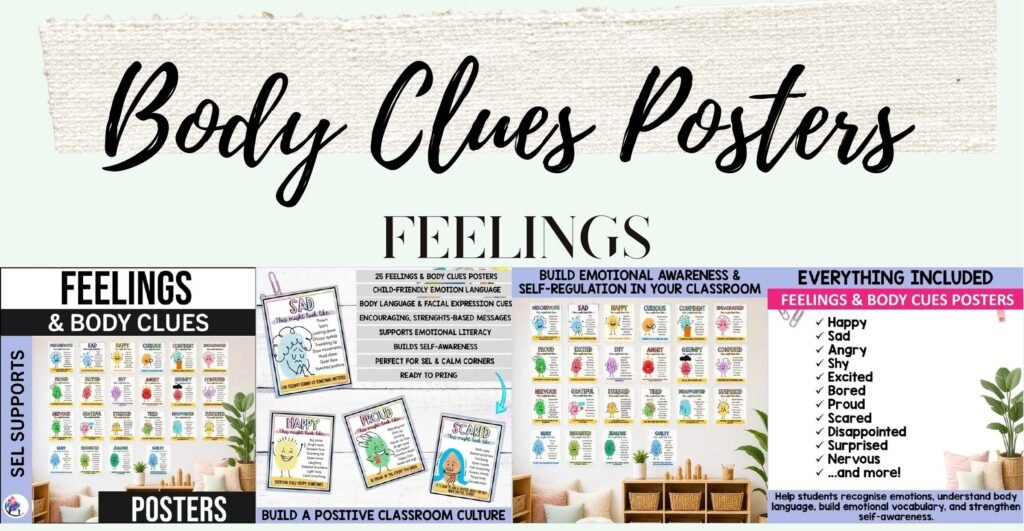
Try this in your next session: the STOP step depends on children noticing their body clues early, and a visual reference makes that much easier. Our Feelings and Body Clues Posters connect each emotion to facial expressions, body language, and internal sensations, with gentle, trauma-informed messages. Display them in a calm corner or counseling office and ask, “Which body clue showed up first?” before practicing the stop. One reviewer said the posters “give students a concrete way to recognize how emotions show up in their bodies…” and found them helpful during check-ins and emotional regulation lessons.
THINK: Consider what is happening and what could help
Once there is a pause, children have a better chance of using problem-solving, perspective-taking, and awareness of consequences. Teach a small set of questions they can ask themselves:
- “What is happening right now?”
- “What could I do instead?”
- “What might happen next?”
This step draws on cognitive-behavioral problem-solving, where children practice talking themselves through a situation and generating more than one option. For younger students, offer two or three picture choices rather than an open question. Older students can weigh options aloud: “If I yell, I’ll get sent out. If I walk away, I can tell the teacher.”
GO: Choose a response and try it
This is where the new behavior happens. The quality of the “Go” depends on the “Stop” and the “Think”: without a pause, there is no real choice. Help children rehearse a few go-to responses in advance, such as asking for help, using a calm-down strategy, using words to say what they need, or walking away.
Some versions of the strategy add an ACT or review step: after trying a response, the child reflects on how it went. A quick, shame-free check-in (“What did you try? How did it work? What might you try next time?”) helps the skill grow without turning mistakes into failures. With repeated, supported practice, pausing tends to become easier and more automatic.
Impulse Control Is a Skill, Not a Trait
One of the most useful shifts for educators and counselors is this: impulse control is not something a child either has or does not have. It is a developing executive functioning skill. Harvard’s Center on the Developing Child describes these skills as something children are not born with, which develop through practice and continue growing through adolescence and into early adulthood.
That means impulse control can be taught, practiced, and strengthened over time. It also means moving away from “They should know better” and toward “They are still building this capacity.” This shift alone changes how we respond as professionals: from punishment toward teaching, coaching, and support.
What Stop, Think, Go Looks Like in Practice
Picture a student who can explain, in a calm moment, exactly what they should do when a peer takes their seat. In the moment, everything falls apart. Afterward, they might say, “I know I’m supposed to calm down, but it’s like my body doesn’t listen.”
That kind of comment tells us two things. The issue is not knowledge. The issue is access to that knowledge in the moment. This is why talking about the strategy is rarely enough on its own. Children benefit from structured, repeated practice with realistic scenarios, where they:
- Practice pausing before they respond
- Name what they were thinking and feeling
- Choose and rehearse a response
Over time, many adults notice children starting to use the language themselves: “Wait, I need to stop first,” or “I can think about it before I react.” When that language appears unprompted, it is a good sign the strategy is becoming the child’s own.
Why Repetition and Engagement Matter
Research on executive functions suggests that repeated practice is key, and that gains tend to be strongest for the skills and situations children practice. Training on one kind of task does not automatically carry over to everyday life. For impulse control, that points to three practical ingredients:
- Repetition, so the steps become familiar
- Engagement, so children want to keep practicing
- Practice in context, using situations that resemble the child’s real life
Combining approaches helps. Reflective, paper-based activities let students break situations down step by step, identify their triggers, and plan alternative responses. Game-based practice adds quicker decision-making, interaction, and a reason to try again. Together, they support a simple progression: understand, practice, apply. For low-prep ways to rehearse the pause, see our guide to impulse control games for children.
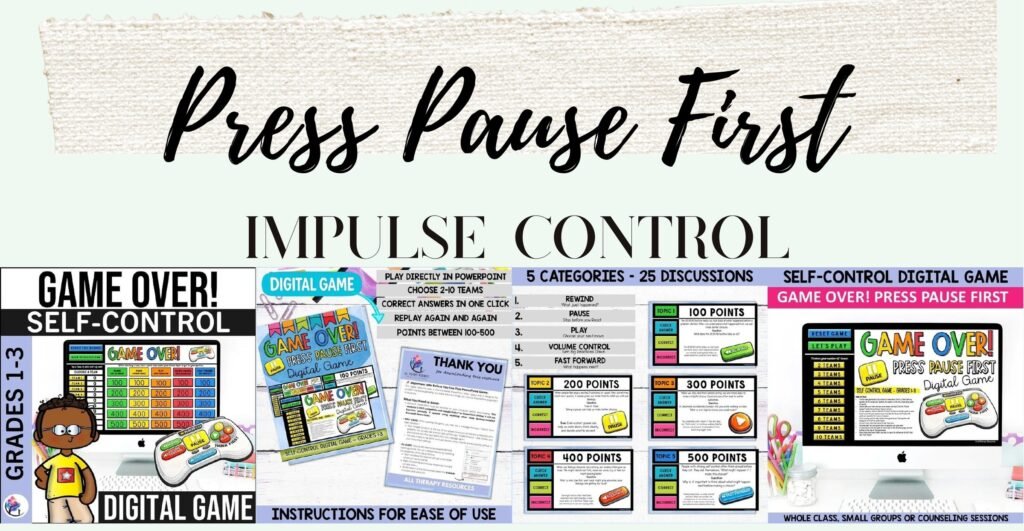
From our counseling room to yours: Game Over! Press Pause First is an interactive digital PowerPoint game built on the idea that the most important button is PAUSE, not PLAY. Students work through discussion questions and real-world scenarios that ask them to recognize triggers, stop before reacting, and think about what happens next. It suits younger elementary students in small groups or whole-class SEL lessons; play a few questions, then connect each answer back to Stop, Think, Go. One reviewer shared that “It turned practicing impulse control and stopping to think before acting into something fun and engaging.” For older students, there is a Grades 4–6 version, which one reviewer said did not feel babyish for older elementary students.
Supporting Different Types of Learners
Impulse control challenges can look different depending on the child. Some students act quickly without thinking, react physically or verbally, or move from frustration to action in seconds. Others hold it in until they feel overwhelmed, freeze or shut down, or struggle to make any decision under pressure.
The Stop, Think, Go strategy can support both groups because it slows the process down, makes thinking visible, and adds structure and predictability. For the child who rushes, the focus is on the STOP. For the child who freezes, the focus may be on the THINK and GO steps, offering a short menu of safe choices so a decision feels manageable. Our article on why some children struggle with impulse control looks at these differences across ages in more depth.
Practical Ways to Use Stop, Think, Go in Your Setting
Consistency across settings matters more than any single lesson. When classroom teachers, counselors, and families use the same words, children hear the same prompt wherever they are.
| Setting | What it looks like | Sample adult prompt |
|---|---|---|
| Whole-class SEL lesson | Teach the three steps proactively with a traffic-light visual and practice them with low-stakes scenarios | “Show me what your STOP looks like.” |
| Small group counseling | Role-play scenarios, then pause the action at each step to discuss choices | “Freeze. What could they think right now?” |
| One-on-one sessions | Identify the student’s personal triggers and early body clues, and plan their own go-to responses | “When does your body first tell you it’s getting hard?” |
| In-the-moment coaching | Use short, calm cues rather than lectures, then debrief later when the child is regulated | “What’s your first step?” “Can we pause?” “What could you do instead?” |
Want more Stop, Think, Go practice? Try the Stop, Think, Go, Choose Digital Game (Grades 1–3), the Grades 4–6 version, or the Stop, Think, Go Traffic Light Collaborative Poster for a whole-class visual.
A Trauma-Informed Perspective on Impulse Control
For some children, impulsive behavior is not only developmental. It can be protective. Children who have experienced trauma, chronic stress, or unpredictability may be more sensitive to perceived threat. One study of children exposed to family violence found heightened amygdala reactivity to angry faces, which the researchers suggested may be an adaptive response to a dangerous environment. In a classroom, that sensitivity can look like faster reactions, lower tolerance for frustration, and more difficulty accessing reasoning skills under stress.
A trauma-informed approach, in line with SAMHSA’s guidance, puts safety, trust, and choice first. In practice, that means predictable routines, co-regulation from a calm adult before any problem-solving, and skill-building without shame. Stop, Think, Go fits well here when it is offered as a tool children can use, never as a demand delivered in a raised voice or a reason for punishment. If a child is too dysregulated to think, the first job is to help them feel safe; the strategy can be revisited once they are calm.
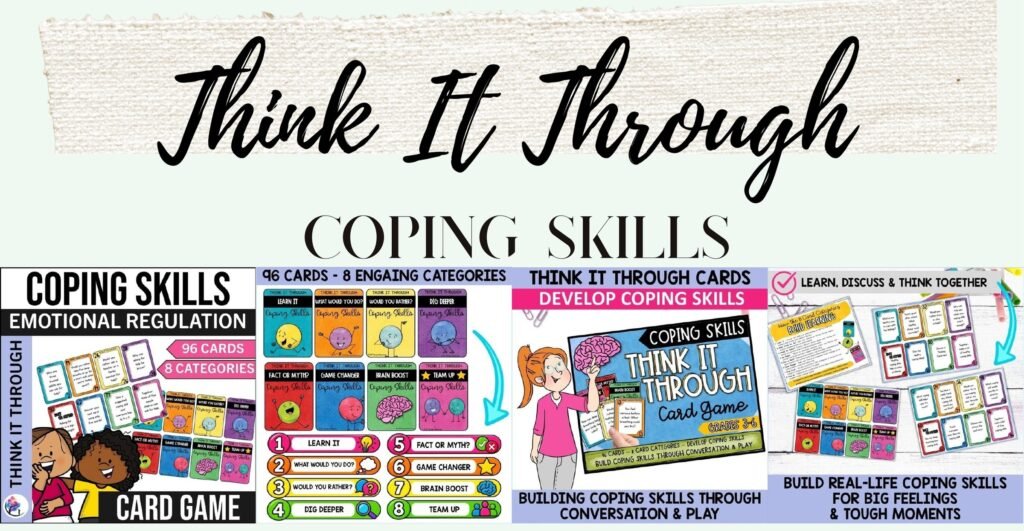
Try this in your next session: the GO step works best when children already have a menu of safe responses to choose from. Think It Through Coping Skills Cards is a conversation card game with 96 cards across eight categories that help students explore emotions, practice coping strategies, and solve everyday challenges. Use it in individual sessions or small groups to help each child build a personal list of go-to strategies, then add their favorites to a Stop, Think, Go plan. One reviewer wrote, “I love the variety of coping strategies because students can explore what genuinely works for them instead of being given the same few suggestions.”
From Reaction to Response
At its core, impulse control is about one shift: from reacting automatically to responding intentionally. That shift can support relationships, learning, self-esteem, and emotional regulation. It will not happen overnight, and it does not need to be perfect. Sometimes the pause is only a second, but each practiced second gives a child a real chance to slow down, think, and choose differently.
Frequently Asked Questions
What is the Stop, Think, Go strategy?
Stop, Think, Go is a simple self-regulation routine, often paired with traffic-light colors. Children learn to stop and calm their body, think about what is happening and what they could do, then go ahead with a chosen response. It is a practical teaching strategy rather than a formal, independently tested program.
What age is Stop, Think, Go suitable for?
It can be adapted from the early elementary years through middle school. Younger children benefit from visuals, movement, and picture choices, while older students can work with more complex scenarios and talk through consequences in more detail.
Why do some children struggle more with impulse control?
Impulse control is influenced by brain development, attention, emotional regulation, sleep, stress, and the child’s environment. Children experiencing stress or trauma may find it harder to reach their planning and reasoning skills in the moment.
Can impulse control be taught?
Yes. Executive function skills develop through practice and support. With modeling, repetition, and practice in realistic situations, children can strengthen their ability to pause and make more thoughtful choices.
References
- Diamond, A. (2013). Executive functions. Annual Review of Psychology, 64, 135–168.
- Center on the Developing Child at Harvard University (2011). Building the brain’s “air traffic control” system (Working Paper No. 11).
- National Institute of Mental Health. The teen brain: 7 things to know.
- McCrory, E. J., et al. (2011). Heightened neural reactivity to threat in child victims of family violence. Current Biology, 21(23).
- SAMHSA (2014). Concept of trauma and guidance for a trauma-informed approach.
Looking for practical, ready-to-use resources to support your impulse control and self-regulation lessons? The All Therapy Resources Membership provides access to a growing collection of thoughtfully developed counseling activities, interactive games, and therapeutic tools designed to save preparation time while supporting meaningful, skill-focused learning.